Feeds:
Posts
Comments

Archive for March, 2012

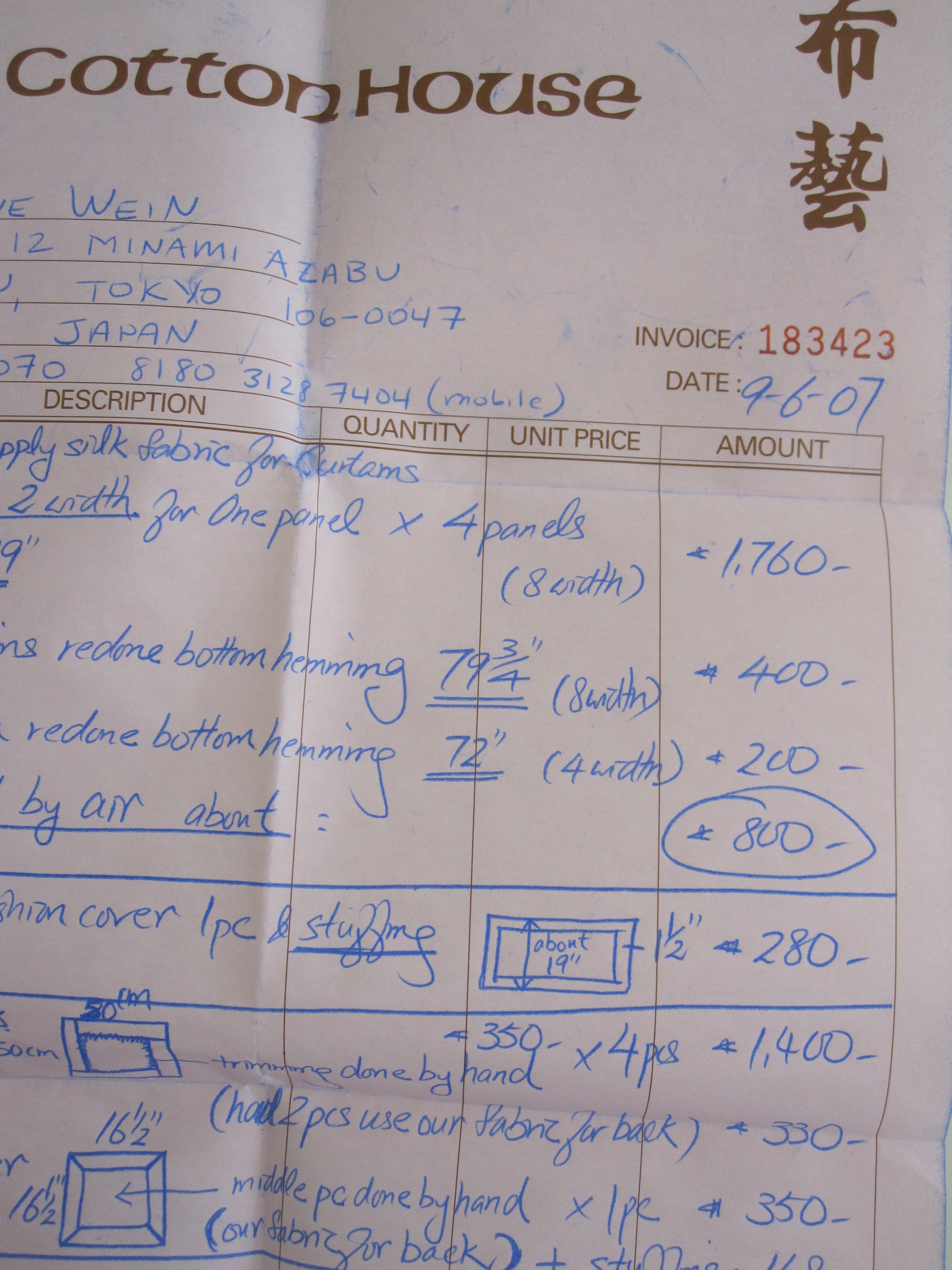
This is one of those posts that I can’t help start with the punch line. Compare the date on the receipt to the left (9-6-2007) with today’s date and it will give you an idea of just how long this project has been in process. Actually, in truth, it has been in process for many more years than that, but its “active phase” has been over these past 5 years.

At some point many years ago I found a group of antique quilt squares in a standard pineapple pattern, but made out of classic crazy quilt fabrics including satins, silks and velvets. I can’t quite date them, but they must be late 19th to early 20th century, part of an unfinished quilting project, that found their way to an antiques fair. With no clear idea of how I would use them (pillows perhaps?) I purchased them and put them away. Years later I unpacked them from my shipment when I arrived in Japan and was happy to rediscover them.

For the non-quilters out there, the pineapple pattern starts with a central square to which narrow strips of trapezoidal fabric are sewn, creating a saw tooth effect. It can be a very busy quilt block by varying the color every row, or different effects can be achieved by holding the colors steady or shading them progressively. If this part of the post particularly interests you, there is a nice overview and example of pineapple block making here.

The ease of finding vintage Japanese textiles and the link between crazy quilts and Japan inspired me to design pillows with the quilt squares at the center and a border made of vintage obi (kimono sashes). I spent months searching out the perfect obi for each square, both in terms of color and variety of pattern. In addition, I needed a different trim for each pillow to cover the juncture where the quilt block met the obi. For this blue one I was lucky to have some antique French velvet trim, another of those purchases made years ago (in this case in Paris at Port de Clingancourt) with no clear use in sight.

The odd colors in this square, a golden honey and pale seafoam mixed with burgundy velvet center and corners proved challenging, but this large-scale repetitive obi pattern proved perfect.

For the varying shades of chartreuse and green in this pillow I went with a pale obi, thinking it would make a nice contrast.

Somewhere along the way I pulled out this old embroidered Chinese patch and paired it with a kaku-obi (men’s obi). While the other pillows would have log cabin corners, I planned for this one to make use of the graphic stripes in the kaku-obi and have mitered ones.

And there was one in a completely different colorway, which I could use in my bedroom with a plain velvet border and pretty ribbon trim.

After numerous broken needles on my sewing machine, I decided professional intervention was necessary. Therein begins the story of the receipt. On a trip to Hong Kong in September of 2007 I brought them to my usual seamstress and asked her to make the pillows, along with some curtains for my house in Tokyo. I paid her and left, sure I would see them within a few weeks. The curtains came promptly, but somehow the pillows never came. I called her repeatedly in the beginning, but she could not seem to get any of her regular workers to make them.  I offered more money, but she wouldn’t take it. She just kept saying she would get them done.

In the months that followed I remembered to call intermittently. Over time, the calls became further and further apart, until I had just about forgotten entirely about them. Then an article in the January 2011 Martha Stewart Living about log cabin quilting, in particular the photo of throw pillows below, reminded me of them and made me determined to get them finished. As Hong Kong was a stop on our evacuation-vacation last spring after the earthquake, I visited the tailor yet again, persuaded her to complete them and left my very kind friend who lives there to follow-up.

I am not the first to use obi to make throw pillows. Many designers and pillow makers take advantage of the heavy brocades and gorgeous colors and patterns available. More often than not, the obi is run down the pillow vertically, bordered with trim and fabric on either side, much like these from Stephen Miller Siegel. And having seen the price tag on these babies, I am all for the DIY or semi-DIY version – these would not be at all difficult to make – as the obi could be sewn on top of an existing pillow.

Here, an obi has been used on a chair in a similar long fashion, reminding me a bit of Muriel Brandolini‘s signature chairs. Just a gorgeous application!

In other cases, the long narrow aspect of the obi is used to make a bolster shaped pillow, often without any additional trim, much as in this iconic 1969 photo of Cecil Beaton’s London home.

My friend D has recently whipped up these similar obi pillows, adding the perfect accent of color and comfort to her deep sofa. It took her no time at all as obi are double-sided and hollow – all she did was cut, stuff and sew up the short side seam with an invisible stitch!

By far the most beautiful obi pillows I have ever seen are these in Candia Fisher’s New York library. I can’t imagine the room without them.  Be sure to note the amazing Japanned linen press – by the time I get around to writing that post I have long been promising I will have used all my photos already. More photos of this amazing apartment can be found at Elle Decor or Habitually Chic.

As for my pillows, thanks to my ever vigilant friend, they finally arrived finished. It took me a few months to find some down pillow inserts here in Tokyo, but even that is now complete. The question that remains is where to use them, although in the meantime I have deployed them to the Chesterfield. I love the way the sawtooth edges, which look almost like pinwheels, pick up on the angles in the kilim rug. Click on the photo to see the details up close – they really are spectacular!

And here is the pale pinky one on the velvet settee in the master bedroom.

And speaking of pillows, we have chosen a winner for the ZAK + FOX pillow giveaway. Drumroll, please! The lucky entrant is number 8, none other than Angela, a reader from Belgium who loves all things linen and all things Japanese. Congratulations!

Related Posts:
A Curtain’s Leading Edge…a New Idea for Kaku-obi
Japan-a-mania…Cracked Ice and Crazy Quilts

Image credits: 1, 3-7, 13-15. me, 2. via Get Creative, 8. Martha Stewart Living January 2011, photo credit: Ditte Isager, 9. Stephen Miller Siegel via 1st dibs, 10. via Eclectic Revisited, 11. Architectural Digest Fall 1969, 12. Elle Decor November 2009, photo credit: Pieter Estersohn

About these ads

Read Full Post »

I have a question for my fellow bloggers out there…What do you do when you find you want to add to or update posts and topics you have already covered? There is the classic, oops, I forgot about that photo and also the selective perception issue, where after you write about something you see it everywhere.  Case in point, my brass drum stool

April’s House Beautiful brought this one in a stylish bathroom by Charlotte based designer Barrie Benson.

I had already discovered that I forgot to include this photo from Schuyler Samperton‘s portfolio in my post.

Love the complimentary brass balls warming this icy cool bedroom from Plum Pretty Sugar.

And then I found this one at Milk and Honey Home while looking for spring flower branches.

In the meantime, Joni at Cote de Texas had recently posted this absolutely perfect room which I had never seen before. I have a pretty encyclopedic memory for any space, but this one is new to me, so I need to write to her and find out where it is from.  But I am including it here both because I love it, but also because there is what looks to be a Japanese Seto porcelain garden stool sitting in front of the main sofa. Now that is something you never see!

Speaking of that Barrie Benson bathroom, here is the view across the room with its gorgeous campaign style vanity.

Which reminds me that I have been meaning to mention Jenny of Little Green Notebook‘s newest project. Remember the kitchen island she made out of a dresser that I showed in my repurposing furniture post?

Now she has changed it out for one she made from an old campaign dresser. Yowza, that girl is the best DIY decorator ever! Click here for the details…

I also ended up scrolling through Barrie Benson’s portfolio and came across these two old friends hanging on the walls…

And while we are at it, there is always room for more Japanese glass fishing float inspiration, whether it be subtle, as in this Scott Currie beach house (note the rope banister too)…

…or fairly over the top via The Enchanted Home! Floats with baskets, cut down altar table for a coffee table, giant planter and Madeline Weinrib rug, – gorgeous, no?

Don’t forget to click into my last post and enter the giveaway for the ZAK + FOX pillow! Simply leave a comment on my post and then hop over to Zak’s site and enter your name in the mailing list.

Related Posts:
Identify This…Brass Drum Stool
Kawagoe Shrine Sale Never Disappoints
Made for Export and in My Basement…Seto Porcelain Garden Stool
Feeling Fresh…Indigo Textiles and Tenugui
The Mail is Always Late…more on Japanese Glass Fishing Floats and Sudare
Everyone Loves Japanese Glass Fishing Floats…A Follow Up
Sheer Simplicity…More Japanese Glass Fishing Float Displays

Read Full Post »

An object becomes so much more interesting when a little bit of history is revealed.
- Zak Profera

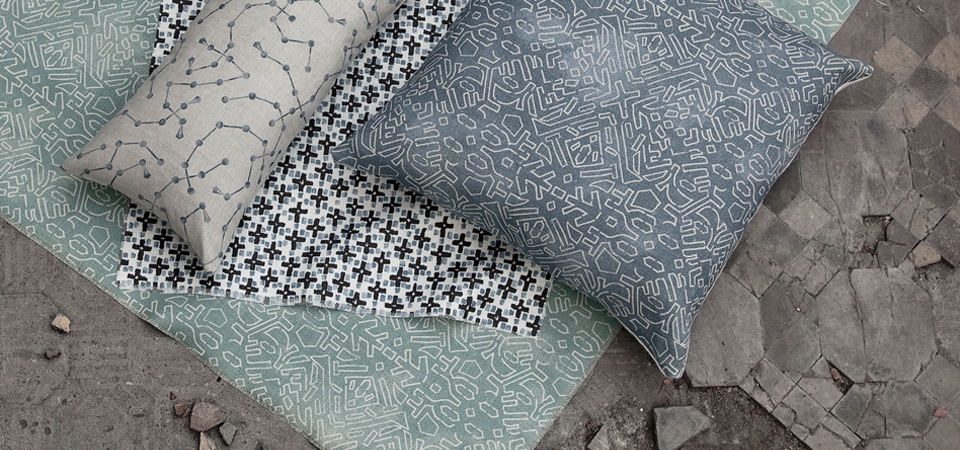
Like “You had me at hello” in Jerry Maguire, Zak Profera’s new textile line ZAK + FOX had me at the quote above and the photo below. Printed on Belgian linen using water-based inks, Profera has created a versatile new line of interiors fabrics with global inspiration. In particular, a few of the patterns have their roots in Japanese symbols and motifs, which I find particularly appealing. In celebration of his launch, Zak is offering the long bolster pillow on the left in the photo below as my first official giveaway. Entering is easy – the details can be found at the end of this post.

JINGASA

The pillow is made of Jingasa fabric in the snow colorway and reads to me as a modern stylized form of karakusa, the scrolling arabesque vine pattern seen over and over again in Japanese decorative arts. The word jingasa refers to the iron helmets that were used by Edo period soldiers and I managed to find an image of one, complete with karakusa pattern, even before reading Zak’s own personal inspiration for it.

According to Zak, Jingasa ”is an abstract, all over composition that was inspired by a crest seen on an antique helmet.  I think I was romanced by the idea of some lone wanderer, so in a way the motif could be seen as marking points on a map or a trail to follow.  The blade-style point gives it a bit of a masculine edge and removes it from just feeling like a bunch of polka dots, though I wanted to keep an “artist’s hand” in the pattern by using watery line-work and giving it an inky tone-on-tone effect.”

MATSU

Next up is his Matsu pattern which is a classic interpretation of pine, or in this case matsukawa bishi, pine bark. This stylized version of pine is seen everywhere, from kamon

…to tsuba (sword guards).

Zak ”loves the simplicity of the pine bark motif and wanted to use it in a way that felt modern and different.  I spotted a kimono with a dense repeat of flowers that started at the shoulders and drifted downward in an airy pattern; with this concept in mind, “Matsu” became an energetic pattern with an almost ombre-like effect to it. Some have told me it feels a bit like snakeskin (and I agree) but I think the minimalistic nature of the motif keeps it timeless and not trendy.”

TAKIGAWA

Takigawa translates to “waterfall and river” or more loosely as “rapids,” an apt name for this asymmetric stripe. For me, it is the least literal in its Japanese influence and instead reminds me of an antique Indian dhurrie rug.

Takigawa is Profera’s “version of the traditional stripe and uses a style of repeat seen in many Japanese textiles.  I wanted to simplify the pattern by keeping the natural linen exposed—it gives it a raw edge that feels untouched, and at the same time it’s super modern.  Depending on the color selected, it can feel tailored or relaxed — a quality that I love.  I’ve seen it in a few different colors now as I work with other designers to create custom colors for projects and it’s definitely one of the most versatile patterns in the collection; it works just as well in a beach house as it does in a New York City loft.” Personally, I think the exact same thing can be said about a dhurrie rug too!

I can’t resist showing this photo from ZAK + FOX’s beautiful photo shoot at Temple Court in New York City.

An amazing 1883 building that has fallen into the very best kind of decay (original details protected for decades by ugly drywall) Temple Court has become the stuff of urban legend and high-end modeling jobs and is supposedly going to be restored as a hotel. Right now it would make the perfect interior setting for filming Ransom Riggs’ Miss Peregrine’s Home for Peculiar Children. For more on Temple Court, there is a wonderful article in The New York Times.

KATAGAMI

His Katagami fabric is a bit of a pun, considering that katagami stencils are used to make Japanese textiles. Is Katagami made with a katagami? No, but fun thinking about it in a loop.

In writing about his inspiration, Profera “became totally infatuated with these stencils, not necessarily the “traditional” ones with recognizable patterns but more so by the abstract, almost tribal patterns that felt a bit unplaceable — not quite bullet-point “Japanese”.  This pattern uses one of the more unique antique stencils I stumbled upon, though quite edited with selections changed and redrawn to feel more composed and harmonious.”

His description reminded me of the unusual stencils in this amazing interior by Steven Gambrel, shown here before.

While I love all the patterns, my personal favorites are Jingasa and Takigawa in the plum colorway. Those of you who know me can’t possibly be surprised by that.

Pillows or cushion to contrast with my Bennison floral in the front entry at the beach?

And for all you Japanese motif junkies out there I have been meaning to mention Snow, Wave, Pine: Traditional Patterns in Japanese Design for ages. It is a beautiful tome, cataloging patterns by category and illustrating them with examples of the finest decorative arts.

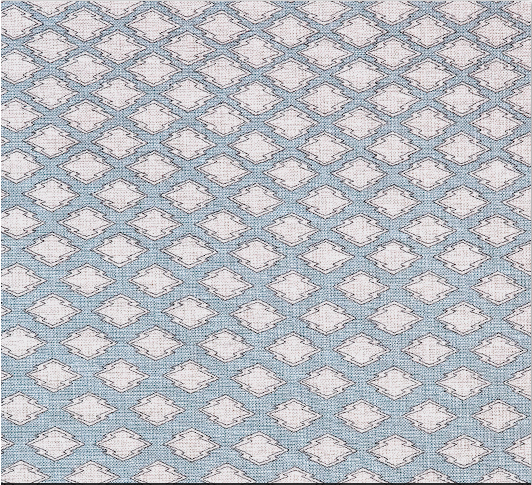
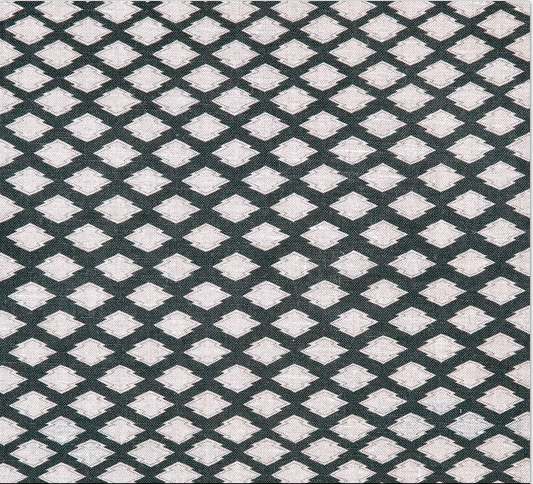
There are also six other patterns – Volubilis, Plus, Karun, Palma, Nimrud, and Postage – in numerous colors in the new ZAK + FOX line, all well worth checking out. Which brings us back to the fun part…the giveaway!

THE GIVEAWAY

You can be the owner of this lovely 11 x 22 inch feather and down filled bolster made of Jingasa fabric in the snow colorway. The pillow is that wonderful long shape that looks perfect in a grouping on a couch, as a lumbar pillow on an armchair or anchoring bed pillows.

As for the details  - it is easy. Simply leave a comment on my post telling me which is your favorite pattern (or frankly, any comment) and then click over to the ZAK + FOX website and join Zak’s mailing list (he promises not to barrage you with emails) by entering your email address in the field in the upper right corner of the home page. We will take entries for a week, until 6pm EST, Wednesday, March 28. One entry per person, although I am tempted to beg someone to enter for me. So unfair that in good sportsmanship I cannot enter myself!!

Related Posts:
More on Mon…The Polka Dots of Japan
R. P. Miller…New Japanese Inspired Fabrics From Rodman Primack Debut at Hollywood at Home
Japanese-Inspired Fabric Follow-Up…Katsugi, Kiku, Kasumi, Kaba Kaba, Katana and More
Katagami…Perfect Thank You Present Found
Sho-Chiku-Bai…The Three Friends of Winter: Pine, Bamboo and Plum

Read Full Post »

Remember this photo? The shelves themselves have since been completed, but I have not been back yet to our beach house to work on the styling. As I was literally walking out the door in December, I threw a few things up there to shoot a vignette for a post, including the French watercolor that inspired the bathroom in the first place, some nicely tarnished brass finds from Singapore, shell and coral collections the girls are gathering, and a shallow patterned kashigata (Japanese sweet mold) that reminded me of starfish and sand dollars.

Here’s a close-up.

Since then I have been gathering inspiration photos to help me crystallize my thinking. There is no one better to turn to for artful display than John Derian and I have long loved this photo with its giant sponge, shells and mercury glass.

A more recent photo from The New Victorian Ruralist is more regimented, but I love the mix of baskets, silver, white ironstone and glass.

And of course I can’t forget the vignette master herself, Joan from For the Love of a House, with this beautiful shelving array from her master bathroom.

All three photos share something in common, which is groupings of like objects contrasted with other groupings in different materials, usually about three kinds, including something natural, something metal and something glass. More than three gets busy and less than three has no animation. Without being too literal about this formula, I would like shells and coral, aged wood and old brass to be part of my display. My recent purchase of more kashigata with shallow relief patterns might just provide the touch I need. What looks to be coral fans is more likely lotus or some other botanical, but to my eye they read like oceanic plants.

I find these circular patterns irresistible too. They are double-sided, with different motifs on the reverse.

I think this classic Japanese pattern of little plover birds with waves is adorable for a beach house!

In addition, I have a friend who has also been buying kashigata with shells and sea life on them for her beach house on Long Island so I am hoping to get a look at them in situ this summer.

As I am not limiting myself to wood, but planning on complementing the unlaquered brass bathroom fittings with some aged brass display items, I was so excited to find this adorable set of brass cookie cutters with scalloped rims and a rolling crimper. Not sure yet whether I plan to use them on the bathroom shelves or save them for the kitchen. Speaking of the kitchen, Camille from The Vintique Object and I have been having fun brainstorming how to improve it without actually spending any money on it. I do eventually plan to renovate the kitchen completely, but in the meantime I want to take the ugly edge off. There will be much more on this project coming later, including the bleak photos of its current state, but one idea I have is to use warm brass and copper to help it along. If you are interested, she and I have a shared Pinterest page going where we exchange photos and ideas. It is such a great way to work with someone long distance!

And I’ve also got boards going for copper and silver on Pinterest, but with my obsession with aged brass, I think I need to start one for that too.

Related Posts:
Renovation Report…”Oldating” the Beach House Bathroom
Summer Simple…Vignettes and the Art of Arranging

Image Credits:1-2, 6-9. me, 3. Martha Stewart Living September 2009, 4. via The New Victorian Ruralist, 5. via For the Love of a House

Read Full Post »

Once again it is that time of year – The American School in Japan‘s annual Gala Fundraiser – and once again I have had the pleasure of being intimately involved in one of its most special projects, the quilt! Reminiscent of summer breezes in a classic rock garden, this year’s ASIJ Gala quilt features one of the most romantic objects in Japan, the furin, or wind chime, hung outdoors in the summer to ring when it catches even the slightest breeze, refreshing the listener through sound in the midst of hot summer.

To further complement the evocative Japanese theme, we have echo quilted the entire background in the style of the rock garden at Ryoanji Temple in Kyoto.

Based on a design by Japanese master quilter Suzuko Koseki, the quilt features irregular sized blocks, hand sewn in bands, from which the furin hang. Each bell is unique, with its own hand drawn individual pattern.

The detailed tracing and cutting even required headlamps for a few folks!

Fabric selection was a careful and complex process, the balancing of color and pattern the key to the design. We used a wide variety of traditional Japanese prints in cotton and silk which were then hand appliqued.

A close-up of one of the bells, just after being appliqued.

The quilt top with all bells appliqued and embroidered  - ready to have the border added.  Take a close look at each individual bell, fabrics coordinated as a whole for their feeling of shibui, the Japanese aesthetic of simple, subtle, and unobtrusive beauty.

Every step adds so much and the border always makes the quilt feel that much closer to finished. Basting day is always fun as the quilt top goes from being flimsy to having its backing and border.

And here it is – the finished quilt!!!

Also be sure to examine the close-ups of the elaborately detailed rock garden quilted into the background, lovingly stitched by many experienced hands.

Get your bids ready!!!

Julie Fukuda’s blog, My Quilt Diary has more posts with details and photos here, here and here, as does Cynthia Nanto’s A Quilter By Night.

Related Posts:
Coming Full Circle…A History of the ASIJ Gala Quilt

Image Credits: 1. via Yoseido Gallery, 2. via Ohmi Gallery, 3. via Tikotin Museum of Japanese Art, all other photos by me or someone from the quilting group.

Read Full Post »

All the pictures in this book are authentic, vintage found photographs…lent from the personal archives of ten collectors, people who have spent years and countless hours hunting through giant bins of unsorted snapshots at flea markets and antiques malls and yard sales to find a transcendent few, rescuing images of historical significance and arresting beauty from obscurity – and, most likely, the dump. Their work is an unglamorous labor of love, and I think they are the unsung heroes of the photography world.

 - Ransom Riggs

So besides the fact that my daughter read this cover to cover, handed it to me and said “I don’t think you are going to get much sleep tonight,” and I didn’t, I can’t resist posting about yet another book recently read and incredibly personal to me. Like my post on The Hare With Amber Eyes last week, once again we have a story that is fueled by a box of items from the past, in this case a group of photos of “peculiar” children that Jacob grows up hearing stories about from his grandfather. As a young child he worshipped his grandfather – an orphaned war hero, the only one of his family to escape Poland before WWII –  and believed his stories to be true. Shipped to a children’s home in Wales to escape the “monsters,” where the sun shone everyday, he and his new friends had all kinds of special talents and he “proves” them to Jacob by showing him their photographs. Riggs has gathered a compelling collection of unusual vintage snapshots demonstrating these special powers and puts them to good use in his storytelling in upping the creepy atmospheric setting. This is definitely one book you can judge by its cover! And as the photographs are the lynchpin of the novel, I really recommend the hardcover book over the Kindle version.

But as age brings maturity and skepticism, Jacob ceases to believe that his grandfather’s stories are literal truths, “But these weren’t the kind of monsters that had tentacles and rotting skin, the kind a seven-year-old might be able to wrap his mind around – they were monsters with human faces, in crisp uniforms, marching in lockstep…Like the monsters, the enchanted-island story was also a truth in disguise. Compared to the horrors of mainland Europe, then children’s home that had taken in my grandfather must’ve seemed like a paradise, and so in his stories had become one: a safe haven of endless summers and guardian angels and magical children…” Without spoiling any of the surprise I think it is safe to say that the stories actually turn out to be true, but it in no way lessens Jacob’s own analogy with the horrors of WWII, and that is what makes the book eminently readable on more than one level, suitable for older kids, teens and adults.

Obviously for me, in addition to the story, the collecting of vintage photographs and other ephemera is dear to my heart and I have written about it before, particularly here. My newest fantasy is that Ransom Riggs decides to layer in the war in the Pacific to his story – after all, the Japanese were major players in the war too – and needs someone to scour the shrine sales of Tokyo for appropriate photographic material. I figure I have passed up plenty of peculiar children in my time and I’d love to give them an eternal home…

And by the way, from what I hear, we will all have a chance to see Miss Peregrine’s Home for Peculiar Children soon at a theater nearby. Tim Burton has signed on to direct – an absolutely perfect choice!

Related Posts:
Windows into an Earlier World…Photos from the Past and “A Town Like Alice”

Image credits: 1. Ransom Riggs, 2-3. via Amazon, 4. me.

Read Full Post »

Ally at From the Right Bank posted new photos of her lovely living room just the other day and a small detail popped out at me – her needlepoint dog pillow – a boxer, to be exact. (Correction: I don’t know what blogging drugs I was on, as it is not a boxer, but a French bulldog) It reminded me that I have been meaning to do a post on these so-out-they-are-in accessories for quite some time now and it seemed like a light-hearted anti-dote to the last few heavy posts.

The needlepoint dog promptly made me think of the one in Ruthie Sommer‘s living room, which was featured in Lonny as well as House Beautiful.

Ruthie is a big user of needlepoint pillows in the spaces she designs, using them to add a bit of quirky light-hearted fun.

Note the needlepoint iris pillow in the photo below…more on that later!

She even offered some in her One Kings Lane Tastemaker Sale.

Rachel over at The Lovely Lifestyle has a cute story about her purchase of that very same iris pillow from the OKL sale, now happily ensconced on her couch. Note yet another dog pillow!

Jonathan Adler is the other great user of needlepoint pillows and perhaps I should have mentioned him first as he really is responsible for resurrecting them, first in the bargello ones he made popular again and now cute and kitschy ones too. He was recently featured in the one year anniversary edition of online magazine Matchbook.

Zodiac anyone? Check out Adler’s website for more pillows and his portfolio.

Adler’s pillows are popular with other designer too, like this beach living room by Leslie Klotz.

The idea for this post has been percolating for almost a year as last spring during our evacu-vacation, I had the pleasure of visiting a dear friend in Hong Kong with the best kind of needlepoint pillows – inherited ones! I find those with personal connections and stories to be the most authentic. As always with me, we are back to grandmas.

Love the Mondrian-esque Broadway Boogie Woogie one.
Another authentic option? Make one yourself…

…or in my case, get my mother-in-law to make it.

Image Credits: 1. via From the Right Bank, 2-3. Lonny July/August 2011, photo credit: Patrick Cline, 4-5. House Beautiful March 2011, photo credit: Victoria Pearson, 6-7. via One Kings Lane, 8. via The Lovely Lifestyle, 9-11. Matchbook February 2012, photo credit: Rima Campbell, 12. House Beautiful July 2008, photo credit: Laura Resen, 13-14 &16. me, 15. via Purl Bee.

Read Full Post »

Japanese fans, bibelots and robes would only come alive in private encounters. They were props for dressing up, role-playing, the sensuous reimagining of self.

-Edmund de Waal, The Hare With Amber Eyes

There were so many Impressionist paintings in The Hare With Amber Eyes that I didn’t have space to mention in my last post, in particular La Japonaise, a portrait of Claude Monet’s first wife Camille dressed in an elaborate kimono-esque style robe decorated with a scary samurai drawing his sword and elaborate gold embroidery. But the key accessory (or should we say accessories in this case) is the quintessential icon of both Japan and the 19th century female world – the fan. Reading my earlier posts on Japonisme and Impressionism herehere and here yields many more fans and Japanese style robes and is a must if this post intrigues you, as some of the very best examples can be found there.

La Japonaise (Camille Monet in Japanese Costume)

Painted only a few years before, Eduoard Manet’s Portrait of Nina Callias also features a fan wall and a boldly coquettish subject.

Woman With Fans, Portrait of Nina de Callias

Olga Boznanska’s subject seems introspective, wearing a simple white robe and holding a single fan.

Japonka

Degas gives a fan to one of his dancers.

Dancer with a Fan

Renoir’s girl is sweet and innocent, not seductive or flirty…

A Girl with a Fan

…nor is Pissarro’s.

Jeanne Holding a Fan

Fans can be the subject themselves as in this painting Still Life with Chinese Vase and Fan. Ironically the vase is not Chinese at all, but instead looks to me to be a piece of Japanese Seto porcelain. The plate next to it is clearly Imari.

Still Life with Chinese Vase and Fan

And another still life with a European pitcher.

Still Life with Oriental Fan

A modern-day version of a fan room, I am loving this pretty bedroom. It would be easy to do something like this with shrine sale finds.

All of which brings me around full circle, thinking about the post I wrote at New Years - We Are the New Victorians - and one with a similar theme by Courtney at Style Court, featuring an exhibition I wish I could go see! The Cult of Beauty: The Victorian Avant-Garde,1860–1900 runs from February 18, 2012 - June 17, 2012 at the Legion of Honor Museum in San Francisco and “is the first major exhibition to explore the unconventional creativity of the British Aesthetic Movement, tracing the evolution of this movement from a small circle of progressive artists and poets, through the achievements of innovative painters and architects, to its broad impact on fashion and the middle-class home. The superb artworks on view encompass the manifold forms of Victorian material culture: the traditional high art of painting, fashionable trends in architecture and interior decoration, handmade and manufactured furnishings for the “artistic” home, art photography and the new modes of dress.”

Once again all my San Francisco friends, please go enjoy for me!

Image Credits: 1. via Museum of Fine Arts Boston, 2. via Musée D’Orsay, 3. via Wikimedia, 4. via WikiPaintings, 5. via WikiPaintings, 6. via Artnet, 7. via Pinterest, 8. via Little Emma English Home

Read Full Post »

“How objects are handed on is all about story-telling. I am giving this to you because I love you. Or because it was given to me, Because I bought it somewhere special. Because you will care for it. Because it will complicate your life. Because it will make someone else envious. There is no easy story in legacy. What is remembered and what is forgotten? There can be a chain of forgetting, the rubbing away of previous ownership as much as the slow accretion of stories.”

Have you ever read a book, assuming you would like it but not expecting it to completely rock your world? Well that is the way it was for me upon reading Edmund de Waal’s family biography The Hare With Amber Eyes. Numerous friends had recommended it to me, assuming I would be interested in the collection of 264 antique Japanese netsuke that are the theoretical protagonists of the book, which I was, but I had not realized how every bit of it would seem to tie in with my own writing and collecting and that reading it would become a very personal journey.

The story itself is like an onion, with layers that peel away, yet link back up with each other. Sometimes it feels almost too fantastical to be true, impossible that such detailed records remain, that the life of these tiny objects can be tracked so clearly. The netsuke themselves are a conceit, used to tie a multi-generational, multi-national story together. Edmund de Waal, the renowned British potter (who makes Japanese inspired pieces himself) inherits an extraordinary collection of Edo period netsuke from his Viennese Uncle Iggie, who actually lived out his adult life in Tokyo. Yet the netsuke were originally acquired by Iggie’s father’s cousin in Paris in the 1870s, then given as a wedding present to Iggie’s father in Vienna at the turn of the century. As we read, we know that war is coming, so it becomes hard to imagine how they eventually make their way onward, and I will not spoil that surprise. But there is also a kind of magic in knowing from the very beginning of the book that these netsuke are a sort of sick punch line, in that they survive even when people don’t, and that somehow they even make it back to their country of origin over 100 years later.

Netsuke, the tiny toggle sculptures used to anchor small carrying cases called sagemono to a kimono sash (obi) are extremely coveted and collectible, and thus by default, quite valuable. Most commonly made of ivory, wood or bone, these lifelike inch long sculptures are detailed works of art, depicting everything from people engaged in everyday rituals of every sorts, to animals, plants and even mythological creatures. I occasionally see them at shrine sales, more often at the better antique shows - Heiwajima would be a good place to look this weekend – but I think of them in the same category as obidome (the jeweled belt clips which I adore) and tsuba (sword guards). In other words, small and beautiful, but somewhat useless. In the last few days I have been to a few shrine sales and really kept my eyes peeled for them, getting lucky with one dealer who had some in complete sets, strung on cords with their inro (a stacked compartment carrying case) and ojime closure bead. The two examples below demonstrate the range of netsuke, from the simplest disk on the left, to a detailed, although fairly crudely carved figure on the right. Both inro are made of lacquer, with maki-e sprinkled gilding.

The original collector of the netsuke, Charles Ephrussi, the cousin of De Waal’s great-grandfather, was at the heart of the art and salon scene in late 19th century Paris. Originally from Odessa, the Ephrussi’s were one of the great Jewish banking clans, second perhaps to only the Rothschilds, that fanned their way out through Europe in the 19th and early 20th century, establishing places of business and grand houses in France, Austria, England, Greece and elsewhere. Charles was a writer and editor of art magazines and collector of fine works of art. Like many of his contemporaries, he became enthralled with the Japonisme craze sweeping through Europe in the 1860s and 1870s. In addition to his 264 netsuke, he had a collection of 33 black and gold lacquer boxes and an extraordinary group of Impressionist paintings, supporting artists whose names we all know now at the very start of their careers. The list of Charles’ paintings reads like the home runs of the Impressionist world, a forty piece collection accumulated in just three short years. Solidifying his fame, Charles himself appears in Renoir’s masterpiece Luncheon of the Boating Party, the man in the top hat towards the back, and served as inspiration for Proust’s Charles Swann in Remembrance of Things Past.

“I want to know what the relationship has been between this wooden object that I am rolling between my fingers – hard and tricky and Japanese – and where it has been. I want to be able to reach to the handle of the door and turn it and feel it open. I want to walk into each room where this object has lived, to feel the volume of the space, to know what pictures were on the walls, how the light fell from the windows. And I want to know whose hands it has been in, and what they felt about it and thought about it – if they thought about it. I want to know what it has witnessed.”

Just like de Waal, I too want to see exactly where and what the netsuke lived with, to imagine them all crowded into his rooms on the rue de Monceau in Paris, so I could not resist pulling up the images of his paintings, now scattered in the world’s finest museums, to share in just that way. All of the paintings below, and many more that I do not show, had places of pride in Charles’ home.

The most charming story centers on Charles’ purchase of Edouard Manet’s Une botte d’asperges, for which Manet charged 800 francs but Charles sent 1000.

In grateful response to his over-payment, Manet sends on second small painting of a single stalk of asparagus!

The influence of Japanese prints on the Impressionist perspective can clearly be seen in Degas’ portrait of Edmund Duranty, painter and subject both friends of Charles, that hung in his study.

Charles also owned Monet’s Les Baines de la Grenouillère that now hangs in The National Gallery in London.

A personal moment for me, as this painting is the sister to the Monet below – La Grenouillère - which has been hanging in the Metropolitan Museum of Art and long been my favorite Monet. I wrote a huge paper about it for an art history class in college. I wonder if it is packed up in a box somewhere?

He also owned Manet’s Portrait de Constantin Guys…

…and General Mellinet and Chief Rabbi Astruc by Degas. I imagine them all hanging (out) on the wall together, chatting, like the portraits at Hogwarts.

I am not sure if this Degas pastel At the Milliner’s is the actual one Charles owned…

…or this one, or perhaps even both.

Charles owned many works by Degas including In a Cafe, better known as L’Absinthe. Their friendship, and many others, ended over the Dreyfus Affair, as the roots of anti-Semitism in French society became exposed.

At the turn of the century, Charles packed up the netsuke and sent it to his nephew Viktor in Vienna on the occasion of his marriage.  Viktor’s new home, the Palais Ephrussi, was so grand that one cannot imagine these tiny figures making any statement there. And they do not. The netsuke were no longer displayed publicly, instead they were kept in Viktor’s wife Emmy’s dressing room, where the children took them out and played with them as they watched her dress.

Here I will stop the tale for a while and recommend that anyone planning on reading the book should not research any further into the story. As we know who and what is coming, in the form of Hitler and the Anschluss, I will leave that tale to de Waal. I find it all too painful to write about anyway.

And so we return full circle, as not only have the netsuke made their way back to Japan with Uncle Iggie and his partner Jiro as the book opens, but de Waal himself studies Japanese ceramics as a young man, a result of that historical Leach-Yanagi friendship that ties British and Japanese pottery together. In the aftermath of the earthquake last year, the Leach Pottery was quick to start a foundation to help rebuild the historic kilns at Mashiko. And ironically for me, the book opens with de Waal taking Japanese language courses at the very school here in Tokyo that I currently attend for the same reason.“Iggie and Jiro’s life was lived in another kind of Real Japan,” and I like to think that we do too.

Just like Charles and Viktor, Iggie keeps the netsuke in a glass vitrine, a display case, which is another conceit for de Waal’s story and one that influences his own work highly. At first, he thinks vitrines ”exist so that you can see objects, but not touch them.” But what he comes to realize is that “the vitrine – as opposed to the museum’s case – is for opening. And that opening glass door and the moment of looking, then choosing, and then reaching in and picking up is a moment of seduction, an encounter between a hand and an object that is electric.”

I have not been able to find any formal writing on the influence of the netsuke and his family’s history on de Waal’s own work, but it clearly has played a major role. He creates huge installations, full of similar but different pots, often grouped on shelves. Does that sound familiar?

“He is an interesting example of a potter who has not left the studio but has been determined to escape that solitary plinth with its unique object atop. You will all be familiar with his move from domestic porcelain to a series of installations that ‘animate’ (his word) particular interiors and to interventions in museum collections. 1999 was the decisive year in which de Waal arranged his pots in cupboards and on tables in Howe and Lescaze’s High Cross House at Dartington in Devon; he described this as a ‘personal conversation with iconic modernism’. De Waal’s post-plinth strategy is based in part on massing. Thus he references the richesse and generous display of the eighteenth century porcelain room.” (quote from a lecture by Tanya Harrod in 2009)

Edmund de Waal’s place in the lexicon of British ceramics is confirmed by his centrally located Signs & Wonders installation in the new ceramic galleries at The Victoria & Albert Museum. To learn more, there is a great 5 minute video and a wonderful article by A.S. Byatt about them.

De Waal will not allow himself any “melancholy” or “nostalgia about all that lost wealth and glamour from a century ago,” he doesn’t want “to get into the sepia saga business.” But after reading the book I find that I am angry for him and I am surprised at the strength of my feelings. My forebears came from the same places as his. I had a great-grandfather from Vienna on one side and a grandfather from Odessa on the other. My grandfather left Russia in 1917 to avoid the Revolution as he was from well-heeled family – he spoke French and was studying to be an architect – and he worked his way across Turkey, through France and onward to America. But I know little more than that about his story and have no objects to tie me to him. In fact, there are no family objects that tie me to any of my ancestors – the little bit of jewelry that remained was stolen out of a parking lot sometime in the 1960s before I was even born. And the truth of the matter is that I sometimes believe that lack of connection through items is what propelled me into being an antiques dealer. As a girl my favorite books were those where the characters explored their grandmother’s attics, opening trunks filled with clothes and talismans from long ago, feeding a fantasy of connection with those long gone. If you think about it, so many books for kids and teens, even the Harry Potter series, rest on those kind of connections.

I did have an exciting inheritance moment last year though, not long after buying the beach house in New Jersey. I was at my in-laws in Florida, packing to fly up to New York and then home to Japan. I looked up in the guest bedroom closet and saw a group of quilted dish protectors, clearly stacked full of a china service. In the back of my mind a little voice said “those are yours” but I couldn’t imagine what they were. I took one down and unzipped it, while simultaneously remembering that my grandmother had a set that no one needed or wanted when we were forced to move her out of her apartment and into a home. At the time, I couldn’t bear to get rid of them while not having enough space in my New York apartment to take them, so I left them in Florida and forgot about them. As I lifted the dish out of its case, I couldn’t believe it – they were absolutely perfect – having just the colors and soft feel I wanted in the beach house. It was as if my beloved grandmother was right there with me in that moment!

When asked by a neighbor if really the netsuke should stay in Japan, de Waal answers no. “Objects have always been carried, sold, bartered, stolen, retrieved and lost. People have always given gifts. It is how you tell their stories that matters.”

Related Posts:
Artist Spotlight…Dancers, Degas and the Demi-Monde in Yokohama
Artist Spotlight…A Final Dose of Japonisme for the New Year
Artist Spotlight…William Merritt Chase’s Japonisme Interiors

Image credits: 1. de Waal’s netsuke, photo credit unknown, 2.via AW Antiques and Collectibles, 3. me, 4. via The Phillips Collection, 5. via Impressionism Art Org, 6. via Musée D’Orsay, 7. via Glasgow Museums, 8. via The National Gallery, 9. via The Metropolitan Museum of Art, 10. via Wiki Media, 11. via Wiki Paintings, 12. The Metropolitan Museum of Art, 13. via Wiki Paintings, 14. via Musée D’Orsay, 15. via Planet Vienna, 16. via The Economist, 17-18. via My Mama’s Table, 19. via The Victoria & Albert Museum, 20. me.

Read Full Post »

Follow

Get every new post delivered to your Inbox.

Join 424 other followers

%d bloggers like this: