Feeds:
Posts
Comments

Archive for the ‘Shop Talk’ Category

As a quick follow-up to last week’s DIY post, for those who are not into sewing and want a purse right now, Katie Gordon of Cheeky Leopard is making lovely clutch bags out of vintage Japanese textiles too.  There has been a spate of birthday gifts circling my friends right now and this is the lovely one I received.  My friends had no trouble picking as it actually screamed my name!
cheeky leaopard mine

Some others recently given include this one…

cheeky leopard jill

…and this one. One of her signatures is the contrast lining found inside the bags.

il_570xN.394783328_4b2y

She even makes them out of Japanese indigo fabric for a more casual feel.

cheeky leopard boro indigo

Tiny coin purses, eyeglass cases and small cosmetic bags are also available in cheeky little prints!

cheeky leopard teapot coin purse

Cheeky Leopard is based out of Tokyo, but she has an Etsy shop and sells all over the world!

Related Post:
Modern and Ancient Collide…Obi iPad and Kindle Case DIY

All photos via Katie Gordon of Cheeky Leopard
About these ads

Read Full Post »

blue and white sashiko sign

So it occurred to me in writing my last post on LuRu Home that Claire and Liza are possibly at the beginning of a similar journey to that started some time ago by Amy Katoh, author, shop owner and flame keeper of all Japanese things handcrafted, indigo and folk art. When Amy Katoh moved to Japan in the 1960s, the local mood was to jettison everything Japanese and traditional in favor of things western and modern. This wasn’t a new trend – it had been happening since the Meiji Restoration – where seemingly overnight Japan went from an agrarian culture to an industrial one. But pockets of the old ways remained for those who sought them out and at the forefront of this group was Amy and her perfectly named shop Blue & White.

blue and white

It seems ironic that it takes an outsider to shine the light into the corners of a culture, pulling out and saving the pieces that are about to be discarded, both figuratively and literally. Amy went to markets and bought up old indigo work clothes, almost warm from their former owners backs, tools considered defunct and pottery no longer wanted. She started out by saving things and went on to re-invent and help create new things from the old. She has been instrumental in bringing outside interest to the folk arts of Japan and it is that very outside interest that has helped the Japanese see the magic of their traditional arts culture themselves.

Amy Katoh

It is not just her knowledge that makes her so compelling, but also her very personality. She is never still, never bored and always interested in seeing and learning more. Whenever I am with her she is engaged and excited about something – a new exhibition or experience – and her vibrancy is infectious. Many a new expat wanders into her shop only to be seduced by the charm of the goods and their proprietor. In fact, I’ve head from numerous people that they chose their neighborhood and apartment because it was near Blue & White.

Lately Amy has been very involved in working with handicrafts fashioned by the handicapped, a group that can often be overlooked. Her committment to numerous groups is strong and the wares in the store reflect that. In May, after Golden Week an exhibition featuring handcraft by the handicapped from Tohoku will be on display. The regions hit by the tsunami were known for their traditional arts and much was destroyed. It has been hard to get those small industries up and running and particularly so for handicapped artists. Money raised from the sale of the genki tenugui (written about here) will also be put towards this cause.

IMG_1071

The Blue & White shop is an atmospheric hodge-podge and has bits of everything, from antiques and modern ceramics…

IMG_1053

…to charming little chopstick rests. Do I spy Otafuku?

IMG_1073

It’s the kind of place where at any moment, an itinerant indigo peddler may show up and stark unpacking his wares. I’ve been lucky enough to be there on one of those days. He should be coming back quite soon, perhaps in the next week or two.

IMG_1068

Kasuri slippers anyone? Not to jump the gun, but you’ll be hearing a lot about kasuri from me in the coming days.

IMG_1056

While there is no formal lesson schedule posted, Kazuko Yoshiura does teach sashiko there…

sashiko throw pillows

as does Akiko Ike, who teaches the rough and primitive form called chiku chiku, which is the sound a sewing needle makes when going thru cloth. I can’t imagine actually using these charming dust cloths for their said purpose.

IMG_1069

And Amy has almost single-handedly kept traditionally dyed yukata fabric from Tokyo Honzome (a consortium of dyers) in production.  No one can afford to buy the handmade rolls anymore for making yukata, but she sells it by the meter, perfect for projects like quilting.  You all know how often we have turned to her for the fabric in the ASIJ quilt borders. These days the dyers are surviving by making tenugui – the Japanese equivalent of a dish cloth – with the traditional techniques and stencils and Blue & White has a large selection of those too.

IMG_1953

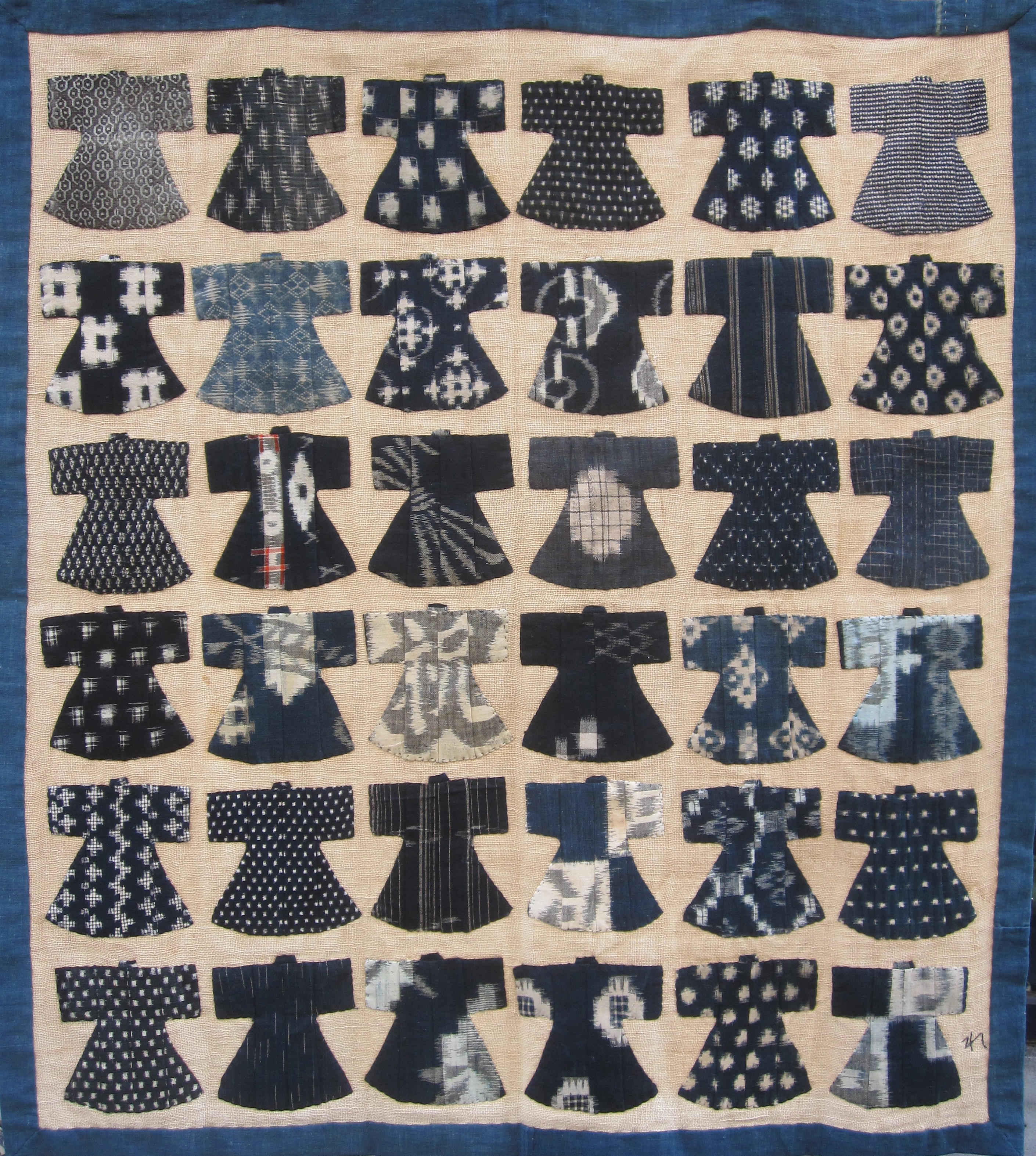
One of the most beloved things sold at Blue & White are the small quilts and hangings by Reiko Inaba. She uses vintage mosquito netting, kasuri and other fabrics to turn out her charming kimono and fish quilts, something she started doing as cancer therapy.

IMG_1057

For those of you who can’t just pop in and visit, Amy’s books have been reprinted a million times and still feel as fresh as ever.  She is currently working on a fifth – I’m not sure that I can give away any details on it!

Blue-and-White-Japan-hardcover japan country living

japan the art of livingotafuku amy katoh

For me personally, Amy has been an inspiration, a teacher and a wonderful example of how to live a life full of constant discovery. She sees the wow! in everything.

Put Blue & White on your bucket list….

Blue & White
2-9-2 Azabu Juban.
Telephone: 03-3451-0537

http://blueandwhitetokyo.com/

On a related note, the giveaway for an indigo and white nankeen pillow from LuRu Home has closed. I’ll have a winner for you by the end of the week.

Related Posts:
Artist Spotlight…Kazuko Yoshiura and Sashiko Fever
Feeling Fresh…Indigo Textiles and Tenugui
LuRu Home…Keeping the Folk Art of Chinese Nankeen Alive And a Giveaway!

Read Full Post »

With the development of economy and progress of industrialization, more and more machine-made cloth has been taking the place of calico, home-made and hand-imprinted and dyed in the country. Therefore, blue calico, as a work of folk art, has been gradually losing its practical value.

Indigo Textiles: Technique and History, Gosta Sandberg

slideshow_3

What do you see in this photo? Japanese yukata (cotton summer kimono) hanging on a line perhaps? It wouldn’t be an unreasonable guess based on the color and pattern, especially if you were just looking at the rolls of yukata fabric in Amy Katoh’s Blue & White store, like I was the other day. Hand-dying is a dying art everywhere, and we are lucky when people like Amy step up to help keep it alive.

IMG_1953

But the answer to my question above is actually not Japanese at all – it is Chinese nankeen, stencilled and dyed in an indigo bath. Originally, the word nankeen was used to indicate the very dense and unrefined hand-woven cotton fabric itself, but over time has come to be used interchangeably with its patterned and colored counterpart. Often referred to as blue calico, it was the main component of peasant clothing in China for centuries and in its plain form came to be an important export. A staple of British clothing from the late 18th century onwards, any Jane Austen fans among my readers will recognize it as a common fabric used for half boots worn for walking, as well as for mens breeches and pantaloons – the modern-day equivalent of chinos. Even its signature pale yellow color is often mentioned.

Nankeen_Trousersournal des Dames et des Modes, 1814

Ironically, while the upper classes in Europe were wearing nankeen, in China it was the fabric of the rice farmers, who used it for warm padded winter clothing. In Indigo Textiles: Technique and History, Gosta Sandberg writes “The jacket of the Chinese rice-farmer has been coloured with indigo since time immemorial. The reason for this is said to be that cloth dyed with indigo is many times stronger than undyed cloth and that it keeps insects and snakes at a distance, which is a considerable advantage for those working in open fields.” I don’t know if that is actually true, but it is consistent with work clothes in many cultures around the world, including our very own Levi’s.

Enter into our story – and there is nothing I like better than a good old-fashioned expat tale - Claire Russo and Liza Serratore, the founders and designers of LuRu Home, a new-ish textile based home design company working with modern versions of nankeen, based out of Shanghai. Selling pillows, napkins, place mats, tea towels and bags, all made from the custom hand dyed fabric in their versions of traditional Chinese patterns, it is good to see others taking up the banner of preservation, while innovating at the same time.

slideshow_7

Liza and Claire had been friends since high school and kept in touch, planning to go abroad for work in response to the poor economy in the United States. After a few twists and turns, both ended up in Shanghai. One day they came across bits of old blue and white Chinese fabrics that they found in a tiny shop at end of long alley way – one of those magical moments that if we are lucky, we stumble across a version of, sometime in our own lives. The store was jam-packed with textiles, many sun bleached around the edges, and they came home with a few individual meters, recent but vintage.  Their original impetus was to make things for their own apartment, and then for gifts, and from there the demand began to grow. They found they had passion for the fabric and as they investigated the printing process, a desire to rejuvenate the industry and bring patronage back to the artist.

Fabric Hanging in Yard

The technique for making nankeen is a rice paste stencil resist technique almost identical to that of Japanese katazome. Just like the two countries currently arguing over the Senkaku Islands, they also argue over whose technique it was first. Frankly, I think it truly originates elsewhere in Asia, but I am not about to enter the scrum.

 Antique Chinese nankeen…

Antique table cloth patchAntique Nankeen

Does it look familiar? Antique Japanese katazome.

katazome

Both techniques use a paste glue to cover the open patterned area of a stencil, keeping it from absorbing the dye. In Japanese these stencils are called katagami – and I have written about them as decorative devices as well as a functional ones before. The Chinese nankeen artists do all their screen cutting by hand using simple craft paper that has been oiled. I can’t help but hear their Japanese counterparts whispering in my ear “They just use plain craft paper?” and the Chinese reply being “Why do they bother glueing all those layers of washi paper together with persimmon extract? Boy, that is a laborious waste of time!” While the Japanese use rice paste, the Chinese use soybean and lime paste mixed with water.

Paper Screen : Paste on Fabric

The base cotton is no longer hand loomed, but it is still very size limited based on the traditionally sized dying vats. It is also quite difficult to work with screens beyond a certain length so the largest screen possible is 32 inches and the rolls of fabric are 12 meters long. This automatically insures that all LuRu Home’s pieces are small batch made and variations are part and parcel of the product, depending upon the whims of the dyer and even the weather for drying.

Nankeen dye dipping

The fabric is finished by using frosting-style knives to scrape away the paste after printing and then the fabric is put through a wash cycle with no soap and dried.

Scraping the paste post-dye

Their patterns have been inspired by historical patterns in An Overall Collection of China Blue Calico Vein Patterns compiled by Wu Yuan Xi, although not everything in the book is a traditional pattern (zebra anyone?). While Claire and Liza want to starting designing their own prints, the nankeen artisans will have none of it until the women build up more guanxi (relationship currency).

Wu Yuanxin 11cropWu Yuanxin 8crop

They have been extrapolating and changing the old prints and ironically that has helped them build guanxi as it shows their respect and appreciation for the process. A perfect example is the Flower pattern, which was too small and tight as it appeared originally. They enlarged the size and added white space to up its graphic punch. So for now, they are going to continue playing with tradition and plan to introduce a new pattern every season, which is twice a year, by adding one and pulling one, keeping 6-7 prints available at all times.

Flower Prints

Their gorgeous website shows all their products and they also have a lovely lookbook with great styled shots. This outdoor view, also shown above previously, is my favorite.

Table Setting 2

I’m dying for a few of the adorable tea towels, pun untended! They make great gifts too.

DSC_9252

So now for the fun part! Liza ad Claire have generously offered one 13 x 22 lumbar pillow (insert included!) in one of their four most popular patterns On The Fence, Babyteeth, Dot Dot Dot and Flower - the giveaway winner’s choice. All you need to do to enter the giveaway is leave a comment below. If you like LuRu Home on Facebook, I will enter you in the giveaway a second time, doubling your chance to win. They can ship to the winner anywhere in the world as they have stock in both the USA and China. The giveaway closes Monday night at 12 EST. I am crushed, of course, that I can’t enter myself!

on the fence pillowbabyteeth pillow

dot dot dot pillowflower pillow

Their pillows look great styled with other indigo and blues, as seen here at Nicky Kehoe

luru at Nicky Kehoe

…as well as with an assortment of other colors, like here at Black & Spiro.

luru at Black & Spiro

Although record prices are being set for fine antique at auctions by wealthy Chinese looking to repatriate lost treasures, the locals LuRu works with are a bit bewildered by the women’s’ fascination with nankeen. Anything folk art based is undesirable these days in China. Louis Vuitton or (even Luois Vitton) is what is hot. But Claire and Liza have stiff competition from other buyers in procuring their fabric. From whom, you may ask? Can you guess?

The Japanese!

Image credits: All images credited to LuRu Home or the publications listed with the exception of #2 (me) and the 19th century fashion plates from Lady’s Repository Museum.

Read Full Post »

After a visit to Hanoi one is curious to learn what the French would have done to Singapore or Hong Kong if they had possessed them.
-Alfred Cunningham

One of the great things about living abroad is the ease of exploring nearby places as we just did this past week in Vietnam. Setting up shop at the historic Hotel Metropole, constructed in 1901 and restored to utter perfection, we got a taste of French Colonial life in Hanoi. The hotel is a veritable who’s who of writers, politicians, heads of state and entertainment personalities, including Joan Baez, who wrote and recorded parts of her anti-war song “Where are you now, my son?” while staying there during the Christmas bombings of 1972.

IMG_1610

Both the hotel and the city itself felt like time had forgotten them in the best way possible.

IMG_1706

Restaurants like the Green Tangerine

IMG_1646

…and Didier Corlou‘s La Verticale, where we ate a divine French-Vietnamese dinner, are housed in 1920-1930s villas, which were as interesting as the food. Here the original enfilade has been preserved, offering diners intimate spaces in the overall restaurant.

IMG_1722

The encaustic tile floors had me at hello.

IMG_1719

I know you are all thinking about that Kristen Buckingham kitchen right now – I certainly was!

IMG_1718

The streets felt like a permanent party…

IMG_1933

…albeit a dangerous one where you could get run over at any time in the crazy traffic, which never stopped. The key to crossing is to find a small opening and just start walking (and praying) that everyone will go around you. And I think I’ll spare you the requisite image of me being pedaled around in a cyclo, although I do have to say is was quite fun and a bit scary.

IMG_1934

A “big” city yes, but so many atmospheric small town moments, from the flower sellers on bikes everywhere…

IMG_1703 IMG_1704

…to fruits…

IMG_1702

…and vegetables. We watched some strapping American men try to shoulder one of these shoulder panniers and they couldn’t do it!

IMG_1701

We particularly enjoyed the thousand-year old Temple of Literature.  In my romantic mind, it was a place where people came to worship the creative written word, but it is actually dedicated to scholars and housed the first Vietnamese university, established in 1076.

IMG_1752

The Stelae of Doctors commemorate the names and birthplaces of those who passed the royal exams.

IMG_1751

At the temples of Hanoi you could really feel the other foreign influence on the city – that of the Chinese.

IMG_1750

In case you were worried we didn’t manage to find time for shopping, let me put your mind at ease. I made a few wonderful finds for work, like this vintage Hmong textile…

IMG_1648

…and a few personal ones for play too, like this dress from Tropical, one of our favorite stores along Hang Gai Street, which has the best shopping in Hanoi. Other stand outs included both the Tan My shops and Embroidery Ninh Khuong, which had lovely PJs for children.

IMG_1647

We were only in Hanoi for a day and a half before flying down to Da Nang, a beach resort with jumping off points for Hoi An and My Son, which could not have been more different from Hanoi and each other. More on those next!

Read Full Post »

I just got back from two quick but wonderful days in Kyoto, traveling with two dear like-minded friends.  We were worried it would be bare in winter, but in the absence of cherry blossoms or fall foliage, Kyoto was a study in green.

Green moss in gardens…

IMG_1260

…and temples everywhere.

IMG_1261

We were utterly and completely captivated by our subway car which felt straight out of the 1940s.  Mint green walls and deeper green velvet upholstery…

IMG_1268

…and even the silvery fretwork on the vents below.  How long would this fabric last in New York City?

IMG_1334

Day two changed hues as we spent most of it exploring the Fushimi Inari shrine and its thousands upon thousand of orange torii gates, each donated by Japanese businesses.

IMG_1309

Walking through the roughly two miles of gates was an extraordinary experience and the jolt of color against the winter landscape was intense.

IMG_1310

Later in the day green and orange joined together in some fretwork at Kiyomizu-dera, perched majestically at the edge of the mountains.

IMG_1311

Good luck offerings were everywhere, from the traditional kitsune (fox) messengers a the Inari shrine…

IMG_1305

…to garlands of rainbow origami cranes.

IMG_1312

Our hotel was most conveniently located in Gion, right along Shinmonzen Street, the main antiques drag of Kyoto.  Imagine that?! As we shopped, our color palette turned to blue from all the porcelain we were seeing, particularly at a shop I believe is called Akando, run by a darling older couple…

IMG_1321

…the proprietor having his likeness on their adorable business card.

IMG_1338

My friend almost bought these amazing Nabeshima dishes, but when we did the math they were well over $400.

IMG_1342

The other shop we spent serious time in I recall from my last trip. R. Kita Old Imari & Kutani has been in its location for over 70 years. They had me at the sign alone.

IMG_1327

In the window was this amazing 19th century Seto porcelain ice bucket, clearly made for the export market. It was the only Seto piece to be had amidst all the Old Imari & Kutani and I really wanted it. Unfortunately, it was a cool 1000 bucks.

IMG_1328

In general all the porcelain and other antiques were extremely expensive. Prices were way higher than in Tokyo and way way way higher than at the shrine sales. That is exactly what I remembered from previous visits.

IMG_1329

So once again, I looked – in this case instagrammed – and didn’t really buy.

IMG_1323

We did better in the soft goods department and my friend Maja of Alegria Design bought some lovely pieces of indigo kasuri to make bolster pillows. I’ve got kasuri on the brain these days, and you’ll see why quite soon as the ASIJ Gala quilt is almost complete!

kasuri

I managed to pick up a very unusually colored plum piece of kasuri.  I am nothing if not predictable! And at a year and a half out, it is starting to seem as if I will never be getting my lampshades from the custom vendor I ordered them from, so perhaps I might use this in another attempt elsewhere or a DIY!

IMG_1320

Gold was also one of the colors of the trip, as you can see from this lucky sun shot in the late afternoon at Kinkaku-ji, the Golden Pavillion.  A piece of Kyoto advice – always go there late in the day so that the sun is setting in front of the building if you want the lighting to be just right.

IMG_1258

One hidden gem we hit was the house and garden Murin-an near Nanzen-ji. Built just before the turn of the century it had that wonderful Anglo-Japan mix that I adore. The wall murals painted in the sitting room were just divine and the garden was a perfect oasis of peace and quiet in the bustling city.

IMG_1333

The Hotel Mume where we stayed was charming, in particular the sudare canopied bed area.

IMG_1335

The vending machines were particularly creative in Kyoto – Cup of Noodles anyone?
IMG_1259

That reminded me of the really interesting exhibit currently running in the Frederick Harris Gallery at the Tokyo American Club. A riff on Hokusai’s Thirty-Six View of Mt. Fuji, Peter MacMillan’s witty prints are well worth a viewing. If you are in Tokyo, it runs until February 24. If you are not, more of them can be found in my Instagram stream.

IMG_1219

And finally to wind down, a bit of black and white. It is quite common for ordinary folk to go to Kyoto and rent kimono for the day along with hair and make-up services.  These girls were not geisha (or maiko and geiko as they are called in Kyoto) but instead just having fun. You’d think they would look better in color, but it took away from their expressions.

kimonogirls

And the most modern white of all? That streamlined shinkansen, pulling in to take us home.

shinkansen

Read Full Post »

IMG_3147

IMG_3158On Bergen Street between Smith and Court Streets, hidden up a few stairs and behind a nondescript door, lies one of my favorite Brooklyn antique shops, Fork + Pencil. It is not the flagship location – which is right around the corner on Court Street – instead it is the newer warehouse store, focusing on furniture and artwork. And theoretically, it is not actually an antiques shop, but officially a consignment shop. The mix is eclectic, but there is always something interesting to be found. What makes the place special is the owner Alex and its mission – all profits after expenses go to charity. While this is good unto itself, I think it creates a unique shopping experience and better quality merchandise gets consigned there – people like to see their goods doing good.

The main floor is always a mix of large items with accessory displays covering every horizontal surface, artwork and mirrors on all the walls and chandeliers hanging everywhere. Eras and styles are all jumbled together in a highly enjoyable smorgasbord.

fork and pencil 1

Intriguing arched shelving unit mounted on a console table.

photo

Mid-century mixes with colonial.

fork and pencil 2

Such a variety of lamps, like the pottery one above and this book stack one below…

stack of books lamp

…and this nicely miss-matched pair of cobalt bottles can be found everywhere.

cobalt blue glass bottle lamps

One of F + P’s specialties is porcelain and pottery. Lots of Staffordshire, Asian ceramics, like the big Imari bowl here, lustreware, Sevres and other French porcelain, and the list goes on.

fork and pencil imari

A favorite find is this giant polychrome transferware bowl. Birds and blossoms in the same place!

IMG_0575

Their other great strength is art – etchings, engravings and all kinds of small works on paper, priced so well as to be worth more even than just their frames.

fork and pencil rose

Loved these antique carriage prints. Very Georgette Heyer!

photo

The basement is more of an adventure than the upstairs and usually looks something like this, but there are always treasures to be unearthed with a little effort.

fork and pencil basement

photo

A case in point – it doesn’t get better than this – a George Smith standard armchair found nestled in a back corner…

IMG_3154

…and now nestling right here. Fresh from a Southampton estate, that chair lists for somewhere in the $6000 range new and even on sale rings up around $4000. Planning to re-cover it, but for now it looks great.

IMG_0868

The artwork finds have been outstanding, including this Brooklyn view with its charming French mat and the small Chinese gouache below.

IMG_0573

And an art triple play over just 2 visits yielded these…

photo

…and this…

photo

…and these…

photo

…which mixed with this new offering from Dash & Albert, the Garden Path runner, and some beautiful antique lace curtains, has created an instantly decorated laundry room for about $500.

Garden Path Dash Albert hooked rug

There is a nice article about Alex and the founding of the stores in the South Brooklyn Post. And the original store around the corner is well worth checking out – many of the valuable “smalls” end up there.

Fork + Pencil
Warehouse: 18 Bergen Street
Main Store: 221a Court Street
Brooklyn New York 11201
718 488 8855  |  info@forkandpencil.com
Tuesday – Sunday 11 – 7

Read Full Post »

I think it has been more than a year ago at least that I promised to do a full shopping guide to the vintage and antique stores in the Meguro neighborhood of Tokyo. Commonly referred to as Interior-dori, it stretches along both sides of Meguro-dori (dori meaning street), south-west of the Meguro train station from just past Yamate-dori, all the way down to the central post office. After my last post mentioning the lack of furniture available here, I got a few kind complaints as to the truth of that statement and thought it time to fully investigate and report on this unusual cluster of stores. These adhere to that “car dealership synchronicity” adage I have talked about elsewhere (here and here, for example) and numerous people, mostly couples, were browsing on the public holiday earlier this week. With a complete lack of parking and the train station a bit of a walk, the density of shops is needed to bring the public.

My tour starts at the intersection of Meguro-dori and Yamate-dori and heads along the south side of the street walking. I stop in at most of the shops on both sides, although there are a few I missed, so the list is not exhaustive.  There are also stores tucked away in the back streets near by, such as the lovely Found, but those are not on this tour. Many of the merchants are listed on the MISC (Meguro Interior Shops Community) webpage and the shopping map to the area that can be picked up at participating stores. Both for those really looking to furnish a home to those just looking for small gifts and Japanese styling, it is a fun outing.

While most of the stores are channeling that mid-century vibe or at the very least European shabby-chic, one of the first stores on the south side of the street is Chapter, featuring Japanese antiques.

One of their specialties is repurposing, so antique ranma (transom panels) are turned into consoles, dining tables and wall dividers. There is quite a collection of them at the back of the shop. They have great vintage milk glass fixtures too.

I thought this was ingenious – tucking a hard to use small tansu into a larger modern piece of furniture.

Brunch + SC was one of the first of five or six different Brunch outlets (Brunch Branch, Brunch Works, Brunch Time, etc.) all selling their modern versions of furniture inspired by the mid-century. You can see on their logo map below that they stretch all along the street and line both sides.

Each shop has their own particular pieces, but this photo gives a general sense of the style.  There was a western couple shopping here and the sizes of the furniture seemed normal and comfortable. Much of it is teak and order made. Really great chairs (think Wegner Wishbone) at these shops – and they are currently having a chair fest through September.

Brunch Branch nearby had charming garden items.

I had to go into chambre de nimes just based on that stacked luggage in the window.

Everything inside the shop seemed to be imported from France and the place had a real les puces vibe. This was the first of many places that also stocked vintage church pew chairs with a pocket in the back for prayer books. They are super popular here in Japan and I’ve seen them often elsewhere, particularly at the Penny Wise.

And the first, but not the last of the day, of the sewing machine base consoles. New Jersey to Japan – they are everywhere.

The next shop AMS seemed to be different owners on different floors, but the ground floor was full of vintage chandeliers and country-style antiques, including windsor, ladder back and the ubiquitous church chairs.

Next was Junks featuring all kinds of great vintage goods, mostly from the USA, including some favorites of mine such as wooden delivery boxes, printers drawers, old globes, authentic mid-century furniture…

…and this fabulous bottle drying rack for 39,800 yen ($509), which might seem expensive but…

…a similar one was for sale on OKL for the same price on the very same day.

And Becky at Buckets of Burlap just recently put her vintage zinc bottle dryer up for sale for $500.

Gallery S featured a combination of vintage and new furniture, but seemed to specialize in hats. Yes, hats. Love the wooden and painted iron desk and chairs on the right out front.

Tucked away upstairs across the small side street is Point No. 39 which looked promising just from the sign alone! And the word repair was quite intriguing as that is hard to find in Tokyo.

It did not disappoint, being stuffed full of great lighting, furniture and decorative pieces.

I loved the giant sunburst mirror. And by the way, it is also a bicycle store. Go figure!

File Home and Interior was full of gorgeous housewares and also boasted one of the prettiest kitchens I have ever seen in Japan.

Turns out there are a few more File shops across the street including one that actually designs and installs kitchens.

After File, things petered out and before reaching the big Meguro post office I decided it was time to cross to the north side of the street. Anchoring the end on the other side of the street is the giant four floor Geographica. The second floor is home to a charming Italian restaurant Il Levante where I stopped for lunch. There are not many choices for food along the main drag, so I recommend it for a rest or meal.

Geographica was stocked with English antiques – they even carry Sanderson’s line of William Morris Fabrics – and at times felt a bit like a gentlemen’s club. Lots of dark wood, bentwood chairs and framed engravings. One really useful thing they stocked was a full line of knobs and pulls and other hardware. And I love these brass train racks – how great would one of these be in a bathroom? They also have a Yokohama factory shop where they do their restorations.

Pour Annick had more of the golden wood mid-century inspired furniture as well as some fun quirky items.

What about one of these bright stools for the teen bedroom project I am working on?

Since the previous shop that involved climbing stairs was such a success, I made sure to go up to Blackboard.

I was rewarded with industrial chic and some real mid-century pieces.

The curated display of found objects was inspiring too. I forgot to check if they are actually for sale. Blackboard also had some great English language design books.

Roughly across the street from Junks on this side is their sister shop Moody’s full of more vintage furniture and lighting. Many of the pieces had big signs advertising their origins, whether it be Heywood-Wakefied or Eames. It felt like there might be a great find lurking in here.

Meister is one of the leading stores on the street carrying modern versions of those same mid-century design icons, including Nakashima style wood slab tables.

This Eames molded plastic rocker is available for order in a full range of colors and was about $650.

A new Eames rocker in the US is $549 at Herman Miller or Design Within Reach.

I didn’t go into Stanley, but just the idea that there might be somewhere to have custom upholstery, rehupolstery and slip covers made here in Tokyo was revolutionary. If anyone goes in to inquire about a project, I’d love to hear about it.

The De Mode shop felt the most American of all the shops, channeling the rough luxe thing. Check out those industrial light fixtures! They have Tolix style chair too. If you click into their website, they seem to have a number of other fabulous locations, including a warehouse. Definitely something to explore next!

I found it oddly reassuring to see that I can buy glass Ball jars here although I forgot to check the prices.

Lewis specializes in Danish modern.

And at the very end of the tour, almost back to Yamate-dori are three outlets of a recycle shop called Sone Chika. Japanese recycle shops are akin to thrift stores in America and are hit and miss like you would expect. There are definitely finds to be made, although no luck for me that day.

Most of the stores are open from 11am until about 8pm and Wednesday seems to be the closure day for the area. You might want to call ahead if you are interested in a particular spot. Be sure to click the Shop Talk tab in the category list on the right side of the blog for more store reviews and neighborhood strolls.

Related Posts:
On Dumbwaiters and Butler’s Trolleys…Non-Japanese Antiques in Tokyo at The Penny Wise and Found
Shop Talk…Discovering Antique Treasures in Nishi-Ogikubo

Read Full Post »

So I declare that giant oversized couches and seating are officially dead. Not for me to decide or declare, but saying it anyway. Even Restoration Hardware has come out with that apologetic ad and its new Big Style, Small Spaces catalog. And as a side note, their baby and child line also has some nice smaller pieces like this iron Parisian side table I just ordered during their July 4th sale.

But back to the topic at hand! One classic piece that has fought its way back to the forefront of fashion is the camel-back sofa. Common as ice in Alaska in its big early 20th century revival, it fell out of favor as dated and grandma-ish, since everybody’s grandma had one! For me personally, it was designer Windsor Smith who led the charge in pulling it out of its old lady depths, with her oft photographed and changed example in her own home. In one of its earliest published incarnations it was a soft sea-foam green, partnered with that amazing Indian octagon coffee table I am perpetually obsessed with. I have to thank Kristen Kerr of Simply Smitten for the link to where to get one… But back to the sofa – it is the Gwen Curved Arm Sofa from Smith’s own furniture line.

Its most famous version was in her iconic pink living room, featured in House Beautiful and later put on the cover of their pink issue. I have this memory that designer Kathryn Ireland gave her the amazing blue embroidered textile she used to recover it, but I can’t remember if that is actually true.

The side angle view with that amazing upholstery job…

Here’s a later view of the same room. Sorry, while the wall art and inlaid chair are fabulous, this room looks absolutely bland with the modern sofa and table in comparison to its pink incarnation above. I love the wall color of both spaces, but wish the camel-back was still here in this one.

Never one to rest on her laurels for a minute, she is always changing things around. I am feeling too lazy to track the chronology of it all, but the ceiling moulding tells me this is a different room than the one above –  the sofa is now in her family room.

So not to get off topic into a Windsor Smith design crush or to fight with those who would argue it was Ruthie Sommers who resuscitated the camel-back on that very first Domino magazine cover – an equally valid argument in my book – I want to offer up the ready availability of these sofas in great condition at truly inexpensive prices in antique and secondhand shops around the country.  Pick a fabric, whether it be bold David Hicks style, ethnic embroidered, humble ticking, velvet, or even a more avant garde choice, and you’ll have the most modern, streamlined, practical piece for your home. The charm and comfort of them lies in the fact that almost their entire length and depth is devoted to actual seat space and not wasted on oversized puffy arms or big loose cushioned backs.

Camel-back is a casual name for a sofa with a curved center hump and scrolled arms, first encountered in the late 18th and early 19th century as the whole concept of sofas and settees was invented. Prior to that there were chairs, but the idea of sitting in comfort was new. Those three famous “cousins” Chippendale, Sheraton and Hepplewhite, cabinet makers in the late 1700s, were influential through the early to mid 1800s when styles changed, only to become popular again in the early 20th century Colonial revival craze. Those are the pieces that are easily found today.

This is how easy it is. Last week while doing the rounds at Point Pleasant Antique Emporium, I could not believe how many nice, inexpensive camel-back and Sheraton style sofas they had out on the floor.

Camels…

Sheratons…

And this was just one large multi-dealer shop! Produced in huge quantities for the last hundred years or so, those from the 20s-40s are the best made so don’t forget to shop your grandma’s attic.

I am not the only one with camel backs on my mind. Michael Penney recently sent a recovered camel-back on its merry way from his new shop – Penney and Company – covered in this fabulous blue ikat.

Ally over at From The Right Bank took a Sheraton style settee from this…

…to this, with some Annie Sloan Chalk Paint and new velvet upholstery.

You all know I have been drooling about Nightwood‘s deconstructed pieces for a while now. Katy Elliott just posted their custom Parker Sofa as an idea for recovering her family heirloom camel-back. The linen upholstery on this piece has such an organic feel.

It makes such a play on its own vintage-ness by having exposed sides (and maybe back),

I’ll follow up tomorrow with my favorite modern version of a Sheraton sofa, great for those who can’t bear the thought of buying one secondhand!

Related Posts:
More Real Locations in New Jersey…Antiquing Along the Northern Shore
Ume Blooming…Maybe Pantone Should Have Called Their Color of the Year Plum Blossom?
Wabi-Sabi Essence in Brooklyn, Courtesy of Nightwood

Image credits: 1-4. via Windsor Smith, 5. Veranda January 2012 via Simply Smitten, 6. Domino via Style Court, 7-12. me, 13. via Michael Penney Style, 14-15. via From the Right Bank, 16-17. Nightwood via Katy Elliott

Read Full Post »

Exciting news here at Tokyo Jinja! Anthony Joh of Tokyo Podcast was lovely enough to feature me on his newest Podcast! While there is nothing worse than listening to a recording of your own voice, it really was exciting to do a live interview. I am the appetizer to a longer feature about Bobby Judo and his cooking show on Japanese television, but I come first in the Podcast, so please take a moment to listen to it by clicking here. There are MP3 and iTunes links as well.

I don’t often write about the technical side of blogging, but it is one that I am increasingly thinking about.  I’d really love to escape this standard WordPress template I have been using for many reasons, the first being that I hate clicking into another blog using the exact same one. It denigrates the quality of what I am working so hard to achieve. But I do love the easy format provided by the WordPress platform and my html skills are definitely not ready to do it on my own! So if anyone out there knows a graphic designer well versed in creating blogs and websites, I’d love to hear about them.

Another reason I am interested in spreading my wings is so that I can consider advertising. Most of the other design blogs are on Blogger, the Google platform, which has built-in advertising available. WordPress just started their own automated ads, called AdSense about a month ago and I signed on as an early user. How many of you have noticed that my new posts have an ad box at the end? What do you think? Does it bother you? If you think about how much time and effort I exert on this blog I think you would agree that earning some money from it would be reasonable. I know some bloggers believe it can compromise their journalistic integrity, but if the ads are selected by some computer algorithm, how would that be the case? In all honesty, I think ads for apartments in Japan and language lessons (which is what has been springing up on my site) are not geared to my target audience and I cannot imagine that any of my readers have been clicking them.  I think this is borne out by the fact that I earned $6.71 from them last month.

I would like to think about taking individual ads from sponsors on related themes and have actually been contacted by antique dealers and others about advertising. For example, take a look at the ads in Joni‘s left side bar and you will see what I mean. That kind of advertising seems to make more sense, but as it stands now, it is not possible in the WordPress platform I am using. On the other hand, the push from sponsors to feature their products in posts might be just the kind of compromise I am not willing to make.

I have also been recently contacted by MyCityAntiquing.org a Wiki project aimed at creating a comprehensive worldwide directory of antique shops and market places. I really love the idea of all that information gathered under one roof so I have gone ahead and linked some of the articles they requested. Take a look at the bottom of this post to see the “Featured Review” button and let me know what you think! There is even an iPhone app with built-in GPS, which seems like an amazing tool for travel.

I know everyone is busy with summer, but I’d love comments and suggestions, including negative ones about the advertising or anything else, as I consider what direction Tokyo Jinja should head in. I’ve received some wonderful personal emails from readers in the last months and I think of this blog as being your and theirs as well as mine.

Related Posts:
Tokyo Jinja on CNNgo Today

Read Full Post »

Back in the USA for about 48 hours and as usual, jet lag has me a bit out of commission, but as usual, I have been to a few of my favorite local antique haunts before making it to the supermarket. As usual I have dragged a bunch of decorative finds from the last year with me, this time in a giant box that I was lucky enough to manage to check on the plane. Many of the things in it you have seen in posts before but there are a few fabulous things that you won’t have seen…

A pair of vintage fans.

A lacquer wagashi (Japanese sweets) covered case, a vintage brass and porcelain iron (can you spot the kanji character?) and a favorite blue and purple transferware bowl forgotten and recently found.

And the piece de resistance, a brass and tin-lined film reel canister, designed to protect old movie reels from fire and damp. It is from a theater in Ginza and seals tightly. I am not sure this photo does it justice, but I am sure you’ll be seeing more of it as I am thinking of using it for recycling in the kitchen. I also brought back this huge wire basket – no purpose in mind yet – but so lovely and sculptural. You can see another one in the background of the photo – I seem to be collecting them!

I am getting the house in order and starting to make a list of everything that needs to be done, but finding the key pieces I still need to be elusive (remember, I have already done a pass through my favorite antique stores with no luck). I might need to travel further afield, and on that note, I am dying to visit Privet House in Connecticut.

Billed as “an Emporium of Home Goods, Antiques and Curiosities” giving it a John Derian-esque air, I first heard about it through a post on the wonderful Good Bones Great Pieces blog written by Lauren and Suzanne McGrath, whose eponymous new book is also on my must read this summer.  Privet House is the baby of Richard Lambertson and Suzanne Cassano, two well-known design industry professionals and neighbors who joined forces to open the shop. Everything in their photos looks interesting, but I am thinking I am so riveted by it because of the paint color - Benjamin Moore Sweet Innocence 2125-50 - so similar to my own beloved Benjamin Moore Pelican Gray 1612. Shopping there would almost be like trying everything out at home!

Vintage leather suitcases – you all know where I stand on those!

Funky swing arm lighting – you know where I stand on that too. And doesn’t the shade remind you of these from here?

I have the feeling it all may be very pricey, so I might just have to content myself with some of these Turkish hammam towels. Dreamy colors, don’t you think?

But the good news is that the Privet look is available to the masses at The Shops at Target - they have a branded line there right now full of lots of things I love including galvanized tin garden supplies.

Dishes galore, including many funky pattern melamine ones, perfect for patio meals…

…and these embossed white china ones which may be my perfect summer home basics!

So in addition to the antique shops, I have also managed to make it over to Target (but still not the supermarket) and loaded up on Privet House items – all on sale too!

Jet lag fugue state closing in so it is time to go sit on the porch. And my children want dinner – the nerve of them! Here’s one more image of wonderful things here at the house – my hydrangeas are gorgeous and look so pretty in the transferware bowl. And you can see how similar the wall paint color is too!

Happy Summer!

Image credits: 1-4 & 14-15. me, 5-7 & 9. via Privet House, 8. via Good Bones Great Pieces, 10-13. via Target

Read Full Post »

Older Posts »

Follow

Get every new post delivered to your Inbox.

Join 405 other followers

%d bloggers like this: