Feeds:
Posts
Comments

Archive for the ‘Lacquer’ Category

“…a young apprentice geisha must learn a new way of sleeping after her hair is styled for the first time. She doesn’t use an ordinary pillow any longer, but a taka-makura-which I’ve mentioned before. It’s not so much a pillow as a cradle for the base of the neck. Most are padded with a bag of wheat chaff, but still they’re not much better than putting your neck on a stone.”
Arthur Golden, Memoirs of a Geisha

It doesn’t sound to me like a very comfortable way to pass the night, but sleeping on a takamakura (tall pillow) was instrumental in preserving the elaborate coiffures worn by geisha.

geisha taking nap on pillow

These days, they make wonderful decorative collectibles, like this one tucked against the books in the side table of a room previously featured in my Provenance column on kasuri over at Cloth & Kind.

IMG_1612

The base is made of lacquered wood that is gently curved, to allow for some rocking movement while in use. A silk or cotton-covered pillow, filled with buckwheat hulls or chaff, crowns it and provides some limited comfort. Dark or orangey-red lacquer is most common and sometimes the pillows are made from interesting textiles, like in this case, covered with asa-no-ha (hemp leaf) pattern. And if you are thinking Kelly Wearstler’s Katana, now you know where she got her inspiration!

takamakura

A similar takamakura rests on the top shelf of a very large collection in a Westchester, NY bedroom. As you can see, most of the geisha pillows are either red or black and the finer ones have detailing in the lacquer. This collection also boasts a few wooden examples as well as some blue & white porcelain ones.

LJ geisha pillows

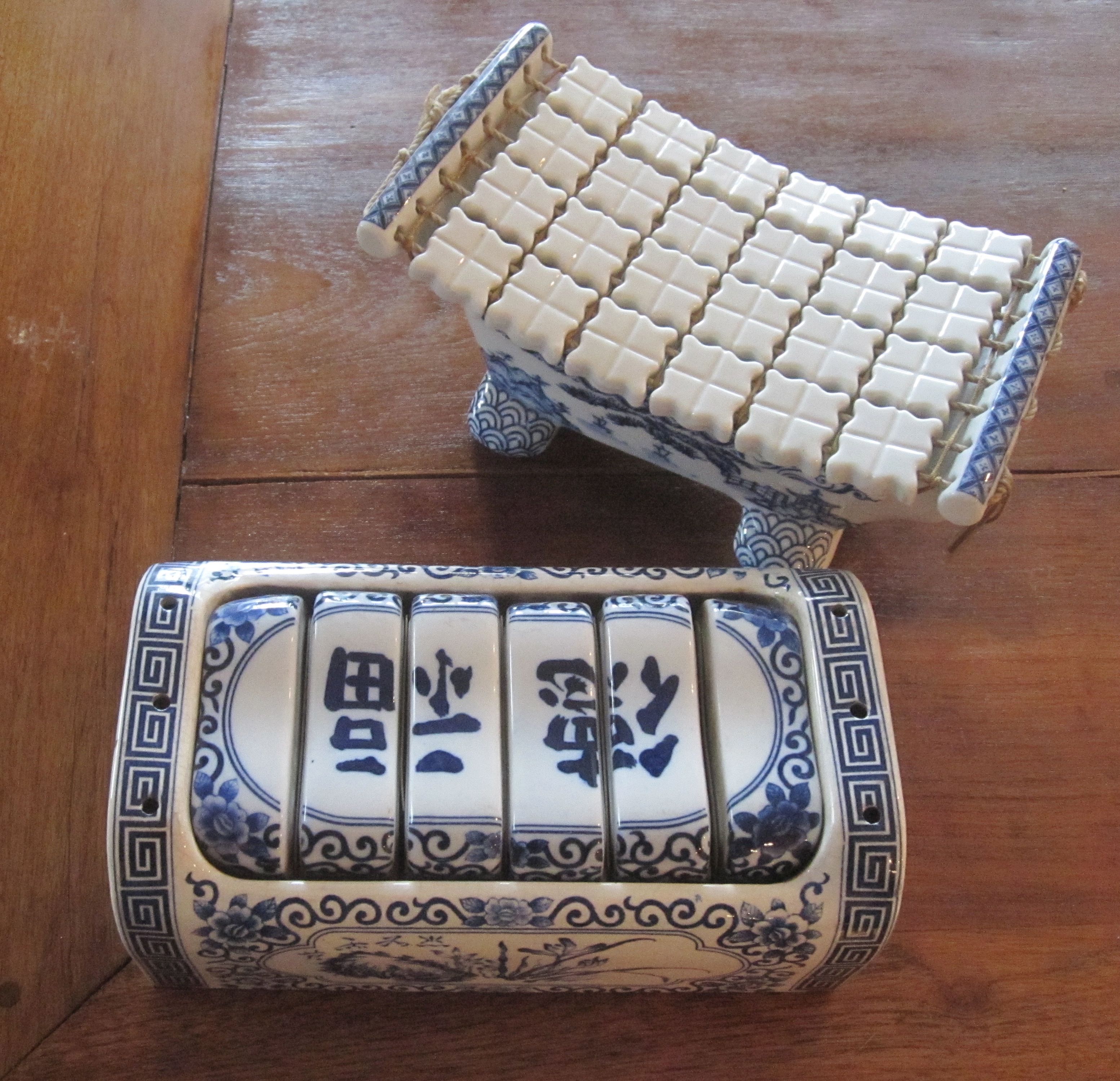
While many of the lacquer and cloth takamakura date from the 19th century, most of the porcelain ones commonly found are early to mid 20th century. The porcelain ones seem even less comfortable to me, although some are designed with special comfort features, like these two. The top one has small porcelain squares strung together almost like a hammock that allow for movement. The one with the kanji marking on top can accommodate hot water and/or medicines in its hollow cavity and the gaps in the top of the pillow let the steam or aroma rise. I’ve actually seen takamakura with pharmacy labels or stamps.

blue white porcelain geisha pillow

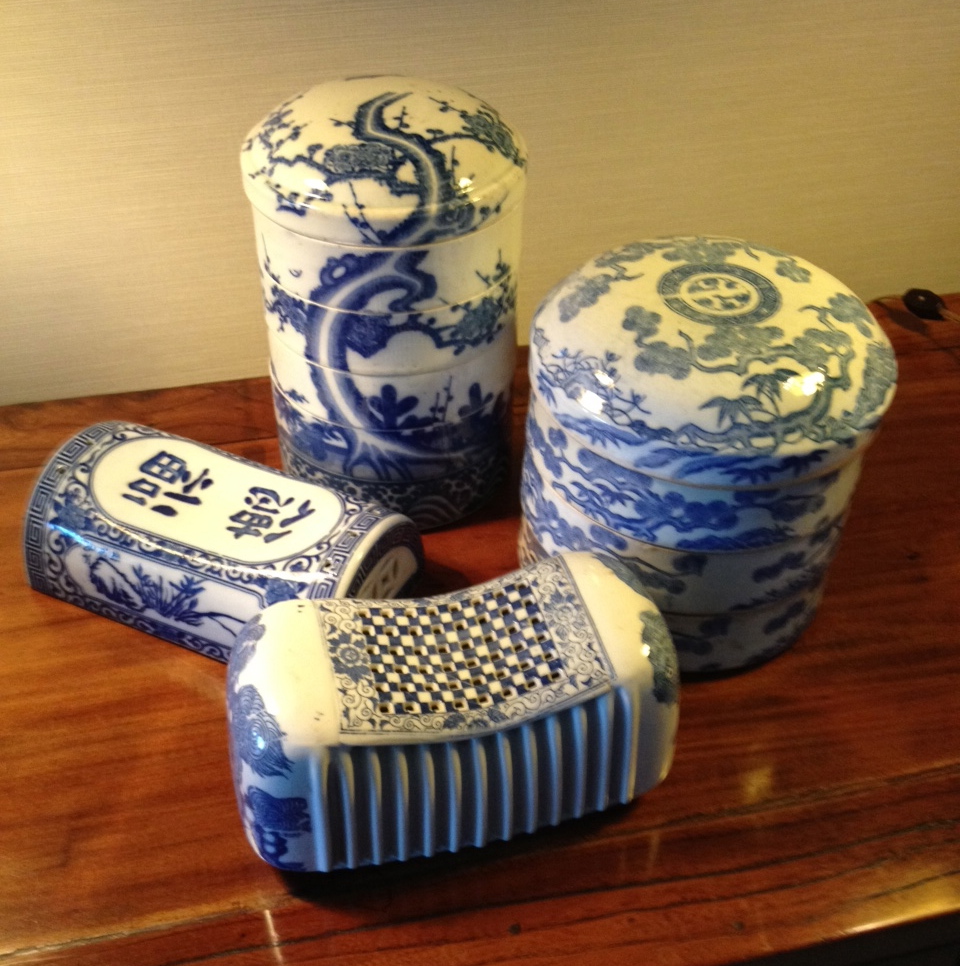
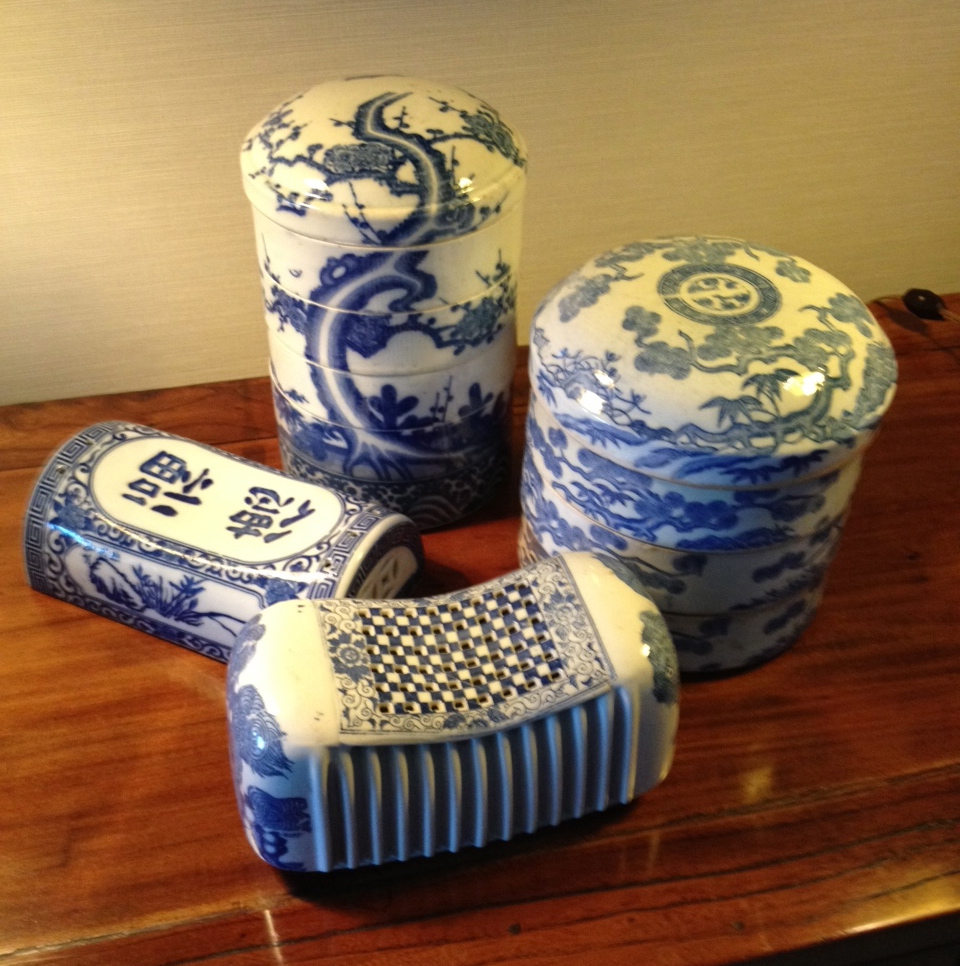
Regardless of their functionality, they are supremely decorative and look great mixed with books in shelves or on their own…

blue white porcelain pillow display

…or combined with other porcelain pieces like these jubako here in a Tokyo entryway…

cate geisha pillows

…or here in a cubbyhole in a girl’s bedroom in San Francisco.

photo

She should be happy they rest on a shelf and that she does not rest on one of them!

N.B. You’ll notice repeats in these photos, but it is not a styling trick. All of these takamakura belong to different people, it’s just that many models were produced on a large-scale. Hand painted ones tend to be older and more individual than the inban, or transferware, versions.

Vintage geisha photo, most probably by T. Enami via Geisha Moments Facebook page.  Thanks to everyone else who provided photos for this post.

About these ads

Read Full Post »

Seto jubako

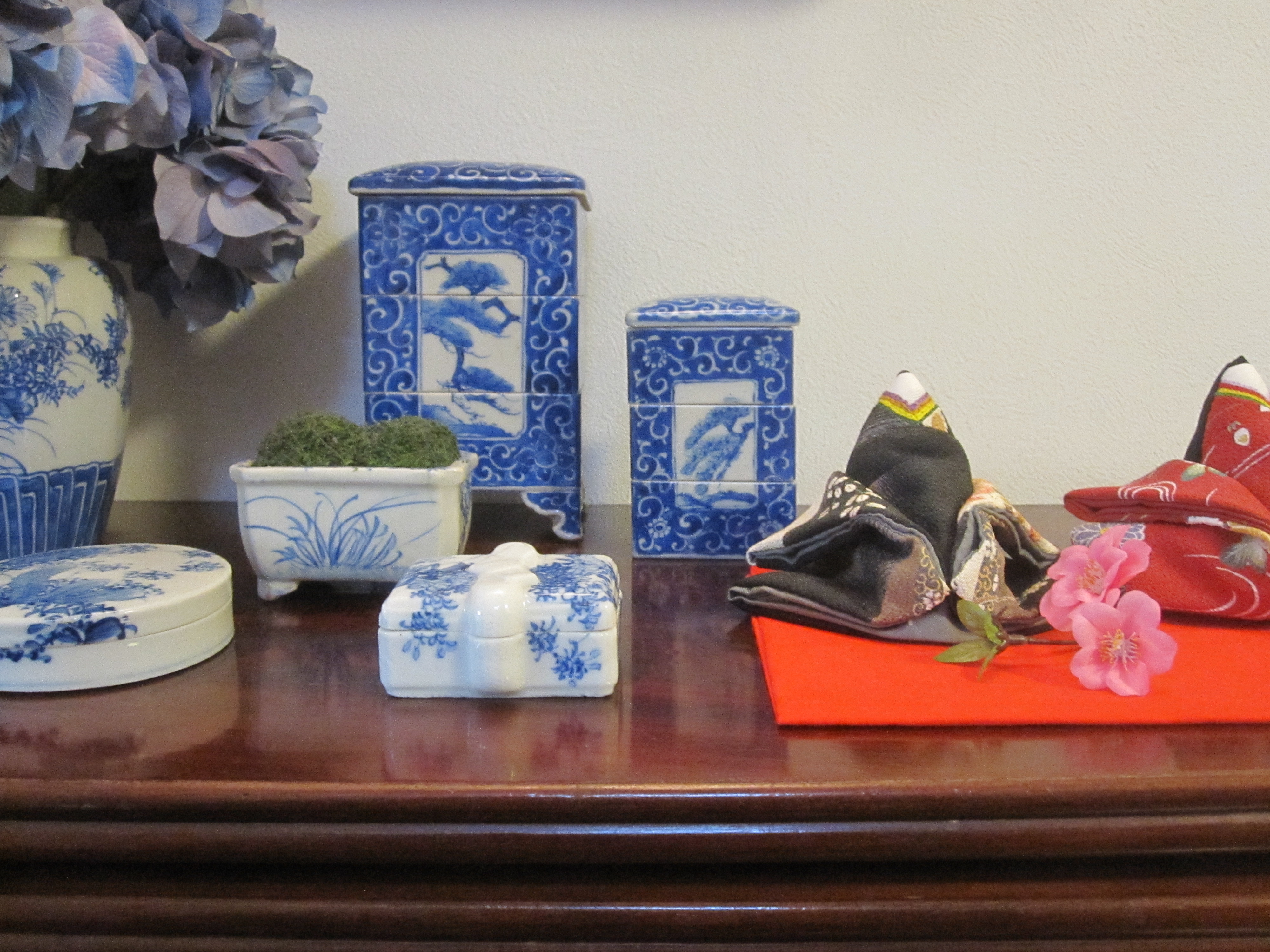
An absolute favorite of mine, porcelain jubako, stacked tiered food boxes, are harder to come across than more standard porcelain shapes such as plates and bowls. That being true, it hasn’t kept me from accumulating quite a few and helping others do the same. I always refer to them as jubako, but it may be that the porcelain ones should be called danju, while the lacquer ones are officially jubako. Shrine sale dealers call them jubako, so for now I will use the terms interchangeably. Personally I’ve never put food in mine. Instead I like to use them for trinkets on night stands, spices in the kitchen and anywhere you need to stash some small valuables.

In my entryway they hold extra keys to the house and car, buttons and hooks that have fallen off jackets and other odds and ends. Mine are unusual in that they are square, much less common than round ones, and the larger one has lovely scrolled feet. The bright cobalt and densely pigmented karakusa (scrolling arabesque pattern) are typical of Seto porcelain, and although purchased at very different times, seem to have been painted by the same artist.  I have enough Seto ware these days that I can see the hand of distinct artists on certain pieces. As for the cloth dolls on the right, they have their own extraordinary tale to tell and will be featured in an upcoming post for Hinamatsuri or Girls Day.

Seto jubako

Over the years I have helped to put together numerous collections.  It seems once bitten by the jubako bug that one is never enough. They look wonderful grouped together or mixed in with other porcelain. It’s always important to vary shapes and heights as well as the density of pigment and painted motif. This collection of five hand painted Imari jubako has a lovely balance of stylized and naturalistic motifs.

Imari jubako

This collection is used in the bathroom to hold cotton balls, Q-tips, make-up, make-up brushes and jewelry. Again note the variety of height, shape and painting style. The three outer cases are inban, Japanese transferware, while the two center ones are painted in a naturalistic style.

jubako

This trio represents three very different styles and eras and you can see those differences reflected clearly in the various shades of blue pigment.

jubako2

Here jubako are mixed with two geisha pillows, the porcelain neck rests used for preserving elaborate coiffures when lying down. I think there will have to be a post on those in the near future too.

jubako and geisha pillow

Blue and white jubako aren’t the only porcelain types out there.  I have a weakness for the prettily painted Kutani ones. This style of Kutani ware isn’t the densely pigmented and almost brocaded paint commonly associated with the best pieces from that region. (It occurs to me that I have never properly written about Kutani porcelain, so that will be added to my check list for spring.) Instead, they have a soft painterly naturalistic style.  The little sake cup warmer in the center makes a great votive candle holder.

kutani jubako

For all the thousands of ginger jars we see each month in the design press, I have almost never seen jubako featured, other than this one in John Anderson’s New York home.

jubako John Anderson

But recently I spied a lacquer one in this Vincente Wolf designed apartment on the January cover of AD – you can just see it on the table in the center of the room. While I am drawn to the porcelain jubako, the most common material they are made of is lacquer and examples of antique and new ones can be found everywhere.

architectural-digest-january-2013

They are used for traditional osechi ryori (New Year’s food) which is served room temperature in the layered lacquered boxes. For more details on the food in this photo check out Savory Japan.

osechi2012.21

The contents and the containers are things of beauty both!

Read Full Post »

I know I have written about selective perception here before, but I had a major case of it just a few days ago at the Kawagoe shrine sale. In 8+ years here in Tokyo I have only see a few handfuls of ami or fish pattern pieces that I wrote about the other day, but somehow everywhere I turned last Wednesday I came across another one.  These small inban (Japanese transferware) dishes had an intricate and very finely patterned net, complete with cute fish swimming around.

ami fish net inban

This lacquer tray had cranes flying by, probably looking for fish to eat.

lacquer cranes fish net ami

And I found a few small dishes like this one with beautiful hand painted nets.

small fish net ami dish

Coincidence? Fate? Luck? Or just selective perception?

Related Post:
Caught in a Net…Ami Pattern on Porcelain and More
Selective Perception…Maekake at the Heiwajima Antiques Fair and Kawagoe Shrine Sale

Read Full Post »

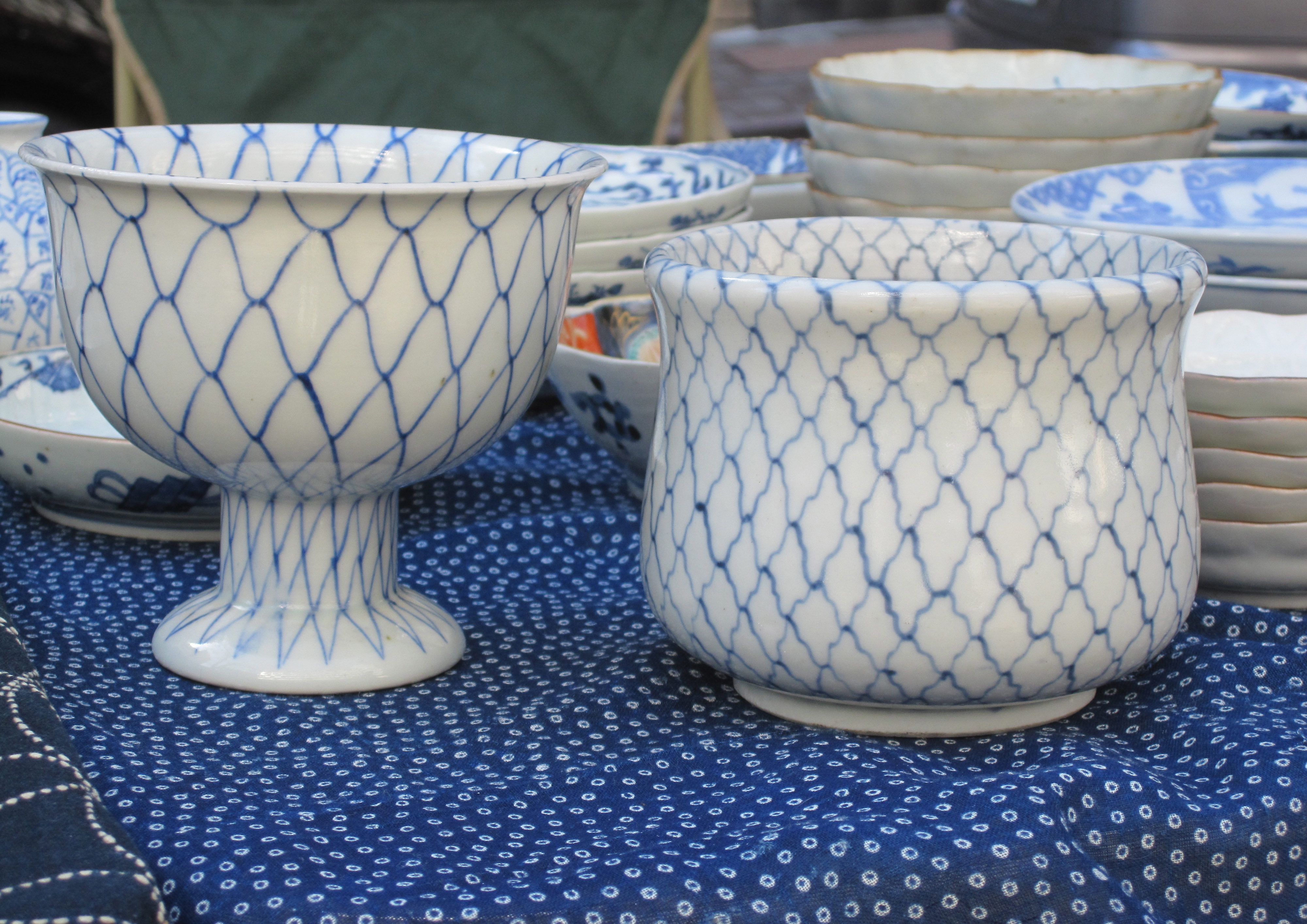
One of my favorite “so ancient and simple that it’s modern” Japanese motifs is ami or fish net pattern. I’ve been tracking blue and white porcelain pieces here at shrine sales and antique shops for years, like this beautiful sake cup washer and hire (like a small hibachi from a smoking set). The sake cup washer has a very linear version of the pattern, while the hire looks almost Middle Eastern in its curvilinear painting, reminding me of these floor tiles! The pattern is common, but rare at the same time, so I always notice it when I see a piece. Not an unexpected motif if you think about how much life in Japan revolves around fish!

Unlike the rounded pieces above, these rectangular dishes show the star-like pattern at the center of the nets and the larger of the dishes even has an open and loosely linked rendition, versus the tighter nets.

Here on this small dish the net is softly and irregularly painted.

Imagine my surprise when ami cropped up in a slightly different form at a recent ladies luncheon with the renowned Japanese food expert Elizabeth Andoh that focused on the art of mixing dishes and plating food.  Out came a rustic but elegant Mashiko pottery plate in the fish net pattern in a glossy copper and verdigris. She called the pattern ajiro, but I think that is actually more of a traditional herringbone style basket weave and that this too is ami.

Just a week or so later, I finally got to visit the Mashiko pottery festival myself, which I haven’t been to in years! I came across a few examples of that same style, perhaps even the same potter to my eye, including this huge spectacular vessel. From my lack of posts lately you can tell life has got me by the ankle and isn’t letting go, but I hope to write more about my experience there soon.

Shortly after that I came across this formal lacquer ware version from my friend Mizue Sasa’s shop Okura Oriental Art - haute couture fish net!

Fish net pattern can be found on much more than just dishes, whether stylized in sashiko embroidery as well as realistically patterned directly in textiles and art. There are a few very famous ukiyo-e featuring actual nets, but I quite like this one by Utagawa Yoshiiku, called  “A Parody of Goldfish with Actor’s Expressions.” It seems the public in the day would have recognized these fish faces for whom they were meant to represent. I quite like that the title is written against a background of fish net.

While I can do without the silly faces on those fish, all this talk (writing?) of fish and fish nets has got me thinking about another project I am working on, the 2013 ASIJ Gala Quilt. Using a background of vintage blue kasuri (the Japanese version of ikat) pieced in a neat but kinda boro style, we are planning on appliqueing a grouping of koi.

The koi will be varying shades of orange and white silk shibori (tie-dye). Here’s a first glimpse of a mock-up to whet your appetite.

We had been talking about some water pattern quilting but now I am thinking that perhaps we want to use the fish net motif, picked out in white quilting thread.  Just loving this idea! What say you Julie Fukuda and Kendra Morgenstern?

Related Posts:
After the Earthquake…Help Rebuild the Kilns at Mashiko
Guest Post…Visiting the Mashiko Pottery Festival
The ASIJ Quilt…Summer Breezes: Furin in the Rock Garden
Coming Full Circle…A History of the ASIJ Gala Quilt

Read Full Post »

“In Japan, sake has always been a way of bringing our gods and people together. In some of this country’s oldest texts the word used for sake is miki, written with the characters for ‘god’ and ‘wine.’ People would go a shrine festival and be given rice wine to drink, and they would feel happy and closer to the gods.”
-Tetsuo Hasuo of the Japan Sake Brewers Association in The Japan Times

Komokaburi, the straw-wrapped cypress kegs used for transporting sake are a common enough sight in Japan, especially the stacks and stacks of empties found at shrines, the only remains of ceremonial donations.

The shape, rope and ornamentation have remained pretty constant over the centuries, with the main difference between them being the logos of the different breweries.

While I like the regular barrels, I am particularly fond of the much rarer porcelain ones, modeled for all intents and purposes to look just like the wooden ones, including simulated molded ropes holding the straw wrapping in place. During the Edo period, rural sake brewers needed a method of transporting their brew to the large cities. These large porcelain casks could be carried on pack horses or transported on special ships called taru kaisen or cask ships. Until the 1940’s, they continued to be used to dispense draft sake in shops. Customers would come into the shop with their own smaller ceramic bottles and have them refilled with their favorite brand.

On this beautiful pair you can really see the simulated wrapping and ropes raised in the porcelain.

Here the molded ropes are a different woven style.

Good examples will have their original stopper tops and perhaps their bamboo wrapped handles. Decoration tends to be simple blue on white, with occasional additional details picked out in color, like the green pine needles above, or even occasionally other colors added to simple images related to the brewery, as in the case of the jug below with its charming waterfall.

The back sides tend to be pretty simple, with additional information picked out in blue kanji. I have never seen color on the reverse.

Large jugs are the most common, but I have found some smaller ones, including these two decorated with very graphic stars. I have been experimenting with photographing objects lately and I really like how these play off against the indigo blue background.

Porcelain sake barrels look great nestled into arrangements with other casual porcelain pieces.

A common modern-day adaptation is to wire the jugs and turn them into lamps, which is very attractive and functional.

Sig Bergamin, whose eclectic interiors chock-full of color I have featured here before, has a sake jug lamp interspersed with other blue and white treasures. We can only see the simple back side of his jug in this photo. Try as I might, I couldn’t come up with a picture from the other side.

Another sake jug lamp peeks from the corner in a very differently styled room by Jeffrey Bilhuber.


Tokkuri, the smaller Japanese stoneware sake bottles, decorated with not much more that the names of their distillers are also wonderful accents when grouped in a vignette.

They too make excellent lamps. Which do you prefer? A dark shade…

…or light ones?

Tsunodaru, the red lacquer ceremonial horn/two-handled barrels used at wedding ceremonies are less commonly found, but out there nonetheless. Again, note the mock “ropes” carved from wood. They often are offered as a gift to the bride and groom together with lacquered cups as sake is always drunk to mark important occasions. Because it is meant to be enjoyed with friends and family, tradition holds that a person must never pour their own sake; instead another person pours for you, and you do the same for them, which is such a lovely custom.

Can you spy the pair of ceremonial jugs in this London home?

So would you rather drink sake or illuminate your room?

Image credits: 1-3. courtesy M. Wilce and L. Border, 4-9, 14 & 17. me, 10. courtesy M. Small, 11. via Joseph Joseph & Joseph, 12. via Once Upon a Tea Time, 14. The Way Home by Jeffrey Bilhuber, photo credit: William Abranowicz, 15. via Antique Lamp Shop, 16. via 1st dibs, 18. World of Interiors July 2010, photo credit: Bob Smith

Read Full Post »

“How objects are handed on is all about story-telling. I am giving this to you because I love you. Or because it was given to me, Because I bought it somewhere special. Because you will care for it. Because it will complicate your life. Because it will make someone else envious. There is no easy story in legacy. What is remembered and what is forgotten? There can be a chain of forgetting, the rubbing away of previous ownership as much as the slow accretion of stories.”

Have you ever read a book, assuming you would like it but not expecting it to completely rock your world? Well that is the way it was for me upon reading Edmund de Waal’s family biography The Hare With Amber Eyes. Numerous friends had recommended it to me, assuming I would be interested in the collection of 264 antique Japanese netsuke that are the theoretical protagonists of the book, which I was, but I had not realized how every bit of it would seem to tie in with my own writing and collecting and that reading it would become a very personal journey.

The story itself is like an onion, with layers that peel away, yet link back up with each other. Sometimes it feels almost too fantastical to be true, impossible that such detailed records remain, that the life of these tiny objects can be tracked so clearly. The netsuke themselves are a conceit, used to tie a multi-generational, multi-national story together. Edmund de Waal, the renowned British potter (who makes Japanese inspired pieces himself) inherits an extraordinary collection of Edo period netsuke from his Viennese Uncle Iggie, who actually lived out his adult life in Tokyo. Yet the netsuke were originally acquired by Iggie’s father’s cousin in Paris in the 1870s, then given as a wedding present to Iggie’s father in Vienna at the turn of the century. As we read, we know that war is coming, so it becomes hard to imagine how they eventually make their way onward, and I will not spoil that surprise. But there is also a kind of magic in knowing from the very beginning of the book that these netsuke are a sort of sick punch line, in that they survive even when people don’t, and that somehow they even make it back to their country of origin over 100 years later.

Netsuke, the tiny toggle sculptures used to anchor small carrying cases called sagemono to a kimono sash (obi) are extremely coveted and collectible, and thus by default, quite valuable. Most commonly made of ivory, wood or bone, these lifelike inch long sculptures are detailed works of art, depicting everything from people engaged in everyday rituals of every sorts, to animals, plants and even mythological creatures. I occasionally see them at shrine sales, more often at the better antique shows - Heiwajima would be a good place to look this weekend – but I think of them in the same category as obidome (the jeweled belt clips which I adore) and tsuba (sword guards). In other words, small and beautiful, but somewhat useless. In the last few days I have been to a few shrine sales and really kept my eyes peeled for them, getting lucky with one dealer who had some in complete sets, strung on cords with their inro (a stacked compartment carrying case) and ojime closure bead. The two examples below demonstrate the range of netsuke, from the simplest disk on the left, to a detailed, although fairly crudely carved figure on the right. Both inro are made of lacquer, with maki-e sprinkled gilding.

The original collector of the netsuke, Charles Ephrussi, the cousin of De Waal’s great-grandfather, was at the heart of the art and salon scene in late 19th century Paris. Originally from Odessa, the Ephrussi’s were one of the great Jewish banking clans, second perhaps to only the Rothschilds, that fanned their way out through Europe in the 19th and early 20th century, establishing places of business and grand houses in France, Austria, England, Greece and elsewhere. Charles was a writer and editor of art magazines and collector of fine works of art. Like many of his contemporaries, he became enthralled with the Japonisme craze sweeping through Europe in the 1860s and 1870s. In addition to his 264 netsuke, he had a collection of 33 black and gold lacquer boxes and an extraordinary group of Impressionist paintings, supporting artists whose names we all know now at the very start of their careers. The list of Charles’ paintings reads like the home runs of the Impressionist world, a forty piece collection accumulated in just three short years. Solidifying his fame, Charles himself appears in Renoir’s masterpiece Luncheon of the Boating Party, the man in the top hat towards the back, and served as inspiration for Proust’s Charles Swann in Remembrance of Things Past.

“I want to know what the relationship has been between this wooden object that I am rolling between my fingers – hard and tricky and Japanese – and where it has been. I want to be able to reach to the handle of the door and turn it and feel it open. I want to walk into each room where this object has lived, to feel the volume of the space, to know what pictures were on the walls, how the light fell from the windows. And I want to know whose hands it has been in, and what they felt about it and thought about it – if they thought about it. I want to know what it has witnessed.”

Just like de Waal, I too want to see exactly where and what the netsuke lived with, to imagine them all crowded into his rooms on the rue de Monceau in Paris, so I could not resist pulling up the images of his paintings, now scattered in the world’s finest museums, to share in just that way. All of the paintings below, and many more that I do not show, had places of pride in Charles’ home.

The most charming story centers on Charles’ purchase of Edouard Manet’s Une botte d’asperges, for which Manet charged 800 francs but Charles sent 1000.

In grateful response to his over-payment, Manet sends on second small painting of a single stalk of asparagus!

The influence of Japanese prints on the Impressionist perspective can clearly be seen in Degas’ portrait of Edmund Duranty, painter and subject both friends of Charles, that hung in his study.

Charles also owned Monet’s Les Baines de la Grenouillère that now hangs in The National Gallery in London.

A personal moment for me, as this painting is the sister to the Monet below – La Grenouillère - which has been hanging in the Metropolitan Museum of Art and long been my favorite Monet. I wrote a huge paper about it for an art history class in college. I wonder if it is packed up in a box somewhere?

He also owned Manet’s Portrait de Constantin Guys…

…and General Mellinet and Chief Rabbi Astruc by Degas. I imagine them all hanging (out) on the wall together, chatting, like the portraits at Hogwarts.

I am not sure if this Degas pastel At the Milliner’s is the actual one Charles owned…

…or this one, or perhaps even both.

Charles owned many works by Degas including In a Cafe, better known as L’Absinthe. Their friendship, and many others, ended over the Dreyfus Affair, as the roots of anti-Semitism in French society became exposed.

At the turn of the century, Charles packed up the netsuke and sent it to his nephew Viktor in Vienna on the occasion of his marriage.  Viktor’s new home, the Palais Ephrussi, was so grand that one cannot imagine these tiny figures making any statement there. And they do not. The netsuke were no longer displayed publicly, instead they were kept in Viktor’s wife Emmy’s dressing room, where the children took them out and played with them as they watched her dress.

Here I will stop the tale for a while and recommend that anyone planning on reading the book should not research any further into the story. As we know who and what is coming, in the form of Hitler and the Anschluss, I will leave that tale to de Waal. I find it all too painful to write about anyway.

And so we return full circle, as not only have the netsuke made their way back to Japan with Uncle Iggie and his partner Jiro as the book opens, but de Waal himself studies Japanese ceramics as a young man, a result of that historical Leach-Yanagi friendship that ties British and Japanese pottery together. In the aftermath of the earthquake last year, the Leach Pottery was quick to start a foundation to help rebuild the historic kilns at Mashiko. And ironically for me, the book opens with de Waal taking Japanese language courses at the very school here in Tokyo that I currently attend for the same reason.“Iggie and Jiro’s life was lived in another kind of Real Japan,” and I like to think that we do too.

Just like Charles and Viktor, Iggie keeps the netsuke in a glass vitrine, a display case, which is another conceit for de Waal’s story and one that influences his own work highly. At first, he thinks vitrines ”exist so that you can see objects, but not touch them.” But what he comes to realize is that “the vitrine – as opposed to the museum’s case – is for opening. And that opening glass door and the moment of looking, then choosing, and then reaching in and picking up is a moment of seduction, an encounter between a hand and an object that is electric.”

I have not been able to find any formal writing on the influence of the netsuke and his family’s history on de Waal’s own work, but it clearly has played a major role. He creates huge installations, full of similar but different pots, often grouped on shelves. Does that sound familiar?

“He is an interesting example of a potter who has not left the studio but has been determined to escape that solitary plinth with its unique object atop. You will all be familiar with his move from domestic porcelain to a series of installations that ‘animate’ (his word) particular interiors and to interventions in museum collections. 1999 was the decisive year in which de Waal arranged his pots in cupboards and on tables in Howe and Lescaze’s High Cross House at Dartington in Devon; he described this as a ‘personal conversation with iconic modernism’. De Waal’s post-plinth strategy is based in part on massing. Thus he references the richesse and generous display of the eighteenth century porcelain room.” (quote from a lecture by Tanya Harrod in 2009)

Edmund de Waal’s place in the lexicon of British ceramics is confirmed by his centrally located Signs & Wonders installation in the new ceramic galleries at The Victoria & Albert Museum. To learn more, there is a great 5 minute video and a wonderful article by A.S. Byatt about them.

De Waal will not allow himself any “melancholy” or “nostalgia about all that lost wealth and glamour from a century ago,” he doesn’t want “to get into the sepia saga business.” But after reading the book I find that I am angry for him and I am surprised at the strength of my feelings. My forebears came from the same places as his. I had a great-grandfather from Vienna on one side and a grandfather from Odessa on the other. My grandfather left Russia in 1917 to avoid the Revolution as he was from well-heeled family – he spoke French and was studying to be an architect – and he worked his way across Turkey, through France and onward to America. But I know little more than that about his story and have no objects to tie me to him. In fact, there are no family objects that tie me to any of my ancestors – the little bit of jewelry that remained was stolen out of a parking lot sometime in the 1960s before I was even born. And the truth of the matter is that I sometimes believe that lack of connection through items is what propelled me into being an antiques dealer. As a girl my favorite books were those where the characters explored their grandmother’s attics, opening trunks filled with clothes and talismans from long ago, feeding a fantasy of connection with those long gone. If you think about it, so many books for kids and teens, even the Harry Potter series, rest on those kind of connections.

I did have an exciting inheritance moment last year though, not long after buying the beach house in New Jersey. I was at my in-laws in Florida, packing to fly up to New York and then home to Japan. I looked up in the guest bedroom closet and saw a group of quilted dish protectors, clearly stacked full of a china service. In the back of my mind a little voice said “those are yours” but I couldn’t imagine what they were. I took one down and unzipped it, while simultaneously remembering that my grandmother had a set that no one needed or wanted when we were forced to move her out of her apartment and into a home. At the time, I couldn’t bear to get rid of them while not having enough space in my New York apartment to take them, so I left them in Florida and forgot about them. As I lifted the dish out of its case, I couldn’t believe it – they were absolutely perfect – having just the colors and soft feel I wanted in the beach house. It was as if my beloved grandmother was right there with me in that moment!

When asked by a neighbor if really the netsuke should stay in Japan, de Waal answers no. “Objects have always been carried, sold, bartered, stolen, retrieved and lost. People have always given gifts. It is how you tell their stories that matters.”

Related Posts:
Artist Spotlight…Dancers, Degas and the Demi-Monde in Yokohama
Artist Spotlight…A Final Dose of Japonisme for the New Year
Artist Spotlight…William Merritt Chase’s Japonisme Interiors

Image credits: 1. de Waal’s netsuke, photo credit unknown, 2.via AW Antiques and Collectibles, 3. me, 4. via The Phillips Collection, 5. via Impressionism Art Org, 6. via Musée D’Orsay, 7. via Glasgow Museums, 8. via The National Gallery, 9. via The Metropolitan Museum of Art, 10. via Wiki Media, 11. via Wiki Paintings, 12. The Metropolitan Museum of Art, 13. via Wiki Paintings, 14. via Musée D’Orsay, 15. via Planet Vienna, 16. via The Economist, 17-18. via My Mama’s Table, 19. via The Victoria & Albert Museum, 20. me.

Read Full Post »

“There’s No Cultural Divide When It Comes To Design”
-House Beautiful, December/January 2012

Moorish Smoking Room, Worsham-Rockefeller House c1881, Brooklyn Museum

The word Victorian has been rolling around my mind for months, but only partially because that is the official period in which our beach house was built. As an adjective, Victorian means buttoned up and prudish. For most people, when they hear it, they think of ornate embellished houses and furniture, but for me, the word has a different connotation, as seen from a design history perspective. After “trying on” many revivals – Medieval, Gothic, Rococo, Renaissance – in the early Victorian period, the opening of Japan in 1854 , the discoveries of archaeologists in Egypt and an interest in all things exotic and foreign created dramatic new styles in interior design. The Aesthetic Movement in the later part of the 19th century highlighted art in the production of furniture and design for the home, partially as a response against the Industrial Revolution. Maybe it is a stretch to make the comparison, but I feel that for the last decade or so, interior design has been traveling down this same path, only with a much paler and lighter color scheme. For a while, I assumed the desire to weave an eclectic mix of objects from different time periods and nations stood out to me because I was living abroad and doing just that. But the overt prevalence of it everywhere has turned it into its very own style, whether in a modern or traditional context.  Simultaneously, the recent movement towards homemade and authentic goods comes as a similar response to our consumer culture and poor economy.

While not wanting to be overly literal about this idea, the much written about December/January 2012 issue of House Beautiful (the title, by the way, of an influential lecture given by the touring Oscar Wilde in 1882) makes this same point and can be used to illustrate it perfectly. Joni over at Cote de Texas, did an interesting post last month comparing the home below, designed by Mark Sikes and Michael Griffin, with her own (and I thank her for the photos as the magazine is not making them available online), but I am going to use it for my own comparative purposes. The living room, well worth clicking on and enlarging, has influences from around the globe. Blue and white porcelain abounds, from Chinese garden stools to Japanese hibachi as planter, African Zebra skin, French style chairs and a massive gilt console.. The giant antique Chinese lacquer cabinet is the kind of universally useful piece I always recommended purchasing back when they could still be easily found in Hong Kong and China. On that note, you’ll be hearing more from me on Chinese antiques later this month when I do a special series for Chinese New Year week.

Just pages away is another spread, designed by Katie and Jason Maine, whose style proclaims them clearly Michael Smith alumnae, called “The New Global,” featuring an amazing English Japanned lacquer secretary from Therian, a piece that reads similarly to the Chinese cabinet above. Other worldwide influences include an English arts & crafts mantel, Oushak rug, and antique cloisonné lamps, and again, it is worth clicking the photo to see it in detail. Watch for an upcoming post on Japanned furniture too.

Their dining room is an absolute tour-de-force, featuring Indian motif wall panels by Iksel in lieu of…

…the slightly more expected Gracie or de Gournay paper seen just pages before in the Sikes/Griffin home. But in either case, both rooms are an extraordinary mix and actually quite similar in their details – extravagant wall covering, Chinoiserie chairs, statement making chandelier.

I have been following the work of the Iksels for a while, as they represent exactly the kind of cross-cultural trend I am talking about. The living room from their Paris apartment is almost a literal version of a Victorian space, only lighter and softer in color.

And I have always loved this tented bedroom from the apartment, and shown it before here.

Ten years ago, few people had heard of ikat or suzanis. Now there is not a photo spread to be found without them or some other ethnic textile, whether in small doses…

…or large.

Modern design is not left out of the equation either in this project from by Pamela Shamshiri of Commune Design. While using a different set of diverse objects and styles, the mix is still there. It kind of cracked me up that the magazine has full on re-discovered the Japanese aesthetic of wabi-sabi, the beauty of things imperfect, impermanent, and incomplete, although in their desire to throw the term around (they use it at least three times) I am still not sure they truly understand the meaning. The house has the “weathered, organic” feeling they describe, but every detail is utterly and absolutely perfect. For some authentic local wabi-sabi, look back here. That said, the house is beautiful and there is as much going on in this dining room as those above.

For local folks, I’ll be tracking down some modern icons like the Wegner Wishbone chairs above in an upcoming “Shop Talk” post on the mid-century modern antiques and furniture available along Meguri-dori.

Again, the warm rugs, kilim pillows and other global textiles are the perfect counterpoint to all the wood.

The rooms most directly referential to Japanese design are the kitchen (and if you like this you might want to look here)…

…and the bath.

For the full article with more photos, click here. Interestingly enough, this house is shown as being a 2008 project in their portfolio, making it not that new…And as for not that new, I am sure I saw the February issue already on the news stand as I ran through the airport two days ago.

For me personally, this global aesthetic runs rampant through my Tokyo home and is definitely starting to appear in the beach house. I only had a few days in New Jersey over winter break, but managed to move a few projects along and here are a few sneak peaks. Our bedroom is shaping up – remember how I said there isn’t a photo spread without a suzani? We are using a long narrow one as a window valence.

The guest room is still waiting for its lampshades…

…but a bargain vintage find, sent off to be reupholstered will go from hideous yellow moire to lovely linen floral (draped for example in the photo). Guest room chair checked off my list!

Downstairs there is a little Belgian meets Scandinavian meets English floral prettiness going on, but it is temporary, as my Bunny Williams OKL purchase is slated for the kitchen.

I wish I had more to report on from the house, but three days right before Christmas is not a lot of time…More details on these rooms soon!

Here’s to 2012!

Related Posts:
Some Resolutions for 2011 and Bamboo in January

Image credits: 1. via Brooklyn Muesum, 1,4, & 7. House Beautiful December/January 2012, photo credit: Amy Neusinger, via Cote de Texas, 2-3, &8. House Beautiful December/January 2012, photo credit: Victoria Pearson, 5. Elle Decor December 2006, photo credit: Simon Upton, 6. Domino February 2008, photo credit: unknown, 9-13. House Beautiful December/January 2012, photo credit: Amy Neusinger, 16-18. me.

Read Full Post »

Some antique stores always have primo stock while others are of the hit-or-miss variety. Yamamoto Syoten, a neighborhood antiques shop in Yoyogi-Uehara is the latter. A few visits will yield nothing of interest, and then “kapow!” and you want to buy the whole place. I had been hearing about it from local friends for years, but not actually visited until these past weeks, when I went with friends who are leaving Japan this year and want to stock up on memories. The key to visiting such a shop is a discriminating eye to help you sort through the mixture of vintage, truly antique, not actually old and just plain junk. Japan is not the only country that abounds with shops like these – they can be found all over the world -and they make for some of the most fun shopping around.

One thing found in abundance at Yamamoto Syoten is tansu (Japanese chests). Stacked 3 high in some places in the shop and arranged in tight rows, it is difficult to get a good look at them. I was happy there were no aftershocks while we were in there because I worried they would topple over on us. In addition to large mizuya tansu (kitchen cupboards) and iron strap isho tansu (clothing chests), they also have a large selection of smaller decorative burlwood tansu from the 1930-1940s era. Prices are reasonable and condition is good, although perhaps not excellent. In addition they had lots of vintage lighting, wonderful bevel-edged framed mirrors, piles of porcelain hibachi and many other bits and bobs. The tight quarters made photos difficult, but you can get the flavor of the place from these.

Perhaps the best way to show you what can be found is to highlight my friend’s purchases. She came through and plucked the best pieces and that is the way it always works with stores like this. It will take a while for them to recharge, at least on items like the ones below, but remember, every customer has their own eye, so you may see your own jewels there.

Neither of the light fixtures show to advantage sitting around back in her house. The wooden one on the table cast a soft glow when lit, with patterns coming through the fretwork. The larger iron and glass chandelier will be perfect hanging in her breakfast nook back in Atlanta. And the ceramic geisha pillow (used to preserve elaborate coiffures) is a great conversation piece.

My friend also purchased a big mizuya tansu with some nice details, a rustic ladder on which she is planning to display her vintage quilt collection from India and two huge blue-green glass bottles like mine that she will have turned into lamps when she gets home. And of course there is the requisite glass fishing float too. Sometimes I wonder if I have accomplished anything with this blog other than to turn all of the Tokyo expat community fishing float crazy!

She bought two huge senbei (rice cracker) canisters as well which I forgot to photograph, but they looked much like the big rounded ones in this photo. And don’t forget, I got my fabulous and funky green lamp shade there too!

Read Full Post »

Sho-Chiku-Bai. If that name doesn’t sound Japanese to you, then you have a good ear, as it is actually the Chinese reading of the Kanji characters 松竹梅. In Japanese, they are read matsu (pine), take (bamboo) and ume (plum) and they form a threesome as one of the most popular decorative motifs the “Three Friends of Winter,” representing promise and good fortune. Together, they stand for the scholarly ideals of pure spirit (plum), longevity (pine) and flexibility (bamboo).

One of the most common places to find them is on Japanese porcelain, often in a very stylized form, so that you might not even notice they are there. This old Imari pattern is extremely common and at first glance there is no real sign of any botanical motifs.

When you look closely at the design in the round, the two trunks of the pine and the plum and the bamboo pole become visible. This central motif has been repeated on versions of this pattern for centuries and continues to be very collectible.

I’d say about a third of the traditional polychrome Imari patterns with a central roundel have our three friends in the center. Close-ups of the photos highlight the details and the difference between the blue underglaze and the enamel and gold overglaze.

So similar to the one above, yet oh so different!

Notice the different manner of painting the pine on this dish – the spiky needle style instead of the puffy bush style.

The Three Friends of Winter are also a common motif on Japanese transfer printed blue and white porcelain. Transfer printing was invented in England in 1756 and is commonly associated with the Staffordshire potteries and the classic “Blue Willow” pattern. This process was developed as an inexpensive way to recreate the characteristics of the hand painted underglaze blue ceramics of China and Japan. Ironically, transfer printing does not become popular in Japan until the late 19th century, but modern-day markets abound with transfer printed pieces that show it eventually did. Often very inexpensive, they are a great purchase as they have more character than modern blue and white. Patterns are often standardized (like this stylized Sho-Chiku-Bai dish) so collecting a particular one is easy – or they are fun to mix and match.

This small covered dish is also transfer printed, with the plum and bamboo encased in fans (a common design device) and the pine in snow, represented by the ruffled circle surrounding it.

This small dish has a naturalistic rendering.

The Three Friend of Winter are not limited to porcelain. They can be found on lacquer…

…and here is a set of three kashigata (sweets molds) in the motif.

This paste-resist dyed indigo cloth takes a different approach, blending the naturalistic pine and plum with the stylized kamon for bamboo. The process is called tsutsugaki (literally, tube drawing) as rice paste is squeezed from a tube to draw the design, much like a giant crayon. The cloth is subsequently dyed and then the rice paste is washed off. This antique futon cover dates to the late 19th century.

Same for this one.

A more formal version can be found on this brocade fukusa. Popularized in the Edo period, a fukusa was used to “wrap” a formal or important gift by being draped over the box or tray on which it was presented. The Three Friends are a very common motif on fukusa as they represent such good wishes to the recipient as well as the New Year.

Speaking of important gifts, how about this set of watches from Vacheron Constantin? They have paired up with Zohiko, a 300+ year old lacquer maker in Kyoto to create these limited edition maki-e (literally, sprinkled picture) timepieces, embellished with Sho-Chiku-Bai. I am not sure what you do with three and at $335,000 for the set, I don’t think I’ll be getting them anytime soon. But interesting, desu ne (isn’t it)?

All of these example came from the Antique Jamboree held at Tokyo Big Sight the weekend of January 8-9th. And for more on the symbolism of these three friends, see Kadomatsu…A Traditional Welcome for the New Year.

Image credits: All images by Jacqueline Wein except Blue Willow platter: marks4antiques.com, and Vacheron Constantin watches: via House of Pens

Read Full Post »

Last month’s posts on Japanese furniture in the White House and Imari porcelain lead me right to my next subject - Michael S. Smith, designer extraordinaire and decorator to the Obamas.

Michael Smith first imprinted himself on my consciousness with the apartment he designed for Cindy Crawford in the Police Building in New York City.  I still have the entire Oct/Nov. 1997 issue of Elle Decor because I could not bear to tear out the pages. The apartment impressed me so much because it reminded me of my own – both the physical space and the look I was trying to achieve in decorating it. Smith seemed to bring a fresh view on using classic antiques paired with ethnic textiles and touches.  I knew he was a talent to watch and I have early tear sheets of the homes he decorated for movie producers, actors and other Hollywood royalty in my files, including the first home Smith designed for actor James Belushi. This November, Architectural Digest featured Belushi’s new California home designed by Michael Smith, of course, but I think I like the smaller original one better!

Smith studied art at University, then worked briefly for antiques dealer Gep Durenberger and trained under John Saladino for a few years. You can see the Saladino influence on his designs, but whereas Saladino is more of a pure classicist, Smith adds the layering of traditional English country house style to his projects. When Saladino works with fine antiques, there is curatorial aspect to his perspective, art objet versus furniture. Smith’s interiors appear as though all the fine things are really used. After working with Saladino, he opened a home furnishings store in California.  I imagine that is how he met all his early Hollywood clients.

As Smith mines deeply the lexicon of Japanese decorative arts, from furniture to folk craft to lighting, I thought it would be great fun to try to source the items in some of his interiors. I tried to stay local, but occasionally had to resort to the internet (and even use a piece of my own). First up is his New York apartment, featured in Elle Decor. The standout piece is the isho tansu (clothing chest) in the right hand corner of the living room. Also note the Japanese style blinds and the covered Imari urn on the left hand side bookcase. I’ve written so much about Imari porcelain lately, that I won’t post another photo here…

Here is a standout Sendai region tansu very similar to the one in his living room.

Next up are the door panels mounted to the wall in his entry hall in Manhattan. The grill work pattern is a classic, one of the most common Japanese motifs called seigaiha or seikaiha (English translation spelling varies). Used extensively throughout the decorative arts on textiles, ceramics, etc., it is also often seen on exterior buildings and walls. My best match up is a similar door with an overlayed circle pattern called shippou-tsunagi (seven treasures pattern).

Smith seems to enjoy using Japanese pieces in his own homes. Moving on from Manhattan to his home in Bel Air, also featured in Elle Decor, we find traditional low tables used in the living room and sunroom.  These tables were not originally made to be used as coffee tables - sitting on the floor was the norm, therefore the low height. Some smaller low tables were used for altar displays.

Here is an art deco era lacquer low table, combining the curved legs of the table in the living room, with some of the color and fanciness of the table in the sun room.

The blue and white porcelain in the Bel Air home is just gorgeous (as are the peonies)!  I love the repurposed vase lamp, but it is the moon flask vases which are particularly special.

I’m cheating a little here and sourcing from my own house…

Michael Smith also has (or had) a house in Santa Monica. I wish I knew the date on this photo spread but I didn’t mark it down when I tore it out. I do know it is quite early and I imagine he no longer lives here. For me, this represents California casual decorating at its best. The plain silvered byobu (screen) behind the sofa reminded me of this lovely plain screen I saw at an antique show last month. 

Rather than focussing on the gilt and wood cabinet in the hallway of a London project, I thought the unusual placement of a wood and inlay hibachi (charcoal brazier) as an accent piece on the floor was ingenious. This is an easy piece to match. Found at shrine sales and antique stores, it simply is a matter of picking size and design. I saw an inlaid hibachi with hydrangea once and passed it up. Now I am waiting to find another.

The amazing lacquer trunk under the table in this next photo challenged me and I couldn’t find an exact match nor could I stay local. Instead, I have gone to the Naga Antiques site and pulled up this lacquer samurai armor chest. Note the blue and white vase lamp here too.

One of his most beautiful projects is this Malibu home featured in the October 2009 Elle Decor. I find it to be less English country house and the most ”Saladino” like of his recent projects. The bedroom has such perfect proportions and symmetry, with its John Robshaw bed and gorgeous inlaid small tansu on stands used as the night tables. Blue and white lamps too!

I couldn’t find any lacquer ones right now, but these small chests on stands are not hard to come by.

I used the kitchen in this house in one of my earliest posts and I keep coming back to the perfection of this room. The sleekness of the modern streamlined kitchen combined with the rustic mizuya tansu (kitchen cupboard) and those amazing pre-WWII light fixtures hanging from the wooden ceiling beams. I found a second view too, highlighting the gorgeous metal stove hood and a small collection of bamboo baskets on the upper shelves. This tansu here looks to be late 18th century, while most readily available today are late 19th century, like the one sourced below. The light fixtures in the photo are fabric stretched over a metal frame. I have sourced some milk glass ones from the same period with metal detailing on the outside.

Michael Smith’s interiors are unusual in that he weaves in Japanese antiques in almost ever project he does – rare in the decorating world we see published in the glossy magazines.  Testament to his greatness is the way they fit seamlessly into the eclectic melange he conjures.

Image credits: 1 & 3. Elle Decor April 2010, photo credit: Simon Upton, 2, 4, 12, 16-17 and 21. Kanarusha Antiques, 5-6 and 8. Elle Decor, photo credit: Simon Upton, 7. Edo Arts, 9 and 20.  Okura Oriental Art, 10. me, 11. Metroplitan Home?, date unknown, 12. Michael S. Smith, 13. Not sure of attribution here, please let me know, 14. Naga Antiques, 15 and 19. Elle Decor October 2009, photo credit: Simon Upton, 18. via Chinoiserie Chic.

Read Full Post »

Older Posts »

Follow

Get every new post delivered to your Inbox.

Join 405 other followers

%d bloggers like this: