Feeds:
Posts
Comments

Posts Tagged ‘vintage’

I am having another round of selective perception. Do you know the feeling when you notice something once and then next thing you know it is just everywhere? That has been the case with vintage Japanese maekake, the heavy cotton aprons, usually dark indigo in color, historically worn by staff at small manufacturers and breweries. These days they are retro-chic with the young set, being worn by staff at cool izakayas (simple food and bar restaurants). They have almost a denim feel and the waist ties are a thick woven double-sided cotton, often bright orange. Their simple but strong graphics caught my eye again and again at the Heiwajima Antiques Fair last week.

Many are around the fifty year old mark. You can often tell more specifically by the old-fashioned telephone numbers or styles of writing.

One idea on how to reuse the maekake, besides the obvious original intention, is to turn them into visually graphic pillows like these in Paul Ludick’s living room made from simple kamon (japanese crests) banners.

But the best idea by far is one I don’t have a photo of. Aaargh! Much to my chagrin, I was too busy talking to a lovely gentleman at the fair about his handmade maekake tote bag that I forgot to take a photo. (Hmmm….seem to be doing a lot of that lately). Anyway, he (or actually his wife) had sewn a bag out of a vintage apron and it was great looking. The zipper pocket in this one got me thinking about making one for myself – perfect for a cellphone or a couple of bucks (or should I say yen?). I didn’t end up buying any but went home stewing on the idea.

A few days later the Kawagoe market was full of aprons too.

I found a fabulous and unusually colored faded green one too, but another young woman browsing seemed to want it so desperately that I gave it to her. I found more joy in her happiness than I would have had in purchasing it.

My favorite dealer was wearing one exactly as it should be worn! I noticed other dealers wearing the sturdy aprons too.

So if fate was surrounding me with aprons, then I was clearly meant to buy one. I found a really cute small one with an outside pocket and a great design. I am pretty sure it is from a sake brewery.

Stay tuned to see the finished project!

Speaking of indigo bags, my friend Jane Farrell has been sewing absolutely beautiful patchwork and sashiko totes. I am going to try to have her work for sale sometime soon!

And speaking of selective perception, the aprons are not the only things that have been clubbing me over the head. Remember those great vintage shoyu (soy sauce) bottles I just wrote about?  I had never particularly noticed them before either, yet I saw them everywhere at the Oedo fair with Peri Wolfman and also at Heiwajima. Definitely different bottles and different dealers too!

Continuing off the topic, but still kinda on it, hop over to the post I wrote this summer about Wedgwood jasperware cheese keepers. Had a huge spate of selective perception there too so I added a big addendum to the post!

Image credits: all photos mine with the exception of the Elle Decor December 2006, photo credit: William Waldron, and Jane Farrell bags courtesy of the artist.

About these ads

Read Full Post »

The Oedo Antiques Market is a jewel. While it lacks the charm of being on the grounds of a temple or shrine, it makes up for it by being held in the shady courtyard of the Tokyo International Forum at the convenient junction point of Hibiya, Marounouchi and Yurakacho. While it tends to be higher along the antiques food chain and thus higher priced than a conventional shrine sale, it makes up for it by having some of the best quality merchandise to be found. Held on the first and third Sundays of the month, and the fifth Sunday is there is one (like there will be this October), it is one of the most pleasant antiquing experiences to be had in Tokyo.

Luckily for me, Peri Wolfman of Wolfman-Gold & Good fame was in town visiting her niece, my friend D. For more on Peri, see my previous post. This past Sunday I took them to shop the Oedo market and we all had a wonderful time and bought lots of goodies. The entire day was colored by Peri’s aura, meaning it was black and white. We looked at and bought nothing frou-frou or fancy. No blue and white porcelain, nothing gilded. Everything was simple, streamlined, functional and lovely because of it. I did mean to take so many more photos chronicling the day. Photos of what we looked at, what we liked, you name it.  But sometimes you have to live just to live, not live to blog, and Sunday was such a day. I was too engaged to even remember to pull out my camera half the time, so I can only show you a record of what we actually bought.

First up were these bowls by ceramicist Ando Masanobu. As I am not familiar with his work, I did a little research and found this description in the online edition of Kateigaho magazine (which you should be reading if you are at all interested in Japanese arts and culture). ”Perhaps the most fitting description of his pottery, reflecting a balance of sensibility and philosophy, is the word refinement. The striking forms of his solid white or black semi-matte vessels bear minimal ornamentation.”  No way to say it better than that. I do wonder how these bowls ended up down in Tokyo, but the karma was perfect because they were meant for Peri. As a pair, they also display one of her golden rules, which is never buy ”onesies”. Multiples are king!

Ando also runs a gallery called Momogusa in an old minka (farmhouse) that he moved to in Tajimi and rebuilt. Besides his own work he exhibits ceramics, glass, washi, textiles, and so on by other artists. Looks like it is worth a visit!


These were quintessential Peri – a group of Edo period pottery stacking bowls – albeit the largest one was the size of a golf ball. Scale is hard to show in this kind of close-up but consider the grain of the matting underneath and it gives you a sense of their tiny-ness. Peri is currently developing a line of tableware for Restoration Hardware –  the reason for her visit – and stacking items are definitely a part of it.

We almost overlooked the military dealer – you know the one who has all the Japanese army uniforms and sometimes other creepy stuff – there is always one like that at every market. Luckily these caught our eye and we stopped. These are old mess hall dishes made of white ironstone from the days before plastic. The small deep bowl is meant for tea.

And of course it wouldn’t be Peri without some white ironstone pitchers.  These look French, but the marks are actually Japanese. Wonderful shapes! And shown perched on one of a pair of rustic children’s chairs bought too.

We both got amazing little black and white woodblock prints. One for her…

…and one for me.

These metal clip on sconces may not look like much here, but let me tell you they are dynamite! Painted green metal with wonderful patina and best of all, they don’t require any holes drilled to hang them (which is a big issue in Japanese rentals, let me tell you). Just clip ‘em where you want ‘em.

Imagine them like these in this dreamy Jill Brinson designed bedroom.

Simple bargain frames made of sakura (cherry) and bamboo came home with us too. Peri thought the speckled paper under the glass of the rectangular one was so pretty it could be used as a tray instead.

Peri is all about storage (just peek back at that Oprah magazine article) and both D and I got some of these charming vintage apothecary drawers to stack on my desk and in her entryway.

What a great day! Peri looking fabulous in her usual black and white while I look as goofy and over excited in this photo as I felt.

Oh, and last but not least, I need to report that the marble-topped pastry table in Peri’s earlier kitchens was sold along with the house…

Read Full Post »

While not quite on par with Dixie Highway, relaxed Nishi-Ogikubo in Tokyo’s western suburbs has a grouping of 60+ antique and vintage shops gathered near the train station. Situated along the Chuo line, Nishi-Ogikubo (nicknamed Nishiogi) was a counterculture hotbed in the 1960s, then receded from notice, only to become popular in recent years as the “slow life” movement has gained steam in Japan. It seems like just the kind of place one would find a collection of quirky and individualistic antique shops.

Conveniently, a free map of the stores is available right in front of the koban (police box) on the left side of the station right outside the North Exit. The map seems fairly current but things can change overnight, so think of it only as a basic guide. Most stores do not open before 12p.m., they all seem to have variable hit-or-miss opening days, and there is not much spoken English to be had, but it is a lovely way to while away an afternoon. Hopefully this post will help steer you in the direction of the best shops!

Organized into four zones, NE, NW, SE and SW on the map, I’ll say right off the bat that the South side of the station has much less to offer than the North side, and can be skipped entirely when pressed for time. The NW zone is by far the best for traditional antiques, so I will start the tour headed in that direction, counter-clockwise around the rough rectangle the walking tour makes.  The shops are numbered numerically on the listing pages, but do not always appear in numeric order on the map.

Actually the first few shops don’t even seem to be listed on the map. After peeking in grape, a small but charming vintage kimono shop with two other locations in the area, our first stop is not Japanese at all. Filled to the brim with lanterns, poufs, silvered mirrors and embroidered slippers, Morocco Marché is one-stop shopping for adding a bit of middle-eastern flair to your decor.

Weaving up and down the small side streets along the main road, we pass a few small shops, including Baby Doll (#60), which is not open, but full of antique and vintage toys and dolls. Moving back towards the main road we come to Les Yeux Noirs (#42), the unquestionable star of the tour, deserving its own individual post (coming tomorrow). Owner Haruko Hasegawa has one of the best eyes I have seen for choosing unusual and rare pieces of porcelain. We were very excited and spent a long time (and quite a bit of money) in her shop. If you are interested in porcelain, this is one of the main attractions and it is well worth the train ride for this store alone.

As we continue along the main road we pass mood (#45), full of groovy 60′s looking used goods. We try to stop into Quilt & Old Textiles (#44) way hidden in a back lane, but they are closed – perhaps to go to the Tokyo International Great Quilt Festival. At the turn in the main road, we come to Kido Airku (#59), a great mixed shop full of smaller tansu, porcelain, textiles and odd and ends. Unusual things there include vintage spool threads, great for using as plant stands or display props. A collection of old iron tea kettles looks great on these.

Some modern shibori dyed textiles.

One of the most interesting finds for me personally were wood blocks, used to print patterns on textiles. I have been scouring eBay for Indian wood blocks for a DIY project I am planning this summer, but hadn’t considered using Japanese ones.  Frankly, I hadn’t realized that in addition to all the stencils, tie-dying and resist techniques used here, that wood blocks are too.  Definitely something to look into more.

Numbers 48,49 and 54 were all the same named shop, Antiques Jikoh, with mainly used modern furniture. The branch at the #49 location was full of heavy oak Victorian and Arts & Crafts era furniture.

My friend H spotted a gorgeous blue and white porcelain “umbrella stand” that she loved there. I was so sorry to have to let her know it was actually a late 19th century urinal. Needless to say, she could not look past its original use.

The next two shops were eureka! moments for me. I have been searching for the perfect vintage milk glass ceiling fixture for the bathroom in the beach house, passing up many individual pieces at shrine sales. Imagine my delight at stumbling across the Teardrop Club (#53). I’ll be dragging my patient husband back there soon. If you too are interested, please note they are open 12-6 and not on Wednesday. More photos here and here.

Rakuda (#51) which means camel, also had numerous vintage light fixtures in addition to ranma (transom) panels, old doors, stained glass and cut glass…

Turning the corner right after Rakuda completes the NW zone. The tour continues east, crossing a small river. Other than the charming Le Midi (#37) full of imports from the South of France, not much else was open. Any visit to Nishi-Ogikubo comes with that risk.

Continuing to the next major intersection the tour turns right to head south back to the station. Most of the shops along this NE section seem to specialize in vintage clothing and used goods. Perhaps because we were getting hungry, they didn’t hold our attention. In the grand tradition of antiquing outside of Tokyo, we ate Indian food for lunch at Ganesha Ghar, right near #31 and the bridge over the river on the map. As would be expected, it was packed! And following shortly thereafter was Amy’s Bakeshop, which billed itself as “NY Style Sweets & Things”. Of course we had to stop!

If you arrive hungry, it might be easiest to head the opposite direction (clockwise from the station) and eat first as shops don’t open until lunch time or afterwards.

We skimmed the shops listed on the map on the South side, but many were closed, perhaps permanently. None stood out this visit but perhaps they merit a second chance.

Nishi-Ogikubo is very easy to get to and quite close to central Tokyo. It is only 16 minutes from Shinjuku and 18 minutes from Yoyogi on the Sobu Chuo line. Taking the Toei Oedo line from Azabu Juban and changing at Yoyogi took a total of 32 minutes. I’d love to hear from anyone who goes, especially if you discover a gem I haven’t mentioned. Happy hunting!

Read Full Post »

So I have to gather my courage to show you the “before” photo of one of the ugliest bathrooms in the world! Unfortunately, the lucky owner of this beauty is me. It is the downstairs bathroom in our beach house and serves as the powder room for guests and a full bath for the guest room. The ceiling is low, the room is dark, and the floor is yucky linoleum. It is tiny and everything is cheap and old – 1970s old, not good old! As an antiques dealer I am always looking for old, wanting patina. This was not it. The challenge was not just to update but to take this bathroom back in time…

In addition to being tiny, the bathroom layout was a straight railroad, which limited the floor space. The shower was a pre-fab 36 inch square, but the remaining unused 7 inches was useless. The opaque shower doors limited the visual size of the room by seeming like a solid wall. We won’t even bother discussing the color, the fittings or that wallpaper border. There were no redeeming qualities whatsoever!

Changes to the original floor plan below include sealing the door into the bathroom and moving it to where the sink is shown. The sink will be relocated to the where the door was. The shower pan will be 42 inches wide and fill the whole back wall. The shower doors will be frameless glass so that the line of vision goes all the way to the back wall, making the bathroom feel visually larger.

The layout of the whole downstairs was one of the problems as well.  The bathroom was entered through the back bedroom/TV room (which was itself entered through the kitchen). Our first step was to change the entrance to both rooms, sealing the kitchen entrance (and gaining a pantry) and turning the doors of both rooms to enter directly into the main house. Here is the back corner under the stairs before the renovation.

Here it is with the two new doors. The door on the left opens into the TV room/extra bedroom. The door on the right is the new bathroom door.

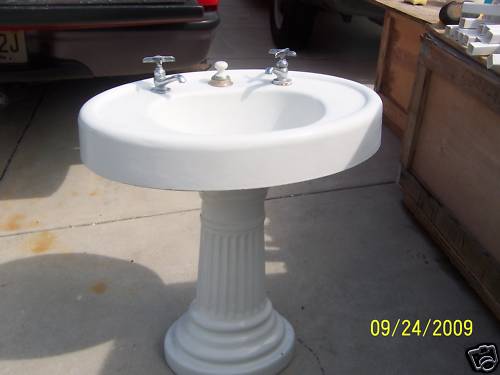
The house is a very simple 1880s Victorian cottage. Neither the budget nor the room itself calls for anything fancy and I want the bathroom to look as if maybe it was always just like that. My inspiration for the design came from a small French watercolor that I love, the historic pharmacy turned ice cream shop in town, and other original fixtures in the house made of aged brass.  I had already bought a salvaged white pedestal sink from the turn of the century in anticipation. So that means simple white fittings – 1 inch white hexagon tiles for the floor and subway tiles for the shower enclosure – and unlacquered brass faucets and fixtures. Planning for Farrow & Ball Pale Powder on the walls, which is the second lightest color in the second column of the paint chart on the inspiration board below.

Natural or unlacquered brass is definitely on its way back – take a look at the droolicious Henry Collection at Waterworks – but try convincing the locals around here. Everybody was worrying about polishing! It took a lot to convince them that I wanted that deep oxidized caramel color and that my only worry was how long it would take to stop being “brassy” looking. The Waterworks collection was both budget busting and frankly, too stylized to suit my house, which was actually a relief to not have to want it! Nickel or chrome fittings also felt too 1920s art deco.

Here are a few photos from my inspiration files. This bathroom had just the kind of exposed shower I was looking for, but the color and the shelves also really caught my eye.  No chance of opening the sheetrock in my tiny space, but I think it is a great idea. Sometimes shells and sea motifs can feel trite in a beach house, but this is charming. It also has a single plain framed window, similar to my bathroom.

This next photo has the hexagon tiles, vintage sink and natural unrenovated, undecorated look I want. We have discussed beadboard to death too, as the house has some original in the kitchen, but in the end, simplicity won out and not the beadboard. Again, space was a big issue and giving up half an inch to beadboard on the walls felt like it would make the room smaller.

The renovation was well on its way when the Dec/Jan issue of House Beautiful came out, featuring a gorgeous Windsor Smith project with this bathroom. While dressier that I plan and significantly more glamorous, this has the closest feel, with thick white molding, a beautifully shaped white tub, and pale wall color. It has a wood floor, not tile, which adds a dark note, which I am hoping to add to my room with a wooden mirror and accessories.

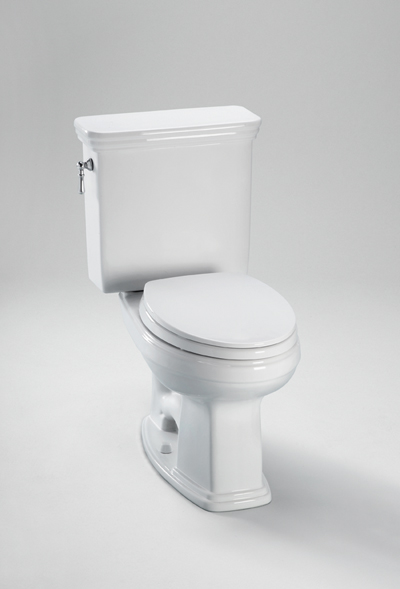
We assembled the pieces – the vintage sink, a round profile Promenade toilet from Toto, which has just the right amount of vintage feeling and is very compact and well priced, an exposed shower from Baths From the Past and an unlacquered brass faucet from Sunrise Specialty to retrofit the sink. I was the only one in the family who voted to keep the original separate hot and cold taps on the sink for authenticity! I also bought a salvaged 24 inch door from Recycling the Past in Barnegat, New Jersey as the original door is too large for the new entrance.

Here is the (almost) finished project. I got into town 3 days ago and was lucky enough to find the perfect mirror at a favorite antiques store (antiquing on the Jersey shore is fabulous – and I am sure I’ll post about it this summer). The frameless shower doors will be installed soon and there is no styling or accessories yet, but you can get the basic idea….

I am planning on small shelves in the cutout above the toilet, like the ones behind the bathtub in the Windsor Smith bathroom. Not sure how long the oxidation will take, but some of the brass is tarnishing already.  I also bought a great vintage brass towel bar for a song on eBay, and that will go up on the wall opposite the toilet.

The bathroom is so light and pretty – even more that I expected – and it feels roomier too. I’d love to hear from you all and know what you think! Styling and accessories will have to wait until the summer as we leave for Florida tomorrow, but it gives me something to hunt for.  Oh, and I am still considering wallpaper (and can pull out inspiration photos of quirky wallpapered bathrooms too) so let me know what you think of that…

Image Credits: 1-5, 9, 13-16. me, 6. via The Lettered Cottage, 7. from Found Style by David and Amy Butler, 8. House Beautiful December/January 2011 photo credit: Victoria Pearson, 10. Toto, 11. Baths From the Past, 12. Sunrise Specialty

Read Full Post »

I like living with my stuff. I feel safe when it’s around.
Judyth van Amringe

Some expats come abroad with nothing but a few suitcases and rent furniture for their apartments or buy everything new again. But we brought everything we owned, lock, stock and barrel, because I am in complete agreement with Judyth van Amringe. I like living with my stuff. And living in Tokyo with my things – gathered slowly and carefully over time –  makes me feel connected to the very fabric of my life when I am so far from home.

Fabric, it seems, is something I cannot resist. Once again, at the shrine sale this weekend, I bought another vintage kimono. I tell myself I don’t need another but their colors, their patterns and the feel of the fabric call out to me. It’s easy to give in as they are relatively inexpensive, costing all of 500-1000 yen ($5-$10). I imagine the projects, the throw pillows, and the dress-up possibilities, both for the imaginary play of my children and for myself. This weekend my friend C actually found a fabulous black lace happi coat (short kimono) at the market and she plans to wear it over a camisole and skinny jeans for a night out.

I really believe there is such a thing as a “magpie gene” and that the desire to collect is inborn in some of us. My younger daughter, who is all of 6 years old, has it for sure. She has dug up a collection of porcelain and pottery fragments from the dirt of all the parks around us in Tokyo and keeps boxes and boxes of them for some future use (Why the fragments are there is another question entirely).  Her eye is good enough that when she finds a piece of the Seto region porcelain I collect, she can pick it out to give to me to add to my collection.  This giant fragment took her a number of tries over a few days to dig up and we are thinking of using it as a doorstop.

Collecting, assembling and re-purposing are inherent to the magpie mentality. Reading Dominique Browning‘s blog Slow Love Life last night I stumbled across scarves made of vintage kimono by artist Judyth van Amringe. Van Amringe seems to be the master magpie - an artist working in many different mediums, switching gears throughout her life. And Dominique Browning herself (formerly editor-in-chief of the now defunct House & Garden) is re-purposing as she explores life in the slow lane. I am looking forward to reading her book Slow Love: How I Lost My Job, Put On My Pajamas & Found Happiness. The title alone is irresistible.

In making the scarves, Judyth combines different fabrics and colors and they are reversible. Sometimes she adds details like beads or embroidery. They sound as interesting as they look in the photos, but I do wish I could see the combination of fabrics more clearly.  This silk ikat positively glows – I’d love to know what she adds to it.

This one has embellishments, with a narrow obi jime (silk cord overbelt) and beads. It may even be a purse as she makes them too.

To my thinking, Judyth van Amringe’s apartment may very well be her “master work”, an accumulated montage of a life’s belongings distilled into a small space. The expression used to describe her place by The New York Times is “artfully crammed” and it is a good one.  Van Amringe brings nothing new in without knowing where it is going and how it will relate to everything already there. Her space feels serene, even though it is jam-packed with objects, most of which she has changed or improved in some way. 

To compensate for a standard boring bathroom in her rental, she layered a huge bookshelf, a hand carved coat stand, an upholstered slipper chair and real rugs. Oh, how I love real rugs in a bathroom, but that will have to wait for a future post.

It looks like a perfect spot for a little birdie to rest…

Photo credits: 1 & 2. me, 3 & 4. from Slow Love Life, 5 & 6. The New York Times, Photo: David Allee

Read Full Post »

Today I went to Tomioka Hachimangu shrine sale for the very first time.  Established in 1627, the shrine has burned and been rebuilt repeatedly over the centuries and is particularly famous for its connection with sumo wrestling. Held on all Sundays of the month except the 3rd Sunday, the market was outstanding today (the 4th Sunday) with well over 80 dealers. Repeat visits will confirm which days are best, as I recognized many dealers who go elsewhere on other weekends.  My guess is that the 4th Sunday may be the best one as there are few other nearby options. I did also meet a number of dealers unique to this market as well.

But today, even amidst all the wonderful Japanese antiques, what caught my eye over and over again were the vintage glass senbei (rice cracker) canisters. Occasionally you see one or two, but today they were everywhere in splendid and unusual variety. These were not the only ones I saw, but I tried to keep the photos to the best ones.

I had never seen a double stacked one before…What efficient use of counter space!

This shape was very rare, being squared off in the back to sit against the wall. The price reflected its scarcity!

Charming art deco styling on this one.

By far the best was this long narrow one. The metal cover is hinged for easy opening and it says “Cake Vessel” on the front. It would be perfect to hold spaghetti or bread sticks.

Modest upon first sight and taste, senbei are an integral part of Japanese food culture. On one hand, they are a basic snack kids love, while on the other hand, they can be sent as elegant gifts and souvenirs. They can be salty when dipped in soy sauce or speckled with nori (seaweed) or sweet when dipped in sugar or honey. There are still many traditional senbei shops scattered around in the nooks and crannies of Japan.  Some have modernized, but others, like Tamaiya in Shimokitazawa, still keep the crackers in glass canisters.

My favorite senbei is from Tanuki Senbei in Azabu Juban. A tanuki translates best as “badger” or “racoon” in English,  but is actually a mythical creature. A giant tanuki stands guard over the entranceway and their delicious crackers are baked in the shape of the animal. Supposedly, the Emperor orders his senbei from them!

Today’s market trip proves what I have been suspecting for a while. There is no doubt or surprise about it, I have country kitchens on my mind…Beadboard, weathered cabinets and butcher’s block, with rows of vintage canisters filled with staples lining the shelves.

A perfectly collated pantry…

Cuteness in a jar!

Tomioka Hachimangu is a few blocks from the Monzen Nakacho stop on the Toei Oedo line and the Tozai line. More details about the shrine sale can be found on the “Shrine Sale” tab at the top of the blog.

Image credits: 1-5. me, 6. via Tokyobling, 7. via Rekishi no Tabi, 8-10. all Country Living Magazine, 8. photo credit: Michael Luppino, 9. photo credit: Steve Gross & Sue Daley, 10. photo credit not listed.

Read Full Post »

Although it has dwindled in size over the last few years, you will usually still find me at the Nogi shrine sale on the second Sunday of the month.  Started in 1976 (more or less) and considered to be the oldest shrine sale in the Kanto region, it still has some excellent dealers, although nowhere near the 40 that guidebooks list. I imagine they get a lot of gaijin (foreigners) as it is one of the most conveniently located sales. I know I often bump into friends. And it was the first sale I ever attended when I moved here 6 years ago.

Today there were 11 dealers – the usual suspects – plus an obi/textile dealer I had not seen there before.  The merchandise all felt high end,  as it generally does there, or perhaps it was just fresh to my eye as I have been gone all summer. Here are some photos of the goodies…

There was a dealer there this morning whom I had seen before but never really stopped to examine her wares. She specializes in ephemera and has the usual prints and postcards, which tend to be romanticized images of old Japan and copies of ukiyo-e.  Today she had an extraordinary collection of matchbook covers from the 1920s and 30s, all carefully mounted in album pages by the original collector.  I was smitten by them all, but limited myself to just a few sheets, which I plan on framing.  Each matchbook cover is in itself an individual work of art, complete in just 2″x1″, but grouped together they were something more. The Taisho era between the World Wars was a time  in which the trappings of modernity were truly embraced, much in the way they were in the West.  Advertising of the era shows the changes in society – cafe culture, women’s liberation and female buying power, rise of the middle class, etc.

Isetan Department Store (the 2 on bottom right) is like the Saks Fifth Avenue of Japan.

These were grouped by design – one page all momiji (maple leaves) and the other gourds.

The stylized figures and art deco colors of the Nozawaya Department store cover overlayed with a traditional style Japanese seal is a great example of advertising art from the era (upper right corner).

A great dated cover for a salon.

Opportunities for travel expanded. Hotels and their bars became places young moderns would “hang out”.

All in all, a truly unusual find today.

Read Full Post »

Follow

Get every new post delivered to your Inbox.

Join 405 other followers

%d bloggers like this: