Feeds:
Posts
Comments

Posts Tagged ‘tsutsugaki’

So I am continuing to love Instagram as it allows me to post shrine sale finds and other interesting items on a real-time basis which is just so satisfying. For those of you who have not taken the leap, I’ve been finding some great treasures for myself recently and I’d love to share them. My blue-green glass addiction is unabated and I found this chubby sake bottle last week.  The two “ears” on either side of the bottle neck would have had a handle running through them originally. I think this one is perfectly shaped to be a lamp, but in the meantime, I will allow him to just hang out with his friends.

blue green sake bottle for lamp

Speaking of lamps, this sake jug with its flowers, unusual in that most rustic jugs just have a manufacturer’s name or mark painted on them like these, is also a wonderful shape for a lamp.

flowered sake jug

I love its implied relation to an American classic, the stoneware jug. It took the floral decoration on it to make me see it that way.

Somerset Potters stoneware jug

Actual lamps have been another find, although I know I paid more than I should have for this purpley-indigo beauty. I have wanted a tiny task lamp for my desk at the beach house and looked everywhere the last two summers for one with no luck.

blue work lamp

It will be absolutely perfect up here, so I had to have it.

hydrangeas in transferware bowl

I also couldn’t resist this minty green metal storage box. Don’t know what it is for or where exactly it will go, but I am sure I will find a place!

vintage metal box mint green

My lavender and blue dreams continue, with the markets fully supporting them. Lavender is not a typical color in Japanese textiles – it really is rare to see it – but I found an extraordinary lavender and blue tsutusgaki furoshiki (a traditional wrapping cloth made with a hand drawn rice paste resist technique) with a soft shibori faded background. I was having trouble convincing myself to buy it (“Do I really need it?”) when I realized I had an item stalker. You know what that is, someone who has spotted something you are looking at and decided they want it, so they follow you around the booth hoping you will put it down so they can grab it. An item stalker always helps to force a purchase!

IMG_2366

Since then I’ve found a length of typical shibori (Japanese tie-dye), but in lavender and blue.

lavender shibori

While I’m at it, here’s another really pretty and detailed piece…

blue shibori

…and did someone say pop of color? Obviously May Daouk‘s living room is still on my mind when you look at these colors together.

pink shibori

My spate of finding incredible Japanese prints – impeccably framed no less – at Kawagoe continues unabated. These small lithographs aren’t stand out pieces alone, but as part of a larger gallery wall, I know they will be fantastic.

IMG_2531

I am not familiar with the artist and haven’t had time yet to research it, but I do love them.

IMG_2533

So have you made any great finds recently? I’d love to hear about them!

Related Posts:
Shrine Sale Stories…Yamamoto’s Steamer Trunk
Shrine Sale Stories…My French Moderne Bar Cart
Shrine Sale Stories…Vintage Matchboxes, Frank Lloyd Wright’s Imperial Hotel and The 1948 London Olympics

About these ads

Read Full Post »

Sho-Chiku-Bai. If that name doesn’t sound Japanese to you, then you have a good ear, as it is actually the Chinese reading of the Kanji characters 松竹梅. In Japanese, they are read matsu (pine), take (bamboo) and ume (plum) and they form a threesome as one of the most popular decorative motifs the “Three Friends of Winter,” representing promise and good fortune. Together, they stand for the scholarly ideals of pure spirit (plum), longevity (pine) and flexibility (bamboo).

One of the most common places to find them is on Japanese porcelain, often in a very stylized form, so that you might not even notice they are there. This old Imari pattern is extremely common and at first glance there is no real sign of any botanical motifs.

When you look closely at the design in the round, the two trunks of the pine and the plum and the bamboo pole become visible. This central motif has been repeated on versions of this pattern for centuries and continues to be very collectible.

I’d say about a third of the traditional polychrome Imari patterns with a central roundel have our three friends in the center. Close-ups of the photos highlight the details and the difference between the blue underglaze and the enamel and gold overglaze.

So similar to the one above, yet oh so different!

Notice the different manner of painting the pine on this dish – the spiky needle style instead of the puffy bush style.

The Three Friends of Winter are also a common motif on Japanese transfer printed blue and white porcelain. Transfer printing was invented in England in 1756 and is commonly associated with the Staffordshire potteries and the classic “Blue Willow” pattern. This process was developed as an inexpensive way to recreate the characteristics of the hand painted underglaze blue ceramics of China and Japan. Ironically, transfer printing does not become popular in Japan until the late 19th century, but modern-day markets abound with transfer printed pieces that show it eventually did. Often very inexpensive, they are a great purchase as they have more character than modern blue and white. Patterns are often standardized (like this stylized Sho-Chiku-Bai dish) so collecting a particular one is easy – or they are fun to mix and match.

This small covered dish is also transfer printed, with the plum and bamboo encased in fans (a common design device) and the pine in snow, represented by the ruffled circle surrounding it.

This small dish has a naturalistic rendering.

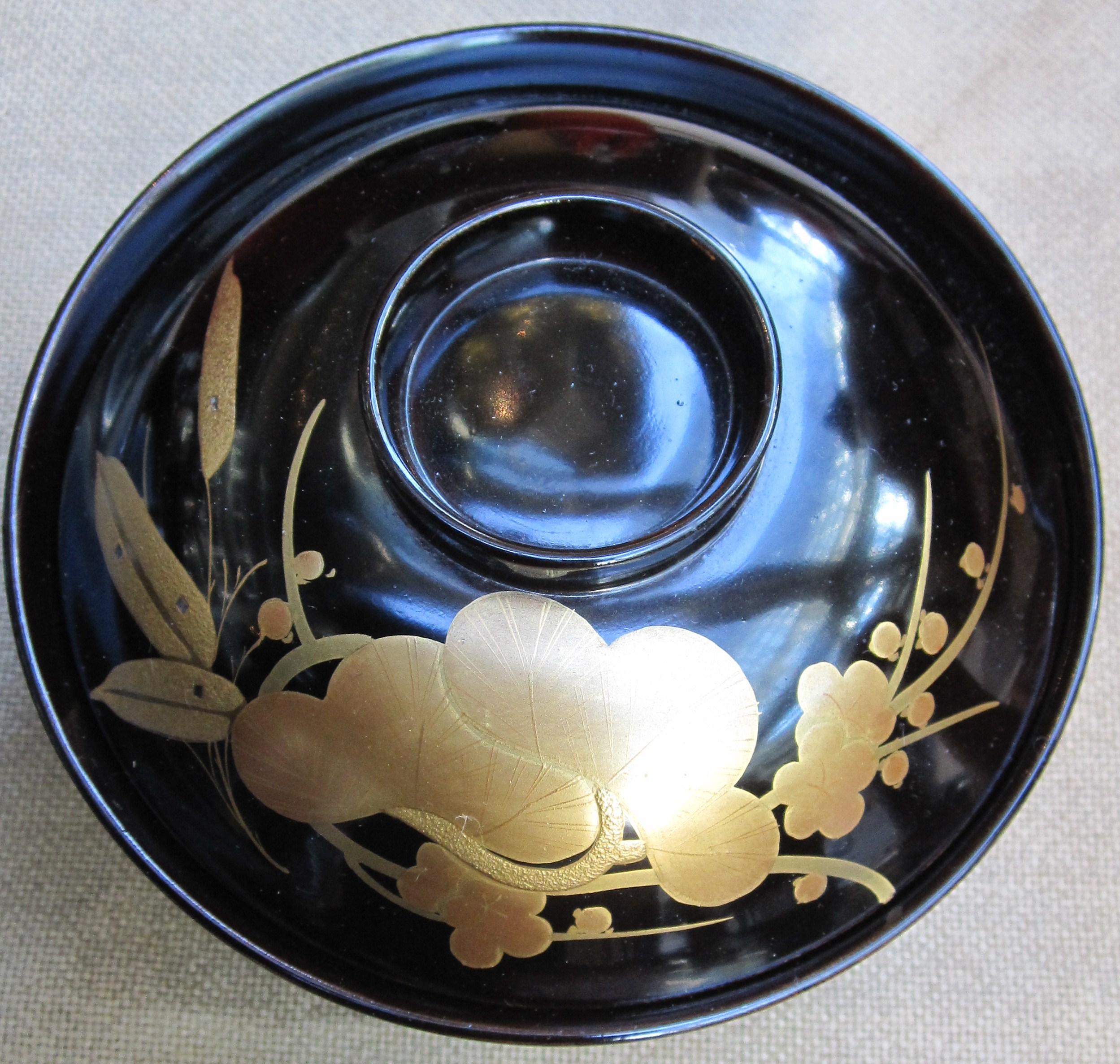
The Three Friend of Winter are not limited to porcelain. They can be found on lacquer…

…and here is a set of three kashigata (sweets molds) in the motif.

This paste-resist dyed indigo cloth takes a different approach, blending the naturalistic pine and plum with the stylized kamon for bamboo. The process is called tsutsugaki (literally, tube drawing) as rice paste is squeezed from a tube to draw the design, much like a giant crayon. The cloth is subsequently dyed and then the rice paste is washed off. This antique futon cover dates to the late 19th century.

Same for this one.

A more formal version can be found on this brocade fukusa. Popularized in the Edo period, a fukusa was used to “wrap” a formal or important gift by being draped over the box or tray on which it was presented. The Three Friends are a very common motif on fukusa as they represent such good wishes to the recipient as well as the New Year.

Speaking of important gifts, how about this set of watches from Vacheron Constantin? They have paired up with Zohiko, a 300+ year old lacquer maker in Kyoto to create these limited edition maki-e (literally, sprinkled picture) timepieces, embellished with Sho-Chiku-Bai. I am not sure what you do with three and at $335,000 for the set, I don’t think I’ll be getting them anytime soon. But interesting, desu ne (isn’t it)?

All of these example came from the Antique Jamboree held at Tokyo Big Sight the weekend of January 8-9th. And for more on the symbolism of these three friends, see Kadomatsu…A Traditional Welcome for the New Year.

Image credits: All images by Jacqueline Wein except Blue Willow platter: marks4antiques.com, and Vacheron Constantin watches: via House of Pens

Read Full Post »

Follow

Get every new post delivered to your Inbox.

Join 404 other followers

%d bloggers like this: