Feeds:
Posts
Comments

Posts Tagged ‘textiles’

Was it this room in the October 2010 issue of Lonny that started it?

Or this one in the November 2010 issue of Elle Decor?

Either way, I don’t know the answer, but it is no longer just my own selective perception. I figure everyone must be tired of ikat and suzani throw pillows, as every time I turn around (or actually, click on a link) I come across indigo pillows, new and vintage, shibori or tie dyed, sashiko stitched, wax-resist dyed, printed and other techniques, all reminiscent of or actually made from Japanese textiles. Not a new topic for me at all, but I do think they have gone from being a rarely seen item to being prevalent and readily available. So if you are not here in Japan where you can stop by a shrine sale and pick up Japanese textiles to sew into pillows, or if you like your pillows ready-made, here’s a look at what’s out there.

There are certain places you’d expect to find them of course…John Robshaw for instance (his room is the top one above).  The website has tie dyed pillows for sale which I won’t call shibori as I believe they are made in India, not Japan.

Jayson Home & Garden still stocks the Zoe tie dyed pillow in the second photo, but unfortunately they are out of the blue and only have it in sage and plum. Don’t despair as Roni over at The Loaded Trunk has a nice selection of hand tied indigo pillows as well as a full assortment of Moroccan, Kuba cloth, Hmong, Afghan, Mexican, Indian – you name it – pillows from around the world.

Here’s a close up of the big 24 inch pillow on the floor in the photo above. It would make a good substitute for the ones in the Elle Decor photo.

Anupama also has a wide range of global pillows, including this typical shibori circles pillow…

…and this more unusual beehive shibori pattern.

Big shibori furoshiki (wrapping cloths) make great floor pillows as shown here by these from Ouno Design. I recently sourced a great furoshiki that designer and friend Maja Smith is making into one for her Lake Tahoe home. Looking forward to photos of that!

One Kings Lane has had some very authentic looking pillows from a shop called Viridian made from vintage tsutsugaki (literally, tube drawing) textiles, a paste resist method of decoration…

…as well as others made using the katazome (stencil paste resist) method from Erin Taylor of Botanik.

There are also some boro (tattered rags) styles too.

Even mainstream retailers are getting into the game. While Anthropologie is no longer stocking the Japanese inspired bedding and pillows they had last year, Serena and Lily, normally so preppy and demure, has been stepping up their game with an online bazaar filled with vintage accessories as well as their line of linens and furniture. They have also caught a bit of that boro fever…

…and have some new Japanese inspired textiles.

Even Ralph Lauren isn’t being left out with his Indigo Modern Stripe Collection, a dip dyed pillow and sheeting set.

Related Posts:
Tie Dye Heaven…Painterly Effects from Monique Lhuillier and Eskayel
A Little Shibori Feeling From Eskayel and Anthropologie
Selective Perception…Maekake at the Heiwajima Antiques Fair and Kawagoe Shrine Sale

About these ads

Read Full Post »

I am having another round of selective perception. Do you know the feeling when you notice something once and then next thing you know it is just everywhere? That has been the case with vintage Japanese maekake, the heavy cotton aprons, usually dark indigo in color, historically worn by staff at small manufacturers and breweries. These days they are retro-chic with the young set, being worn by staff at cool izakayas (simple food and bar restaurants). They have almost a denim feel and the waist ties are a thick woven double-sided cotton, often bright orange. Their simple but strong graphics caught my eye again and again at the Heiwajima Antiques Fair last week.

Many are around the fifty year old mark. You can often tell more specifically by the old-fashioned telephone numbers or styles of writing.

One idea on how to reuse the maekake, besides the obvious original intention, is to turn them into visually graphic pillows like these in Paul Ludick’s living room made from simple kamon (japanese crests) banners.

But the best idea by far is one I don’t have a photo of. Aaargh! Much to my chagrin, I was too busy talking to a lovely gentleman at the fair about his handmade maekake tote bag that I forgot to take a photo. (Hmmm….seem to be doing a lot of that lately). Anyway, he (or actually his wife) had sewn a bag out of a vintage apron and it was great looking. The zipper pocket in this one got me thinking about making one for myself – perfect for a cellphone or a couple of bucks (or should I say yen?). I didn’t end up buying any but went home stewing on the idea.

A few days later the Kawagoe market was full of aprons too.

I found a fabulous and unusually colored faded green one too, but another young woman browsing seemed to want it so desperately that I gave it to her. I found more joy in her happiness than I would have had in purchasing it.

My favorite dealer was wearing one exactly as it should be worn! I noticed other dealers wearing the sturdy aprons too.

So if fate was surrounding me with aprons, then I was clearly meant to buy one. I found a really cute small one with an outside pocket and a great design. I am pretty sure it is from a sake brewery.

Stay tuned to see the finished project!

Speaking of indigo bags, my friend Jane Farrell has been sewing absolutely beautiful patchwork and sashiko totes. I am going to try to have her work for sale sometime soon!

And speaking of selective perception, the aprons are not the only things that have been clubbing me over the head. Remember those great vintage shoyu (soy sauce) bottles I just wrote about?  I had never particularly noticed them before either, yet I saw them everywhere at the Oedo fair with Peri Wolfman and also at Heiwajima. Definitely different bottles and different dealers too!

Continuing off the topic, but still kinda on it, hop over to the post I wrote this summer about Wedgwood jasperware cheese keepers. Had a huge spate of selective perception there too so I added a big addendum to the post!

Image credits: all photos mine with the exception of the Elle Decor December 2006, photo credit: William Waldron, and Jane Farrell bags courtesy of the artist.

Read Full Post »

Shiboru in Japanese means “to wring, squeeze, press.” Although shibori used to be designated as a particular group of resist- dyed textiles, the verb root of the word emphasizes the action performed on cloth, the process of manipulating fabric. Rather than treating cloth as a two-dimensional surface, with shibori it is given a three-dimensional form by folding, crumpling,stitching, plaiting, or plucking and twisting.
-Shibori Textile Museum

Everywhere I turned this summer, Brooklyn based design studio Eskayel was featured, from apartment therapy, to House Beautiful and Lonny. Artist Shanan Campanaro’s unusual abstract patterns drawn from her paintings and then digitally manipulated and expanded as wallpaper and fabric are utterly riveting. I received numerous emails from friends and readers who also had noticed it in the press and wanted to alert me to its beauty.

While her textiles and papers are not in any way shibori (tie-dye) related, every time I looked at them, I couldn’t help but be reminded of it.

Perhaps it is the rich indigo blue colorways?

Or the Rorschach quality the patterns share with shibori?

Here are two classic shibori patterns, tegumo and hinode for comparison with the pillows above. Are you feeling it too?

Even this Galileo basket feels Japanese in shape and nature.

If you are loving her patterns but not interested in indigo, be sure to check out the full website as there are other gorgeous colors and designs.

Last June, the design team at Anthropologie, fascinated by an antique piece of Japanese cloth, traveled to Kyoto in search of more information and inspiration. The result was their “Arimatsu” bedding line.  The history of Arimatsu, a town known as the center of shibori, dates back to 1608 and it has been a dyeing center ever since.

A room view of the bedding from the catalog.

You know me, I cannot ever resist an interesting lamp shade. This Arashi shade has classic shibori details. Love the pleating too! Hmmm…where could I use it?

Shibori is not Anthro’s only inspiration. Their Nightbloom bedding series is based on a few Japanese motifs. The central medallions are stylized chrysanthemums, the kamon of the emperor. And the circular pattern is a complicated version of shippou-tsunagi (seven treasures pattern), just recently shown here.

The sheet set reverses the colorway.

The bolsters would make a great accent anywhere.

This spliced shibori throw pillow is both dyed and pleated.

And this long thin swatch bolster has to be my favorite. It is a little smörgåsbord of everything.

Hey my quilting friends, doesn’t it make you want to gather our yukata fabric scraps and make some pillows?

Related Post: Feeling Fresh…Indigo Textiles and Tenugui

Read Full Post »

Lately I seem to be passing up amazing indigo textiles at markets all over town, like this antique katazome futon cover, with scrolling floral and arabesque design.

This giant furoshiki (wrapping cloth) with sashiko stitched corners was purchased by someone else, perhaps at my urging. Am I turning into my grandmother if I am talking to strangers and pushing them to buy things?

And it is fairly rare to see such a fantastic boro futon cover. This one was so artistically patched that I went back and looked at it numerous times before leaving Kawagoe. I am sure purists would decry that tiny bit of red, but I think it is the perfect touch.

My reasoning for not purchasing, besides the usual “I can’t have everything,” is that I am not sure what to do with them. Not usually my problem…

But lately, I have been seeing indigo textiles in design projects everywhere and I have been craving some of that organic deep blue as it has such a cooling effect in warm weather. Many of the textiles in these projects are not Japanese but are instead Indonesian batik or even French Provencal fabrics, but they all have the same visual effect. In the best spaces, textiles from all over the world have been blended together!

I spied what looks to be a Japanese textile thrown over the sofa on the cover of the newest House Beautiful.

April’s Elle Decor featured the Brazilian beach house of designer Sig Bergamin, always a master of the global textile mix. The most unusual fabric placement? The indigo piece on the wall, serving as a backdrop/frame to the painting!

One guest room has beautiful batiks as extra coverlets at the foot of the beds.

Another is such a riot of color, country and pattern all piled on an amazing antique Chinese bed. Click the photo to enlarge and you will see textiles from almost every continent!

Stylist Peter Frank’s house was featured last fall, but I had to include his living room. That perfect blue patchwork pillow, made from antique Japanese textiles, the blue grasscloth on the walls and the amazing 18th century Korean screen, all on a woven paper tatami mat rug from Merida, exude an elegant cool. His entire Hudson Valley house is well worth looking at here.

Interested in cooling down and adding a bit of indigo to your life? I have been cruising the internet for throw pillows and found these made from vintage kimono at Jayson Home & Garden. That might be a good DIY!

Want a bigger swath of blue? Madeline Weinrib, famous for her ikat pillows and Moroccan motif flatweave rugs, also does a denim patchwork line, combining the look of patched Japanese textiles and vintage dhurries.

While we are mentioning Ms. Weinrib, here are a few photos of her New York apartment, resplendent with her textiles and also a great collection of Japanese inban (transfer printed porcelain) and other porcelain.

For those of us in Japan, it is easy to add a bit of indigo to our lives, and what better way to do it than by helping those up north in Tohoku? Amy Katoh’s Azabu Juban shop Blue & White is selling special “Genki Japan” tenugui. The checkerboard motif (remember it here?) is interspersed with encouraging kanji phrases, such as “Let’s Join Hands” and “The Power of Everyone.” All profits from sales will be donated to relief agencies. I think everyone needs one!

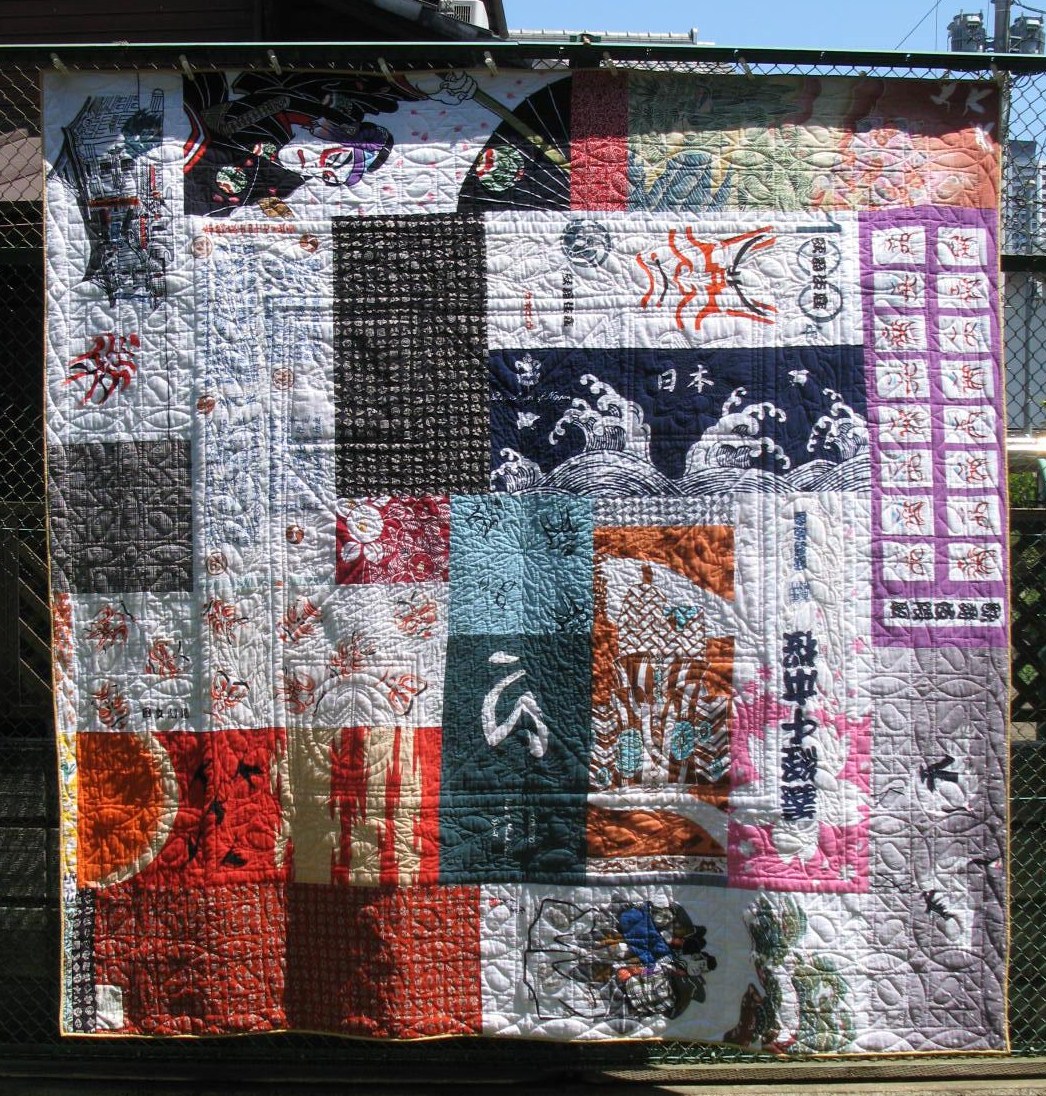
And speaking of tenugui, I promised to devote some time to them in my last post, but my dear friend and quilting master Julie Fukuda has beaten me to it and written a great piece on her blog My Quilt Diary. Take a look! Julie often pieces tenugui to create the backs of her quilts and while it may look random, there is always a masterful artistic hand at work. Julie, don’t be angry with me, but sometimes I love the tenugui backs as much as the amazing quilt fronts!

Which brings me to one last indigo image from recent press – this bedroom in Maine by Tom Scheerer. The quilt on the bed must be American, but it is reminiscent of a patched Japanese textile or even Julie’s tenugui quilt back.

Stay cool wherever you are! And stop in to Blue & White for your “Genki Japan” tenugui!

Image credits: 1-3 & 14. me, 4. House Beautiful June 2011, photo credit: Francesco Lagnese, 5-7. Elle Decor April 2011, photo credit: Simon Upton, 8. House Beautiful October 2010, photo credit: William Abranowicz, 9. Jayson Home & Garden, 10. Madeline Weinrib Atelier, 11-13. Elle Decor December 2008, photo credit: Simon Upton, 15. Julie Fukuda at My Quilt Diary, 16. House Beautiful April 2011, photo credit: Francesco Lagnese.

Read Full Post »

In response to my post in April about R.P. Miller’s new textile line, a reader from Vienna, Austria wrote, “Love this post – and it just so happens that I am looking for Japanese-inspired upholstery fabric – I found a delightful Schumacher fabric called “Katsugi” that I really enjoy because of its rich colors and organic, imperfect design. Can you recommend any other lines?”  So I thought I’d do a quick although not necessarily comprehensive round-up of some of the fabrics I think she might like.

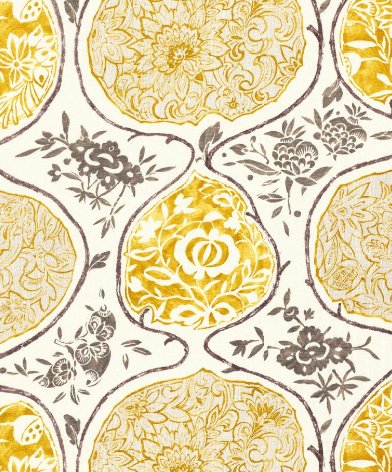
For everyone else, I’ll start with the popular Schumacher linen and cotton blend Katsugi that she mentions, which comes in five colorways.

Don’t be deceived by these swatches. The surprise about Katsugi, and often many other fabrics viewed only in photos, is the scale. If you are imagining the circular patterns are about the size of an apple or the pomegranate they resemble, then you are incorrect.  They are actually unexpectedly large. Designer Tom Scheerer has used this fabric to great effect in numerous projects.

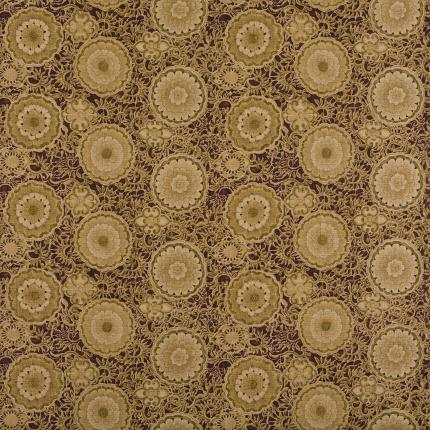
Designer Suzanne Tucker makes a similar, although smaller in scale pattern called Kiku, which means chrysanthemum in Japanese. According to her website, the pattern is reinterpreted from a 19th century Japanese futon cover, with stylized chrysanthemum and lotus roundels and interlocking arabesques on a heavy linen ground.

By the way, there are 11 meters of it available in the sapphire blue on eBay right now for a fantastic price.

I don’t believe Martyn Lawrence-Bullard’s Kaba Kaba is based on Japanese textiles, but it looks like an elongated version of shippo tsunagi, also known as linked circles or seven treasures pattern. It also looks as if it was made with a traditional paste resist dye technique, even though it is not.

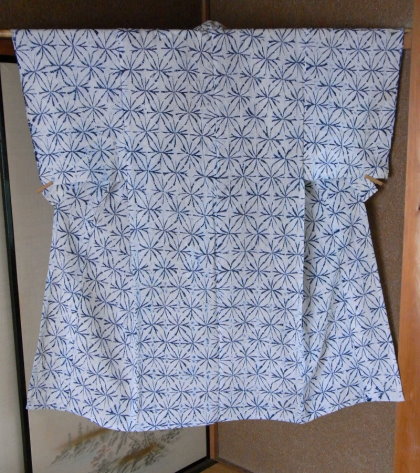
Compare it to this 19th century shibori (tie-dyed) yukata (cotton kimono).

For a sense of scale, you can see it on the pillow here, with two other great fabrics from his line.

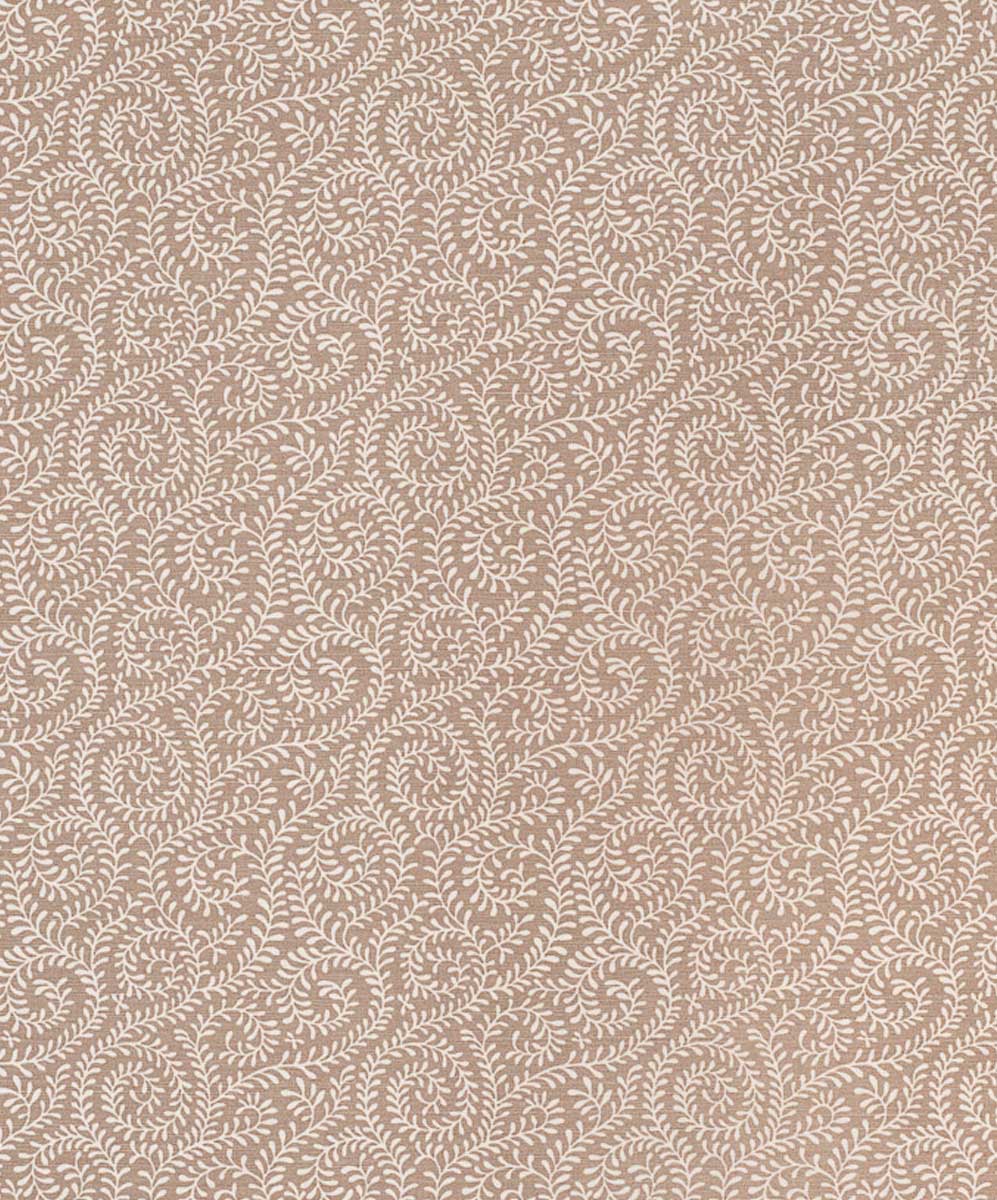
As many of you know, I am a total Bennison junkie and have been using their floral linens in my beach house.  While those patterns are their most famous, they also make a number of fabrics based on the karakusa (arabesque vine) pattern. Their “Kasumi” comes small, medium and large in numerous colorways. Unfortunately, none of the photos show the difference in scale, but it is dramatic, with the smallest size being a very fine subtle pattern and the extra-large size making a bold graphic statement.

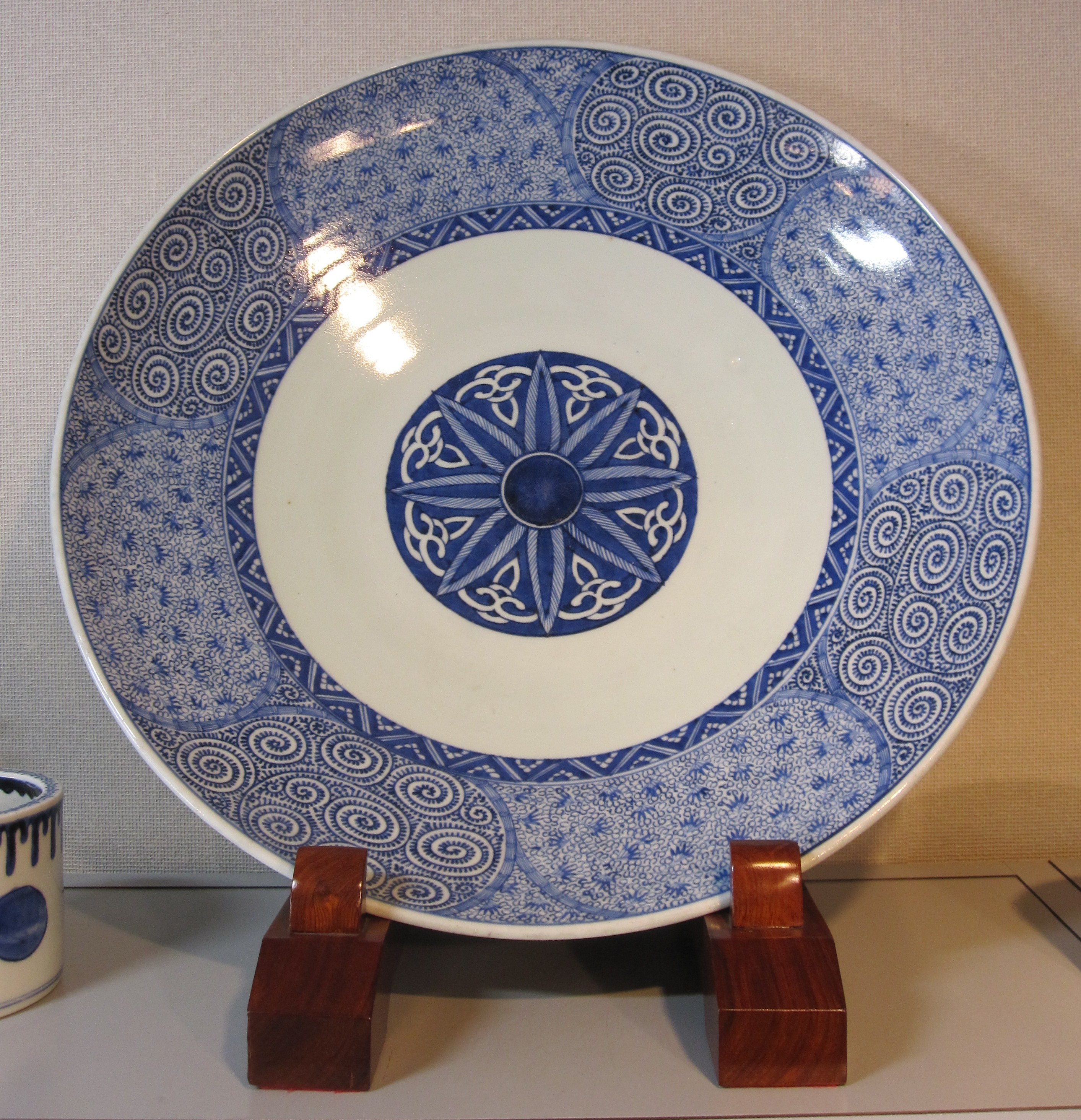
The easiest way to show karakusa patterns is on Japanese porcelain, but it can be found in almost all the decorative arts.

For a quick and easy dose of karakusa-style fabric, one of my favorite home bedding brands, Pine Cone Hill, has a full line of products in their “Scramble” pattern, from duvets to dust ruffles to table napkins, all in a wide variety of colors.

Annie Selke has also issued Scramble as a fabric by the yard available at Calico Corners in five colorways. Here she has used it to upholster chairs in a Cape Cod dining room.

Lisa Fine’s Maharab, shown here in the indigo colorway, and on some cushions that actually look like old-fashioned Japanese futon, is not actually Japanese inspired.

But while the individual motifs are Indian inspired, the overall pattern reminds me of a typical style of Japanese fabric in which multiple stencils are used to make an overlapping collage like pattern.  This fabric is a close-up from a mid-19th century futon cover, made with a rice paste resist method.

Asa no ha, or hemp pattern, is one of the most classic Japanese patterns there is. Ironically, for all that it is so ancient, it looks so modern. Here is it on an early 20th century yukata.

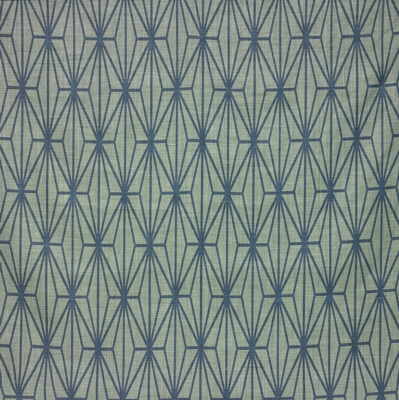
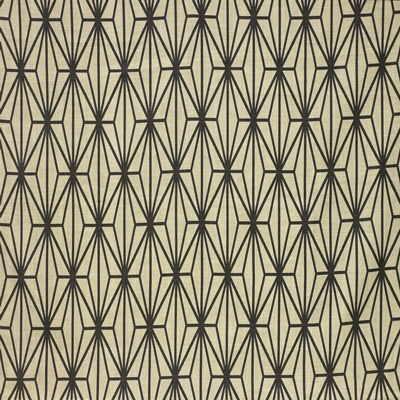
For a truly mod version of asa no ha, look no further that Kelly Wearstler’s fabric line for Groundworks in the Katana pattern, which takes the motif and stretches it to great dynamic effect.

Like some of the other fabrics in the post, the scale is surprisingly large.

Vanderhurd makes an amazing hand-embroidered linen in a hemp pattern called “Grande Etoile,” which comes in numerous colors, not all of which are pictured here, as well as a smaller version called “Petite Etoile.”  


RP Miller’s new hemp pattern fabric has the unusual name of “1509 EB.” I imagine there must be a story behind that somewhere…

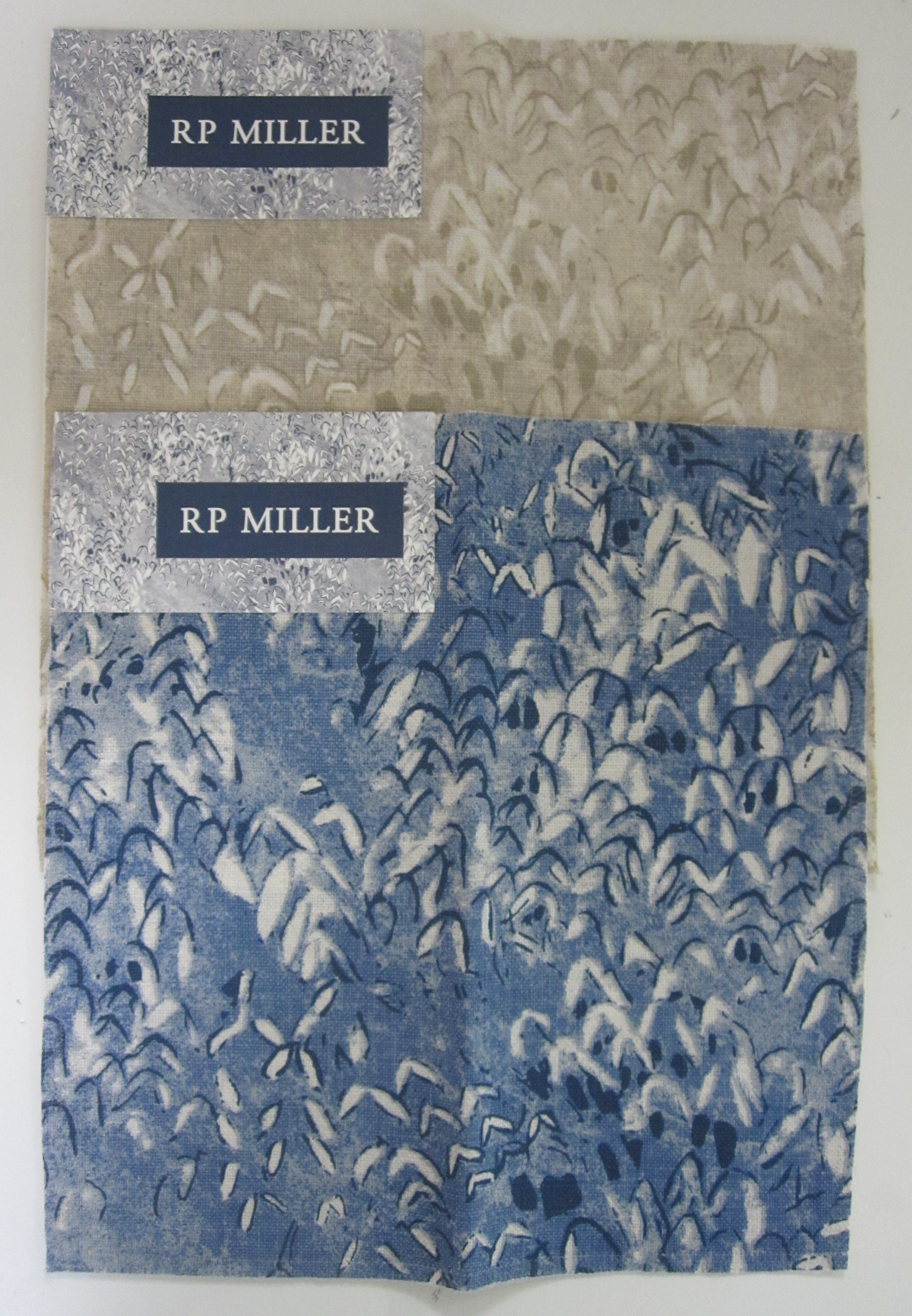
Thanks to the lovely Ariel at Hollywood at Home, I have gotten my hands on some samples from that new line, including a few I did not mention in the last post, such as the large chrysanthemum pattern Mrs. Burnside, the small star pattern Tanabata Night Sky and the delicate and leafy Weymouth place shown here in wheat ind indigo.

The wheat colors were a great surprise, very subtle and satisfying for those who like to work with neutrals.

Chiyo’s Pond, the pattern that looks like flowing water and petals reminds me of typical Okinawan bingata stenciled fabrics.

But my favorite is still the very unusual woodblock print inspired Le Witt Loom. In the wheat colorway if has a faux bois effect while in the indigo and white it is crisp and clean. I can’t think of anything else like it on the market.

For more photos and information on that pattern and the rest of RP Miller’s new line, see my previous post R. P. Miller…New Japanese Inspired Fabrics From Rodman Primack Debut at Hollywood at Home.

All of the photos of antique Japanese textiles came from what looks to be a fantatsic website called narablog, which features wonderful antique textiles, mainly Japanese, many for sale. I really recommend you take a look!  Another fabulous resource for antique Japanese textiles is Sri Threads.

Photo credits for the three Tom Scheerer photos are: 1. Simon Upton, 2. William Waldron, 3. Eric Bowman. Annie Selke dining room from House Beautiful February 2009, photo credit: John Kernick. Kelly Wearstler image via decorpad.

Read Full Post »

While not quite on par with Dixie Highway, relaxed Nishi-Ogikubo in Tokyo’s western suburbs has a grouping of 60+ antique and vintage shops gathered near the train station. Situated along the Chuo line, Nishi-Ogikubo (nicknamed Nishiogi) was a counterculture hotbed in the 1960s, then receded from notice, only to become popular in recent years as the “slow life” movement has gained steam in Japan. It seems like just the kind of place one would find a collection of quirky and individualistic antique shops.

Conveniently, a free map of the stores is available right in front of the koban (police box) on the left side of the station right outside the North Exit. The map seems fairly current but things can change overnight, so think of it only as a basic guide. Most stores do not open before 12p.m., they all seem to have variable hit-or-miss opening days, and there is not much spoken English to be had, but it is a lovely way to while away an afternoon. Hopefully this post will help steer you in the direction of the best shops!

Organized into four zones, NE, NW, SE and SW on the map, I’ll say right off the bat that the South side of the station has much less to offer than the North side, and can be skipped entirely when pressed for time. The NW zone is by far the best for traditional antiques, so I will start the tour headed in that direction, counter-clockwise around the rough rectangle the walking tour makes.  The shops are numbered numerically on the listing pages, but do not always appear in numeric order on the map.

Actually the first few shops don’t even seem to be listed on the map. After peeking in grape, a small but charming vintage kimono shop with two other locations in the area, our first stop is not Japanese at all. Filled to the brim with lanterns, poufs, silvered mirrors and embroidered slippers, Morocco Marché is one-stop shopping for adding a bit of middle-eastern flair to your decor.

Weaving up and down the small side streets along the main road, we pass a few small shops, including Baby Doll (#60), which is not open, but full of antique and vintage toys and dolls. Moving back towards the main road we come to Les Yeux Noirs (#42), the unquestionable star of the tour, deserving its own individual post (coming tomorrow). Owner Haruko Hasegawa has one of the best eyes I have seen for choosing unusual and rare pieces of porcelain. We were very excited and spent a long time (and quite a bit of money) in her shop. If you are interested in porcelain, this is one of the main attractions and it is well worth the train ride for this store alone.

As we continue along the main road we pass mood (#45), full of groovy 60′s looking used goods. We try to stop into Quilt & Old Textiles (#44) way hidden in a back lane, but they are closed – perhaps to go to the Tokyo International Great Quilt Festival. At the turn in the main road, we come to Kido Airku (#59), a great mixed shop full of smaller tansu, porcelain, textiles and odd and ends. Unusual things there include vintage spool threads, great for using as plant stands or display props. A collection of old iron tea kettles looks great on these.

Some modern shibori dyed textiles.

One of the most interesting finds for me personally were wood blocks, used to print patterns on textiles. I have been scouring eBay for Indian wood blocks for a DIY project I am planning this summer, but hadn’t considered using Japanese ones.  Frankly, I hadn’t realized that in addition to all the stencils, tie-dying and resist techniques used here, that wood blocks are too.  Definitely something to look into more.

Numbers 48,49 and 54 were all the same named shop, Antiques Jikoh, with mainly used modern furniture. The branch at the #49 location was full of heavy oak Victorian and Arts & Crafts era furniture.

My friend H spotted a gorgeous blue and white porcelain “umbrella stand” that she loved there. I was so sorry to have to let her know it was actually a late 19th century urinal. Needless to say, she could not look past its original use.

The next two shops were eureka! moments for me. I have been searching for the perfect vintage milk glass ceiling fixture for the bathroom in the beach house, passing up many individual pieces at shrine sales. Imagine my delight at stumbling across the Teardrop Club (#53). I’ll be dragging my patient husband back there soon. If you too are interested, please note they are open 12-6 and not on Wednesday. More photos here and here.

Rakuda (#51) which means camel, also had numerous vintage light fixtures in addition to ranma (transom) panels, old doors, stained glass and cut glass…

Turning the corner right after Rakuda completes the NW zone. The tour continues east, crossing a small river. Other than the charming Le Midi (#37) full of imports from the South of France, not much else was open. Any visit to Nishi-Ogikubo comes with that risk.

Continuing to the next major intersection the tour turns right to head south back to the station. Most of the shops along this NE section seem to specialize in vintage clothing and used goods. Perhaps because we were getting hungry, they didn’t hold our attention. In the grand tradition of antiquing outside of Tokyo, we ate Indian food for lunch at Ganesha Ghar, right near #31 and the bridge over the river on the map. As would be expected, it was packed! And following shortly thereafter was Amy’s Bakeshop, which billed itself as “NY Style Sweets & Things”. Of course we had to stop!

If you arrive hungry, it might be easiest to head the opposite direction (clockwise from the station) and eat first as shops don’t open until lunch time or afterwards.

We skimmed the shops listed on the map on the South side, but many were closed, perhaps permanently. None stood out this visit but perhaps they merit a second chance.

Nishi-Ogikubo is very easy to get to and quite close to central Tokyo. It is only 16 minutes from Shinjuku and 18 minutes from Yoyogi on the Sobu Chuo line. Taking the Toei Oedo line from Azabu Juban and changing at Yoyogi took a total of 32 minutes. I’d love to hear from anyone who goes, especially if you discover a gem I haven’t mentioned. Happy hunting!

Read Full Post »

Sho-Chiku-Bai. If that name doesn’t sound Japanese to you, then you have a good ear, as it is actually the Chinese reading of the Kanji characters 松竹梅. In Japanese, they are read matsu (pine), take (bamboo) and ume (plum) and they form a threesome as one of the most popular decorative motifs the “Three Friends of Winter,” representing promise and good fortune. Together, they stand for the scholarly ideals of pure spirit (plum), longevity (pine) and flexibility (bamboo).

One of the most common places to find them is on Japanese porcelain, often in a very stylized form, so that you might not even notice they are there. This old Imari pattern is extremely common and at first glance there is no real sign of any botanical motifs.

When you look closely at the design in the round, the two trunks of the pine and the plum and the bamboo pole become visible. This central motif has been repeated on versions of this pattern for centuries and continues to be very collectible.

I’d say about a third of the traditional polychrome Imari patterns with a central roundel have our three friends in the center. Close-ups of the photos highlight the details and the difference between the blue underglaze and the enamel and gold overglaze.

So similar to the one above, yet oh so different!

Notice the different manner of painting the pine on this dish – the spiky needle style instead of the puffy bush style.

The Three Friends of Winter are also a common motif on Japanese transfer printed blue and white porcelain. Transfer printing was invented in England in 1756 and is commonly associated with the Staffordshire potteries and the classic “Blue Willow” pattern. This process was developed as an inexpensive way to recreate the characteristics of the hand painted underglaze blue ceramics of China and Japan. Ironically, transfer printing does not become popular in Japan until the late 19th century, but modern-day markets abound with transfer printed pieces that show it eventually did. Often very inexpensive, they are a great purchase as they have more character than modern blue and white. Patterns are often standardized (like this stylized Sho-Chiku-Bai dish) so collecting a particular one is easy – or they are fun to mix and match.

This small covered dish is also transfer printed, with the plum and bamboo encased in fans (a common design device) and the pine in snow, represented by the ruffled circle surrounding it.

This small dish has a naturalistic rendering.

The Three Friend of Winter are not limited to porcelain. They can be found on lacquer…

…and here is a set of three kashigata (sweets molds) in the motif.

This paste-resist dyed indigo cloth takes a different approach, blending the naturalistic pine and plum with the stylized kamon for bamboo. The process is called tsutsugaki (literally, tube drawing) as rice paste is squeezed from a tube to draw the design, much like a giant crayon. The cloth is subsequently dyed and then the rice paste is washed off. This antique futon cover dates to the late 19th century.

Same for this one.

A more formal version can be found on this brocade fukusa. Popularized in the Edo period, a fukusa was used to “wrap” a formal or important gift by being draped over the box or tray on which it was presented. The Three Friends are a very common motif on fukusa as they represent such good wishes to the recipient as well as the New Year.

Speaking of important gifts, how about this set of watches from Vacheron Constantin? They have paired up with Zohiko, a 300+ year old lacquer maker in Kyoto to create these limited edition maki-e (literally, sprinkled picture) timepieces, embellished with Sho-Chiku-Bai. I am not sure what you do with three and at $335,000 for the set, I don’t think I’ll be getting them anytime soon. But interesting, desu ne (isn’t it)?

All of these example came from the Antique Jamboree held at Tokyo Big Sight the weekend of January 8-9th. And for more on the symbolism of these three friends, see Kadomatsu…A Traditional Welcome for the New Year.

Image credits: All images by Jacqueline Wein except Blue Willow platter: marks4antiques.com, and Vacheron Constantin watches: via House of Pens

Read Full Post »


For me, there are two perfect kinds of antique stores.  The first is a carefully curated small shop, while the second is a large unorganized warehouse that you have to search through.  Mizue Sasa’s Okura Oriental Art is the former and it is a jewel – my favorite in central Tokyo.  She and her husband Yasuhiro Shimizu are celebrating their 10th anniversary of owning Okura this year.

In addition to wonderful tansu and porcelain, Sasa-san has a great mix of hard to find items such as altar candlesticks…

antique maps of Tokyo and Japan, both framed and unframed…

ikebana baskets…

and lanterns.

She is also the only dealer I have found who carries traditional copper rain chains, which are the “gutters” of Japan. These are not antique, but they patinate quickly and easily. An amazing sayonara or housewarming gift!

Sasa-san’s pick? This Meiji period tai (sea bream) jizaikagi yokogi (decoration on hanging hearth pole) is a great piece of folk art. Used over a traditional irori (open sunken hearth) it held the kettle above the flame.

My current pick? This hard to find small size step tansu. Often they are very large and very deep and can be impractical if you don’t have the perfect space.

Sasa-san has a fully detailed on-line catalogue and a loyal customer base that visits often from around the world. She handles on-line sales easily, speaks English and ships just about anywhere. She also has a decorating site with staged rooms – you can purchase a whole look if you like or just browse for ideas. Sasa-san will also help her customers arrange their items and improve their decorating in their home. She is not afraid to tell clients to get rid of stuff (which is unusual here). She will also track down specific items for you – just give her dimensions or good descriptions.

I love the juxtaposition of the poured concrete wall with the tansu and the giant porcelain plate that she shows in the photo below. Sasa-san is interested in mixing antiques with modern furniture, a trend that is just getting off the ground here in Japan.

Here she stages vintage blue and white in the bathroom.

The shop is full of great gifts for the holidays!

Image credits: All shop photos taken by me, courtesy of Okura. Decorating photos by Mizue Sasa.

Okura Oriental Art

Read Full Post »

I like living with my stuff. I feel safe when it’s around.
Judyth van Amringe

Some expats come abroad with nothing but a few suitcases and rent furniture for their apartments or buy everything new again. But we brought everything we owned, lock, stock and barrel, because I am in complete agreement with Judyth van Amringe. I like living with my stuff. And living in Tokyo with my things – gathered slowly and carefully over time –  makes me feel connected to the very fabric of my life when I am so far from home.

Fabric, it seems, is something I cannot resist. Once again, at the shrine sale this weekend, I bought another vintage kimono. I tell myself I don’t need another but their colors, their patterns and the feel of the fabric call out to me. It’s easy to give in as they are relatively inexpensive, costing all of 500-1000 yen ($5-$10). I imagine the projects, the throw pillows, and the dress-up possibilities, both for the imaginary play of my children and for myself. This weekend my friend C actually found a fabulous black lace happi coat (short kimono) at the market and she plans to wear it over a camisole and skinny jeans for a night out.

I really believe there is such a thing as a “magpie gene” and that the desire to collect is inborn in some of us. My younger daughter, who is all of 6 years old, has it for sure. She has dug up a collection of porcelain and pottery fragments from the dirt of all the parks around us in Tokyo and keeps boxes and boxes of them for some future use (Why the fragments are there is another question entirely).  Her eye is good enough that when she finds a piece of the Seto region porcelain I collect, she can pick it out to give to me to add to my collection.  This giant fragment took her a number of tries over a few days to dig up and we are thinking of using it as a doorstop.

Collecting, assembling and re-purposing are inherent to the magpie mentality. Reading Dominique Browning‘s blog Slow Love Life last night I stumbled across scarves made of vintage kimono by artist Judyth van Amringe. Van Amringe seems to be the master magpie - an artist working in many different mediums, switching gears throughout her life. And Dominique Browning herself (formerly editor-in-chief of the now defunct House & Garden) is re-purposing as she explores life in the slow lane. I am looking forward to reading her book Slow Love: How I Lost My Job, Put On My Pajamas & Found Happiness. The title alone is irresistible.

In making the scarves, Judyth combines different fabrics and colors and they are reversible. Sometimes she adds details like beads or embroidery. They sound as interesting as they look in the photos, but I do wish I could see the combination of fabrics more clearly.  This silk ikat positively glows – I’d love to know what she adds to it.

This one has embellishments, with a narrow obi jime (silk cord overbelt) and beads. It may even be a purse as she makes them too.

To my thinking, Judyth van Amringe’s apartment may very well be her “master work”, an accumulated montage of a life’s belongings distilled into a small space. The expression used to describe her place by The New York Times is “artfully crammed” and it is a good one.  Van Amringe brings nothing new in without knowing where it is going and how it will relate to everything already there. Her space feels serene, even though it is jam-packed with objects, most of which she has changed or improved in some way. 

To compensate for a standard boring bathroom in her rental, she layered a huge bookshelf, a hand carved coat stand, an upholstered slipper chair and real rugs. Oh, how I love real rugs in a bathroom, but that will have to wait for a future post.

It looks like a perfect spot for a little birdie to rest…

Photo credits: 1 & 2. me, 3 & 4. from Slow Love Life, 5 & 6. The New York Times, Photo: David Allee

Read Full Post »

Sudare are bamboo blinds used to screen out the sun and stay cool during the hot summer months in Japan. The blinds keep out the sun’s rays, while letting the breeze blow through.  They also offer a modicum of privacy when doors and windows are thrown open (in a hopeful attempt to catch the aforementioned breeze). Traditionally hand-crafted, the art of making sudare has been lost to inexpensive imports from China, although craftsmen do still exist (particularly in Kyoto) and antique and vintage examples can be found at shrine sales and antique shops. Fancy sudare have decorative brocade trim around the edges, elaborate cording with tassels and engraved metal hooks to hold the blinds rolled open.

A typical view of a house in high sun in Kyoto, with sudare hanging over the veranda and front windows. 

The decorative arts offer proof of the use of sudare through the ages. One of the first images that springs to mind is this amazing 17th century byobu (Japanese screen) depicting “The Tale of Genji” in the collection of the Isabella Stewart Gardner Museum in Boston. If you click on it to enlarge, you can see sudare hanging in the doorways and windows.

More recent Edo and Meiji period byobu create a direct window view using a trompe l’oeil sudare. This charming screen was for sale at the Heiwajima Antiques Fair.

A second one, styled in an apartment filled with Japanese objects – split tansu, map of old Tokyo, and shoji lanterns.

Built in 1878, the Fujiya Hotel was the first hotel in Japan that catered to Western tourists.  It is an absolute fantasy of a building – all Victorianism and Japonism scrambled together and should not be missed by anyone interested in either. The grand dining room, built in 1930, has amazing botanical frescoes on the ceilings, carved ranma (transom) panels, and the loveliest decorative sudare I have ever seen. They are hard to see in the photo below, but I couldn’t resist the view of the building and the autumn foliage out the window.

The detail is a little easier to see in this photo.

So how to use my sudare in a modern interior? I have always loved the look of matchstick blinds hung behind curtains and if you open any decorating magazine today, it seems as if everyone else does too. Joni at Cote de Texas has an amazing post about curtains, both with and without blinds, and great suggestions on hanging curtains in all kinds of situations.  To hang the blind correctly, you mount it on the outside of the window, filling the space between the window frame and the curtain rod, which has been hung as close to the ceiling as possible to maximize the illusion of height.

So, the plan is to take this window in the den/extra bedroom of the beach house (sorry for the poor photo – room under renovation)…

and add this lovely Indian block print fabric (Cream Hibiscus Flower Buta) from Aleta Fabrics

or possibly this one (Aleta’s Cream Hibiscus Flower Branch), as floor length curtains hung from a slim aged brass curtain rod from Gracious Home (more on my love of aged unprotected brass another time)…

using the sudare from the top of the post as the blind.

Aleta’s fabrics were featured in the to-die-for apartment of Nancy Tilghman, designed by Daniel Sachs, in the October 2010 issue of House Beautiful, including the Cream Hibiscus Branch fabric which was used on a chair in the bedroom.  The bedroom has just the feel of what I want the den/extra bedroom to look like, although taking the children into consideration, perhaps a little darker color scheme.

Image credits: 1,4,6,7,9 &12. me, 2. from il-ne-kore, 3. Property of Isabella Stewart Gardner Museum, photo via The Curated Object, 5. Okura Oriental Art, 8. via Cote de Texas, 10 & 11. from Aleta Online, 13. October 2010 House Beautiful, photographed by Ngoc Minh Ngo


Read Full Post »

Older Posts »

Follow

Get every new post delivered to your Inbox.

Join 424 other followers

%d bloggers like this: