Feeds:
Posts
Comments

Posts Tagged ‘shrine sale’

I continue to find much inspiration in the small details from this photo, previously featured here and here. On the side table next to the lamp (and oh how gorgeous and divine is that lamp!) there is a small wooden soroban, better known in English as an abacus. A counting tool still common in Asia, even in the age of electronics, abaci (or abacuses, depending on who you talk to) are still sold and their use is taught in Japanese elementary school.

IMG_1612

Abaci are not unique to Japan and actually were imported from China around 1600 and this one is actually Chinese (so it is really a suanpan). Originally, the upper part of the Japanese abacus had two “heavenly” beads and the lower part five “earth” beads just like this. Around 1850 it was improved and changed to 1 and 5 beads, and then again in 1891 changed to 1 and 4, which continues to be the common modern abacus used in Japan. Personally, I find these dates to be a little rigid and I don’t think they date pieces exactly, but rather roughly.

abacus

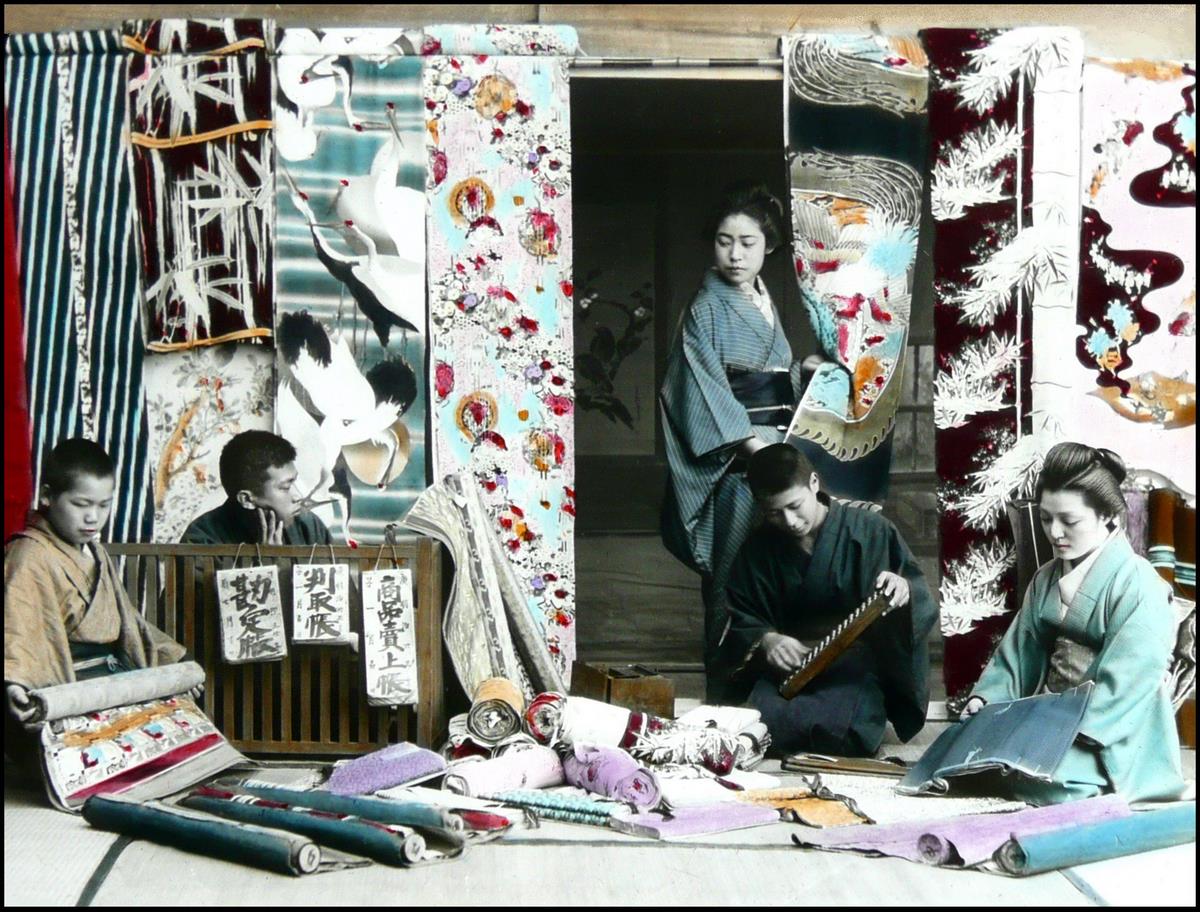
Hand colored late 19th-early 20th century photos confirm its use in transactions at all kinds of businesses. I couldn’t resist this kimono shop photo – just look at those amazing rolls of fabric!

KimonoSilkStoreInOldJapan_ShowsSoroban_1890sGlassSlideOkinawaSobaCollection

Like I said, abaci were used in many countries, and while we are on old photos, here’s one of a young Russian abacus seller. You can see quite clearly the difference in their style – there is no separation of heavenly and earthly beads – and as a result the method of calculation.

russian abacus seller

So do I know how to use one? Of course not! But I think they make charming additions to vignettes in the home.

abacus vignette amanda wright via design sponge abacus vignette via belle brocante abacus vignette via pinterest pinterest.com:pin:575405289860988289:

I see one peeking out from behind the lamp in this project by Lauren Liess.

lauren liess abacus

Even Pottery Barn and CB2 have jumped on the abacus bandwagon, although neither of these are still available.

abacus via FYNCT pottery barncb2 abacus

I run across abaci at the shrine sales quite frequently. I tend to look out for the older or more unusual ones as a general rule.

abacus at nogi shrine sale

I found a particularly giant one designed for classroom teaching or shop use at Kawagoe last spring. It was featured in the article by Lisa Jardine now on the CNN Travel website. The beads are bright yellow to make it easy to see at a distance.

kawagoe----our-haul

In 9 years I have only seen a few of these huge ones, and never outside of Japan, except in this photo of Sibella Court’s Sydney shop The Society. Somehow I’m not surprised she managed to get her hands on one along with many other Japanese goodies.

giant abacus via an indian summer

So I just happened to stumble across two recently – how is that for luck?. You can get a sense of how big these really are by comparing them to the regular sized abacus propped up along the yellow one. It’s interesting that the beads on these teaching abaci stick where you move them to facilitate lessons.

abacus soroban

Tons of potential! I could see the yellow one in a kids room or den, but it is the wooden one which calls my name!

abacus soroban detail

What would you do with one?

My heart goes out to everyone in Boston today. I am counting my blessings and sending out love to all those affected.

Related Posts:
Tokyo Jinja on CNNgo Today
Takamakura…A Geisha’s Hard Night Sleep

Image credits: 1, 10, 13-14. taken by me, 2. via The Slide Rule Museum (gotta love that name!), 3. William Carrick via National Galleries of Scotland, 4. via Design Sponge, 5. via Belle Brocante, 6. via Pinterest, 7. via Pure Style Home, 8. via Pottery Barn, 9. via CB2, 11. Lisa Jardine for CNNgo, 12.The Society via An Indian Summer.

About these ads

Read Full Post »

Today was a crisp and very cold day at the Oedo market at the International Forum, but as usual there was lots to see and plenty to buy. I have been wanting to find a way to start sharing what I am seeing at the markets every week, but when there isn’t a theme or cohesive feeling about the merchandise I find it fairly boring to post about. I have been thinking that real-time photos of what I am buying, both for myself and for sale, might be more fun and more interesting for both me and for my readers. So as of today, my plans are to start instagramming (is that a verb yet?) while I am out and about at shrine sales and antique shows. So if you would like to keep up with me, you can follow me on Instagram on your mobile device here.

One of the fun parts of Instagram if you haven’t tried it is playing with the filters and the framing to add special effects to your photos. Typical me, I like all the filters that give an aged feel…

IMG_0993

…and I am a sucker for those old-fashioned photo borders…

IMG_0994

…or burned edges.

IMG_0996

I already made a faux pas in editing this photo down so that it didn’t fit the Instagram format.  Won’t make that mistake again.

IMG_0997

The photos have the perfect format for a blog post – a nice big square. There is also a very effective exposure button, used to fun effect here.

IMG_0998

This art deco mirror glows like a jewel using one of the filters.

IMG_0999

Kasuri kimonos seem lit from within.

IMG_1001

As usual Oedo was full of European goods, these lace patterns being some of my favorites.

IMG_1002

No lack of British goods either. This collection rivals any I’ve seen in English antique shops.

IMG_1003

Couldn’t resist these door knockers – just for Steve at An Urban Cottage.

IMG_1004

And you know you want it…If you see items you want to buy, just let me know via email.

IMG_1005

I made a couple of wonderful scores for myself, including this handmade folksy heart chair. It has a beautiful grey-blue wash paint and is soooo much prettier than it looks in this photo – the only find of the day that the Instagram filters failed to enhance.

IMG_0992

I know just where this sweet little baby is going to go…

beach house living room

I have also been finding the most irresistible and inexpensive art lately which deserves a post of its own. But this little oval print (nothing better than a few art pieces with circles or ovals to break up a lot of rectangles) is headed to my youngest daughter’s room at the beach…

IMG_0995

…along with this chiyogami you may remember from here. She begged me to hold it back for her from the sale so I did.

chiyogami 5

Won’t they look so sweet in here?

miss p beach bedroom

I am going to try to add the Instagram button to my sidebar, probably right below the Pinterest one. But I am including the link here again, in case I am not successful.

Related Posts:
Like La Brocante…French Day at Oedo Antiques Fair
Paper for a Thousand Years…Vintage Chiyogami

Read Full Post »

Today was a very hot although lovely day at the shrine sale, full of friends and faces missed over the summer. The temperature forced us to be leisurely and it was fun to be open to exploring and not have an agenda or be on the hunt for anything in particular. That being said, like all days at any market, a theme usually emerges and today was no different. One of my personal obsession jumped out at me today and I did my best not get lured in, trying instead to take photos for you and pretend to collect instead of buy.

Remember these mirrors from John Derian in this post? The caption identifies them as nineteenth century, but I think they are more likely to be 1920-30s and were often used on shaving stands and dressing tables. I checked and the date on this tear sheet is 2002 – which should give you a sense of how long I have been holding on to it. Add to that the myriad of posts this summer showing old and etched mirrors in the bedrooms and bathrooms back at the Shore and that should give you a sense of the depth of my love for anything silvered and bevelled.

Well today was a mirror day at Tomioka Hachiman, starting with this beauty, with its heart shape scroll stand and bevelled edge. If you can ignore my point and shoot ruining the photo, the reflection gives such a great sense of what the market is like.

Next up was this tiny round and a small hanging shop mirror. I thought the circular shape would make a great counterpoint to the larger rectangle above.

And you know the rule of threes – I thought this smaller rectangle was just what was needed to complete a trio.

Along the way I found this frameless one compelling. It’s hard to see how pretty the chain and clips are, but take my word for it.

So what do you think I did? I was a good girl and bought only the first mirror – no way I could resist that scrolling stand – and I am waiting to see if the regret rolls in. There is always the chance I’ll be racing back there soon, hoping against hope, that the others are still unsold.

My trusty helper had a great day too, finding boxes of matchboxes to sort through. Unlike last time, no one bought the entire box out from under her! Some friends bought matchboxes too and we are thinking of having a shadowbox workshop sometime soon.

Read Full Post »

Goodbye ephemera and katagami lady…

Goodbye military paraphenalia guy…

Goodbye excellent porcelain dealers…

Goodbye senbei canister guy (although I don’t have your photo I know I will still see you at Kawagoe)…

Today was a gorgeous Mother’s Day, but unfortunately the closing day of an historic shrine sale at Nogi Shrine. It had dwindled to no more than about 8 antique dealers, but excellent dealers they were. My very first shrine sale experience was there and my first post ever featured it too. It was the place the Lalique lamp was bought out from under me when I turned my head. It was so close by and easy to pop into and always yielded some good treasure – I don’t think I ever left empty handed.

Word is afoot of a new sale starting up soon and close by. I’ll keep you all informed when I have fully scouted the details. Until then have a moment of silence with me at the passing of this institution.

Related Posts:
Nogizaka…A Good Place to Start
The End of an Era…Togo Shrine Sale Ends

Read Full Post »

Ranma, the pierced or open-work transom panels found in almost all traditional dwellings are a staple of classical Japanese architecture. Placed above shoji or fusuma sliding doors and used to allow light and air to move between rooms when the doors were closed, they also became a place for designers to exercise their decorative imagination.

Like the sake jugs of my last post, Japanese ranma can be found with a bit of searching at most shrine sales here in Japan. In general there are two types, pictorial and geometric, as shown below. The pictorial ranma can be highly carved and detailed, and sometimes even lacquered or gilded. The geometric ranma are comprised of oft repeated Japanese motifs or employ balanced openwork compositions.

Pictorial ranma are almost always oriented horizontally, which would follow naturally based on their form.

The level of open-work in any design varies with the function of the panel – some are almost completely open, while others, like the one below, have very little piercing.

Published examples of ranma screens used in interior design are slim, although I did find this interior featuring a ranma in an overlayed circle pattern called shippou-tsunagi (seven treasures pattern). On the other hand, there are many similar items such as Chinese fretwork and Indonesian transoms out there, which I am going to use to illustrate my post as they perform the same decorate function. And as always I wonder why Japanese antiques continue to be under used by designers, while doing my darndest to remedy that.

One of the most obvious placements for a long horizontally oriented ranma (besides actually building it into construction as an actual transom) is over a bed or even turned into a headboard. Designer Jonathan Pierce has hung what looks to be a Chinese screen over the bed in this apartment…

…and a pair of Asian panels here. He also has a show Interiors, Inc. on HGTV that I am curious to watch this summer. Has anyone out there seen it?

Vincente Wolf is a master at weaving in global wooden screens, such as these Indonesian transoms hung above the fireplace. Note the Chinese fretwork screen just off to the left of the fireplace as well.

Here’s the same room from another angle – you can see the Chinese fretwork screen better here.

Long ranma panels with non-directional designs can easily be hinged together to make standing screens too.

Another great idea courtesy of Mr. Wolf is backing a screen with a mirrored panel, adding a whole new element to the composition and helping to brighten a darker space.

This ornate and gilded ranma in a similarly colored space has quite a similar effect. (And be sure to note the pillow on the chair, won in my ZAK + FOX giveaway!)

Panels can also be propped instead of hung, such as in this Rosemary Beach home by Tracery Interiors.

Their firm also seems to love using open-work panels as both their portfolio and referential company name and logo would imply. Note the small green transom in this project – Indonesian again I believe – in the corner beside the fireplace.

And I am not sure what kind of panel is featured here, but I had to include it if for no other reason than the amazing glass bottle display!

Michael Smith has propped and old wooden panel – this one looks Indian to my eye – along with some other mounted objects on this Malibu home’s mantle.

Ranma in the bathroom? Why not? I love the use of these fretwork panels in this cool and spare Manhattan bathroom…

…and I also love the way these Chinese fretwork pieces cozy up this warm London bathroom.

And let’s not leave out the kitchen – shown here with a stack of small Chinese fretwork doors on the wall.

Related Posts:
Divide and Conquer…Thomas Hamel, Jalis and Shoji Screens

Image credits: 1. Japan Style by Geeta Mehta and Kimie Tada, photo credit: Noboru Murata, 2-4 & 10. me, 5. D Home March/April 2007, photo credit: Danny Piassick, via My Notting Hill, 6-7 & 18. Pierce & Co., 8. House Beautiful May 2010, photo credit: Eric Piasecki, 9 & 11. via Vincente Wolf Blog, 12. via A. Ridge, 13-15. Tracery Interiors, 16. Elle Decor October 2009, photo credit: Henry Bourne, 17.Elle Decor November 2009, photo credit: Pieter Estersohn, 18. World of Interiors July 2010, photo credit: Bob Smith.

Read Full Post »

If you’ve been to an antiques market in Tokyo or one of the area’s many shrine sales in the past few years, it’s likely you’ve come across Jacqueline Wein — or Tokyo Jinja as she’s known to her dedicated band of online followers.

-Lisa Jardine on CNNgo

So today was a fun day! I was featured in an article about antiquing at the Kawagoe shrine sale on CNNgo. I’ve been getting positive feedback and lots of love all day! When I started this blog a year and a half ago, I never expected it to grow into the incredible place it has become – a crossroads of East and West – for design lovers around the world. I want to thank all my lovely readers and friends, and in particular the article’s author Lisa Jardine, who has her own blog - Wasabiwabi - where she chronicles her experiences here in Japan.

To read the article in full, click here. For more posts about shrine sales, click that topic under the categories list on the right. For information, dates and times of sales, click the Shrines Sale/Antique Show tab at the top of the blog. And as always, I am happy to answer questions and help you find the antique object of your dreams! I can be reached via email at jacquelinewein[at]yahoo.com.

Read Full Post »

Remember this photo? The shelves themselves have since been completed, but I have not been back yet to our beach house to work on the styling. As I was literally walking out the door in December, I threw a few things up there to shoot a vignette for a post, including the French watercolor that inspired the bathroom in the first place, some nicely tarnished brass finds from Singapore, shell and coral collections the girls are gathering, and a shallow patterned kashigata (Japanese sweet mold) that reminded me of starfish and sand dollars.

Here’s a close-up.

Since then I have been gathering inspiration photos to help me crystallize my thinking. There is no one better to turn to for artful display than John Derian and I have long loved this photo with its giant sponge, shells and mercury glass.

A more recent photo from The New Victorian Ruralist is more regimented, but I love the mix of baskets, silver, white ironstone and glass.

And of course I can’t forget the vignette master herself, Joan from For the Love of a House, with this beautiful shelving array from her master bathroom.

All three photos share something in common, which is groupings of like objects contrasted with other groupings in different materials, usually about three kinds, including something natural, something metal and something glass. More than three gets busy and less than three has no animation. Without being too literal about this formula, I would like shells and coral, aged wood and old brass to be part of my display. My recent purchase of more kashigata with shallow relief patterns might just provide the touch I need. What looks to be coral fans is more likely lotus or some other botanical, but to my eye they read like oceanic plants.

I find these circular patterns irresistible too. They are double-sided, with different motifs on the reverse.

I think this classic Japanese pattern of little plover birds with waves is adorable for a beach house!

In addition, I have a friend who has also been buying kashigata with shells and sea life on them for her beach house on Long Island so I am hoping to get a look at them in situ this summer.

As I am not limiting myself to wood, but planning on complementing the unlaquered brass bathroom fittings with some aged brass display items, I was so excited to find this adorable set of brass cookie cutters with scalloped rims and a rolling crimper. Not sure yet whether I plan to use them on the bathroom shelves or save them for the kitchen. Speaking of the kitchen, Camille from The Vintique Object and I have been having fun brainstorming how to improve it without actually spending any money on it. I do eventually plan to renovate the kitchen completely, but in the meantime I want to take the ugly edge off. There will be much more on this project coming later, including the bleak photos of its current state, but one idea I have is to use warm brass and copper to help it along. If you are interested, she and I have a shared Pinterest page going where we exchange photos and ideas. It is such a great way to work with someone long distance!

And I’ve also got boards going for copper and silver on Pinterest, but with my obsession with aged brass, I think I need to start one for that too.

Related Posts:
Renovation Report…”Oldating” the Beach House Bathroom
Summer Simple…Vignettes and the Art of Arranging

Image Credits:1-2, 6-9. me, 3. Martha Stewart Living September 2009, 4. via The New Victorian Ruralist, 5. via For the Love of a House

Read Full Post »

Everyone has been loving bar carts for the last few years, so much so that it almost feels redundant to write about them. Posts at all the big blogs from Apartment Therapy to Design Sponge have featured them, there are pages and pages of them on Pinterest, and even The New York Times had jumped into the fray with an article about Eddie Ross and his flea market cart find. I had highlighted some bar carts made from English butler trolleys before, but I had been stashing away photos of the classic glass and brass kind, with an eye towards having one perhaps?

They look great with a lamp too, either in conjunction with a bar…

…or in this case as a side table. Small children in this house meant that the beautifully styled alcohol bottles needed to be moved to the adjacent secretary.

While always liking them, I had never needed one personally. In October, I chanced across a special one at my favorite place, the Kawagoe shrine sale. It might seem unusual in that it was clearly not a Japanese item or of local origin, but actually there are many great international pieces to be found, including a Lalique lamp that I missed purchasing by moments recently too.  My husband gave the drinks cart the thumbs down and for some unknown reason, I actually listened to him!?!  But I continued to moon over it a bit, trying to console myself that I didn’t need it. That changed after I made an amazing find of two 1970s Chizuko Yoshida butterfly prints. I hung them stacked vertically on the wall, just next to a slipper chair in my living room. All of a sudden I desperately needed something to tie the arrangement together and it occurred to me that the bar cart was just the thing. The only problem was I had left it at the market, breaking the golden rule of antiquing, and was sure it would not be there the next time I returned.

So here’s where the story kicks in. The following month I went back, but I didn’t see it at the dealer’s stall. I was so bummed. On a lark I approached anyway to ask him about it and at first he had no idea what I was talking about (you try translating “bar cart” into Japanese). When he realized what I was looking for, he had good news for me – he had not sold it – but he had not brought it to the market because it was too fine. He offered to bring it in December, but I would be away for the holidays. We exchanged email addresses and phone numbers with a promise to sort it out and off I went.

In the weeks that passed I wanted it more and more, although by that point I had only a dim recollection of what it looked like. Finally January arrived and back to the shrine I went. The dealer was busy as I arrived and I didn’t see it out at his stall so I proceeded to shop the market, only to be pulled up short by him hyperventilating into my telephone a little while later. It seemed he had another avid buyer and wanted to be sure I was taking it. I scurried on back, took one look at its elegant lines and was sold. It screamed French moderne to me, with its black glass shelves, gilded curved edge frame and old-fashioned wheels. I have since tried to research it, with no real luck, although I came up with a few 1940s pieces – fully attributed or signed - that have a similar feel, including these from Jean Royere and Jacques Adnet.

In general, only the French pieces seem to have black glass, but last night I noticed this vintage Italian cart in a One Kings Lane Tastemaker sale. Note the price tag! And those signed French pieces above sold for thousands at auction!

The dealer bought if from a Japanese family that had spent serious time abroad in Europe, particularly France, so I think I am on the right track. I need to crawl all over it and look for a mark or label, but in the meantime, I have quick styled it to show you in situ. Just loving this little baby!

Image credits: 1.Deborah Needleman in Lonny Fall 2009, photo credit: Patrick Cline, 2. Jennifer Boles in Atlanta Homes & Lifestyles March 2011, photo credit: David Christensen, 3. Jen Altman via Design Sponge, 4. Domino via Apartment Therapy, 5. Sills Huniford in Elle Decor November 2007, photo credit: Pieter Estersohn, 6. Ashlina Kaposta‘s in Adore Home Oct/Nov 2011, 7. R. Michaelson, 8. Lisa Jardine, 9. via Architonic, photo credit: Brain Franczyk, 10. via Orange on 1stdibs, 11. screenshot via One Kings Lane, 12. me.

Read Full Post »

The large spark of interest created by Yamamura’s suitcase and story (screenplay anyone?) have pushed me to continue on in my investigations. While I have sorted out the large label (Dairen Mansyu Hotel in Manchuria) and medium label (Onnuri Ryokan in Seoul, Korea) on this side of the suitcase, the only challenge that remained was the smallest label on the bottom in this photo. Further research (with great help from my reader Mary) reveals it to be a Japanese owned ryokan that was popular in Shanghai in the between-the-war period. The kanji escaped me, but not her –  常盤館 – and we think it is pronounced Tokiwakan. No photos of it from the period, or any additional labels, but the building is still standing in China and here is how it looks today. I don’t find it hard to close my eyes and imagine a more glamorous past life for the run down structure – actually all of the old foreign areas of Shanghai still feel like a movie set to me.

To do a truly thorough job of exploring Yamamura-san’s travels, it seemed that we needed to track down each and every hotel, so the next challenge was the other label on the right hand side of this photo. While the label says Japan Hotel in English, the kanji identifies it as the Fusokan or Fusangkuan in Beijing.

Yamamura’s label is pretty tame, but here are two jazzier examples.

An undated photo of the Fusokan reveals multiple forms of transportation, from autos to rickshaws. My guess is early 1930s, right around the time Yamamura may have stayed there.

Finding this hotel advertising flyer, with its drawing of the Temple of Heaven, seems to confirm its nearby location.

Mary also discovered that Japanese short story writer Ryunosuke Akutagawa stayed at the Fusokan for about a month in 1921.

The label on the left in my original photo (which I am showing once again above as this all starts to get a bit confusing) says Shenyo Hotel Mubuden, and I had hypothesized in my original post that perhaps it was an alternate spelling for Mukden in Manchuria. I continue to believe they are the same place, perhaps one is a regional name and the other the city. The kanji can also be read as Hoten, making this the Shenyo or Shinyo Hotel, as seen in these alternative labels below.

These great labels came from another collector’s suitcase, and if your Japanese is good, you can read more about them here.

This photo shows Hoten in Manchuria, called Shenyang today in China, around 1931.

While we are still on this side of the suitcase, let’s finish by showing a great view of the Anto Hotel (the middle sticker). I had a view of it from the train station in the original post, but you can really see the size and the art deco grandeur of it here…

…and the strength of the Japanese presence in Manchuria made so perfectly clear by this card – sakura season!!!!!

So we know Yamamura made his way around China, including Manchuria, Shanghai, and Beijing, as well as Seoul, Korea. The one clue I still haven’t acted upon is the fairly modern meishi (business card) in the luggage tag. It is newer than the suitcase and has a different family name and an address in Osaka, but still the possibility to reveal more about our mysterious Mr. Yamamura.

Again, thanks to Mary and as always, my sweet husband, without whom this post could not have been written. If there was ever anything to give that kick I am needing to work on my kanji, this might be it!

Quickly before I go to publish – I saw this set of 3 vintage leather suitcases in a design store today in New Jersey. A perfectly proportioned stack, with a price tag to match, but no back story. Nonetheless, I was tempted…

Related Posts:
If Only This Suitcase Could Talk
Research From a Reader…More On Yamamura-san’s Suitcase

Image credits: 1,3, 8 & 15. me, 2. The Weblog With Osaka Dialect, 4-7. The World of Hotel Label, 9-11. paperlabel.blog, 12. eurodollers flickr, 13-14. International Center for Chinese Studies

Read Full Post »

While we are chatting about my recent brass finds, let’s look back at another cute vintage brass item sourced from a Tokyo area shrine sale. Remember this guy found here last spring?

Well, he is now cleaned up a bit and safely ensconced here in my living room, having become an extremely useful addition to our household, a perfect spot to rest a book or cup of tea and serving as extra seating in a party pinch.

This is a slightly different style of “Identify This” post as I am honestly the one looking for help figuring out the origins of this small brass stool or table. I had not seen one before mine, but this summer at Calypso Home in NYC they had a larger and brand new side table sized one in the shop. No one there had any insight into the history of its style.

I have only ever seen one featured in a home design spread.

(Addendum: On a funny note, it was only after I received the Katie Ridder book I wrote about in my last post that I realized I had just shown another photo featuring not one, but two of these stools in one of her interiors! There is a shiny brass one adjacent to each the chairs in the photo.)

So without much to go on, I dived in to my usual research sources…Currently, there are a few available on 1stdibs right now, including this one from Belvair

and this pair from lawson-fenning. Both are simply identified as 1960s vintage brass drum stools or tables and are priced at $325-365 each.

Adam Bram Straus just had one for sale in his Tastemaker Tag Sale on OKL too. It and the one directly above on the left look the most like mine, although mine is in better condition than either of them and none have the repeated concentric circles on the seat/tabletop.

Less expensive new ones, which honestly have inferiors lines, seem readily available, like this one from Cyan Design for $247.

They even come in other finishes, such as aged bronze or this fancy polished nickel from Arteriors, the most expensive of the bunch at $458 for the small size and over $1000 for the side table size.

But I haven’t been able to find any additional information, or even proof that these are 1960s designs. One source suggested they are Italian, another art deco, but I don’t see any evidence of either, other than the usual problem in which someone wrote it on the internet once, so now everyone quotes it like it is true. For my eye, they have a real campaign furniture look, but as they don’t actually fold up or disassemble easily, that is not it either.

So I open it to you my readers – any theories or clues on origin, time period or even additional photos of these in use? I’d love any ideas, speculative or fact-based….And most of all, I wonder how it ended up in Japan?

Read Full Post »

Older Posts »

Follow

Get every new post delivered to your Inbox.

Join 405 other followers

%d bloggers like this: