Feeds:
Posts
Comments

Posts Tagged ‘Seto’

Seto jubako

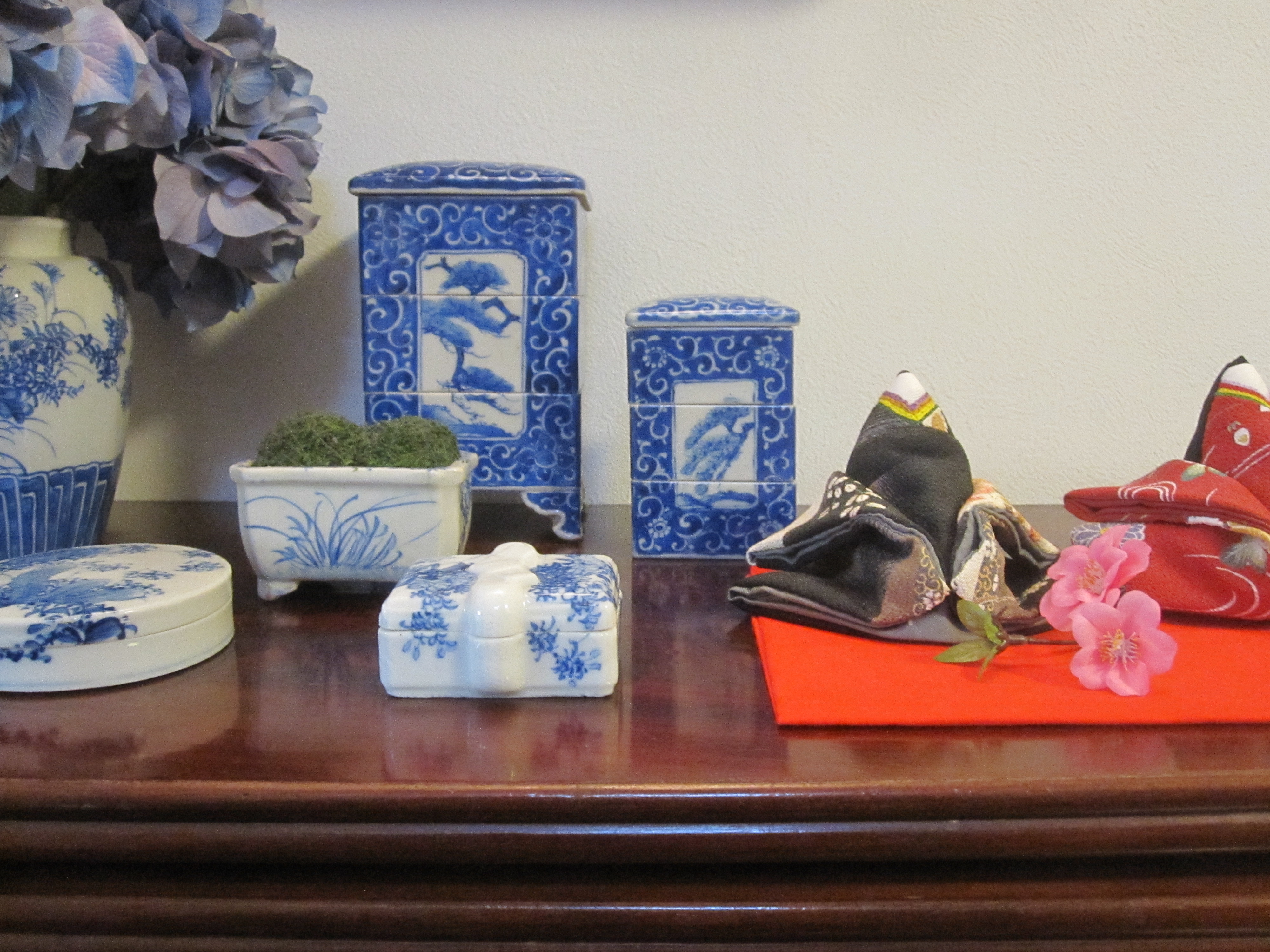
An absolute favorite of mine, porcelain jubako, stacked tiered food boxes, are harder to come across than more standard porcelain shapes such as plates and bowls. That being true, it hasn’t kept me from accumulating quite a few and helping others do the same. I always refer to them as jubako, but it may be that the porcelain ones should be called danju, while the lacquer ones are officially jubako. Shrine sale dealers call them jubako, so for now I will use the terms interchangeably. Personally I’ve never put food in mine. Instead I like to use them for trinkets on night stands, spices in the kitchen and anywhere you need to stash some small valuables.

In my entryway they hold extra keys to the house and car, buttons and hooks that have fallen off jackets and other odds and ends. Mine are unusual in that they are square, much less common than round ones, and the larger one has lovely scrolled feet. The bright cobalt and densely pigmented karakusa (scrolling arabesque pattern) are typical of Seto porcelain, and although purchased at very different times, seem to have been painted by the same artist.  I have enough Seto ware these days that I can see the hand of distinct artists on certain pieces. As for the cloth dolls on the right, they have their own extraordinary tale to tell and will be featured in an upcoming post for Hinamatsuri or Girls Day.

Seto jubako

Over the years I have helped to put together numerous collections.  It seems once bitten by the jubako bug that one is never enough. They look wonderful grouped together or mixed in with other porcelain. It’s always important to vary shapes and heights as well as the density of pigment and painted motif. This collection of five hand painted Imari jubako has a lovely balance of stylized and naturalistic motifs.

Imari jubako

This collection is used in the bathroom to hold cotton balls, Q-tips, make-up, make-up brushes and jewelry. Again note the variety of height, shape and painting style. The three outer cases are inban, Japanese transferware, while the two center ones are painted in a naturalistic style.

jubako

This trio represents three very different styles and eras and you can see those differences reflected clearly in the various shades of blue pigment.

jubako2

Here jubako are mixed with two geisha pillows, the porcelain neck rests used for preserving elaborate coiffures when lying down. I think there will have to be a post on those in the near future too.

jubako and geisha pillow

Blue and white jubako aren’t the only porcelain types out there.  I have a weakness for the prettily painted Kutani ones. This style of Kutani ware isn’t the densely pigmented and almost brocaded paint commonly associated with the best pieces from that region. (It occurs to me that I have never properly written about Kutani porcelain, so that will be added to my check list for spring.) Instead, they have a soft painterly naturalistic style.  The little sake cup warmer in the center makes a great votive candle holder.

kutani jubako

For all the thousands of ginger jars we see each month in the design press, I have almost never seen jubako featured, other than this one in John Anderson’s New York home.

jubako John Anderson

But recently I spied a lacquer one in this Vincente Wolf designed apartment on the January cover of AD – you can just see it on the table in the center of the room. While I am drawn to the porcelain jubako, the most common material they are made of is lacquer and examples of antique and new ones can be found everywhere.

architectural-digest-january-2013

They are used for traditional osechi ryori (New Year’s food) which is served room temperature in the layered lacquered boxes. For more details on the food in this photo check out Savory Japan.

osechi2012.21

The contents and the containers are things of beauty both!

About these ads

Read Full Post »

So, if a picture paints a thousand words, what does this one paint for you? Do you see antique blue and white porcelain umbrella stands and plant holders? Or do you see three squatty potties and two urinals? If you chose the latter, then you have chosen correctly. Antique blue and white toilets called benki were popular in the late Meiji and Showa periods, often installed in fine ryokan (inns) or wealthier people’s homes. Fairly rare as singletons, to see an entire collection of five all together is almost unheard of, but this dealer at Kawagoe shrine sale last month bucked the odds. I assume he salvaged them all at one place, perhaps as an old building was being torn down.

Most of these painted pieces are in the Seto style, my favorite, although some seem to be Imari as well. And they were definitely produced on some kind of large organized scale as I have noticed there are only a few basic shapes and patterns that are repeated in all the ones I have seen.  The toilets tend to be rectangular, with a squared off front or oval, with a rounded front. The rims always have a tiny detailed painted pattern, quite often traditional karakusa (scrolling arabesque), while the under hood area has a large bunch of flowers.

The urinals fall into one of two categories, either the more tubular umbrella stand shape on the right or the more cornucopia shaped one laying on the ground on the left. Older examples, both of the toilet and the urinals, like the one I saw before here, are hand painted, while the later versions are often more heavily transfer printed.

Somushi Tea House in Kyoto looks as if it has been around for ever, but actually was renovated to look old. To give it that Meiji feel they installed vintage bathroom fixtures. If you were at all confused about how this functioned as a toilet, here’s your answer. And note how similar this one is to two of the toilets above.

On the left is the urinal at Somushi which is more of a cornucopia shape and looks like an earlier hand painted Seto piece. The photo on the right is not as finely painted and looks to be Imari, but it is quite similar to the one laying on the left in the Kawagoe photo above. Umbrella stands seem to be the standard use du jour of retired urinals. The toilets make good planters and I have even seen one turned vertically and used as a garden fountain.

Now for those of you who don’t know, there is complicated toilet etiquette in Japan. In addition to taking off your shoes upon entering any home and putting on slippers, there are special separate toilet slippers kept inside the bathroom. Normally these are ordinary slippers, but I have actually seen painted porcelain ones on a few occasions, out in the markets that is, not in someone’s home. Were these really worn? Or are they just ornamental? I’m not sure, but I didn’t buy this pair last May because their condition wasn’t great. I think they’d make a witty addition to a vignette.

I have seen a few other pairs in my travels and they have always been similar to these, with that distinct feathery Seto style painting.

Without any formal knowledge on the subject, my instincts tell me that the idea for the painted fixtures comes straight from the West. It was not unusual to have painted and transfer printed toilets in the 19th century, like these Victorian versions from Great Britain. There was a tremendous amount of cross-fertilization in the porcelain industry going on in the late 19th century, with ideas, motifs and techniques (such as transfer printing) winging their way back and forth.

And the title of this post? It roughly translates as “feels good toilet,” but maybe “looks good toilet” would be even better. And I know my Japanese grammar isn’t actually correct, but I couldn’t resist the rhyme…

Related Posts:
Made for Export and in My Basement…Seto Porcelain Garden Stool
Shop Talk…Discovering Antique Treasures in Nishi-Ogikubo

Read Full Post »

As a child in Japan, I used to go to a temple and write out a wish on a piece of thin paper and tie it around the branch of a tree. Trees in temple courtyards were always filled with people’s wish knots, which looked like white flowers blossoming from afar.”

Yoko Ono: “All My Works Are A Form Of Wishing”

Yoko Ono has picked up on and modernized a 2000 year old tradition called tanabata wherein people write their wishes on tanzaku (colorful, small strips of paper) and hang them on trees. These temple wishes can be seen throughout Japanese art history, from this circa 1675 byobu (screen) by Tosa Mitsuoki now held by the The Art Institute of Chicago, to this 1852 woodblock print by Hiroshige, from his Thirty-six Views of Mt. Fuji series.

Ono’s project, begun in 1996, is to have wish trees placed all over the world and those wishes for peace gathered together for her Imagine Peace Tower. From the courtyard of the Museum of Modern Art in New York City…

… to the United States Ambassador’s residence here in Tokyo. It was my first viewing of this wish tree that inspired me to do something similar for my daughter’s Bat Mitzvah. How about a wish tree for her, and while we were at it, why not have it be cherry blossoms, in tune with both the season and event?

As the idea progressed in my mind, I thought it would be lovely to actually have the tags be shaped like sakura blossoms. Unfortunately, no matter where I looked I could not find any already made and thus this became a DIY project. Luckily for me, the uber-talented Alisha of Felt So Cute had moved to Tokyo this year and become a great friend! She is a crafting maestro and has all the tools that go with the title including some kind of vinyl cutter called a Silhouette. She found a cherry blossom shape and set the program to cut out the blossoms from three shades of pink cardstock.

We used a pretty hemp twine to make the tie strings and put a sign (using our logo again) in a silver photo frame.

I used one of my antique Seto porcelain planters to hold the pot and bought some moss to cover the not-so-attractive soil.

Here’s what it looked like set up before the party.

And here is what it looked like about halfway through the evening.

So pretty!!

We are going to harvest the wishes tomorrow and plant the tree behind our house. I thought about sending them to Yoko, but we may just have to keep them for our scrapbook.

Related Posts:
A Little Bat Mitzvah Inspiration…Sakura Season in Japan

Image credits: 1. via The Art Institute of Chicago, 2. via Wikipedia, Dominique Browning, Slow Love Life, all other photos by me.

Read Full Post »

I have a question for my fellow bloggers out there…What do you do when you find you want to add to or update posts and topics you have already covered? There is the classic, oops, I forgot about that photo and also the selective perception issue, where after you write about something you see it everywhere.  Case in point, my brass drum stool

April’s House Beautiful brought this one in a stylish bathroom by Charlotte based designer Barrie Benson.

I had already discovered that I forgot to include this photo from Schuyler Samperton‘s portfolio in my post.

Love the complimentary brass balls warming this icy cool bedroom from Plum Pretty Sugar.

And then I found this one at Milk and Honey Home while looking for spring flower branches.

In the meantime, Joni at Cote de Texas had recently posted this absolutely perfect room which I had never seen before. I have a pretty encyclopedic memory for any space, but this one is new to me, so I need to write to her and find out where it is from.  But I am including it here both because I love it, but also because there is what looks to be a Japanese Seto porcelain garden stool sitting in front of the main sofa. Now that is something you never see!

Speaking of that Barrie Benson bathroom, here is the view across the room with its gorgeous campaign style vanity.

Which reminds me that I have been meaning to mention Jenny of Little Green Notebook‘s newest project. Remember the kitchen island she made out of a dresser that I showed in my repurposing furniture post?

Now she has changed it out for one she made from an old campaign dresser. Yowza, that girl is the best DIY decorator ever! Click here for the details…
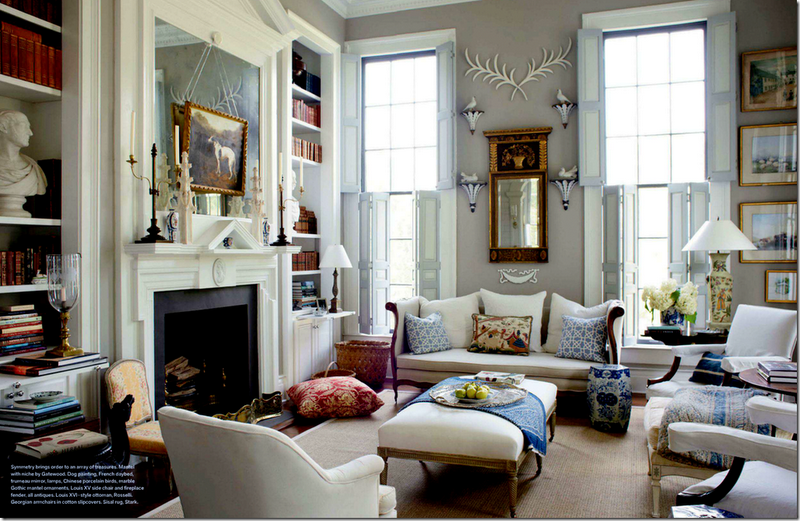
I also ended up scrolling through Barrie Benson’s portfolio and came across these two old friends hanging on the walls…

And while we are at it, there is always room for more Japanese glass fishing float inspiration, whether it be subtle, as in this Scott Currie beach house (note the rope banister too)…

…or fairly over the top via The Enchanted Home! Floats with baskets, cut down altar table for a coffee table, giant planter and Madeline Weinrib rug, – gorgeous, no?

Don’t forget to click into my last post and enter the giveaway for the ZAK + FOX pillow! Simply leave a comment on my post and then hop over to Zak’s site and enter your name in the mailing list.

Related Posts:
Identify This…Brass Drum Stool
Kawagoe Shrine Sale Never Disappoints
Made for Export and in My Basement…Seto Porcelain Garden Stool
Feeling Fresh…Indigo Textiles and Tenugui
The Mail is Always Late…more on Japanese Glass Fishing Floats and Sudare
Everyone Loves Japanese Glass Fishing Floats…A Follow Up
Sheer Simplicity…More Japanese Glass Fishing Float Displays

Read Full Post »

As I wandered through the stuffed-with-junk antique stores here in New Jersey last week, I stumbled across this small Japanese Seto porcelain tea-cup and saucer. Based on its traditional Western style and shape, it was most likely made for the export market somewhere around the turn of the 20th century. This reminded me once again, that although I am a blue and white porcelain junkie in Tokyo, many of my best finds have been made abroad in the US and England. And those finds are not limited to ceramics, but also glass, silver and just about anything that could be exported.

Fine sometsuke (underglazed cobalt porcelain) has been produced in Seto City and Aichi Prefecture for about the last 200 years, although the region boasted one of the six old kilns of medieval Japan and produced pottery since the 14th century. I bought my first piece in Hong Kong 14 years ago, a square planter, drawn to the brilliance of the cobalt and the feathery painting style of the artist. Ironically, I got it for a great price as the Chinese don’t tend to value Japanese porcelain. That piece lives happily in my Tokyo living room with two siblings, found at shrine sales.

Over the years I have accumulated many more pieces, including these lovely jubako (stacked food boxes)…

…and this cricket cage and covered fan box.

Thanks to a recent Kawagoe trip, I now have 2 big fish bowls.

One of the most beautiful and rare Seto items are garden stools. A fixture in China for 1000 years, porcelain garden stools have become one of the basic staples of home decorating, but they were actually used in gardens originally. Some find them ubiquitous these days, but they continue to fill that niche between seat and table and their variety of color and design means there is a place for them everywhere. I could do a 20 photo post on amazing rooms with them, but I’ll limit myself to some blue and white ones. All Chinese as there are many more on the marketplace, and I have yet to see a Japanese one in a magazine spread.

A few posts ago, I featured the home of Brazilian designer Sig Bergamin, but did not include this photo. A blue and white garden stool sits at the edge, ready to hold a drink for the person lounging in the white chaise.

Jeffrey Bilhuber is one designer who uses them all the time to great effect. This one has lovely open fretwork on the side.

Back in 1997-1998 there was a pair of Japanese stools at a shop in Cat Street in Hong Kong that I couldn’t afford. I had never seen any like them and I fantasized about them for years. No photo of course, but they live in my memory as being hexagonal. In 2005 I found one on my first trip to Kyoto, not long after we had moved to Japan. I didn’t buy it then either, but I did take a photo! Not a great photo, but it shows you how seriously I was thinking about it. Although in retrospect, it wasn’t that great of a garden stool either.

So the tea-cup at the top of the post reminded me of the amazing find I made last summer, that somehow I had forgotten about in all the hullaballoo and busy-ness of my life.

I went down to the basement and found this. What do you think is in here?

This!

I haven’t stopped to clean it or anything but am absolutely bowled over by it! It has so many of my favorite motifs – cracked ice, fan vignettes, open fretwork - and the form and painting is spectacular. And I had literally forgotten that I had ever bought it! My swiss cheese brain is starting to worry me….

Now the question is, how do I get it back to its family and friends in my Tokyo living room?

Related post: Colors of the Rainbow…Blue and White Porcelain is Neutral. And more on porcelain garden stools at Apartment Therapy.


Image credits: All photos by me except 6. Elle Decor April 2011 photo credit: Simon Upton, 7. design by Jeffrey Bilhuber, Photo credit unknown.

Read Full Post »

I am a bit of a porcelain proselytizer, particularly of the blue and white variety. My faith lies firmly with the clear blue cobalt of Japanese Seto porcelain, and its more sophisticated cousin Imari, but I am open to decorating with blue and white of any kind, may it be Chinese, Dutch Delftware, English Staffordshire or any other. I preach the gospel often and have converted many to its charms. Sometimes my difficulty lies in convincing others of the true neutrality of blue and white and the undeniable truth that it can work with any color decor and any style of furnishings.

Having had this post living in my queue for months, adding a photo to it every now and then, I’d like to finally share a visual rainbow of the possibilities of color with blue and white porcelain. There are certain designers who could furnish the full spectrum on their own, but I have attempted to present a variety of styles and suppliers. For the most part, I have limited myself to porcelain from Asia and homes from America as it would be easy to trot out the stately homes of Europe and their incredible collections, but not that diverse.

Red – Mary McDonald

Orange – Mary McDonald

Yellow – Christopher Spitzmiller

Chartreuse Green – Markham Roberts

Hunter Green – Jeffrey Bilhuber

Laquered Cobalt Blue – Miles Redd

Blue Venetian Plaster – Allison Caccoma

Pale Blue – Milly de Cabrol

Lavender – Aerin Lauder

Pink – Mary McDonald

Brown – Ned Marshall

Grey - Grant Gibson

White and Modern -Kristen Buckingham

Rustic Elegance- Cathy Kincaid

Classic – Miles Redd

Glamorous – Daniel Romualdez

Have I converted you?

Read Full Post »

Thursday was the 28th of the month which means that it is time for the Kawagoe shrine sale. We have had a lot of rainy 28ths lately, so it was lovely to wake to a warm sunshiny day.  I went with every intention of not buying anything (ha!), which of course proved to be an impossible task. The market felt a bit quieter than usual, but there were plenty of Tokyo folks there.

The theme of the day was clearly baskets…

I was dying for these amazing huge winnower baskets, imaging them hung on a wall in the den of a country house. I know I’ve seen a recent photo of a similar basket display, but can’t remember where. When I do, I’ll add it in here.

Addendum: I didn’t find the photo I was thinking of, but I did find this one with a symmetrical display of Vietnamese fishing hats…

and this one from The Bootstrap Project (more on that in a later post) of handmade Zambian baskets displayed asymetrically.

These baskets would be perfect in a bathroom with one closed holding extra toilet paper and the other open with extra towels.

I didn’t buy any baskets, having just found this one last week. It is just perfect for holding magazines.

But there were some things I couldn’t resist…

I have a weakness for Japanese bellflowers, so this katagami stencil came home with me.

A couple of Tokyo friends got lucky and bought big Japanese fishing floats from this dealer. I got a bunch of small rolling pin or roller floats, all slightly different in shape and size, but roughly around five inches long. I figure I can’t get my big floats back to the US anytime soon, but a handful of these in a basket in the bathroom might do!

Speaking of the bathroom, I thought this kashigata looked like a sand dollar and a starfish and would be perfect to display alongside the bowls of the real things collected by the girls.

Gorgeous shape and color, but it was the glass screw top that sold me!

Is it a stool or a table? Either! This was my favorite find of the day.

Remember this post from a couple of days ago? Patina over perfection…antiques with flaws can be very affordable. I didn’t need this big Seto pot, but it was a lovely one, fishbowl style with a finished and glazed interior. At first glance a 30,000yen (about $300) piece…

…at second glance, this repair brought the price down to 10% of that.  For 3000yen ($30) it came home with me.

Friends scored big time too. The sake jug on the left came home with M, as her birthday present. I was so happy to find it after another friend got the one on the right last October.

M got this amazing roof tile cap from Nagano too.

And these 3 smaller inban hibachi (transfer printed charcoal brazier), probably from tobacco sets.

Another friend bought these gorgeous late-Edo period covered bowls. I want to research the unusual painted pattern as I know I have seen it in a museum collection somewhere.  Just so modern!

We finished with our usual post-antiquing repast. Indian food! Their keema curry is super-delish!

Read Full Post »

Follow

Get every new post delivered to your Inbox.

Join 406 other followers

%d bloggers like this: