Feeds:
Posts
Comments

Posts Tagged ‘porcelain’

What does a girl do with unmade decisions hanging over her head? Sulk? Panic? Nope! Fantasy decorate is the answer!

may-daouk-beirut-home-AD

Ever since this time last year, I have been obsessed with designer May Daouk’s Beirut home, which was featured in Architectural Digest, stunningly photographed by Simon Watson. The luminescent lavender living room, chock-a-block with blue and white porcelain, comfy seating and that divine 19th century Oushak spoke eloquently to me. And those arched windows – those windows! – maybe I really need to go back and start with them. The fact that her home was in the Middle East didn’t particularly register with me at the time and only came to seem like an important point much later. While I am only showing the living room in this post, the entire space is fantastic so click here to see the slide show over at AD.  And please be sure to click on the photos themselves in this post to see the enlarged versions which truly show the spectacular details.

Simon Watson May Daouk LR

I might not have imagined trying to apply the wonder of this space to my life before, even though it is my favorite color and holds so many favorite things. But it got me thinking…Many houses that I looked at in Doha had arched windows and large rectangular living spaces – granted not quite like this – but lovely nonetheless. So what in this photo don’t I already have? Neutral linen covered sofa? Check! A pair of velvet armchairs? Check? A big dark trestle table like the ones along the side of the room? Check! (That one is down in the garage for those of you wondering). Antique global textiles turned into pillows or throws? Check! Gobs and gobs of blue and white porcelain? Check! 19th century carpets? Check! (Although much smaller ones that could be laid over jute or seagrass perhaps). Could I be happy in Doha if I lived in a room like this? Somehow I think the answer to that is Yes!

may-daouk-beirut-home-03

I’ve even got a pair of antique slipper chairs with a bullion fringe and their original coral pink velvet fabric – definitely in the same spirit as these. And you all know I’ve got a gorgeous blue & white garden stool – just got to get it there. Should I be sure to put an IKEA Rand black and white striped dhurrie in my shipment? No, because IKEA opened in Doha just a month or so ago. Check!

may-daouk-beirut-home-04

Before you start scratching your head and thinking I am off my rocker, let me show you a few more inspiration examples, like this Moroccan fantasy from the late Domino magazine. Remember those pink chairs I just mentioned? And how divine is all that inlaid furniture? (More on that below). But the pièce de résistance has to be that armless settee upholstered a la suzani!

moroccan lavender Domino

Instead of blue & white, painted  and glazed earthenware is featured.  That would be a chance to start a whole new collection!

Moroccan lavender detail Domino

Perhaps a new collection isn’t the answer – after all I do love my porcelain. Maybe going a bit more formal – soft with a bit of whimsy actually – with the lavender and blue in the space would be lovely, just like at Aerin’s place?

Aerin lauder ED0709 pc Simon Upton

Tufted Chesterfield? Check! Queen Anne tea table? Check! (That one is in the garage too!)

APT_with_LSD_Aerin_Lauder_Vogue_

Katie Ridder gets the formal but whimsical combo down just right too.

Galbraith & Paul seeds-katieridderrooms

Another choice would be to use the fresh slate to steer off in a more modern direction. This is not my usual style but speaks to me nonetheless. The mix is outstanding! Orangey-toned tribal carpet? Check! Moroccan side table? Check!
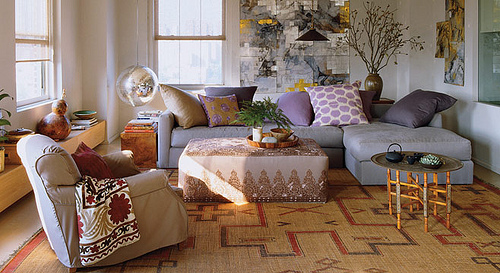
lavender moroccan room coco kelley

It seems as if the flea market gods are having their say as well. Speaking of Moroccan side tables, I found this one at the market last week and had to buy it. Trying to decide if it should go to the beach or if I should take it with me.

IMG_2423

Kinda seems like carrying coals to Newcastle, no?

And breaking news…In the time it took me to write this post I got a fresh email in my inbox with my elder daughter’s acceptance into school in Doha. Looks like the pendulum may be swinging that way. Hello lavender!

Related Posts:
Major Life Changes Ahead…Shall We Let the Architecture Decide?
Colors of the Rainbow…Blue and White Porcelain is Neutral

Image credits: 1, 3-4. Architectural Digest May 2012, photo credit: Simon Watson, 2. via Simon Watson, 5-6. Domino magazine, further credit unknown, 7. Aerin Lauder in Elle Decor July 2009, photo credit: Simon Upton, 8. Aerin Lauder in Vogue, via Habitually Chic, 9. Katie Ridder via Galbraith & Paul, 10. via Coco & Kelley, 11. me.

About these ads

Read Full Post »

I just got back from two quick but wonderful days in Kyoto, traveling with two dear like-minded friends.  We were worried it would be bare in winter, but in the absence of cherry blossoms or fall foliage, Kyoto was a study in green.

Green moss in gardens…

IMG_1260

…and temples everywhere.

IMG_1261

We were utterly and completely captivated by our subway car which felt straight out of the 1940s.  Mint green walls and deeper green velvet upholstery…

IMG_1268

…and even the silvery fretwork on the vents below.  How long would this fabric last in New York City?

IMG_1334

Day two changed hues as we spent most of it exploring the Fushimi Inari shrine and its thousands upon thousand of orange torii gates, each donated by Japanese businesses.

IMG_1309

Walking through the roughly two miles of gates was an extraordinary experience and the jolt of color against the winter landscape was intense.

IMG_1310

Later in the day green and orange joined together in some fretwork at Kiyomizu-dera, perched majestically at the edge of the mountains.

IMG_1311

Good luck offerings were everywhere, from the traditional kitsune (fox) messengers a the Inari shrine…

IMG_1305

…to garlands of rainbow origami cranes.

IMG_1312

Our hotel was most conveniently located in Gion, right along Shinmonzen Street, the main antiques drag of Kyoto.  Imagine that?! As we shopped, our color palette turned to blue from all the porcelain we were seeing, particularly at a shop I believe is called Akando, run by a darling older couple…

IMG_1321

…the proprietor having his likeness on their adorable business card.

IMG_1338

My friend almost bought these amazing Nabeshima dishes, but when we did the math they were well over $400.

IMG_1342

The other shop we spent serious time in I recall from my last trip. R. Kita Old Imari & Kutani has been in its location for over 70 years. They had me at the sign alone.

IMG_1327

In the window was this amazing 19th century Seto porcelain ice bucket, clearly made for the export market. It was the only Seto piece to be had amidst all the Old Imari & Kutani and I really wanted it. Unfortunately, it was a cool 1000 bucks.

IMG_1328

In general all the porcelain and other antiques were extremely expensive. Prices were way higher than in Tokyo and way way way higher than at the shrine sales. That is exactly what I remembered from previous visits.

IMG_1329

So once again, I looked – in this case instagrammed – and didn’t really buy.

IMG_1323

We did better in the soft goods department and my friend Maja of Alegria Design bought some lovely pieces of indigo kasuri to make bolster pillows. I’ve got kasuri on the brain these days, and you’ll see why quite soon as the ASIJ Gala quilt is almost complete!

kasuri

I managed to pick up a very unusually colored plum piece of kasuri.  I am nothing if not predictable! And at a year and a half out, it is starting to seem as if I will never be getting my lampshades from the custom vendor I ordered them from, so perhaps I might use this in another attempt elsewhere or a DIY!

IMG_1320

Gold was also one of the colors of the trip, as you can see from this lucky sun shot in the late afternoon at Kinkaku-ji, the Golden Pavillion.  A piece of Kyoto advice – always go there late in the day so that the sun is setting in front of the building if you want the lighting to be just right.

IMG_1258

One hidden gem we hit was the house and garden Murin-an near Nanzen-ji. Built just before the turn of the century it had that wonderful Anglo-Japan mix that I adore. The wall murals painted in the sitting room were just divine and the garden was a perfect oasis of peace and quiet in the bustling city.

IMG_1333

The Hotel Mume where we stayed was charming, in particular the sudare canopied bed area.

IMG_1335

The vending machines were particularly creative in Kyoto – Cup of Noodles anyone?

IMG_1259

That reminded me of the really interesting exhibit currently running in the Frederick Harris Gallery at the Tokyo American Club. A riff on Hokusai’s Thirty-Six View of Mt. Fuji, Peter MacMillan’s witty prints are well worth a viewing. If you are in Tokyo, it runs until February 24. If you are not, more of them can be found in my Instagram stream.

IMG_1219

And finally to wind down, a bit of black and white. It is quite common for ordinary folk to go to Kyoto and rent kimono for the day along with hair and make-up services.  These girls were not geisha (or maiko and geiko as they are called in Kyoto) but instead just having fun. You’d think they would look better in color, but it took away from their expressions.

kimonogirls

And the most modern white of all? That streamlined shinkansen, pulling in to take us home.

shinkansen

Read Full Post »

Seto jubako

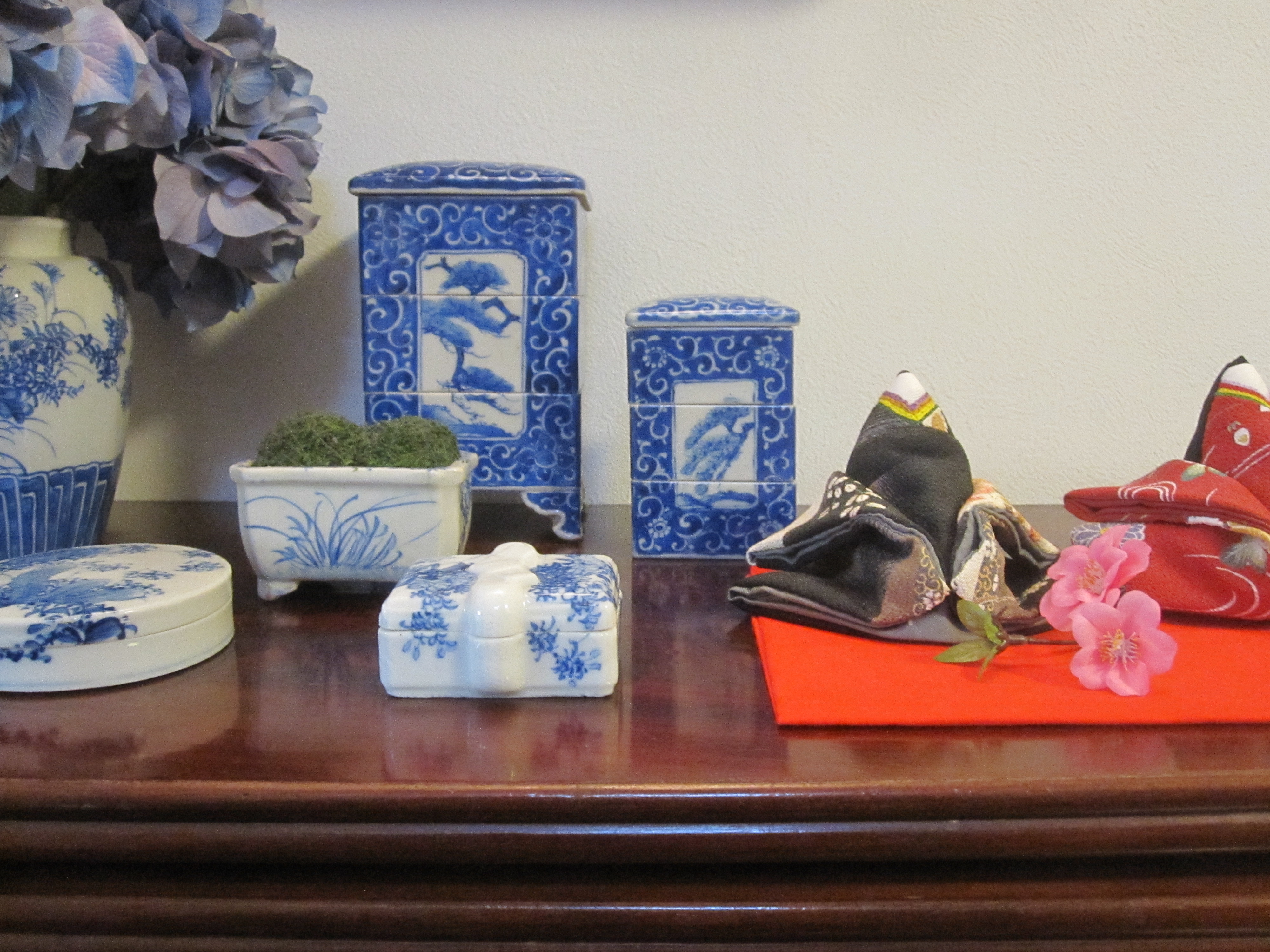
An absolute favorite of mine, porcelain jubako, stacked tiered food boxes, are harder to come across than more standard porcelain shapes such as plates and bowls. That being true, it hasn’t kept me from accumulating quite a few and helping others do the same. I always refer to them as jubako, but it may be that the porcelain ones should be called danju, while the lacquer ones are officially jubako. Shrine sale dealers call them jubako, so for now I will use the terms interchangeably. Personally I’ve never put food in mine. Instead I like to use them for trinkets on night stands, spices in the kitchen and anywhere you need to stash some small valuables.

In my entryway they hold extra keys to the house and car, buttons and hooks that have fallen off jackets and other odds and ends. Mine are unusual in that they are square, much less common than round ones, and the larger one has lovely scrolled feet. The bright cobalt and densely pigmented karakusa (scrolling arabesque pattern) are typical of Seto porcelain, and although purchased at very different times, seem to have been painted by the same artist.  I have enough Seto ware these days that I can see the hand of distinct artists on certain pieces. As for the cloth dolls on the right, they have their own extraordinary tale to tell and will be featured in an upcoming post for Hinamatsuri or Girls Day.

Seto jubako

Over the years I have helped to put together numerous collections.  It seems once bitten by the jubako bug that one is never enough. They look wonderful grouped together or mixed in with other porcelain. It’s always important to vary shapes and heights as well as the density of pigment and painted motif. This collection of five hand painted Imari jubako has a lovely balance of stylized and naturalistic motifs.

Imari jubako

This collection is used in the bathroom to hold cotton balls, Q-tips, make-up, make-up brushes and jewelry. Again note the variety of height, shape and painting style. The three outer cases are inban, Japanese transferware, while the two center ones are painted in a naturalistic style.

jubako

This trio represents three very different styles and eras and you can see those differences reflected clearly in the various shades of blue pigment.

jubako2

Here jubako are mixed with two geisha pillows, the porcelain neck rests used for preserving elaborate coiffures when lying down. I think there will have to be a post on those in the near future too.

jubako and geisha pillow

Blue and white jubako aren’t the only porcelain types out there.  I have a weakness for the prettily painted Kutani ones. This style of Kutani ware isn’t the densely pigmented and almost brocaded paint commonly associated with the best pieces from that region. (It occurs to me that I have never properly written about Kutani porcelain, so that will be added to my check list for spring.) Instead, they have a soft painterly naturalistic style.  The little sake cup warmer in the center makes a great votive candle holder.

kutani jubako

For all the thousands of ginger jars we see each month in the design press, I have almost never seen jubako featured, other than this one in John Anderson’s New York home.

jubako John Anderson

But recently I spied a lacquer one in this Vincente Wolf designed apartment on the January cover of AD – you can just see it on the table in the center of the room. While I am drawn to the porcelain jubako, the most common material they are made of is lacquer and examples of antique and new ones can be found everywhere.

architectural-digest-january-2013

They are used for traditional osechi ryori (New Year’s food) which is served room temperature in the layered lacquered boxes. For more details on the food in this photo check out Savory Japan.

osechi2012.21

The contents and the containers are things of beauty both!

Read Full Post »

A few great shrine sale finds and a good friend’s decorating plans got me to thinking about blue and white porcelain again last night – as if that is an uncommon thing for me to think about…

I had long been saving photos of groupings of porcelain on brackets or corbels, a classic way to present a collection en masse. For example, this 1959 photo of Jayne Wrightsman’s Palm Beach library designed by Maison Jansen, with a grouping of what looks to be Meissen figurines.

Figurines not withstanding, Asian porcelain, whether Chinese or other, blue and white or polychrome, tends to be the most commonly presented in this fashion. Aerin Lauder inherited this collection as well as the house from her grandmother Estée…

…and it still looks fresh today in that East Hampton home.

Carolyne Roehm went completely blue and white in her bedroom, even painting the brackets to fit in with the decor. Can’t imagine doing this in Japan, as the earthquakes would be sure to give you an unpleasant surprise one night.

Thomas Burak went with an all out chinoiserie theme in this Bridgehampton bedroom, pagoda bed, and all.

And another view.

Designer Mary Watkins Wood simplifies the look with a white background, white linens and white brackets, using mainly Chinese ginger jars. I think Japanese jubako (stacked lunch boxes) would give a similar effect. Gotta love that fantastic Portuguese bed!

Did Dallas store owner Betty Gertz have this niche custom designer for this amazing grouping of Chinese vases or was it already there? The vases themselves are Ming dynasty antiques, part of the Hatcher trove. Now how’s that for provenance?

I had never seen this show house hallway by Mary McDonald before – thanks to Jennifer at The Peak of Chic for the photos.

I love the blue and white against the grey.

Not limiting the post to blue & white, here Robert Goodwin uses a collection of Blanc de Chine figurines in a similar fashion. The fabulous wall color is Benjamin Moore’s Iron Mountain.

Miles Redd turns up the modernity a notch in this celadon dining room with a grouping of simple celadon vases on plainer matched brackets.

Here Oscar de la Renta does the same with coral in his Punta Cana home.

And perhaps the most tongue in cheek is this simple bathroom with the grandest of porcelain displays.

My question for you readers, is whether you like this look? Do you find it traditional? Elegant? Fussy? Do you like the brackets to all be the same? Or a variety? Painted like the wall color, contrasting or gilded? I am thinking on it too, considering it for an upcoming project…

Related Posts:
Colors of the Rainbow…Blue and White Porcelain is Neutral

Image credits: 1. via The Peak of Chic, , 2-3. Elle Decor, 4. Veranda via Chinoiserie Chic,  5. via The Enchanted Home, 6. House & Garden via Chinoiserie Chic, 7, 11-12. House Beautiful, 8. scanned by me from magazine tear sheets, but credit unknown, 9-10. via The Peak of Chic, 13. via Habitually Chic, 14. Martha Stewart Living via The Enchanted Home.

Read Full Post »

I am a bit of a porcelain proselytizer, particularly of the blue and white variety. My faith lies firmly with the clear blue cobalt of Japanese Seto porcelain, and its more sophisticated cousin Imari, but I am open to decorating with blue and white of any kind, may it be Chinese, Dutch Delftware, English Staffordshire or any other. I preach the gospel often and have converted many to its charms. Sometimes my difficulty lies in convincing others of the true neutrality of blue and white and the undeniable truth that it can work with any color decor and any style of furnishings.

Having had this post living in my queue for months, adding a photo to it every now and then, I’d like to finally share a visual rainbow of the possibilities of color with blue and white porcelain. There are certain designers who could furnish the full spectrum on their own, but I have attempted to present a variety of styles and suppliers. For the most part, I have limited myself to porcelain from Asia and homes from America as it would be easy to trot out the stately homes of Europe and their incredible collections, but not that diverse.

Red – Mary McDonald

Orange – Mary McDonald

Yellow – Christopher Spitzmiller

Chartreuse Green – Markham Roberts

Hunter Green – Jeffrey Bilhuber

Laquered Cobalt Blue – Miles Redd

Blue Venetian Plaster – Allison Caccoma

Pale Blue – Milly de Cabrol

Lavender – Aerin Lauder

Pink – Mary McDonald

Brown – Ned Marshall

Grey - Grant Gibson

White and Modern -Kristen Buckingham

Rustic Elegance- Cathy Kincaid

Classic – Miles Redd

Glamorous – Daniel Romualdez

Have I converted you?

Read Full Post »

To help out all my Sunday church-going readers I have been wanting to report favorably on the second Saturday of the month shrine sale at Gokoku-ji. I don’t have it on my “official” shrine sale page because I don’t like to recommend anything that might be disappointing and while it has been good in the past, I tend to find it unreliable now, both in terms of schedule and quality/quantity of  dealers and merchandise. Today wasn’t much different from that assessment – only about a dozen vendors. Now, we all know that Nogi Shrine only ever has about that many dealers at best, but they are all top quality.  The goods today were more junk shop and imports from China than real antiques, so if you live in the nearby Mejiro neighborhood or on the Yurakucho line, it might be worth stopping by. I am not sure I would have anyone travel there, although that being said, it only took me 15 minutes driving from my house on the Shuto.

Just because it wasn’t the best market doesn’t mean there weren’t things to be found.  My subconscious has been making itself heard lately by pointing me towards medium-sized unusually shaped Imari plates. I think it wants them for first course or lunch settings. I have been resisting, on the grounds that I don’t need them, but today brought two examples.

The first was eye-catching, but…

… it was the second set that was breathtaking.

If you do go and the market turns out to be lousy or unexpectedly cancelled, the Temple complex, situated up on a hill and surrounded by substantial grounds, is beautiful and well-worth visiting.  Built in 1681 by the 5th Tokugawa Shogun at the request of his mother, it has survived earthquakes, fires, and WWII, and the main temple is designated an important cultural property of Japan. Today they had a special flower arranging exhibit on the grounds and in the main sanctuary. Take note of the unusually colored sudare.

Unfortunately for me, my practical conscious mind ruled out and I didn’t buy that second set of plates. I am now mooning over the photo at home, so if anyone sees them tomorrow or next week at a different market, please feel free to let me know!

Read Full Post »

Thursday was the 28th of the month which means that it is time for the Kawagoe shrine sale. We have had a lot of rainy 28ths lately, so it was lovely to wake to a warm sunshiny day.  I went with every intention of not buying anything (ha!), which of course proved to be an impossible task. The market felt a bit quieter than usual, but there were plenty of Tokyo folks there.

The theme of the day was clearly baskets…

I was dying for these amazing huge winnower baskets, imaging them hung on a wall in the den of a country house. I know I’ve seen a recent photo of a similar basket display, but can’t remember where. When I do, I’ll add it in here.

Addendum: I didn’t find the photo I was thinking of, but I did find this one with a symmetrical display of Vietnamese fishing hats…

and this one from The Bootstrap Project (more on that in a later post) of handmade Zambian baskets displayed asymetrically.

These baskets would be perfect in a bathroom with one closed holding extra toilet paper and the other open with extra towels.

I didn’t buy any baskets, having just found this one last week. It is just perfect for holding magazines.

But there were some things I couldn’t resist…

I have a weakness for Japanese bellflowers, so this katagami stencil came home with me.

A couple of Tokyo friends got lucky and bought big Japanese fishing floats from this dealer. I got a bunch of small rolling pin or roller floats, all slightly different in shape and size, but roughly around five inches long. I figure I can’t get my big floats back to the US anytime soon, but a handful of these in a basket in the bathroom might do!

Speaking of the bathroom, I thought this kashigata looked like a sand dollar and a starfish and would be perfect to display alongside the bowls of the real things collected by the girls.

Gorgeous shape and color, but it was the glass screw top that sold me!

Is it a stool or a table? Either! This was my favorite find of the day.

Remember this post from a couple of days ago? Patina over perfection…antiques with flaws can be very affordable. I didn’t need this big Seto pot, but it was a lovely one, fishbowl style with a finished and glazed interior. At first glance a 30,000yen (about $300) piece…

…at second glance, this repair brought the price down to 10% of that.  For 3000yen ($30) it came home with me.

Friends scored big time too. The sake jug on the left came home with M, as her birthday present. I was so happy to find it after another friend got the one on the right last October.

M got this amazing roof tile cap from Nagano too.

And these 3 smaller inban hibachi (transfer printed charcoal brazier), probably from tobacco sets.

Another friend bought these gorgeous late-Edo period covered bowls. I want to research the unusual painted pattern as I know I have seen it in a museum collection somewhere.  Just so modern!

We finished with our usual post-antiquing repast. Indian food! Their keema curry is super-delish!

Read Full Post »

As a follow-up to yesterday’s post on antiquing in Nishi-Ogikubo, I wanted to devote a little more airtime to a wonderful shop, selling mainly porcelain, called Les Yeux Noirs. Owner Haruko Hasegawa has assembled one of the prettiest and most cohesive collections of antique Japanese porcelain that I have seen. She seems to buy and stock nothing ordinary – everything felt special and unusual, whether it was the motif, the shape or the pattern.

One of the things I really liked about the shop was the diversity of styles and periods and therefore prices.  While she had her very valuable Edo period karakusa (Chinese winding grass or arabesque) pattern pieces locked in a cabinet, she also had the largest most diverse collection of inban (transfer printed porcelain) I have come across. As mentioned earlier, mass-produced transfer printing did not become popular in Japan until the Meiji period, even though it had been produced extensively in the West for more than 100 years prior. In transfer printing, a pre-made image is inked with dye and then pressed against a blank surface. The dye is “transferred” (thus the name) and the item is then fired in the kiln. There is none of the hand-painting that you find on all the other types of antique porcelain. But the transfer prints have their own distinct charm and a following. At shrine sales you can often see piles of these small round plates, in a few basic patterns. Hasegawa-san had an extraordinary display with great depth and variety. They are great fun to collect – often being more affordable that other porcelain – and wonderful to mix and match.

Take a close look at this scenic, almost map-like plate and the charming momiji (maple leaf) patterned covered bowls. Both are fairly rare shapes for transfer printed pieces.

We had great fun arranging pieces into groups, perhaps for wall display. Looking closely you’ll see everything from wisteria to peach to our good friends sho-chiku-bai (pine, bamboo, plum). Quite a few of these patterns were new to me.

On the opposite side of the shop prices went up, with gorgeous pieces of Imari, like these giant display plates. Don’t let the small photos fool you – they are enormous - and would be a real focus in any room. There were also lots of  hard to find small hibachi – great for little planters.

There is also a branch of Les Yeux Noirs in the lovely mountain town of Karuizawa.  That shop is open from April 20 – May 25 and again from July 20 – November 25.  What is currently unclear to me is whether or not that means the Nishi-Ogikubo shop is closed during that period. I’ll update that here as soon as I have an answer.

The most difficult part about traveling to Les Yeux Noirs is that they are open tokidoki (sometimes) from roughly 12 p.m. until 6:30 p.m. It might be best to call ahead.  But well worth the effort!

  • Les Yeux Noirs, 4-1-22 Nishi Ogikubo: telephone 03-3395-5509
  • Les Yeux Noirs, Karuizawa: telephone 0267-42-1534

For more on antiques in Nishi-Ogikubo see Shop Talk…Discovering Antique Treasures in Nishi-Ogikubo.

Read Full Post »

While not quite on par with Dixie Highway, relaxed Nishi-Ogikubo in Tokyo’s western suburbs has a grouping of 60+ antique and vintage shops gathered near the train station. Situated along the Chuo line, Nishi-Ogikubo (nicknamed Nishiogi) was a counterculture hotbed in the 1960s, then receded from notice, only to become popular in recent years as the “slow life” movement has gained steam in Japan. It seems like just the kind of place one would find a collection of quirky and individualistic antique shops.

Conveniently, a free map of the stores is available right in front of the koban (police box) on the left side of the station right outside the North Exit. The map seems fairly current but things can change overnight, so think of it only as a basic guide. Most stores do not open before 12p.m., they all seem to have variable hit-or-miss opening days, and there is not much spoken English to be had, but it is a lovely way to while away an afternoon. Hopefully this post will help steer you in the direction of the best shops!

Organized into four zones, NE, NW, SE and SW on the map, I’ll say right off the bat that the South side of the station has much less to offer than the North side, and can be skipped entirely when pressed for time. The NW zone is by far the best for traditional antiques, so I will start the tour headed in that direction, counter-clockwise around the rough rectangle the walking tour makes.  The shops are numbered numerically on the listing pages, but do not always appear in numeric order on the map.

Actually the first few shops don’t even seem to be listed on the map. After peeking in grape, a small but charming vintage kimono shop with two other locations in the area, our first stop is not Japanese at all. Filled to the brim with lanterns, poufs, silvered mirrors and embroidered slippers, Morocco Marché is one-stop shopping for adding a bit of middle-eastern flair to your decor.

Weaving up and down the small side streets along the main road, we pass a few small shops, including Baby Doll (#60), which is not open, but full of antique and vintage toys and dolls. Moving back towards the main road we come to Les Yeux Noirs (#42), the unquestionable star of the tour, deserving its own individual post (coming tomorrow). Owner Haruko Hasegawa has one of the best eyes I have seen for choosing unusual and rare pieces of porcelain. We were very excited and spent a long time (and quite a bit of money) in her shop. If you are interested in porcelain, this is one of the main attractions and it is well worth the train ride for this store alone.

As we continue along the main road we pass mood (#45), full of groovy 60′s looking used goods. We try to stop into Quilt & Old Textiles (#44) way hidden in a back lane, but they are closed – perhaps to go to the Tokyo International Great Quilt Festival. At the turn in the main road, we come to Kido Airku (#59), a great mixed shop full of smaller tansu, porcelain, textiles and odd and ends. Unusual things there include vintage spool threads, great for using as plant stands or display props. A collection of old iron tea kettles looks great on these.

Some modern shibori dyed textiles.

One of the most interesting finds for me personally were wood blocks, used to print patterns on textiles. I have been scouring eBay for Indian wood blocks for a DIY project I am planning this summer, but hadn’t considered using Japanese ones.  Frankly, I hadn’t realized that in addition to all the stencils, tie-dying and resist techniques used here, that wood blocks are too.  Definitely something to look into more.

Numbers 48,49 and 54 were all the same named shop, Antiques Jikoh, with mainly used modern furniture. The branch at the #49 location was full of heavy oak Victorian and Arts & Crafts era furniture.

My friend H spotted a gorgeous blue and white porcelain “umbrella stand” that she loved there. I was so sorry to have to let her know it was actually a late 19th century urinal. Needless to say, she could not look past its original use.

The next two shops were eureka! moments for me. I have been searching for the perfect vintage milk glass ceiling fixture for the bathroom in the beach house, passing up many individual pieces at shrine sales. Imagine my delight at stumbling across the Teardrop Club (#53). I’ll be dragging my patient husband back there soon. If you too are interested, please note they are open 12-6 and not on Wednesday. More photos here and here.

Rakuda (#51) which means camel, also had numerous vintage light fixtures in addition to ranma (transom) panels, old doors, stained glass and cut glass…

Turning the corner right after Rakuda completes the NW zone. The tour continues east, crossing a small river. Other than the charming Le Midi (#37) full of imports from the South of France, not much else was open. Any visit to Nishi-Ogikubo comes with that risk.

Continuing to the next major intersection the tour turns right to head south back to the station. Most of the shops along this NE section seem to specialize in vintage clothing and used goods. Perhaps because we were getting hungry, they didn’t hold our attention. In the grand tradition of antiquing outside of Tokyo, we ate Indian food for lunch at Ganesha Ghar, right near #31 and the bridge over the river on the map. As would be expected, it was packed! And following shortly thereafter was Amy’s Bakeshop, which billed itself as “NY Style Sweets & Things”. Of course we had to stop!

If you arrive hungry, it might be easiest to head the opposite direction (clockwise from the station) and eat first as shops don’t open until lunch time or afterwards.

We skimmed the shops listed on the map on the South side, but many were closed, perhaps permanently. None stood out this visit but perhaps they merit a second chance.

Nishi-Ogikubo is very easy to get to and quite close to central Tokyo. It is only 16 minutes from Shinjuku and 18 minutes from Yoyogi on the Sobu Chuo line. Taking the Toei Oedo line from Azabu Juban and changing at Yoyogi took a total of 32 minutes. I’d love to hear from anyone who goes, especially if you discover a gem I haven’t mentioned. Happy hunting!

Read Full Post »

Sho-Chiku-Bai. If that name doesn’t sound Japanese to you, then you have a good ear, as it is actually the Chinese reading of the Kanji characters 松竹梅. In Japanese, they are read matsu (pine), take (bamboo) and ume (plum) and they form a threesome as one of the most popular decorative motifs the “Three Friends of Winter,” representing promise and good fortune. Together, they stand for the scholarly ideals of pure spirit (plum), longevity (pine) and flexibility (bamboo).

One of the most common places to find them is on Japanese porcelain, often in a very stylized form, so that you might not even notice they are there. This old Imari pattern is extremely common and at first glance there is no real sign of any botanical motifs.

When you look closely at the design in the round, the two trunks of the pine and the plum and the bamboo pole become visible. This central motif has been repeated on versions of this pattern for centuries and continues to be very collectible.

I’d say about a third of the traditional polychrome Imari patterns with a central roundel have our three friends in the center. Close-ups of the photos highlight the details and the difference between the blue underglaze and the enamel and gold overglaze.

So similar to the one above, yet oh so different!

Notice the different manner of painting the pine on this dish – the spiky needle style instead of the puffy bush style.

The Three Friends of Winter are also a common motif on Japanese transfer printed blue and white porcelain. Transfer printing was invented in England in 1756 and is commonly associated with the Staffordshire potteries and the classic “Blue Willow” pattern. This process was developed as an inexpensive way to recreate the characteristics of the hand painted underglaze blue ceramics of China and Japan. Ironically, transfer printing does not become popular in Japan until the late 19th century, but modern-day markets abound with transfer printed pieces that show it eventually did. Often very inexpensive, they are a great purchase as they have more character than modern blue and white. Patterns are often standardized (like this stylized Sho-Chiku-Bai dish) so collecting a particular one is easy – or they are fun to mix and match.

This small covered dish is also transfer printed, with the plum and bamboo encased in fans (a common design device) and the pine in snow, represented by the ruffled circle surrounding it.

This small dish has a naturalistic rendering.

The Three Friend of Winter are not limited to porcelain. They can be found on lacquer…

…and here is a set of three kashigata (sweets molds) in the motif.

This paste-resist dyed indigo cloth takes a different approach, blending the naturalistic pine and plum with the stylized kamon for bamboo. The process is called tsutsugaki (literally, tube drawing) as rice paste is squeezed from a tube to draw the design, much like a giant crayon. The cloth is subsequently dyed and then the rice paste is washed off. This antique futon cover dates to the late 19th century.

Same for this one.

A more formal version can be found on this brocade fukusa. Popularized in the Edo period, a fukusa was used to “wrap” a formal or important gift by being draped over the box or tray on which it was presented. The Three Friends are a very common motif on fukusa as they represent such good wishes to the recipient as well as the New Year.

Speaking of important gifts, how about this set of watches from Vacheron Constantin? They have paired up with Zohiko, a 300+ year old lacquer maker in Kyoto to create these limited edition maki-e (literally, sprinkled picture) timepieces, embellished with Sho-Chiku-Bai. I am not sure what you do with three and at $335,000 for the set, I don’t think I’ll be getting them anytime soon. But interesting, desu ne (isn’t it)?

All of these example came from the Antique Jamboree held at Tokyo Big Sight the weekend of January 8-9th. And for more on the symbolism of these three friends, see Kadomatsu…A Traditional Welcome for the New Year.

Image credits: All images by Jacqueline Wein except Blue Willow platter: marks4antiques.com, and Vacheron Constantin watches: via House of Pens

Read Full Post »

Older Posts »

Follow

Get every new post delivered to your Inbox.

Join 424 other followers

%d bloggers like this: