Feeds:
Posts
Comments

Posts Tagged ‘obi’

Each year after the ASIJ Quilt is completed, I am left with a crafting hole in my life. Last year, the lovely and talented Erin Leong brought her hand sewn iPad case to one of our last quilting sessions and the oohs and aahs were deafening.

IMG_6119

Using vintage and antique obi, kimono and haori lining fabrics, coupled with obijime as closure ties, she fashioned cases pretty enough to stand on their own as small clutches in addition to their proscribed use.
IMG_6120

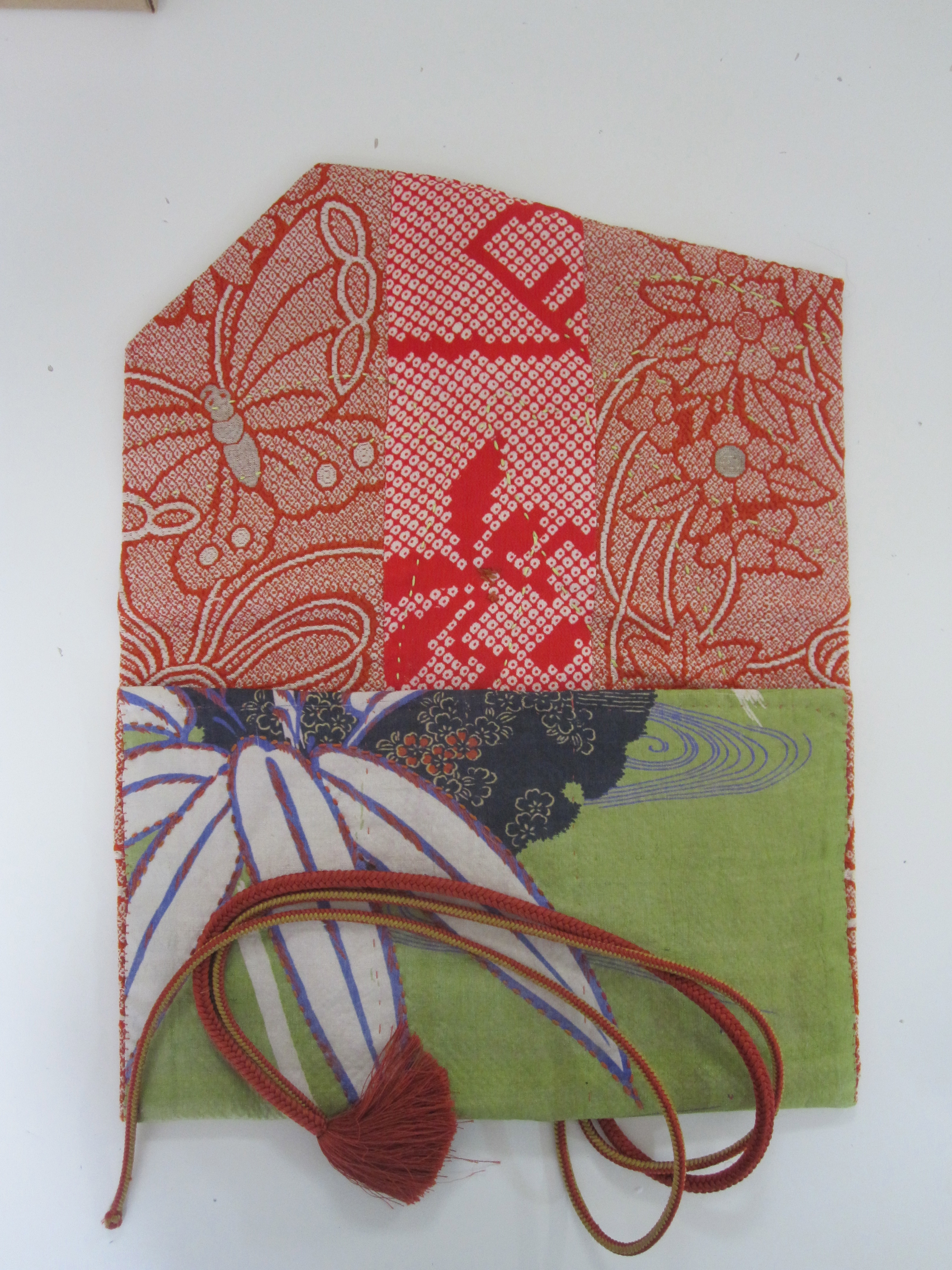
We decided to meet and all make a case or two for ourselves. Erin brought a sample that she had just begun (click on photos throughout this post for details). Obi brocades are just thick enough to provide some soft cushioning for electronics and they are just the right width for a standard large iPad. For a Kindle or iPad mini, the width needs to be cut down to fit. Since obi are thick and reinforced inside, she takes them apart to cut the outside layer of the bag. Soft silk, rayon or cotton lining fabric is perfect for the inside.

Each one is simply a long rectangle of fabric, folded in thirds, with two sections sewed together to make the pocket and the third section left free as the flap.

IMG_6124IMG_6123

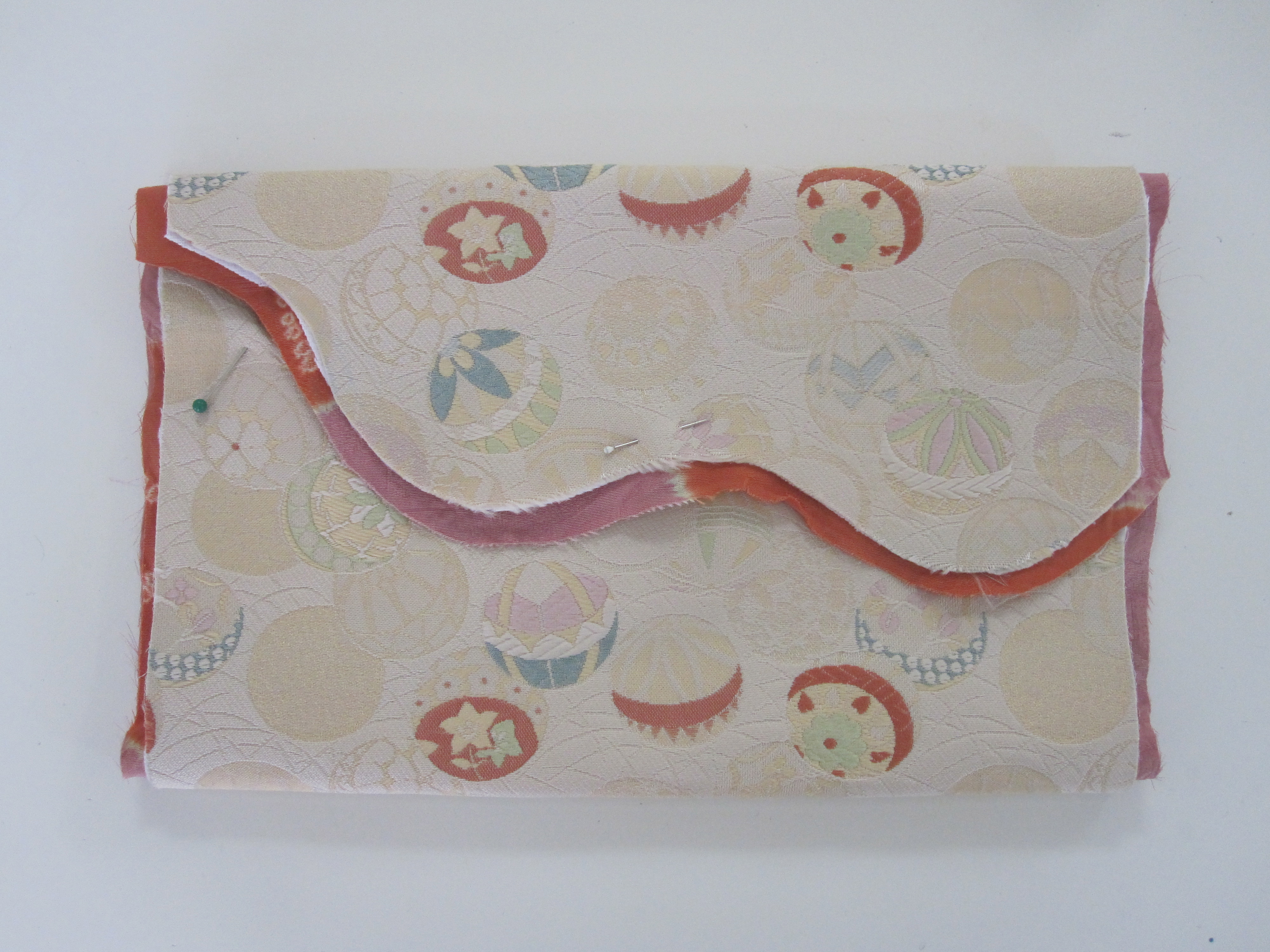
The play between the colors of the wrapped detail edge of the lining and the obijime, contrasted with the outer obi fabric is what makes these bags so fun to design. Erin has also included a bit of sashiko embroidery on her two bags, giving them extra depth and detail.

IMG_1294

This one was custom sized for a Kindle.
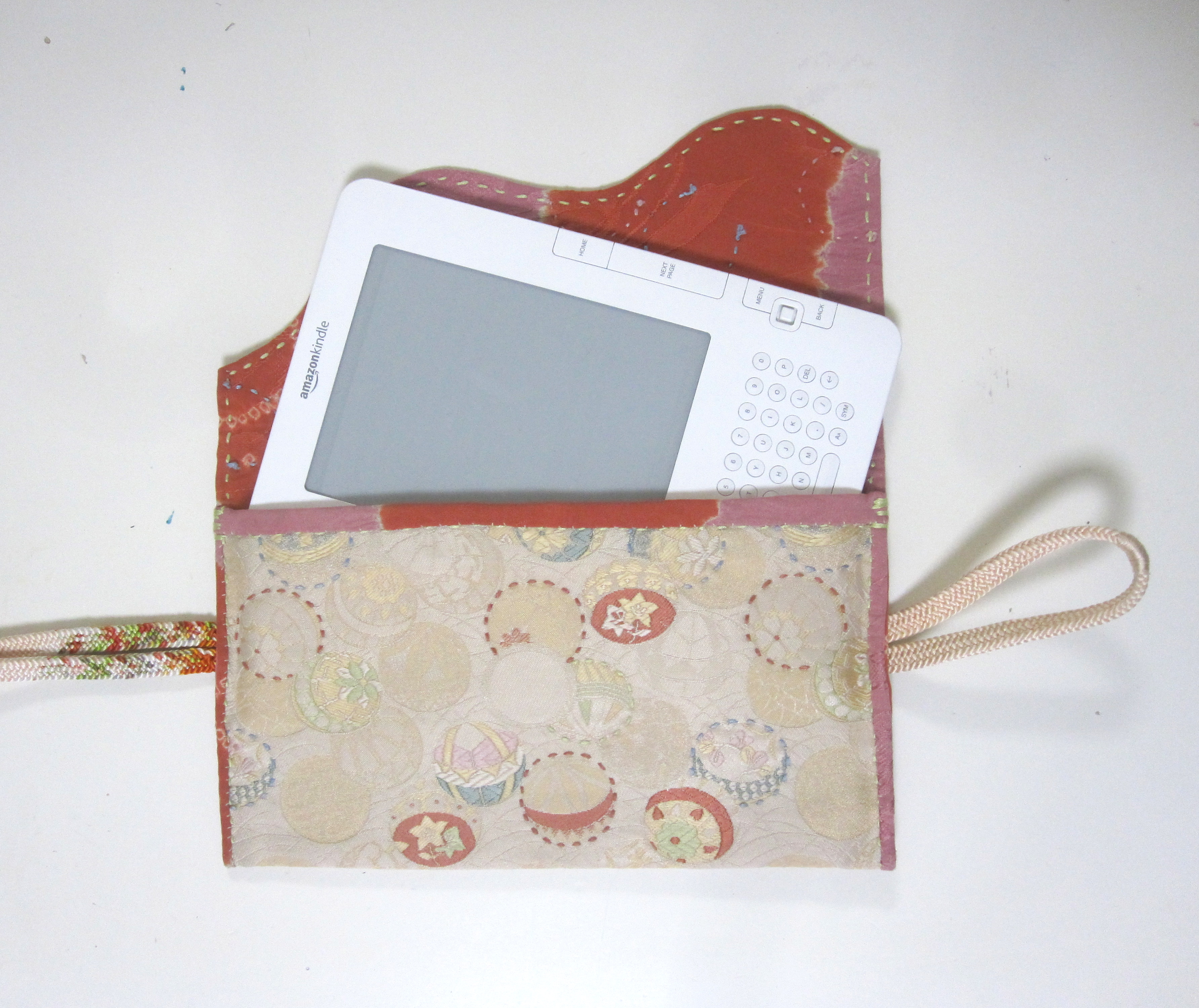
IMG_1298

She and I pooled our stash of non-valuable obi for the group and the creativity began. Combinations were tried out and tested.

IMG_6130IMG_6128

In the end, this traditional brocade on the left looked best paired with the indigo cotton in a stylized bamboo pattern on the right. We decided that a curvy flap went best with the pattern too. If you compare Erin’s two bags above, one has an angular flap, while the other a soft scroll similar to this one.  Aesthetic decisions were left to each person and dependent on the fabric and taste.

The outer fabric is cut to be about half an inch wider on each side than the object you want stored in it. The lining is cut with about an additional quarter-inch seam allowance. If you cut it too big, it is too bulky to sew along the outside edge.  Cut it too narrow and you can’t fold it under to make a clean edge before sewing. There are no exact instructions for this project – it is kinda do as you go.

IMG_6135

This case looked a little blah when finished and closed, so a bright orange obijime and some sashiko stitching were added. You’ll notice that small cases look and work best with the obijime running horizontally, while on the large size it is best vertically.

IMG_1296

Erin’s detail work is lovely – she did all the sashiko stitching on this one.

IMG_1297

This is another that I made and love the play of the watery green lining and the bold mauve obi. The cases are designed to look handmade, and to counteract the formality of this piece I sewed the lining edge with a blanket stitch, done in a very casual style.

IMG_6132IMG_6136

In the end, the case had some issues.  I had decided I wanted the extra thickness of the obi and did not dismantle it.  The net result was that it was almost impossible to get the needle through to sew it. Does that sound familiar? Without Erin’s assistance it would never have been done! As it is quite formal and very pretty, I think it will be kept to use as an evening clutch – I can’t quite see dragging it around as a case.

IMG_1295

Another friend could not resist the idea of making an evening bag and chose a formal silk obi and silk lining that matched and contrasted at the same time.
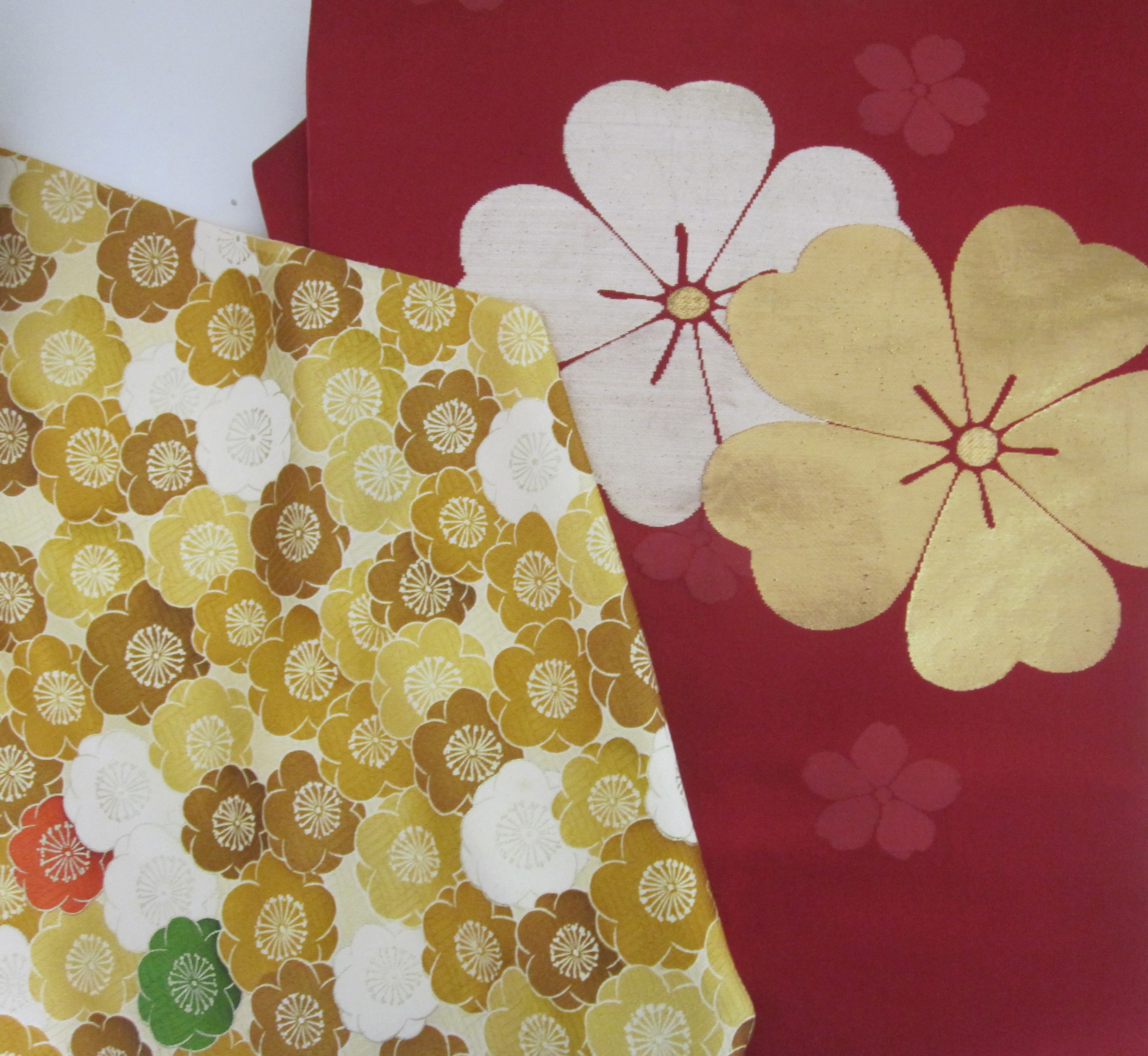
IMG_6126

IMG_6134

She never got around to finding an obijime for it so I believe she simply used a hidden interior fastener. I think that one green flower in the lining is what makes this so perfect and so Japanese!

obi ipad caseobi ipad case inside

Yet another friend went all green – fancy brocade exterior with silk lining in a realistic bamboo pattern. After taking apart her obi, she found the fabric to be too soft, so she reinforced it with some iron-on interfacing. You can see how each project evolved a bit differently. She also chose to follow the shape of the hexagon in the brocade when cutting the shape of her flap. I’m not sure she has progressed much beyond this point.  Like I said, sewing through obi fabric is a huge pain!
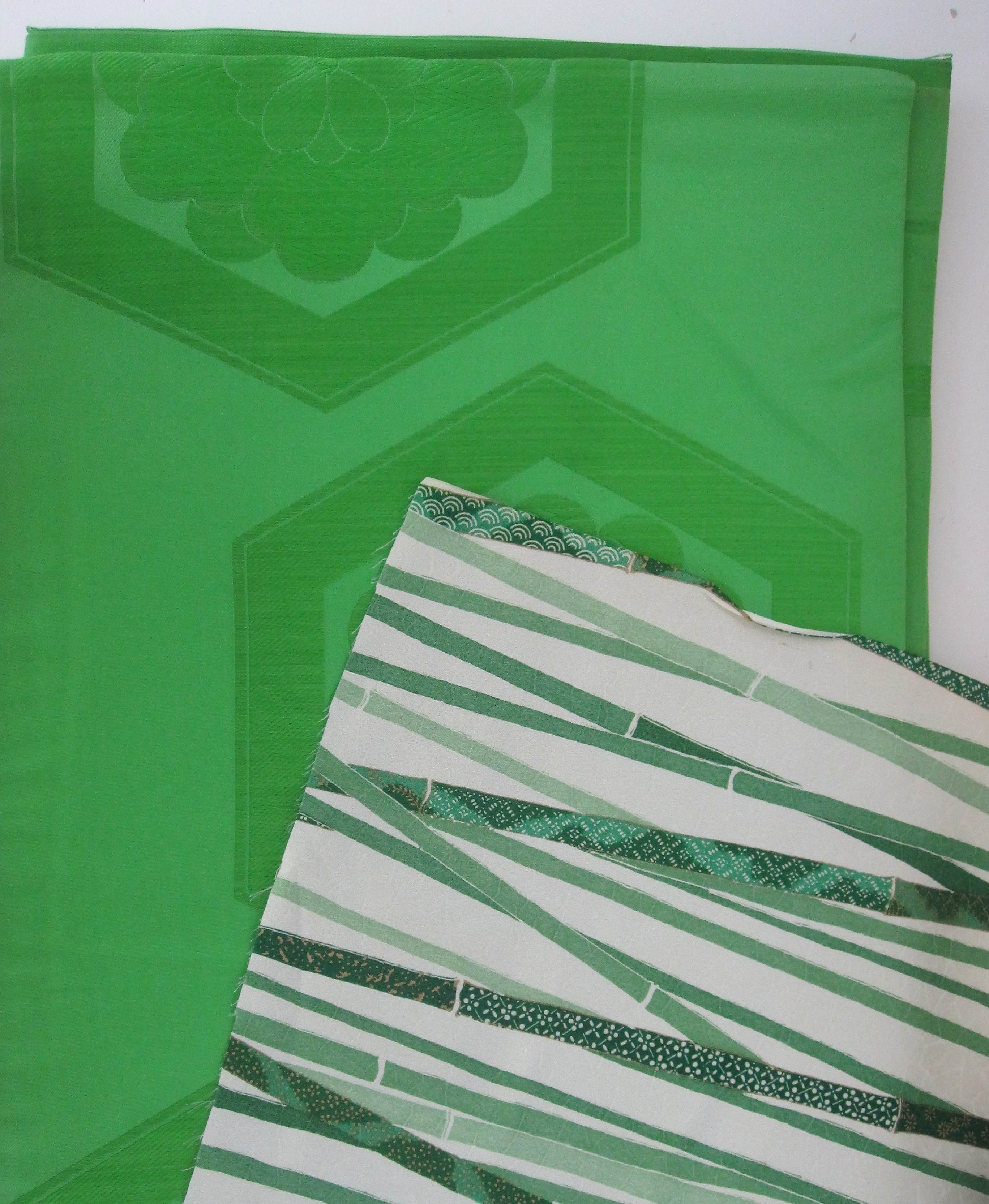
IMG_6125IMG_6133

We are trying to convince Erin to start making these for sale, so if you would be interested, please give a shout out in the comments or send me an email.  They are absolutely gorgeous – the combination of antique and vintage textiles with the hand sewing is so unusual.

Related Posts:

A Not Quite DIY…An Obi and Quilt Block Pillow Tale
The Magpie Gene…Vintage Kimono and Judyth van Amringe
Saving Coral…Finding Treasure in Shrine Sale Junk
About these ads

Read Full Post »

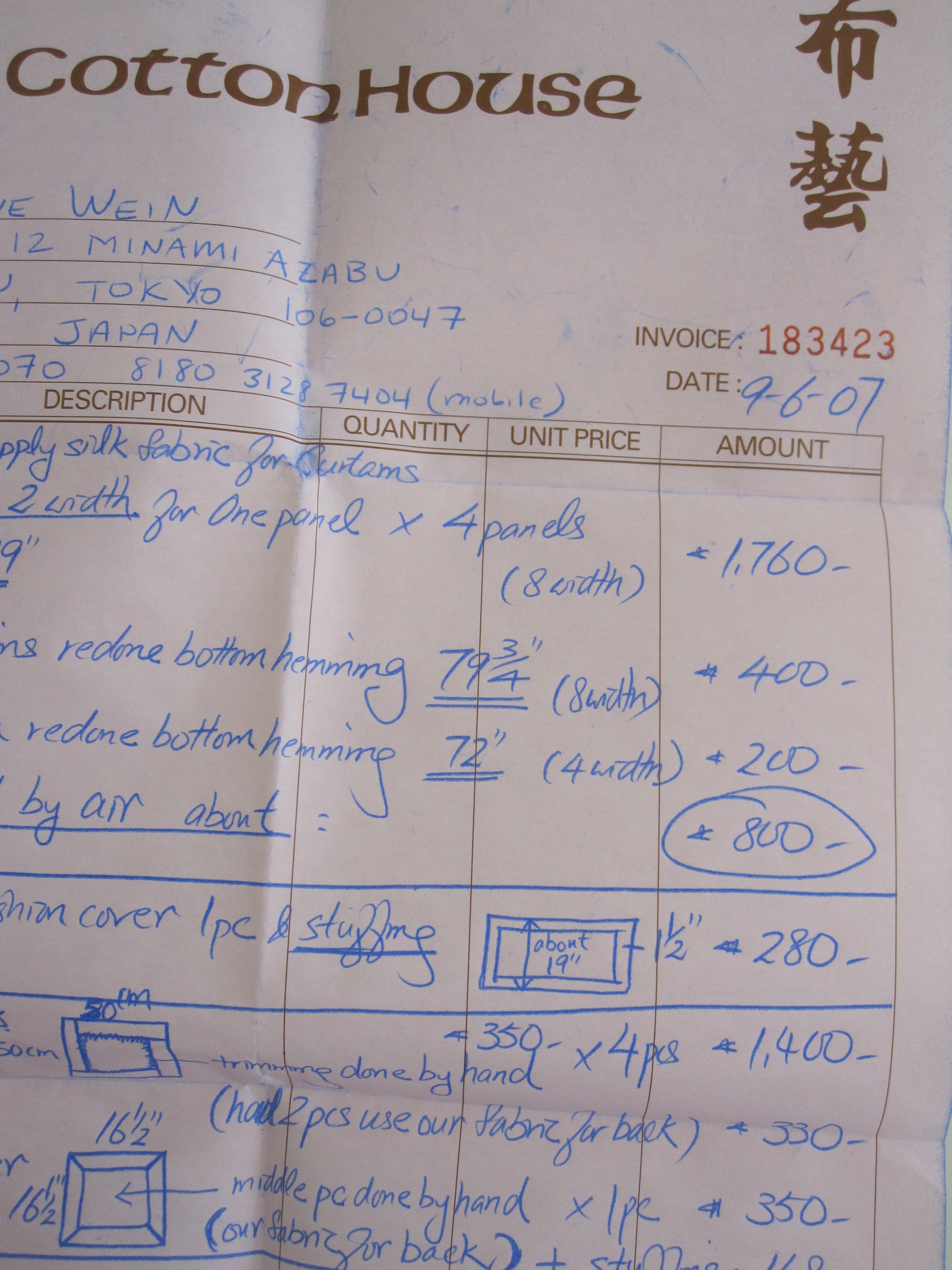
This is one of those posts that I can’t help start with the punch line. Compare the date on the receipt to the left (9-6-2007) with today’s date and it will give you an idea of just how long this project has been in process. Actually, in truth, it has been in process for many more years than that, but its “active phase” has been over these past 5 years.

At some point many years ago I found a group of antique quilt squares in a standard pineapple pattern, but made out of classic crazy quilt fabrics including satins, silks and velvets. I can’t quite date them, but they must be late 19th to early 20th century, part of an unfinished quilting project, that found their way to an antiques fair. With no clear idea of how I would use them (pillows perhaps?) I purchased them and put them away. Years later I unpacked them from my shipment when I arrived in Japan and was happy to rediscover them.

For the non-quilters out there, the pineapple pattern starts with a central square to which narrow strips of trapezoidal fabric are sewn, creating a saw tooth effect. It can be a very busy quilt block by varying the color every row, or different effects can be achieved by holding the colors steady or shading them progressively. If this part of the post particularly interests you, there is a nice overview and example of pineapple block making here.

The ease of finding vintage Japanese textiles and the link between crazy quilts and Japan inspired me to design pillows with the quilt squares at the center and a border made of vintage obi (kimono sashes). I spent months searching out the perfect obi for each square, both in terms of color and variety of pattern. In addition, I needed a different trim for each pillow to cover the juncture where the quilt block met the obi. For this blue one I was lucky to have some antique French velvet trim, another of those purchases made years ago (in this case in Paris at Port de Clingancourt) with no clear use in sight.

The odd colors in this square, a golden honey and pale seafoam mixed with burgundy velvet center and corners proved challenging, but this large-scale repetitive obi pattern proved perfect.

For the varying shades of chartreuse and green in this pillow I went with a pale obi, thinking it would make a nice contrast.

Somewhere along the way I pulled out this old embroidered Chinese patch and paired it with a kaku-obi (men’s obi). While the other pillows would have log cabin corners, I planned for this one to make use of the graphic stripes in the kaku-obi and have mitered ones.

And there was one in a completely different colorway, which I could use in my bedroom with a plain velvet border and pretty ribbon trim.

After numerous broken needles on my sewing machine, I decided professional intervention was necessary. Therein begins the story of the receipt. On a trip to Hong Kong in September of 2007 I brought them to my usual seamstress and asked her to make the pillows, along with some curtains for my house in Tokyo. I paid her and left, sure I would see them within a few weeks. The curtains came promptly, but somehow the pillows never came. I called her repeatedly in the beginning, but she could not seem to get any of her regular workers to make them.  I offered more money, but she wouldn’t take it. She just kept saying she would get them done.

In the months that followed I remembered to call intermittently. Over time, the calls became further and further apart, until I had just about forgotten entirely about them. Then an article in the January 2011 Martha Stewart Living about log cabin quilting, in particular the photo of throw pillows below, reminded me of them and made me determined to get them finished. As Hong Kong was a stop on our evacuation-vacation last spring after the earthquake, I visited the tailor yet again, persuaded her to complete them and left my very kind friend who lives there to follow-up.

I am not the first to use obi to make throw pillows. Many designers and pillow makers take advantage of the heavy brocades and gorgeous colors and patterns available. More often than not, the obi is run down the pillow vertically, bordered with trim and fabric on either side, much like these from Stephen Miller Siegel. And having seen the price tag on these babies, I am all for the DIY or semi-DIY version – these would not be at all difficult to make – as the obi could be sewn on top of an existing pillow.

Here, an obi has been used on a chair in a similar long fashion, reminding me a bit of Muriel Brandolini‘s signature chairs. Just a gorgeous application!

In other cases, the long narrow aspect of the obi is used to make a bolster shaped pillow, often without any additional trim, much as in this iconic 1969 photo of Cecil Beaton’s London home.

My friend D has recently whipped up these similar obi pillows, adding the perfect accent of color and comfort to her deep sofa. It took her no time at all as obi are double-sided and hollow – all she did was cut, stuff and sew up the short side seam with an invisible stitch!

By far the most beautiful obi pillows I have ever seen are these in Candia Fisher’s New York library. I can’t imagine the room without them.  Be sure to note the amazing Japanned linen press – by the time I get around to writing that post I have long been promising I will have used all my photos already. More photos of this amazing apartment can be found at Elle Decor or Habitually Chic.

As for my pillows, thanks to my ever vigilant friend, they finally arrived finished. It took me a few months to find some down pillow inserts here in Tokyo, but even that is now complete. The question that remains is where to use them, although in the meantime I have deployed them to the Chesterfield. I love the way the sawtooth edges, which look almost like pinwheels, pick up on the angles in the kilim rug. Click on the photo to see the details up close – they really are spectacular!

And here is the pale pinky one on the velvet settee in the master bedroom.

And speaking of pillows, we have chosen a winner for the ZAK + FOX pillow giveaway. Drumroll, please! The lucky entrant is number 8, none other than Angela, a reader from Belgium who loves all things linen and all things Japanese. Congratulations!

Related Posts:
A Curtain’s Leading Edge…a New Idea for Kaku-obi
Japan-a-mania…Cracked Ice and Crazy Quilts

Image credits: 1, 3-7, 13-15. me, 2. via Get Creative, 8. Martha Stewart Living January 2011, photo credit: Ditte Isager, 9. Stephen Miller Siegel via 1st dibs, 10. via Eclectic Revisited, 11. Architectural Digest Fall 1969, 12. Elle Decor November 2009, photo credit: Pieter Estersohn

Read Full Post »

While not quite on par with Dixie Highway, relaxed Nishi-Ogikubo in Tokyo’s western suburbs has a grouping of 60+ antique and vintage shops gathered near the train station. Situated along the Chuo line, Nishi-Ogikubo (nicknamed Nishiogi) was a counterculture hotbed in the 1960s, then receded from notice, only to become popular in recent years as the “slow life” movement has gained steam in Japan. It seems like just the kind of place one would find a collection of quirky and individualistic antique shops.

Conveniently, a free map of the stores is available right in front of the koban (police box) on the left side of the station right outside the North Exit. The map seems fairly current but things can change overnight, so think of it only as a basic guide. Most stores do not open before 12p.m., they all seem to have variable hit-or-miss opening days, and there is not much spoken English to be had, but it is a lovely way to while away an afternoon. Hopefully this post will help steer you in the direction of the best shops!

Organized into four zones, NE, NW, SE and SW on the map, I’ll say right off the bat that the South side of the station has much less to offer than the North side, and can be skipped entirely when pressed for time. The NW zone is by far the best for traditional antiques, so I will start the tour headed in that direction, counter-clockwise around the rough rectangle the walking tour makes.  The shops are numbered numerically on the listing pages, but do not always appear in numeric order on the map.

Actually the first few shops don’t even seem to be listed on the map. After peeking in grape, a small but charming vintage kimono shop with two other locations in the area, our first stop is not Japanese at all. Filled to the brim with lanterns, poufs, silvered mirrors and embroidered slippers, Morocco Marché is one-stop shopping for adding a bit of middle-eastern flair to your decor.

Weaving up and down the small side streets along the main road, we pass a few small shops, including Baby Doll (#60), which is not open, but full of antique and vintage toys and dolls. Moving back towards the main road we come to Les Yeux Noirs (#42), the unquestionable star of the tour, deserving its own individual post (coming tomorrow). Owner Haruko Hasegawa has one of the best eyes I have seen for choosing unusual and rare pieces of porcelain. We were very excited and spent a long time (and quite a bit of money) in her shop. If you are interested in porcelain, this is one of the main attractions and it is well worth the train ride for this store alone.

As we continue along the main road we pass mood (#45), full of groovy 60′s looking used goods. We try to stop into Quilt & Old Textiles (#44) way hidden in a back lane, but they are closed – perhaps to go to the Tokyo International Great Quilt Festival. At the turn in the main road, we come to Kido Airku (#59), a great mixed shop full of smaller tansu, porcelain, textiles and odd and ends. Unusual things there include vintage spool threads, great for using as plant stands or display props. A collection of old iron tea kettles looks great on these.

Some modern shibori dyed textiles.

One of the most interesting finds for me personally were wood blocks, used to print patterns on textiles. I have been scouring eBay for Indian wood blocks for a DIY project I am planning this summer, but hadn’t considered using Japanese ones.  Frankly, I hadn’t realized that in addition to all the stencils, tie-dying and resist techniques used here, that wood blocks are too.  Definitely something to look into more.

Numbers 48,49 and 54 were all the same named shop, Antiques Jikoh, with mainly used modern furniture. The branch at the #49 location was full of heavy oak Victorian and Arts & Crafts era furniture.

My friend H spotted a gorgeous blue and white porcelain “umbrella stand” that she loved there. I was so sorry to have to let her know it was actually a late 19th century urinal. Needless to say, she could not look past its original use.

The next two shops were eureka! moments for me. I have been searching for the perfect vintage milk glass ceiling fixture for the bathroom in the beach house, passing up many individual pieces at shrine sales. Imagine my delight at stumbling across the Teardrop Club (#53). I’ll be dragging my patient husband back there soon. If you too are interested, please note they are open 12-6 and not on Wednesday. More photos here and here.

Rakuda (#51) which means camel, also had numerous vintage light fixtures in addition to ranma (transom) panels, old doors, stained glass and cut glass…

Turning the corner right after Rakuda completes the NW zone. The tour continues east, crossing a small river. Other than the charming Le Midi (#37) full of imports from the South of France, not much else was open. Any visit to Nishi-Ogikubo comes with that risk.

Continuing to the next major intersection the tour turns right to head south back to the station. Most of the shops along this NE section seem to specialize in vintage clothing and used goods. Perhaps because we were getting hungry, they didn’t hold our attention. In the grand tradition of antiquing outside of Tokyo, we ate Indian food for lunch at Ganesha Ghar, right near #31 and the bridge over the river on the map. As would be expected, it was packed! And following shortly thereafter was Amy’s Bakeshop, which billed itself as “NY Style Sweets & Things”. Of course we had to stop!

If you arrive hungry, it might be easiest to head the opposite direction (clockwise from the station) and eat first as shops don’t open until lunch time or afterwards.

We skimmed the shops listed on the map on the South side, but many were closed, perhaps permanently. None stood out this visit but perhaps they merit a second chance.

Nishi-Ogikubo is very easy to get to and quite close to central Tokyo. It is only 16 minutes from Shinjuku and 18 minutes from Yoyogi on the Sobu Chuo line. Taking the Toei Oedo line from Azabu Juban and changing at Yoyogi took a total of 32 minutes. I’d love to hear from anyone who goes, especially if you discover a gem I haven’t mentioned. Happy hunting!

Read Full Post »

I like living with my stuff. I feel safe when it’s around.
Judyth van Amringe

Some expats come abroad with nothing but a few suitcases and rent furniture for their apartments or buy everything new again. But we brought everything we owned, lock, stock and barrel, because I am in complete agreement with Judyth van Amringe. I like living with my stuff. And living in Tokyo with my things – gathered slowly and carefully over time –  makes me feel connected to the very fabric of my life when I am so far from home.

Fabric, it seems, is something I cannot resist. Once again, at the shrine sale this weekend, I bought another vintage kimono. I tell myself I don’t need another but their colors, their patterns and the feel of the fabric call out to me. It’s easy to give in as they are relatively inexpensive, costing all of 500-1000 yen ($5-$10). I imagine the projects, the throw pillows, and the dress-up possibilities, both for the imaginary play of my children and for myself. This weekend my friend C actually found a fabulous black lace happi coat (short kimono) at the market and she plans to wear it over a camisole and skinny jeans for a night out.

I really believe there is such a thing as a “magpie gene” and that the desire to collect is inborn in some of us. My younger daughter, who is all of 6 years old, has it for sure. She has dug up a collection of porcelain and pottery fragments from the dirt of all the parks around us in Tokyo and keeps boxes and boxes of them for some future use (Why the fragments are there is another question entirely).  Her eye is good enough that when she finds a piece of the Seto region porcelain I collect, she can pick it out to give to me to add to my collection.  This giant fragment took her a number of tries over a few days to dig up and we are thinking of using it as a doorstop.

Collecting, assembling and re-purposing are inherent to the magpie mentality. Reading Dominique Browning‘s blog Slow Love Life last night I stumbled across scarves made of vintage kimono by artist Judyth van Amringe. Van Amringe seems to be the master magpie - an artist working in many different mediums, switching gears throughout her life. And Dominique Browning herself (formerly editor-in-chief of the now defunct House & Garden) is re-purposing as she explores life in the slow lane. I am looking forward to reading her book Slow Love: How I Lost My Job, Put On My Pajamas & Found Happiness. The title alone is irresistible.

In making the scarves, Judyth combines different fabrics and colors and they are reversible. Sometimes she adds details like beads or embroidery. They sound as interesting as they look in the photos, but I do wish I could see the combination of fabrics more clearly.  This silk ikat positively glows – I’d love to know what she adds to it.

This one has embellishments, with a narrow obi jime (silk cord overbelt) and beads. It may even be a purse as she makes them too.

To my thinking, Judyth van Amringe’s apartment may very well be her “master work”, an accumulated montage of a life’s belongings distilled into a small space. The expression used to describe her place by The New York Times is “artfully crammed” and it is a good one.  Van Amringe brings nothing new in without knowing where it is going and how it will relate to everything already there. Her space feels serene, even though it is jam-packed with objects, most of which she has changed or improved in some way. 

To compensate for a standard boring bathroom in her rental, she layered a huge bookshelf, a hand carved coat stand, an upholstered slipper chair and real rugs. Oh, how I love real rugs in a bathroom, but that will have to wait for a future post.

It looks like a perfect spot for a little birdie to rest…

Photo credits: 1 & 2. me, 3 & 4. from Slow Love Life, 5 & 6. The New York Times, Photo: David Allee

Read Full Post »

Vintage and antique obi (the wide sashes tied around Japanese traditional dress called kimono) abound at shrine sales and markets. Most purchasers plan on wearing them. Others buy them just for the beauty of the textiles as they are most commonly made of silk, cotton or rayon and use many different weaving and dyeing techniques from brocade to ikat.  Still others see the decorative possibilities in these long strips of fabric. 

Note the obi fabric pillow on the small red banquette in Cecil Beaton’s London townhouse living room, photographed for Architectural Digest circa 1969.

Fashion designer Trina Turk uses an obi as a table runner in the dining room of her Los Angeles home (Elle Decor Aug. 2007).

While women’s obi have long been collected and made into throw pillows, table runners and the like, men’s obi, called kaku-obi, are not seen in interior design. I have long thought that their narrow shape, stiff feel, and simple graphic patterns would make them useful for some other purpose. But what?  Today, at the Oedo Antique Fair, they caught my eye at a number of booths. 

How they are tied was a mystery to me, and frankly, the dealer selling them did not know either. In classic Japan style, another customer overheared our discussion, and offered to teach me how. The dealer’s partner served as the model and I got a great lesson on how to tie kaku-obi.

My somewhat credible (according to them) second attempt.

Thanks ladies! They also had great kimono and indigo dyed fabrics.

A charming detail found on some of the best curtains is a contrasting leading edge or decorative tape. Two wildly different style rooms below illustrate this design. Both make use of a greek key tape on the curtain edge and, in the case of the Miles Redd dining room, on the bottom edge as well.

Grant K. Gibson’s San Francisco bedroom via The New York Times.

Miles Redd designed dining room featured in Elle Decor Jan./Feb. 2009.

Don’t you think one of the simple two tone kaku-obi would be perfect to edge a curtain? Trim a bedskirt or a chair? Finish off a valence?

Image credits: 1. Architectural Digest, 2. Roger Davies for Elle Decor, 3-6. me, 7. Peter DaSilva for The New York Times, 8. Simon Upton for Elle Decor

Read Full Post »

Follow

Get every new post delivered to your Inbox.

Join 424 other followers

%d bloggers like this: