Feeds:
Posts
Comments

Posts Tagged ‘Nishi-Ogikubo’

Finally, something accomplished and not just thought about! I have long admired the vintage milk glass lamps popular in Japan from the early part of the 20th century through the post-WW II era, with their peak of production and design from the 1920s-1940s.  While quite similar to their counterparts in America and Europe, the Japanese fixtures have extra details that you don’t find elsewhere, meant to approximate earlier lamps with metal mounts. The added charm of the Asian motifs make these glass lamps particularly collectible and as they are rarely seen outside of Japan, a unique addition to one’s decor.

I have a small open bottom fixture hanging in my guest room here in Tokyo as a reading lamp, since there is not really room for a proper night table. I would also like to find one for the ceiling in my newly renovated bathroom at our beach house in New Jersey, albeit much larger.

These open bottom hanging glass shades are the most common, adorned with metal, plastic or bamboo detailing…


or sometimes frosted insets, raised molded glass patterns or a combination of any and all of the above.

Less common, but still frequently seen are the closed variety, particularly this globular shape, often embellished with a hanging tassel.

Here’s another charming example.

A specialized dealer at the Antique Jamboree had an incredible collection of globe fixtures. There is a special summer Jamboree this year from July 22-24. See the ”Shrine Sale” tab at the top of the blog for more details.

Even more spectacular and unusual were these porcelain sockets and fittings. I had occasionally seen the white ones, but never before the blue and white. They seem like the kind of perfect antique detail designer Michael Smith would add to an interior project.

In addition to fixtures that hang from cords, there are also some that have a stiff metal bar. A pair of these would look perfect hanging over a kitchen island.

I debated about buying this unusual long shaped fixture. It had a nautical feel that might have been right for the beach house bathroom, but seemed too long and narrow for the space.

I loved this pair of sconces but couldn’t think of a place to put them

I never did make it back to the fantastic shop The Teardrop Club…

…or Rakuda in Nishi-Ogikubo.

In the end, I decided the detailing on the fixtures was at odds with the simplicity of the bathroom. I also had the realization that the low ceiling might not accommodate a hanging fixture. Luckily, the glass globes can also have fixed ceiling mounts.  I thought about giving up and just buying a new fixture, but in my heart I wanted the vintage charm of an older fixture (even with the hassles of re-wiring) versus a sparkling brand new one from the excellent reproduction companies like Schoolhouse Electric Co. or even the mainstream home catalogs. The answer, I decided, was a simpler more “schoolhouse” shape with a ceiling mount.

So the winner came from Kanarusha Antiques. They had long been holding another glass shade for me, waiting on finding the proper vintage fittings. So often the glass globes are available, but not the lamp socket attachments, and I didn’t want to count on anything in the US actually being the proper size. I was never sure the other shade was perfect – it seemed too small and insignificant -so last Friday I stopped by and they had this beauty!  I dug through a crate of vintage socket fittings they had just received, found this well patinated metal ceiling fitting and married it to the shade. Perfect!

A dear friend sent me this photo of a tenugui she had purchased just before leaving Japan last year. Tenugui are thin cotton towels, usually a standard size, printed with absolutely anything and used for just about everything. They probably deserve a post of their own!  I had never seen this one and got a great laugh from it. She has framed it and some others for a unique art display. Make sure to note the discontinued Lee Jofa fabric covering the chairs that we tracked down from an old 2003 issue of House Beautiful.

The lamp photos were taken over the course of the year at numerous shrine sales and different antique shows, illustrating their high level of availabilty. Keep your eyes open!

Antique Teardrop

About these ads

Read Full Post »

As a follow-up to yesterday’s post on antiquing in Nishi-Ogikubo, I wanted to devote a little more airtime to a wonderful shop, selling mainly porcelain, called Les Yeux Noirs. Owner Haruko Hasegawa has assembled one of the prettiest and most cohesive collections of antique Japanese porcelain that I have seen. She seems to buy and stock nothing ordinary – everything felt special and unusual, whether it was the motif, the shape or the pattern.

One of the things I really liked about the shop was the diversity of styles and periods and therefore prices.  While she had her very valuable Edo period karakusa (Chinese winding grass or arabesque) pattern pieces locked in a cabinet, she also had the largest most diverse collection of inban (transfer printed porcelain) I have come across. As mentioned earlier, mass-produced transfer printing did not become popular in Japan until the Meiji period, even though it had been produced extensively in the West for more than 100 years prior. In transfer printing, a pre-made image is inked with dye and then pressed against a blank surface. The dye is “transferred” (thus the name) and the item is then fired in the kiln. There is none of the hand-painting that you find on all the other types of antique porcelain. But the transfer prints have their own distinct charm and a following. At shrine sales you can often see piles of these small round plates, in a few basic patterns. Hasegawa-san had an extraordinary display with great depth and variety. They are great fun to collect – often being more affordable that other porcelain – and wonderful to mix and match.

Take a close look at this scenic, almost map-like plate and the charming momiji (maple leaf) patterned covered bowls. Both are fairly rare shapes for transfer printed pieces.

We had great fun arranging pieces into groups, perhaps for wall display. Looking closely you’ll see everything from wisteria to peach to our good friends sho-chiku-bai (pine, bamboo, plum). Quite a few of these patterns were new to me.

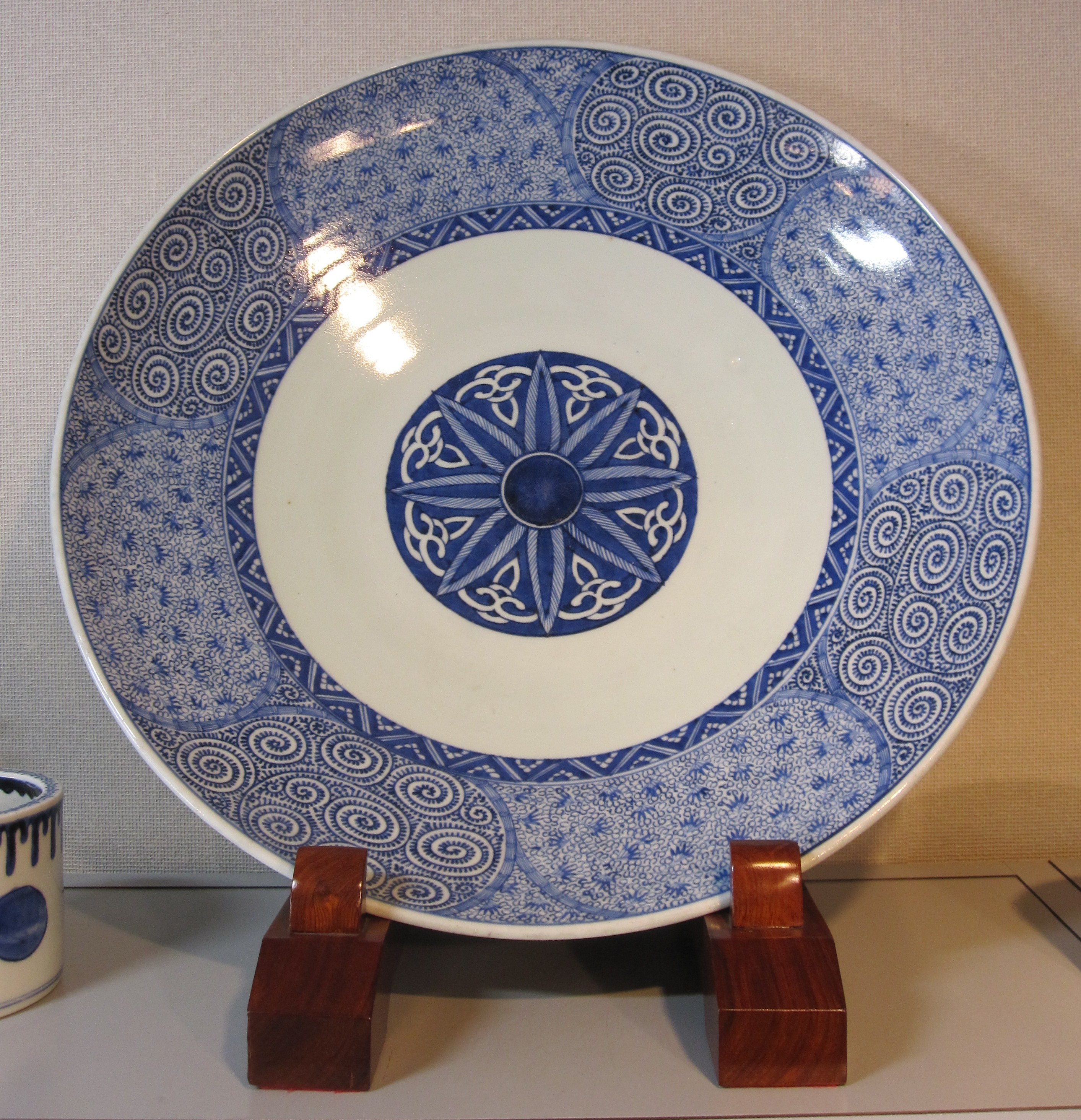
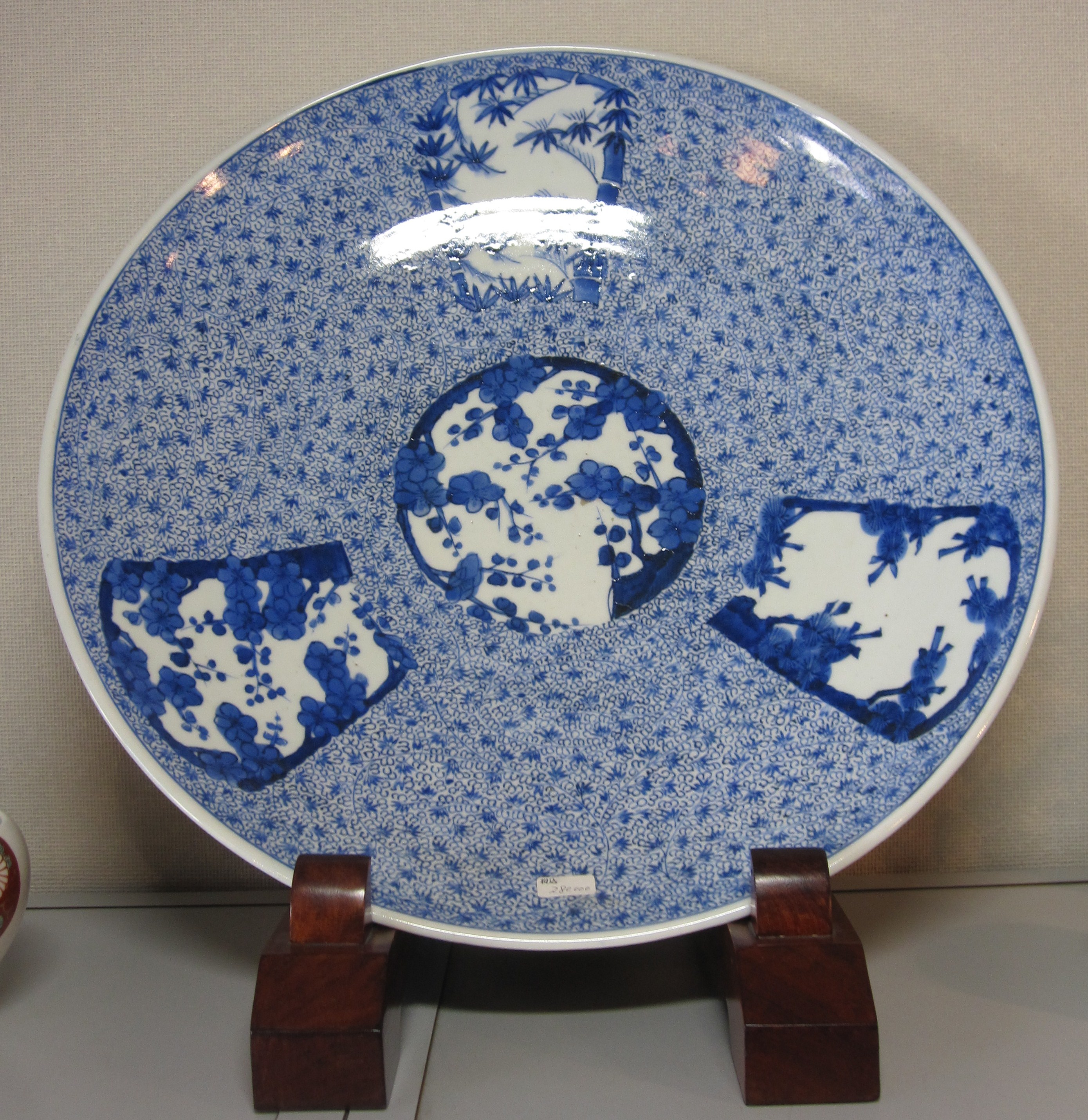
On the opposite side of the shop prices went up, with gorgeous pieces of Imari, like these giant display plates. Don’t let the small photos fool you – they are enormous - and would be a real focus in any room. There were also lots of  hard to find small hibachi – great for little planters.

There is also a branch of Les Yeux Noirs in the lovely mountain town of Karuizawa.  That shop is open from April 20 – May 25 and again from July 20 – November 25.  What is currently unclear to me is whether or not that means the Nishi-Ogikubo shop is closed during that period. I’ll update that here as soon as I have an answer.

The most difficult part about traveling to Les Yeux Noirs is that they are open tokidoki (sometimes) from roughly 12 p.m. until 6:30 p.m. It might be best to call ahead.  But well worth the effort!

  • Les Yeux Noirs, 4-1-22 Nishi Ogikubo: telephone 03-3395-5509
  • Les Yeux Noirs, Karuizawa: telephone 0267-42-1534

For more on antiques in Nishi-Ogikubo see Shop Talk…Discovering Antique Treasures in Nishi-Ogikubo.

Read Full Post »

While not quite on par with Dixie Highway, relaxed Nishi-Ogikubo in Tokyo’s western suburbs has a grouping of 60+ antique and vintage shops gathered near the train station. Situated along the Chuo line, Nishi-Ogikubo (nicknamed Nishiogi) was a counterculture hotbed in the 1960s, then receded from notice, only to become popular in recent years as the “slow life” movement has gained steam in Japan. It seems like just the kind of place one would find a collection of quirky and individualistic antique shops.

Conveniently, a free map of the stores is available right in front of the koban (police box) on the left side of the station right outside the North Exit. The map seems fairly current but things can change overnight, so think of it only as a basic guide. Most stores do not open before 12p.m., they all seem to have variable hit-or-miss opening days, and there is not much spoken English to be had, but it is a lovely way to while away an afternoon. Hopefully this post will help steer you in the direction of the best shops!

Organized into four zones, NE, NW, SE and SW on the map, I’ll say right off the bat that the South side of the station has much less to offer than the North side, and can be skipped entirely when pressed for time. The NW zone is by far the best for traditional antiques, so I will start the tour headed in that direction, counter-clockwise around the rough rectangle the walking tour makes.  The shops are numbered numerically on the listing pages, but do not always appear in numeric order on the map.

Actually the first few shops don’t even seem to be listed on the map. After peeking in grape, a small but charming vintage kimono shop with two other locations in the area, our first stop is not Japanese at all. Filled to the brim with lanterns, poufs, silvered mirrors and embroidered slippers, Morocco Marché is one-stop shopping for adding a bit of middle-eastern flair to your decor.

Weaving up and down the small side streets along the main road, we pass a few small shops, including Baby Doll (#60), which is not open, but full of antique and vintage toys and dolls. Moving back towards the main road we come to Les Yeux Noirs (#42), the unquestionable star of the tour, deserving its own individual post (coming tomorrow). Owner Haruko Hasegawa has one of the best eyes I have seen for choosing unusual and rare pieces of porcelain. We were very excited and spent a long time (and quite a bit of money) in her shop. If you are interested in porcelain, this is one of the main attractions and it is well worth the train ride for this store alone.

As we continue along the main road we pass mood (#45), full of groovy 60′s looking used goods. We try to stop into Quilt & Old Textiles (#44) way hidden in a back lane, but they are closed – perhaps to go to the Tokyo International Great Quilt Festival. At the turn in the main road, we come to Kido Airku (#59), a great mixed shop full of smaller tansu, porcelain, textiles and odd and ends. Unusual things there include vintage spool threads, great for using as plant stands or display props. A collection of old iron tea kettles looks great on these.

Some modern shibori dyed textiles.

One of the most interesting finds for me personally were wood blocks, used to print patterns on textiles. I have been scouring eBay for Indian wood blocks for a DIY project I am planning this summer, but hadn’t considered using Japanese ones.  Frankly, I hadn’t realized that in addition to all the stencils, tie-dying and resist techniques used here, that wood blocks are too.  Definitely something to look into more.

Numbers 48,49 and 54 were all the same named shop, Antiques Jikoh, with mainly used modern furniture. The branch at the #49 location was full of heavy oak Victorian and Arts & Crafts era furniture.

My friend H spotted a gorgeous blue and white porcelain “umbrella stand” that she loved there. I was so sorry to have to let her know it was actually a late 19th century urinal. Needless to say, she could not look past its original use.

The next two shops were eureka! moments for me. I have been searching for the perfect vintage milk glass ceiling fixture for the bathroom in the beach house, passing up many individual pieces at shrine sales. Imagine my delight at stumbling across the Teardrop Club (#53). I’ll be dragging my patient husband back there soon. If you too are interested, please note they are open 12-6 and not on Wednesday. More photos here and here.

Rakuda (#51) which means camel, also had numerous vintage light fixtures in addition to ranma (transom) panels, old doors, stained glass and cut glass…

Turning the corner right after Rakuda completes the NW zone. The tour continues east, crossing a small river. Other than the charming Le Midi (#37) full of imports from the South of France, not much else was open. Any visit to Nishi-Ogikubo comes with that risk.

Continuing to the next major intersection the tour turns right to head south back to the station. Most of the shops along this NE section seem to specialize in vintage clothing and used goods. Perhaps because we were getting hungry, they didn’t hold our attention. In the grand tradition of antiquing outside of Tokyo, we ate Indian food for lunch at Ganesha Ghar, right near #31 and the bridge over the river on the map. As would be expected, it was packed! And following shortly thereafter was Amy’s Bakeshop, which billed itself as “NY Style Sweets & Things”. Of course we had to stop!

If you arrive hungry, it might be easiest to head the opposite direction (clockwise from the station) and eat first as shops don’t open until lunch time or afterwards.

We skimmed the shops listed on the map on the South side, but many were closed, perhaps permanently. None stood out this visit but perhaps they merit a second chance.

Nishi-Ogikubo is very easy to get to and quite close to central Tokyo. It is only 16 minutes from Shinjuku and 18 minutes from Yoyogi on the Sobu Chuo line. Taking the Toei Oedo line from Azabu Juban and changing at Yoyogi took a total of 32 minutes. I’d love to hear from anyone who goes, especially if you discover a gem I haven’t mentioned. Happy hunting!

Read Full Post »

Follow

Get every new post delivered to your Inbox.

Join 405 other followers

%d bloggers like this: