Feeds:
Posts
Comments

Posts Tagged ‘lacquer’

Seto jubako

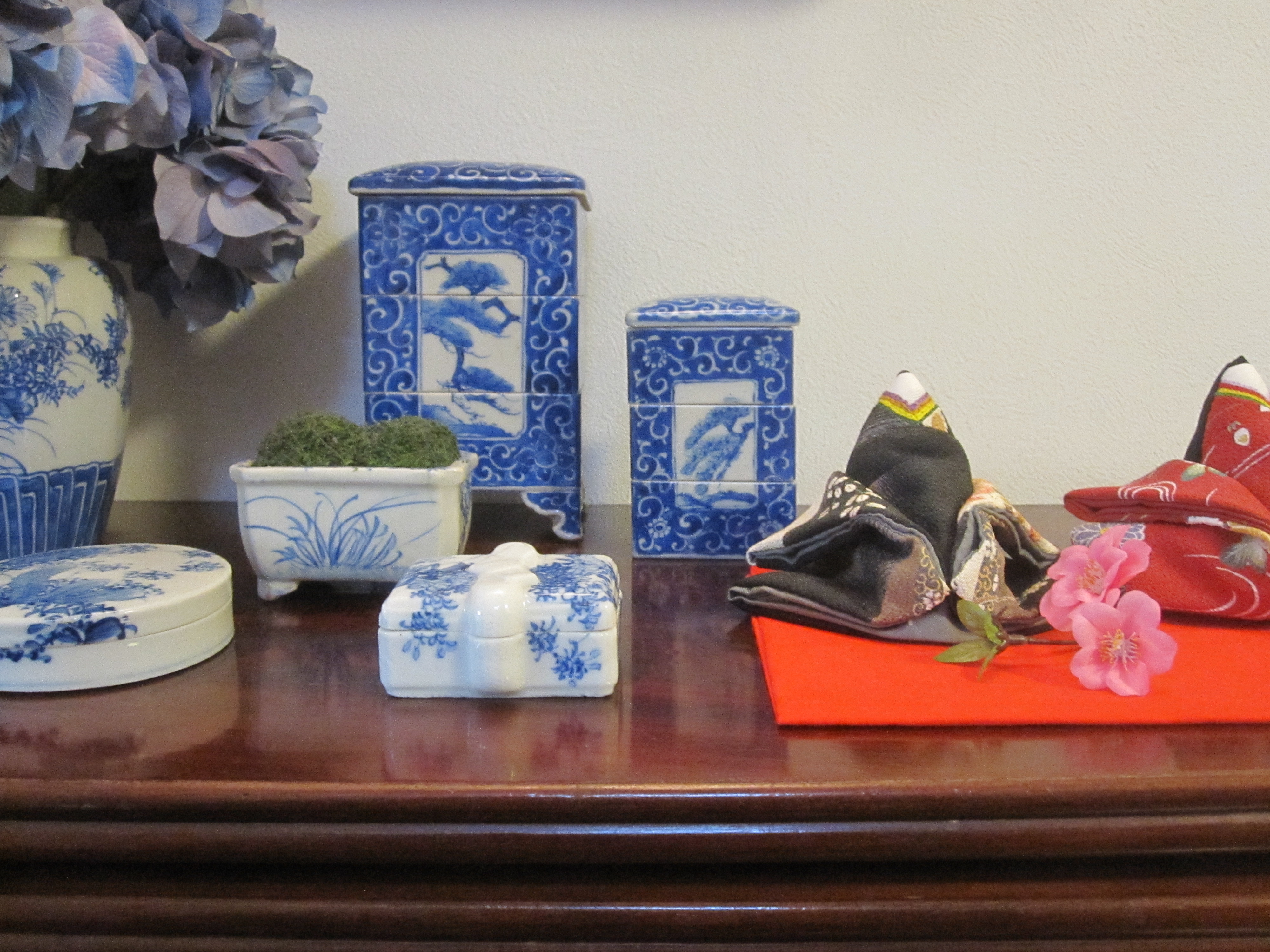
An absolute favorite of mine, porcelain jubako, stacked tiered food boxes, are harder to come across than more standard porcelain shapes such as plates and bowls. That being true, it hasn’t kept me from accumulating quite a few and helping others do the same. I always refer to them as jubako, but it may be that the porcelain ones should be called danju, while the lacquer ones are officially jubako. Shrine sale dealers call them jubako, so for now I will use the terms interchangeably. Personally I’ve never put food in mine. Instead I like to use them for trinkets on night stands, spices in the kitchen and anywhere you need to stash some small valuables.

In my entryway they hold extra keys to the house and car, buttons and hooks that have fallen off jackets and other odds and ends. Mine are unusual in that they are square, much less common than round ones, and the larger one has lovely scrolled feet. The bright cobalt and densely pigmented karakusa (scrolling arabesque pattern) are typical of Seto porcelain, and although purchased at very different times, seem to have been painted by the same artist.  I have enough Seto ware these days that I can see the hand of distinct artists on certain pieces. As for the cloth dolls on the right, they have their own extraordinary tale to tell and will be featured in an upcoming post for Hinamatsuri or Girls Day.

Seto jubako

Over the years I have helped to put together numerous collections.  It seems once bitten by the jubako bug that one is never enough. They look wonderful grouped together or mixed in with other porcelain. It’s always important to vary shapes and heights as well as the density of pigment and painted motif. This collection of five hand painted Imari jubako has a lovely balance of stylized and naturalistic motifs.

Imari jubako

This collection is used in the bathroom to hold cotton balls, Q-tips, make-up, make-up brushes and jewelry. Again note the variety of height, shape and painting style. The three outer cases are inban, Japanese transferware, while the two center ones are painted in a naturalistic style.

jubako

This trio represents three very different styles and eras and you can see those differences reflected clearly in the various shades of blue pigment.

jubako2

Here jubako are mixed with two geisha pillows, the porcelain neck rests used for preserving elaborate coiffures when lying down. I think there will have to be a post on those in the near future too.

jubako and geisha pillow

Blue and white jubako aren’t the only porcelain types out there.  I have a weakness for the prettily painted Kutani ones. This style of Kutani ware isn’t the densely pigmented and almost brocaded paint commonly associated with the best pieces from that region. (It occurs to me that I have never properly written about Kutani porcelain, so that will be added to my check list for spring.) Instead, they have a soft painterly naturalistic style.  The little sake cup warmer in the center makes a great votive candle holder.

kutani jubako

For all the thousands of ginger jars we see each month in the design press, I have almost never seen jubako featured, other than this one in John Anderson’s New York home.

jubako John Anderson

But recently I spied a lacquer one in this Vincente Wolf designed apartment on the January cover of AD – you can just see it on the table in the center of the room. While I am drawn to the porcelain jubako, the most common material they are made of is lacquer and examples of antique and new ones can be found everywhere.

architectural-digest-january-2013

They are used for traditional osechi ryori (New Year’s food) which is served room temperature in the layered lacquered boxes. For more details on the food in this photo check out Savory Japan.

osechi2012.21

The contents and the containers are things of beauty both!

About these ads

Read Full Post »

Since today is both Chinese New Year and Japanese Setsubun (Bean-Throwing Festival), I feel like a dose of red is in order. Coupled with requests for more Asian inspired kitchens, I have two sleek modern kitchens to show – both hinging on the color red – and both quite different from the rustic mizuya tansu (kitchen chests) I have shown in the past.

Designed by the architect Winthrop Faulkner for playwright Barbara McConagha, this first kitchen has many literal Japanese references and details. Inspired by Japanese jewelry cases, the red cabinets were custom-built and lacquered and traditional pull handles, like those found on tansu chests, were ordered from Japan. Upper storage is hidden behind shoji screens which can be lit from behind. Maple cabinetry and small shadow boxes are highlighted by painting their interiors black and filling them with ceramics. A witty touch is the classic farmhouse table – in this case painted black and sealed to look like lacquer.

Storage for extra books was squeezed in below the ceiling and a library ladder, designed to taper like a pair of chopsticks, was built for access.

This second kitchen in a historic 1915 Chicago building was renovated  by architect Lawrence Booth. It’s keystone is the bright red Aga stove, set for cooking worship in its own altar-like niche. The shiny finish looks almost like lacquer and its stalwart British shape could almost be a tansu base.

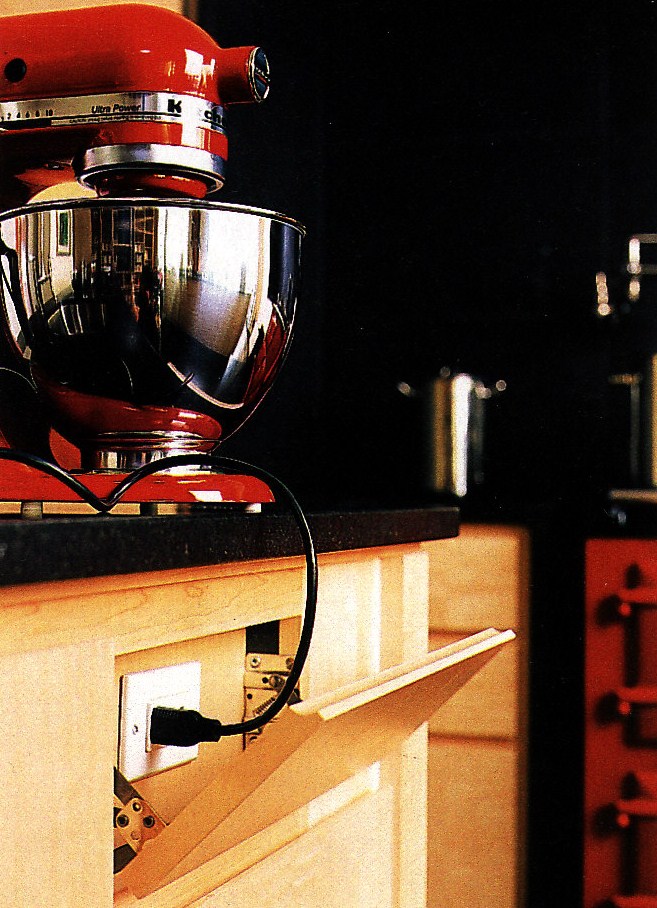
Again we see the contrast between the light maple cabinetry and the dark black honed granite with touches of stainless steel. There are also great details, like the flip down drawers hiding all the electrical outlets and disposal switches and the pot filling faucet at the stove.

The adjacent sitting area has cabinetry filled with Asian display items, including Chinese and Burmese lacquer pieces and a kimono box, an unusual glossy red ceramic garden stool and a richly colored Persian rug. And speaking of molded plywood the other day, how great is that Frank Gehry Ribbon chair? The contrast of textures, finishes and periods makes this space sing.

Definitely two kitchens that would keep any evil spirits at bay…

Image credits: 1 & 2. House & Garden, February 1998, 3-6. House & Garden, date unknown.

Read Full Post »

While not quite on par with Dixie Highway, relaxed Nishi-Ogikubo in Tokyo’s western suburbs has a grouping of 60+ antique and vintage shops gathered near the train station. Situated along the Chuo line, Nishi-Ogikubo (nicknamed Nishiogi) was a counterculture hotbed in the 1960s, then receded from notice, only to become popular in recent years as the “slow life” movement has gained steam in Japan. It seems like just the kind of place one would find a collection of quirky and individualistic antique shops.

Conveniently, a free map of the stores is available right in front of the koban (police box) on the left side of the station right outside the North Exit. The map seems fairly current but things can change overnight, so think of it only as a basic guide. Most stores do not open before 12p.m., they all seem to have variable hit-or-miss opening days, and there is not much spoken English to be had, but it is a lovely way to while away an afternoon. Hopefully this post will help steer you in the direction of the best shops!

Organized into four zones, NE, NW, SE and SW on the map, I’ll say right off the bat that the South side of the station has much less to offer than the North side, and can be skipped entirely when pressed for time. The NW zone is by far the best for traditional antiques, so I will start the tour headed in that direction, counter-clockwise around the rough rectangle the walking tour makes.  The shops are numbered numerically on the listing pages, but do not always appear in numeric order on the map.

Actually the first few shops don’t even seem to be listed on the map. After peeking in grape, a small but charming vintage kimono shop with two other locations in the area, our first stop is not Japanese at all. Filled to the brim with lanterns, poufs, silvered mirrors and embroidered slippers, Morocco Marché is one-stop shopping for adding a bit of middle-eastern flair to your decor.

Weaving up and down the small side streets along the main road, we pass a few small shops, including Baby Doll (#60), which is not open, but full of antique and vintage toys and dolls. Moving back towards the main road we come to Les Yeux Noirs (#42), the unquestionable star of the tour, deserving its own individual post (coming tomorrow). Owner Haruko Hasegawa has one of the best eyes I have seen for choosing unusual and rare pieces of porcelain. We were very excited and spent a long time (and quite a bit of money) in her shop. If you are interested in porcelain, this is one of the main attractions and it is well worth the train ride for this store alone.

As we continue along the main road we pass mood (#45), full of groovy 60′s looking used goods. We try to stop into Quilt & Old Textiles (#44) way hidden in a back lane, but they are closed – perhaps to go to the Tokyo International Great Quilt Festival. At the turn in the main road, we come to Kido Airku (#59), a great mixed shop full of smaller tansu, porcelain, textiles and odd and ends. Unusual things there include vintage spool threads, great for using as plant stands or display props. A collection of old iron tea kettles looks great on these.

Some modern shibori dyed textiles.

One of the most interesting finds for me personally were wood blocks, used to print patterns on textiles. I have been scouring eBay for Indian wood blocks for a DIY project I am planning this summer, but hadn’t considered using Japanese ones.  Frankly, I hadn’t realized that in addition to all the stencils, tie-dying and resist techniques used here, that wood blocks are too.  Definitely something to look into more.

Numbers 48,49 and 54 were all the same named shop, Antiques Jikoh, with mainly used modern furniture. The branch at the #49 location was full of heavy oak Victorian and Arts & Crafts era furniture.

My friend H spotted a gorgeous blue and white porcelain “umbrella stand” that she loved there. I was so sorry to have to let her know it was actually a late 19th century urinal. Needless to say, she could not look past its original use.

The next two shops were eureka! moments for me. I have been searching for the perfect vintage milk glass ceiling fixture for the bathroom in the beach house, passing up many individual pieces at shrine sales. Imagine my delight at stumbling across the Teardrop Club (#53). I’ll be dragging my patient husband back there soon. If you too are interested, please note they are open 12-6 and not on Wednesday. More photos here and here.

Rakuda (#51) which means camel, also had numerous vintage light fixtures in addition to ranma (transom) panels, old doors, stained glass and cut glass…

Turning the corner right after Rakuda completes the NW zone. The tour continues east, crossing a small river. Other than the charming Le Midi (#37) full of imports from the South of France, not much else was open. Any visit to Nishi-Ogikubo comes with that risk.

Continuing to the next major intersection the tour turns right to head south back to the station. Most of the shops along this NE section seem to specialize in vintage clothing and used goods. Perhaps because we were getting hungry, they didn’t hold our attention. In the grand tradition of antiquing outside of Tokyo, we ate Indian food for lunch at Ganesha Ghar, right near #31 and the bridge over the river on the map. As would be expected, it was packed! And following shortly thereafter was Amy’s Bakeshop, which billed itself as “NY Style Sweets & Things”. Of course we had to stop!

If you arrive hungry, it might be easiest to head the opposite direction (clockwise from the station) and eat first as shops don’t open until lunch time or afterwards.

We skimmed the shops listed on the map on the South side, but many were closed, perhaps permanently. None stood out this visit but perhaps they merit a second chance.

Nishi-Ogikubo is very easy to get to and quite close to central Tokyo. It is only 16 minutes from Shinjuku and 18 minutes from Yoyogi on the Sobu Chuo line. Taking the Toei Oedo line from Azabu Juban and changing at Yoyogi took a total of 32 minutes. I’d love to hear from anyone who goes, especially if you discover a gem I haven’t mentioned. Happy hunting!

Read Full Post »


For me, there are two perfect kinds of antique stores.  The first is a carefully curated small shop, while the second is a large unorganized warehouse that you have to search through.  Mizue Sasa’s Okura Oriental Art is the former and it is a jewel – my favorite in central Tokyo.  She and her husband Yasuhiro Shimizu are celebrating their 10th anniversary of owning Okura this year.

In addition to wonderful tansu and porcelain, Sasa-san has a great mix of hard to find items such as altar candlesticks…

antique maps of Tokyo and Japan, both framed and unframed…

ikebana baskets…

and lanterns.

She is also the only dealer I have found who carries traditional copper rain chains, which are the “gutters” of Japan. These are not antique, but they patinate quickly and easily. An amazing sayonara or housewarming gift!

Sasa-san’s pick? This Meiji period tai (sea bream) jizaikagi yokogi (decoration on hanging hearth pole) is a great piece of folk art. Used over a traditional irori (open sunken hearth) it held the kettle above the flame.

My current pick? This hard to find small size step tansu. Often they are very large and very deep and can be impractical if you don’t have the perfect space.

Sasa-san has a fully detailed on-line catalogue and a loyal customer base that visits often from around the world. She handles on-line sales easily, speaks English and ships just about anywhere. She also has a decorating site with staged rooms – you can purchase a whole look if you like or just browse for ideas. Sasa-san will also help her customers arrange their items and improve their decorating in their home. She is not afraid to tell clients to get rid of stuff (which is unusual here). She will also track down specific items for you – just give her dimensions or good descriptions.

I love the juxtaposition of the poured concrete wall with the tansu and the giant porcelain plate that she shows in the photo below. Sasa-san is interested in mixing antiques with modern furniture, a trend that is just getting off the ground here in Japan.

Here she stages vintage blue and white in the bathroom.

The shop is full of great gifts for the holidays!

Image credits: All shop photos taken by me, courtesy of Okura. Decorating photos by Mizue Sasa.

Okura Oriental Art

Read Full Post »

While not actually a secret, no one ever seems to list or mention the small shrine sale held in the patio square of Azabu Juban. I guess in all fairness, it isn’t an actual shrine sale as there is no shrine, but the feel is the same.  No more than 12 dealers come every first Saturday of the month and they usually pack up by 3 p.m. As it is just down the hill from my house, I go regularly and always get lucky. There is something about small sales that makes shopping easier – like going to a favorite boutique instead of a large department store – it just gives you a more focussed view.

There was a bit of everything this past Saturday – lacquer serving pieces and small chests perfect for holding jewelry.

This set of really pretty Imari plates with tiny diapered patterns.

I can imagine them hanging on the wall in Olya and Charles Thompson’s richly colored Brooklyn brownstone.

An adorable collection of tiny shoyu (soy sauce) dishes, particularly the more unusual blue and white and celadon ones, looks like a plate wall display in miniature…

I loved this tiny wooden hibachi (charcoal brazier) with inlaid wisteria. It had its original copper lining and would be perfect for autumn flower displays. I’ve not seen this wooden style so small – it was about the size of a pineapple.

I also loved these two fabulous huge iron hibachi…

…perfect for planting palms in the Schuyler Samperton style. (And if you love palm trees and layered eclecticism make sure to look through her portfolio).

And for myself? OK, I admit I have gone a little crazy – glass crazy that is. Ever since my finds at Kawagoe I am obsessed with blue-green glass, old bottles and floats! I am not sure if my huge bottle will fit where I want it, so what about a small collection of little bottles, just in case?

These two had visible bubbles in the glass and an older hand blown feel.

The smaller bottle had a threaded neck. When I bought it, I hoped to be able to add a spout or pump and use it for liquid soap.

Kind of like this!

More information on the shrine sale schedule can be found in the tab at the top of the blog. Feel free to email me if you have any questions!

Image credits: 1,2,4,5, 6, 8 & 9. me, 3. Vogue January 2010 , photo credit: Francois Halard, 7. Domino April 2007, photo credit: Paul Costello, 10. Unknown

Read Full Post »

I am often asked for suggestions on buying antiques in Tokyo, so this is the first in a series called “Shop Talk”. One of my favorite antique shops, Kanarusha in Fuchu (near the American School) is the perfect mix of a beautifully arranged store with a dusty but treasure filled backroom and attic, providing the best of both worlds.  There are items for the immediate gratification folks to take home on the spot and lots to dig through for those who love to make their own discoveries. To clear up a bit of confusion on the name, Akariya is the name of the parent company and also of their high-end shop in the Yoyogi area, while this store is actually called Kanarusha. Rarely do I stop by the more polished shop in Yoyogi, preferring instead the more casual warehouse-style store. Drop in and let Ohashi-san and his staff help you chose just the right piece for your home.

Inside is a treasure trove of objects…

Tansu of every style and region…

An unusual golden mizuya (kitchen) tansu…

In the back rooms, there are shelves filled with everything imaginable, including these ikebana (flower arranging) baskets…

These shelves have iron lanterns, inlaid hibachi (small charcoal heaters) and vintage milk glass fixtures…

Speaking of hibachi, they have this gorgeous imperial lacquer one…

They also have a number of beautiful byobu (screens) including this unusual two-panel made of fabric using a wax resist dye technique and adorned with embroidered details. I think William Morris would have loved this piece.

Here’s a close-up of the detail on the spider web and thistles…

Cranes are lucky and represent long life in Japanese art. This 1930s copper vase inlaid with silver cranes is signed by the artist.  Frankly, Art Deco pieces can be rarer than 19th century ones.

Ohashi-san’s pick? This extraordinary choba tansu (merchants chest) from Yonazawa Prefecture made of solid keyaki wood.  The gorgeous burl wood has its original finish in dreamy condition. Inside is a shelf and small compartments.

My pick? It has to go to this amazing Meiji period mizuya tansu from the Biwa Lake region near Kyoto.  It is super long – a full 105 inches – and the staff have only ever seen one other like it in 30 years of antique dealing.  I can just imagine it lining a long wall of a kitchen instead of cabinets. Talk about a room-making piece of furniture.

In addition to the items mentioned above, Akariya specializes in antique doors and ranma transom panels, which can be customzied and used in new construction (building a house anyone?)

A few more great things about Kanarusha…They have their own workshop for repairs and customizations and their restoration is always sympathetic and natural.  They are also happy to work with international customers over email with photos and they will ship around the world.

The big news is that Kanarusha is having its big annual Autumn Sale next weekend from Saturday, October 30 – Wednesday, November 3. Everything is 20-35% off the already reasonable prices.  The shop is open 10a.m. – 7p.m. (an hour later than usual).

The really big news is that Tokyo Jinja readers can start shopping at sale prices now!! Just stop in between now and Wednesday, October 27 (Kanarusha is closed for set up on Thursday and Friday) and mention the blog and you can have first pick before the big sale starts. You may have to wade through as things are not fully set up for the sale, but isn’t that the best kind of antique shopping anyway?

Interested in tansu? You might want to read my post from last month “What’s Cooking? Tansu in the Kitchen”.

Driving directions from Tokyo: Take Shuto #4 (Chuo Expressway) to the Chofu exit and head towards Fuchu after the toll as if going to ASIJ. Pass the turn at Ajinimoto Stadium and keep going straight on Route 20 for 2 km. There will be a rise in the road (bridge over the train tracks) and at the next light called Shiraitodai Police Box intersection (Family Mart is on the right hand corner) take a right. Kanarusha is immediately on your left. Parking is available.

Image credits: All courtesy of Kanarusha and taken either by me or Ohashi-san.

Akariya Kanarusha

Read Full Post »

“Any fragments from the past, especially those that you can touch, connect you to the makers of those pieces, making you aware that we are threads in a great tapestry of time.”
John Saladino

Often referred to as the “designer’s designer”, John Saladino has been at the absolute top of the design field for over 30 years. He works not only as an interior designer but also as an architectural designer, landscape designer, and in this case, as a curator as well. This June 1998 House & Garden spread features the Colorado home of a couple with an extraordinary collection of antiques and art. Making sense of such a disparate group of items is something that only a master could achieve. Interspersed among the Greek, Roman and Egyptian antiquities are numerous Japanese antiques of all types.  I would be hard pressed to imagine more than one antique screen (byobu) in a house; somehow he manages to integrate three.  In testament to Saladino’s triumph, it feels neither like the hodgepodge of an antique store nor has the sterility of a museum, but rather a peaceful and lovely home.

The coffee table boasts a grouping of  bamboo letter boxes and what looks to be a bronze hibachi on the raised fireplace hearth.

The dining room/living room has a treasure trove of objects – the first of at least 3 byobu (screens) in the house on the back left hand wall, a kimono rack with an extraordinary brocade (or perhaps embroidered) robe up on the stair landing, a bowl-shaped bamboo ikebana basket between the columns and a rare lacquered trunk in the foreground.

This 17th century antique screen is coupled with an art deco Ruhlman chair, an Italian chest and a Roman bronze head.

Another view of the living room reveals that amazing lacquered trunk, a pair of bronze altar candlesticks and the third screen. The maki-e work on the trunk is covered in symmetrical circular designs called mon or kamon, circular crests used to identify a family, much like a European heraldic coat of arms. For instance, the kamon of the imperial family is the circular chrysanthemum and it’s use by others was prohibited.  Gradually mon became used by commoners and then later on as logos for merchants and products. The use of mon as a decorative device can be seen in lacquerware, porcelain and textiles and is one of my favorites. Looking for your own mon? This site has a full dictionary of them.  

The serene bedroom has a pair of  highly ornamental 18th altar tables being used as small side tables. Definitely use a coaster!

Can you date these rooms without looking back at the beginning of the post? Most likely not, as in addition to their extraordinary beauty, they are also timeless and will never look dated. For me, this agelessness is one of Saladino’s strengths. Another is that his spaces are places in which modernists, traditionalists, classicists, and the like can all agree.

Interested in seeing more? I recommend his books; Villa, which chronicles the renovation and restoration of his elegant 1920s California villa and Style, in which he reveals his design secrets.

Image credits: all from House & Garden, June 1998, Photographed by William Waldron

Read Full Post »

Follow

Get every new post delivered to your Inbox.

Join 424 other followers

%d bloggers like this: