Feeds:
Posts
Comments

Posts Tagged ‘Kristen Buckingham’

So I have been thinking a lot about what I wrote in my last post, about considering buying that French marble pastry table even though I don’t have a use for it right now and keeping it for some later home or project. And I did buy that vintage schoolhouse desk at the garage sale, using the “it’s too cheap and too nice to leave behind” rule. Making me think about it more was seeing the just released September issue of Elle Decor featuring Reese Witherspoon’s early Wallace Neff designed Ojai, California home. Originally built in 1923 as stables for Edward Drummond Libbey, it retains much of its original detail in great condition including hewn beams, stucco walls and iron railings and fixtures.

Decorated quite simply and elegantly by Kristen Buckingham, who is always a favorite, it has got me asking myself that same question about yet another item. Witherspoon’s daughter’s bedroom, full of soft pretty colored textiles and that great alcove bed, has a swagged 1920s tole chandelier, which is a sweet focal point.

I have been tracking a similar fixture at one of my local antiques stores for a few years now. It hangs a bit forlornly over a booth full of mid-century modern furniture, the relic of a previous dealer of Continental antiques. Not inexpensive, but not unreasonable, I have always thought about buying it, even though once again I don’t currently have a need for it. Entryway, dining room, bedroom – it could work anywhere – but will I ever need it? But if I don’t buy it will I one day regret it?

Furniture needs storage, but smaller decorative items can be tucked away. Textiles are another item easy to buy and store as they don’t take up much room. I recently shopped my own linen closet and came up with yards of this hand-printed cotton voile called Shree Teak from John Robshaw that I am using as a lynchpin in my upcoming “cheap and cheerful” kitchen renovation. Where and when I bought it, I couldn’t tell you, but having it on hand and having it be just perfect was great fun.

On the other hand I have an amazing embroidered fringed panel from an antique Chinese bed (bought in Hong Kong in 1998) still wrapped in acid-free tissue, sitting in a drawer at home in Tokyo, waiting for its eventual use. I have a vision of what I want to do with it, but the question is whether or not I will ever have the right house and the right space to do so. But even so, I don’t regret buying it for a minute!

The list of other things in storage is somewhat endless, from fabric to light fixtures, to furniture farmed out on loan to friends and relatives. What about you? Do you buy things and then put them away for the future? When you take them out, do you still love them or wonder why you bought them? Is there some item that got away that you still wistfully dream of?

About these ads

Read Full Post »

In honor of Chinese New Year, I am going to be writing about Chinese antiques this week, starting with one of the more unusual items – ancestor portraits. Commissioned by loved ones of the deceased, they were privately displayed and worshipped as the Chinese believed (and continue to believe) that the spirits of their ancestors could bring them health, long life, prosperity and children. Funerary statues and art date back to early Chinese history, but most of the surviving portraits date from the Qing Dynasty (1644-1911). During the 20th century, westerners began to buy up old portraits as photography became the medium of recording departed family members. In particular, Richard Pritzlaff, a reclusive horse breeder from New Mexico put together an extraordinary collection throughout the 1930s and 40s, which were then acquired by the Arthur M. Sackler Gallery in Washington, DC in 1991. But it was the exhibition Worshipping the Ancestors: Chinese Commemorative Portraits there in 2001 that sparked a changing viewpoint of the portraits as works of art and interest in them rose tremendously as a result. The museum continues to display the portraits fairly regularly, with an exhibition Family Matters: Portraits from the Qing Court just having closed.

Tear sheets of Virginia Witbeck’s apartment from the early 1990s were saved by me in great part for this small image of her in front of an ancestor portrait with a pair of stacking Japanese lacquer tray tables by her side. My interest in them was piqued. When I moved to Hong Kong in 1997, they were not yet that talked about and quite readily available for reasonable prices at many of the antique stores there. Copies and fakes had not become the problem they are today, nor had prices for the real deal risen as high as they have now. But there was great debate about whether or not it was appropriate to hang them as art in a stranger’s home. I had many friends who argued against them, feeling it was a form of sacrilege, while others wanted them for their incredible decorative potential. I was always torn by this argument and decided against one. I think I may rue that decision today.

As the faces in the portraits were painted posthumously, often from verbal descriptions and sample feature books, they are usually impassive and quite similar looking, so it is the fabric of their clothing and the textiles they are seated on that catches my attention. By studying the motifs and details, the iconography of rank becomes clearly readable by scholars and experts. For instance, yellow robes were reserved for the emperor while embroidered badges with different animals and colorful hat knobs proclaim the subjects status and position at court. Ironically, there seems to be an over abundance of high-ranking officials, leading experts to believe that loved ones often fudged and had their ancestors painted with elevated status.

There are some examples of designers using ancestor portraits in their projects throughout the 20th century and Jennifer at The Peak of Chic has a great post showing them in numerous mid-century homes. More recently, they have become even more popular. In this living room designed by Miles Redd, the richness of the color and detail in the furniture and carpet corresponds directly with the paintings. I cannot imagine that he did not have a pair of ancestor portraits in mind when he started.

The same goes for this Santa Monica home designed by Michael Smith. The similarities between the two really stand out.

In paler spaces, the colorful images become vibrant additions, focal points, you might say…

…as shown in these two images from Julian Chichester‘s West London house.

This stylized Chinoiserie room by Michele Bonan uses what looks to be reproduction paintings very effectively. (And who else out there is reminded of my chartreuse dining room in Hong Kong? Wish I had a photo of it!)

Julie Murphy uses bright yellow chairs and a scrubbed wood table to create a casual and cheery kitchen – complete with ancestor portrait – in her home.

As a lover of all things pale and patina-ed, I think this faded portrait is wonderful in this softly subdued space by Kristen Buckingham.

This pair is actually a Korean couple, but I couldn’t resist including them as they also anchor a simple color palette in an elegant London living room. And while we are looking at Korean art in a celadon colored space, I can’t help but mention the Sackler’s current exhibition Cranes and Clouds: The Korean Art of Ceramic Inlay.

So, where do you stand on the issue? Is it disrespectful to display the ancestors of someone you don’t know as decoration? Would you hang one in your home?

For more on the Sackler’s collection and the challenge of restoring damaged paintings, see the fascinating article on conservation in The Book and Paper Group Annual.

Gung Hei Fat Choi!!!

Image Credits: 1. Portrait of Oboi, Collection of Freer/Sackler, 2. credit unknown, 3. Elle Decor March 2006, photo credit: Simon Upton, 4. House Beautiful April 2009, photo credit: Mikkel Vang, 5-6. Elle Decor November 2006, 7. Lonny July/August 2011, photo credit: Patrick Cline, 8. via Design Sponge, 9. via Kristen Buckingham, 10. credit unknown.

Read Full Post »

The only big house project that looms on my horizon is renovating the kitchen here in Ocean Grove. Always an expensive proposition, I don’t want to undertake it lightly. Basically everything has to go – flooring (bad yellowish linoleum), appliances (almond!), and cabinets (1970s) – but I want to replace them with things that feel both special and as if they might have always been here. The key to it all is coming up with a special island that is not from a kitchen cabinet company, whether it be a baking table or my favorite, some kind of repurposed item.

I am not sure what the island in this Swedish kitchen is made from, but I love it and the whole room.

A friend across the street uses an old butcher block that belonged to her grandfather as a small island, much like the one in the photo below.

On the right side of Rachel Ashwell‘s Malibu kitchen, she uses some sort of old counter or bar as an island, with baskets holding supplies on a lower shelf.

Speaking of shabby chic, this painted work table is another favorite.

Striking a completely different note, Darryl Carter‘s kitchen with its gorgeous marble-topped antique table is to die for, although clearly a bit too formal for a beach cottage.


I do love a marble topped island though…The DIY master, Jenny Komenda at Little Green Notebook, has used an old dresser and the marble top from a vintage coffee table to make one of the most stylish (and inexpensive) repurposed islands I have seen. Check out her other recent projects, including the most amazing reupholstery tutorial here.

In my ongoing hunt to complete my house, I spent a full day up at the antique stores in Red Bank, NJ. There are numerous multi-dealer shops with great merchandise, and I’ll be doing a full “Shop Talk” post on them soon. At Monmouth Antiques Shoppes I saw this red industrial cart which would make a funky but functional island.

And while surfing, I did notice this great desk turned island over at Remodeleze.


But the piece I have been obsessing over is this vintage printer’s table currently on eBay. It has an amazing thick slab of a marble top and a few shelves and cubbies.  It even still has its original letter drawers!

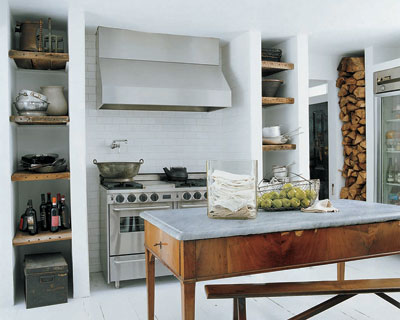
I think it would be perfect in creating a kitchen with the feel of Kristen Buckingham’s, but no matter how many times I measure, it is just too big. Unlike her huge beauty, my entire kitchen is only about 9 x 12…

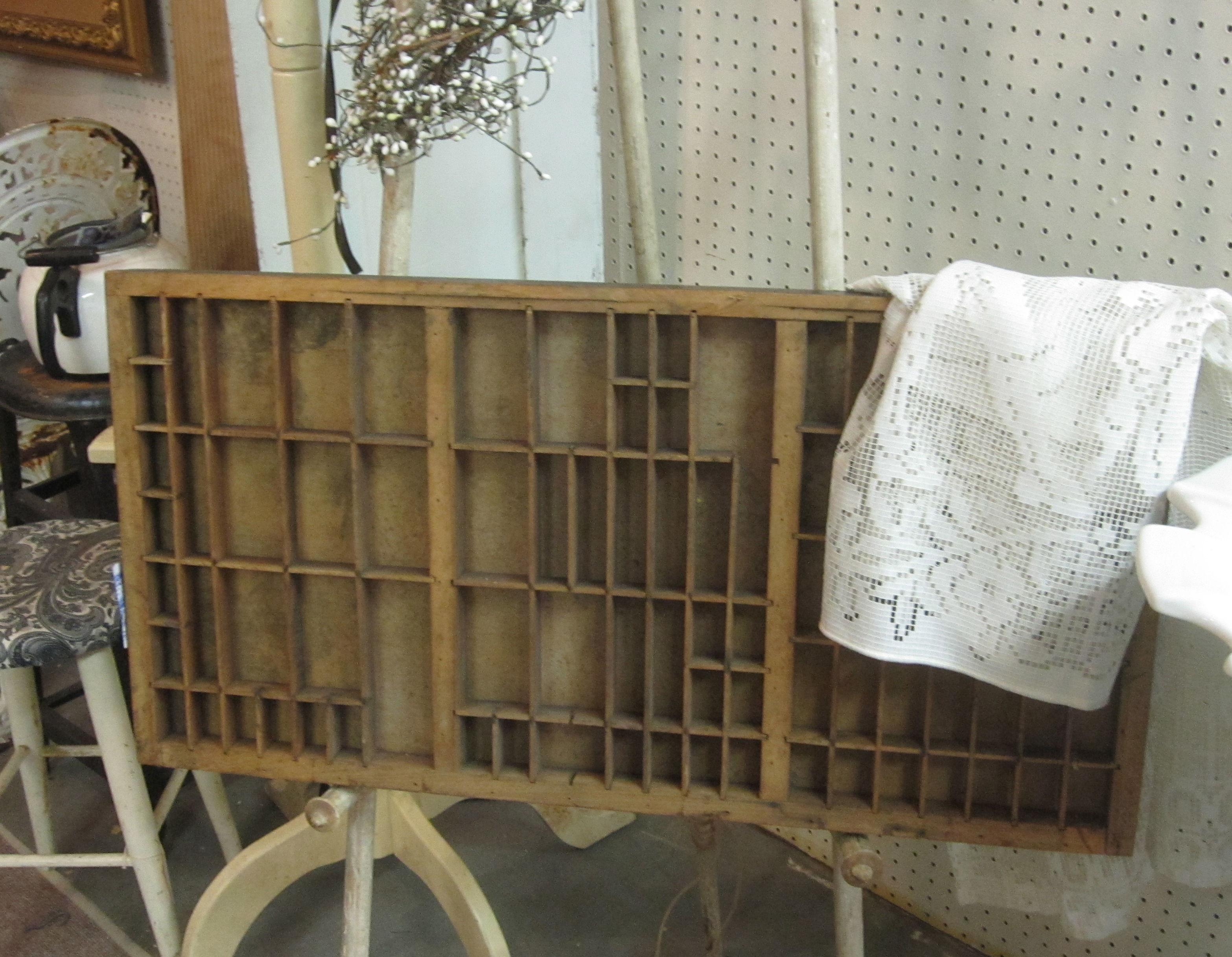
And speaking of the printer drawers, I saw them everywhere at the Point Pleasant and Red Bank antique shops. They have always charmed me, but have really come to my attention of late.


My friend Jamie Edwards, a former Tokyoite, is making these adorable display cases for children from vintage printer drawers, lined with washi paper and custom colored to suit your decor. You can find her EllaBeanBoxes on Etsy.

And another friend mentioned that her mom uses one flat in the narrow top dresser drawer to store jewelry. I found this photo of a great storage solution in my files too.

Ingenious, no?

Image credits:1 & 2. credit unknown, 3. via Cote de Texas, 4.via Elements of Style, 5.Elle Decor May 2008, photo credit: Simon Upton, 6. via Little Green Notebook, 7. via Remodeleze, 8, 11-14. me, 9. via eBay, 10. Elle Decor March 2009, photo credit: Simon Upton, 15-16 EllaBeanBoxes via Etsy, 17. credit unknown.

Read Full Post »

Follow

Get every new post delivered to your Inbox.

Join 423 other followers

%d bloggers like this: