Feeds:
Posts
Comments

Posts Tagged ‘Jeffrey Bilhuber’

After my butterfly finds post last week, I have had a little voice in my head whispering to me over that small detail about the stuffed peacock in the Celerie Kemble designed apartment in the newest Lonny magazine. I had mentioned that taxidermy peacocks have been all the rage for some time now, but as trends go, they don’t do it for me quite the way butterflies do. Here’s the aforementioned bird in the dining room.

But why did it all feel so familiar? The article mentioned that Kemble had designed this space previously as a model apartment for the building’s developer, but that wasn’t it. I knew Kemble herself had a peacock on the wall in her living room, but it was definitely a different one.

She can’t be credited with starting the trend - for instance, here is Anna Sui’s NYC apartment resplendent with pattern and peacock from an autumn 2009 Elle Decor issue…

…and prior to that I can recall the one in Jeffrey Bilhuber‘s gorgeous place, featured in the New York Social Diary.

The recent September Elle Decor featured the San Francisco home of Alexis and Trevor Traina with their peacock filled dining room, which I was also decorated some time ago and shown earlier elsewhere. But I am getting off tangent and I don’t really mean to be writing a post about the trend of dead birds in decorating! If I was really planning on doing that, I’d need to get all historical on you…

Then it finally hit me! Kemble’s dining room, which I had featured in a previous post, was basically the same room. Maybe her clients live in the same building in a similarly laid out apartment?  After all, it is a big new building. And Kemble’s dining room had quite unusual display items too – a pair of samurai warrior armor. Do you remember these?

At the time of that post, I asked what you thought of the armor. So I guess today’s question is which do you prefer? Stuffed birds or stuffed suits?

And while we are talking about peacocks anyway, I simply cannot avoid getting all historical on you. I have to put in a pitch for the most extraordinary peacock related place in the world – James McNeill Whistler’s Peacock Room – the showpiece of the Freer Gallery in Washington D.C. Recently restored to its original splendor…

…the curators have taken yet a further step by temporarily taking down the blue and white style porcelain that Frederick R. Leyland originally displayed in there and installing Charles Lang Freer’s (who later purchased the room and brought it to America) original collection of ancient Asian ceramics. In effect, the room has been rewound to 1908. Furthermore, on the third Thursday of each month, the shutters on the windows will be opened, allowing visitors to view the room in natural light. This is truly a special opportunity and not to be missed! The full history and further information can be found here and here.

Courtney mentioned it this summer and a few friends from the D.C. area wrote to me about it as well. I plan on making a pilgrimage (and when talking about the Peacock Room, that is the correct word) there this summer with the girls. Anyone want to join me?

Related Posts:
Thumbs Up or Down? Samurai Armor in the Home
Artist Spotlight…A Final Dose of Japonisme for the New Year
Artist Spotlight…Whistler, Hiroshige and the Best Coffee table Book of All Time

Photo credits: 1. Lonny September/October 2011, photo credit: Patrick Cline, 2 & 6. Lonny October/November 2010, photo credit: Patrick Cline, 3. Elle Decor September 2009, photo credit: Eric Bowman, 4. New York Social Diary July 13, 2007, photo credit: Jeffrey Hirsch, 5. Elle Decor September 2011, photo credit: Simon Upton, 7-8. Freer/Sackler website

About these ads

Read Full Post »

As I wandered through the stuffed-with-junk antique stores here in New Jersey last week, I stumbled across this small Japanese Seto porcelain tea-cup and saucer. Based on its traditional Western style and shape, it was most likely made for the export market somewhere around the turn of the 20th century. This reminded me once again, that although I am a blue and white porcelain junkie in Tokyo, many of my best finds have been made abroad in the US and England. And those finds are not limited to ceramics, but also glass, silver and just about anything that could be exported.

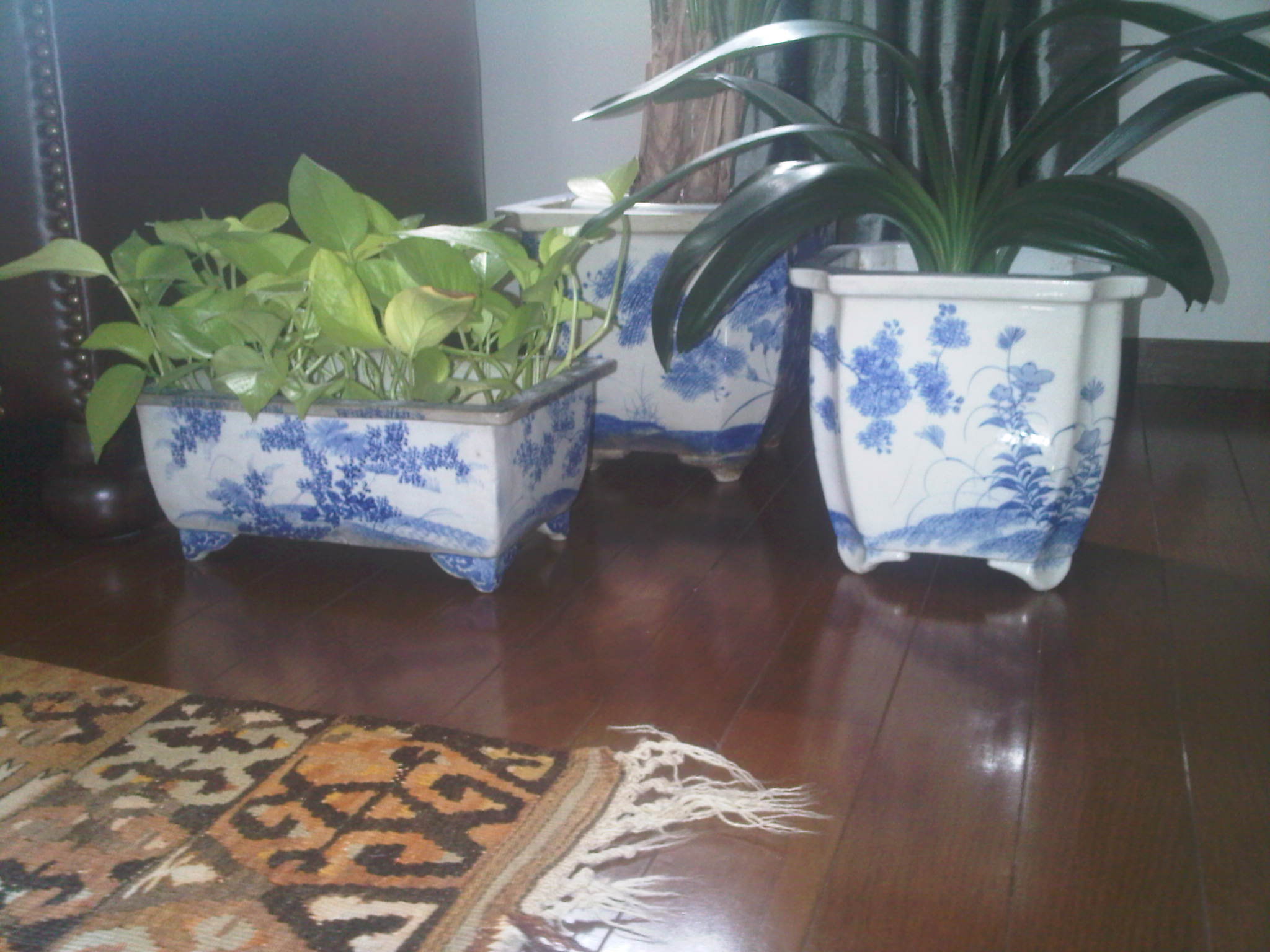
Fine sometsuke (underglazed cobalt porcelain) has been produced in Seto City and Aichi Prefecture for about the last 200 years, although the region boasted one of the six old kilns of medieval Japan and produced pottery since the 14th century. I bought my first piece in Hong Kong 14 years ago, a square planter, drawn to the brilliance of the cobalt and the feathery painting style of the artist. Ironically, I got it for a great price as the Chinese don’t tend to value Japanese porcelain. That piece lives happily in my Tokyo living room with two siblings, found at shrine sales.

Over the years I have accumulated many more pieces, including these lovely jubako (stacked food boxes)…

…and this cricket cage and covered fan box.

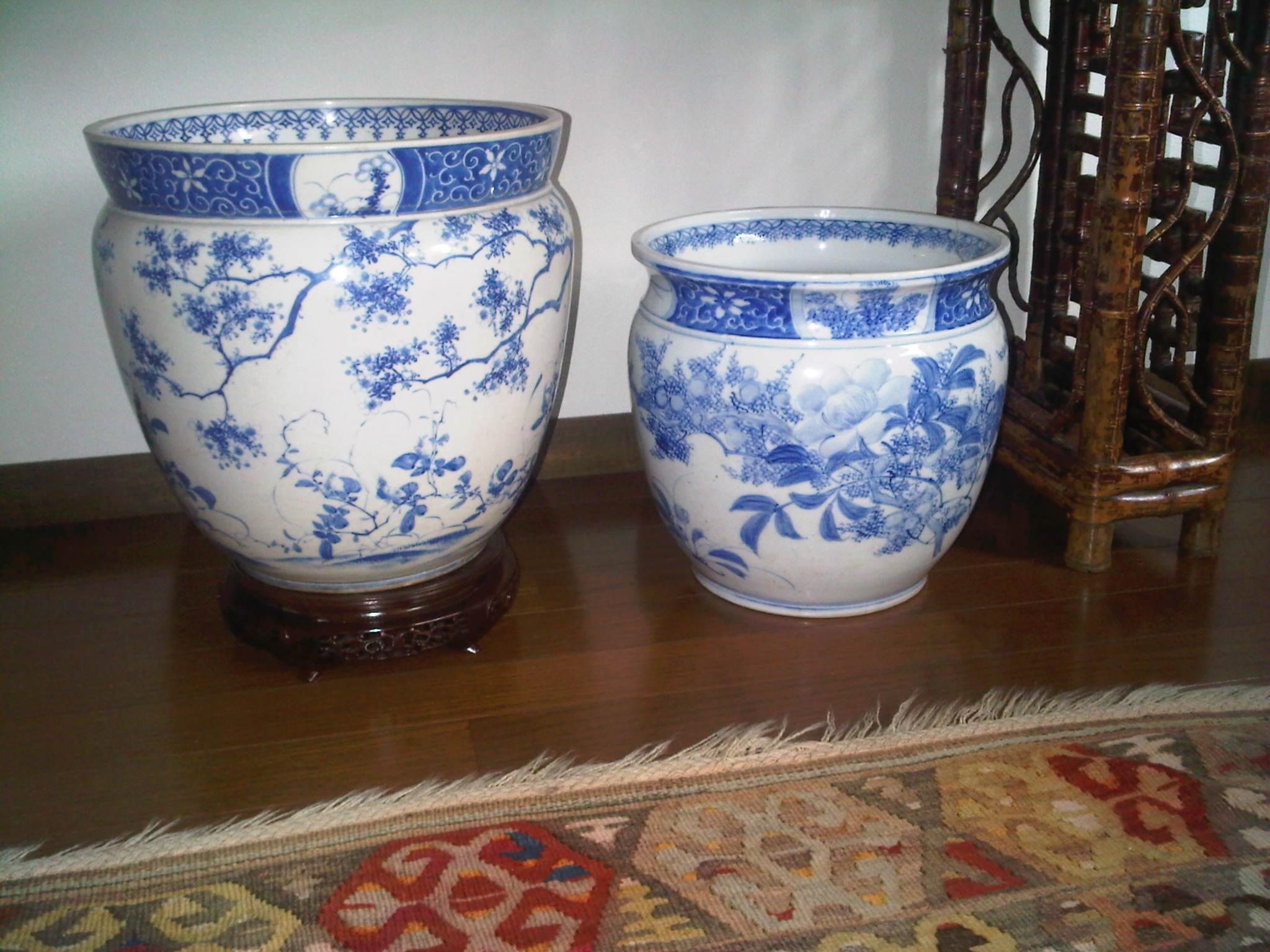
Thanks to a recent Kawagoe trip, I now have 2 big fish bowls.

One of the most beautiful and rare Seto items are garden stools. A fixture in China for 1000 years, porcelain garden stools have become one of the basic staples of home decorating, but they were actually used in gardens originally. Some find them ubiquitous these days, but they continue to fill that niche between seat and table and their variety of color and design means there is a place for them everywhere. I could do a 20 photo post on amazing rooms with them, but I’ll limit myself to some blue and white ones. All Chinese as there are many more on the marketplace, and I have yet to see a Japanese one in a magazine spread.

A few posts ago, I featured the home of Brazilian designer Sig Bergamin, but did not include this photo. A blue and white garden stool sits at the edge, ready to hold a drink for the person lounging in the white chaise.

Jeffrey Bilhuber is one designer who uses them all the time to great effect. This one has lovely open fretwork on the side.

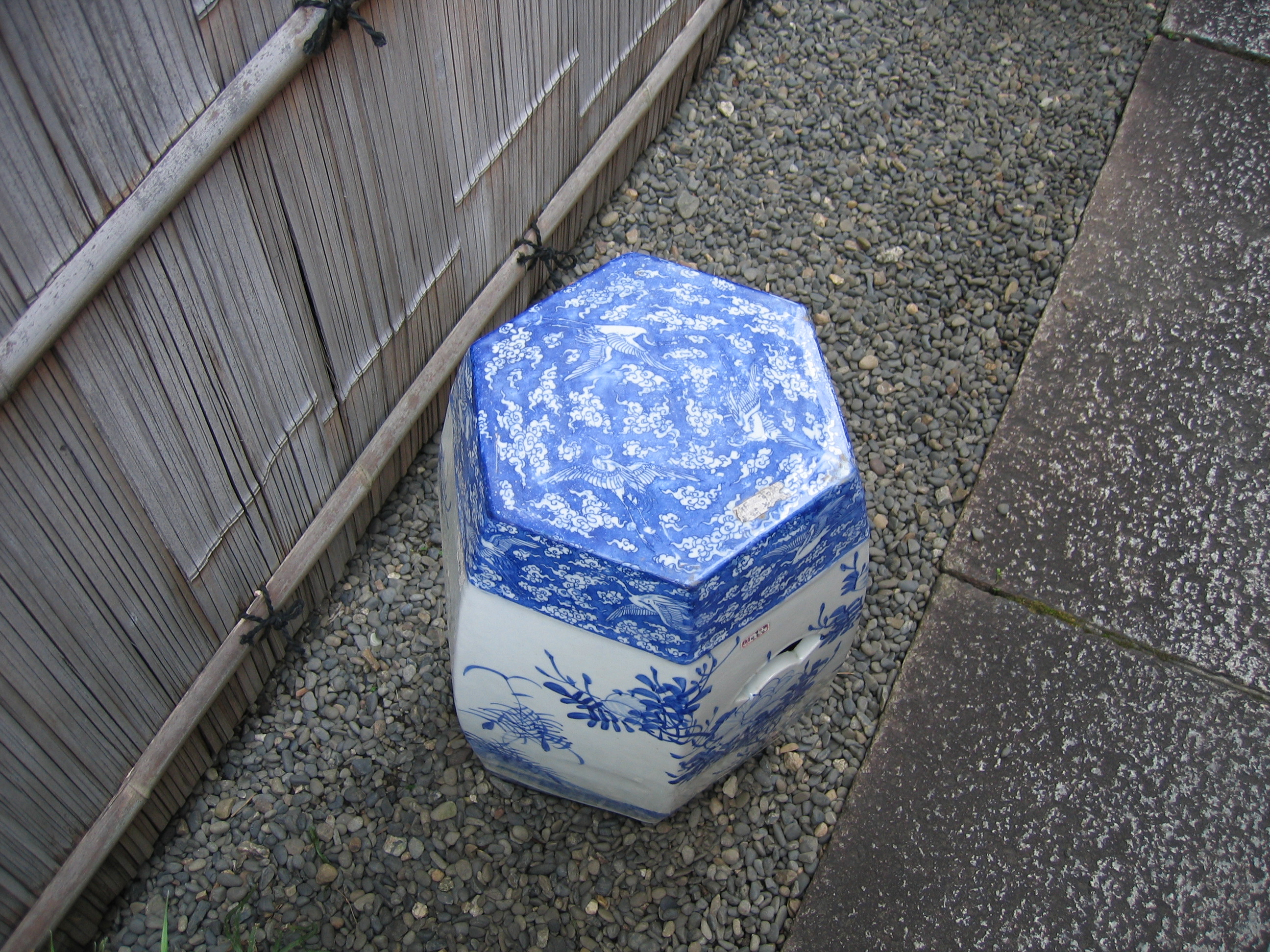
Back in 1997-1998 there was a pair of Japanese stools at a shop in Cat Street in Hong Kong that I couldn’t afford. I had never seen any like them and I fantasized about them for years. No photo of course, but they live in my memory as being hexagonal. In 2005 I found one on my first trip to Kyoto, not long after we had moved to Japan. I didn’t buy it then either, but I did take a photo! Not a great photo, but it shows you how seriously I was thinking about it. Although in retrospect, it wasn’t that great of a garden stool either.

So the tea-cup at the top of the post reminded me of the amazing find I made last summer, that somehow I had forgotten about in all the hullaballoo and busy-ness of my life.

I went down to the basement and found this. What do you think is in here?

This!

I haven’t stopped to clean it or anything but am absolutely bowled over by it! It has so many of my favorite motifs – cracked ice, fan vignettes, open fretwork - and the form and painting is spectacular. And I had literally forgotten that I had ever bought it! My swiss cheese brain is starting to worry me….

Now the question is, how do I get it back to its family and friends in my Tokyo living room?

Related post: Colors of the Rainbow…Blue and White Porcelain is Neutral. And more on porcelain garden stools at Apartment Therapy.


Image credits: All photos by me except 6. Elle Decor April 2011 photo credit: Simon Upton, 7. design by Jeffrey Bilhuber, Photo credit unknown.

Read Full Post »

Back in December I stopped by the Nogi Jinja sale and got “accidentally” pulled in by some 19th century Japanese botanical prints. They called my name (hollered actually) even though I was not out shopping for prints or anything particular at all. Much like ukiyo-e, they were mass printed on paper and probably bound in some sort of book or pamphlet originally. These are entitled “One Hundred Views of Flowers”, a typical naming device, and I am sure there were actually a hundred at some point. While the flowers depicted are all commonly grown in the West and easily recognizable, their presentation within the boundaries of the images is very Eastern and I loved that. Foolishly, I bought three. Foolish because I bought them? No, foolish because I only bought three. Upon further reflection at home I realized of course, I needed four, two to hang on each side of the window.  The difficulty was that there would not be a January sale held at Nogi shrine and I did not know where else to look for that particular dealer. I had never seen these prints elsewhere either.

What charmed me about them was that they felt like a cross between traditional botanical prints which I find more formal…

…and the framed herbiers (pressed flower and plant pictures) we have been seeing a lot of in recent years, such as in this Ginger Barber designed Texas guesthouse.

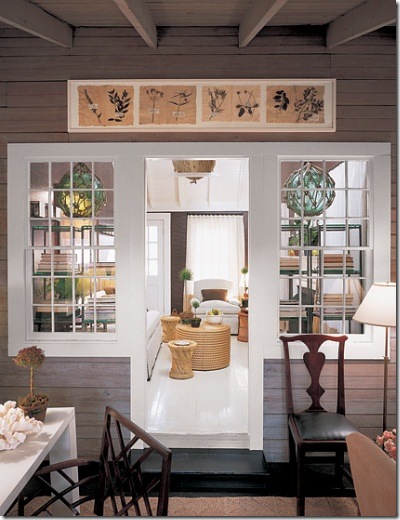
Or these, in Jeffrey Bilhuber’s Nantucket Cottage.

So imagine my surprise when I came across them early on as I browsed the huge Antique Jamboree out at Tokyo Big Sight in early January. Unfortunately, I had forgotten to get cash before going and was hoarding the little I had. I also could not quite remember exactly which three I had bought – which flowers and how they were arranged. It seemed important to have two consistent pairs, with the colors and orientations picked carefully. After a chat with the dealer about when and where I could find her in the coming month, I walked away to scope out the other 499 dealers. (Cue the dramatic tension inducing music)

Wait (even the most inexperienced among my readers) you cry out! Could I possibly be breaking the golden rule of antiquing, NEVER WAIT? As all antiques are unique you roll the dice walking away from anything you might want, even for a short time.  And this is Japan, which while officially in recession for the last 20 years or so, is the land of  “sold out”.  There is no inventory or stock of anything and hesitating before purchasing is sure to bring disappointment. Nonetheless, I was cocky and confident and walked on.

Two hours later, after a long a fruitless afternoon of over-priced and relatively uninteresting items, I was walking out to leave when I spied a Japanese couple looking at MY prints (note the capitals). I sauntered over, sure they would not be buying.  Not wanting to be rude, I held back and waited, only to slowly come to the realization that they were buying and perhaps buying deeply! I knew I would never find this set of prints again. All of a sudden the New Yorker in me stepped up to the plate – I was going to get my print no matter what. We began a dance as they realized I was interested – they were not giving an inch - no gaijin (foreigner) free pass. When they put one down, I picked it up. We both started scrambling. I could see they had the one I wanted in their hands as I realized I held one they desired. I tried to get the dealer to intervene, after all, she knew I had others and needed one more, but she was not going to help as they were buying many. I took a chance and set one down, the husband followed suit. Quickly I picked that one up as the wife seemed annoyed that he had relinquished it. He said something to her that calmed her and they settled and paid up, the dealer giving them a discount for a bulk purchase. As I went to pay, I realized I had been trumped. My print was torn and that was why they left it. Frustratingly, the dealer did not want to give me any discount, neither on the strength of my prior purchase nor the damage of the current one. Shoganai (nothing can be done), is never my favorite term, but in this case, it was true.  The matting would just have to cover the tear.

Luckily, the print I had managed to purchase worked perfectly with the others I had already bought. I called the framer, as key to bringing out the beauty in these would rest on their presentation.  Normally, I am not a colored mat kind of girl, but between everyone else’s obsession with colored mats these days and the fact that they looked blah with just a beigy tea-stained one, I decided to give color a try.

And what a color it is! Inky dark blue-green, with a very thin aged gilded frame. The key to the whole thing was having the inside edge of the mat darkened. I really love how these came out!

While this story has a happy ending, it might not have. Take it from me and remember, if you love something antique or vintage and the price is right, don’t wait, just BUY IT!

Antique Jamboree

Read Full Post »

There is nothing like the indecision of a rainy shrine sale day. Will the vendors be there? Is it worth going? This past Thursday was no exception. The eagerly awaited Kawagoe market falls on the 28th of each month and I skipped it last month as it was pouring out (and later heard that no one was there). We had planned to go this month, no matter what.  But as we readied ourselves to leave, it began to rain. Nonetheless, after stalling over yummy breakfast, we set out on the 1 hour drive.

Well, they say “good things come in small packages”.  I wish there was a similar adage for “great bargains come from rainy day shrine sales”. There were only about 20% of the vendors present, everything was covered in plastic tarps with only a few brave customers wandering around - mostly foreigners (the only ones foolish enough to be there). We jumped in and had the best day! Let me show you what I found…

First, this huge turquoise bottle originally used to hold alcohol of some kind. The dealer offered me his “rainy day special price” and I couldn’t resist.

I have long adored the interiors designed by Tom Scheerer, the king of the giant glass bottle. If you page through his portfolio or back issues of shelter magazines, there is not a single project that doesn’t include a gorgeous glass bottle in some way.

Often, the bottles have been converted into lamps.

I was so excited about my bottle, that I was unprepared for what I found next.  I had long admired these Japanese fishing floats in magazines, but never seen one for sale in Japan. I got the large aquamarine one to go with my giant bottle. It has its original net and is in great condition. I had thought they were asking a bit too much for it, but luckily the dealer who sold me the giant bottle came over and got involved.  He convinced them to give me a rainy day special price too!

Japanese glass fishing floats have been used by fishermen here for most of the last century. Floats continue to be in use today, but many have broken off from their nets and surf the Pacific Ocean, sometimes for decades. The floats follow the ocean currents and tend to wash up on shore in Alaska, the Pacific Northwest and islands throughout the region, especially after storms. There are devoted beachcombers who go out and hunt for these treasures, sometimes even flying to a remote area. Take a look at Glass Float Junkie’s blog for more history, information and great photos.

Modern day collectors love them for their decorative possibilities. Thom Filicia hangs three as an accent in a lake house.

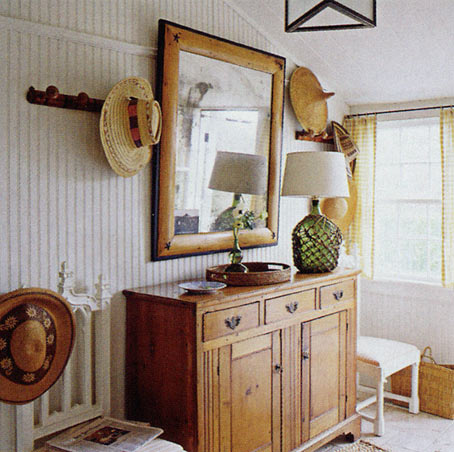
Jeffrey Bilhuber has used two as pendants in his adorable Rose Cottage on Nantucket Island. They are like jewelry in the room!

Tom Scheerer has even managed to inspire one into a lamp.

The popular market place has picked up on the trend as well. Pottery Barn had a Japanese float lamp, which is no longer available, but can be found on eBay…

and currently has the giant bottles.

Japanese glass floats have inspired artists as well. Dale Chihuly, the world-renowned glass artist has a series called Niijima Floats.  Around 1990 he visited a glass school on the island and it reminded him of “the Japanese fishing floats, which [he] used to collect on the beach when [he] was a kid in Washington State on the Pacific Ocean.”  Chihuly’s floats can be giant – up to 40 inches in diameter – and brightly colored, but I found these sheer blue ones particularly beautiful.


I haven’t had a chance yet to clean mine up and look for markings. More details to follow, including where I plan on using my finds, but as many of you know, I am renovating a bathroom at my NJ beach house (hint, hint). Other bloggers have written about these floats and I recommend posts at Completely Coastal and Things that Inspire.

I am going to leave you with this most beautiful image. Maybelline Te of Frou La La took this photo of the loggia at a friend’s house in the Philippines just resplendent with hanging floats.

Wow!

Image credits: 1 & 4. me, 2, 3 & 7. Tom Scheerer, 2. photo credit: Pieter Estersohn, 3 & 7. photo credit: Simon Upton, 5. Thom Filicia,  6. Jeffrey Bihuber in Architectural Digest, September 2003, photo credit: Peter Vanderwarker, 8 & 9. Pottery Barn, 10. Dale Chihuly, 11. Maybelline Te

Read Full Post »

Follow

Get every new post delivered to your Inbox.

Join 424 other followers

%d bloggers like this: