Feeds:
Posts
Comments

Posts Tagged ‘japanese prints’

So I am continuing to love Instagram as it allows me to post shrine sale finds and other interesting items on a real-time basis which is just so satisfying. For those of you who have not taken the leap, I’ve been finding some great treasures for myself recently and I’d love to share them. My blue-green glass addiction is unabated and I found this chubby sake bottle last week.  The two “ears” on either side of the bottle neck would have had a handle running through them originally. I think this one is perfectly shaped to be a lamp, but in the meantime, I will allow him to just hang out with his friends.

blue green sake bottle for lamp

Speaking of lamps, this sake jug with its flowers, unusual in that most rustic jugs just have a manufacturer’s name or mark painted on them like these, is also a wonderful shape for a lamp.

flowered sake jug

I love its implied relation to an American classic, the stoneware jug. It took the floral decoration on it to make me see it that way.

Somerset Potters stoneware jug

Actual lamps have been another find, although I know I paid more than I should have for this purpley-indigo beauty. I have wanted a tiny task lamp for my desk at the beach house and looked everywhere the last two summers for one with no luck.

blue work lamp

It will be absolutely perfect up here, so I had to have it.

hydrangeas in transferware bowl

I also couldn’t resist this minty green metal storage box. Don’t know what it is for or where exactly it will go, but I am sure I will find a place!

vintage metal box mint green

My lavender and blue dreams continue, with the markets fully supporting them. Lavender is not a typical color in Japanese textiles – it really is rare to see it – but I found an extraordinary lavender and blue tsutusgaki furoshiki (a traditional wrapping cloth made with a hand drawn rice paste resist technique) with a soft shibori faded background. I was having trouble convincing myself to buy it (“Do I really need it?”) when I realized I had an item stalker. You know what that is, someone who has spotted something you are looking at and decided they want it, so they follow you around the booth hoping you will put it down so they can grab it. An item stalker always helps to force a purchase!

IMG_2366

Since then I’ve found a length of typical shibori (Japanese tie-dye), but in lavender and blue.

lavender shibori

While I’m at it, here’s another really pretty and detailed piece…

blue shibori

…and did someone say pop of color? Obviously May Daouk‘s living room is still on my mind when you look at these colors together.

pink shibori

My spate of finding incredible Japanese prints – impeccably framed no less – at Kawagoe continues unabated. These small lithographs aren’t stand out pieces alone, but as part of a larger gallery wall, I know they will be fantastic.

IMG_2531

I am not familiar with the artist and haven’t had time yet to research it, but I do love them.

IMG_2533

So have you made any great finds recently? I’d love to hear about them!

Related Posts:
Shrine Sale Stories…Yamamoto’s Steamer Trunk
Shrine Sale Stories…My French Moderne Bar Cart
Shrine Sale Stories…Vintage Matchboxes, Frank Lloyd Wright’s Imperial Hotel and The 1948 London Olympics

About these ads

Read Full Post »

Jenny’s post the other day on the great Warhol print she got for her little girls’ room reminded me of something – another kind of print – a vintage Japanese woodblock one called chiyogami, that looks a lot like her Warhol on a much smaller scale.

Chiyogami (chiyo meaning “a thousand years” or “through eternity” and kami/gami “paper”) has been made since the Edo era and continues to be popular today. Early papers, like these examples from the Taisho period between the wars were block printed much in the same way as traditional ukiyo-eI think their bright colors and stylized prints, based originally on kimono fabric patterns, would look wonderful hung en masse in a child’s room. While based on traditional designs, these patterns skirt the edges of Art Nouveau and Art Deco.

Simple frames of the IKEA variety are one inexpensive and easy way to complete a wall display…

…while wrapping canvas stretchers is a bit more unusual. These are covered in modern chiyogami examples.

New chiyogami is available all over Japan and online at all the paper sites, but the new pieces are silkscreened or machine printed and don’t have quite the same feel. Maybe it’s because the patterns have become ubiquitous to me, but framed they look too much like scrapbook paper – one-dimensional with no heft to the paper. But actually, still pretty…

I love framing and hanging things that were never meant for that purpose.

Related Posts:
Hanga 101…a Quick Primer on Japanese Prints

Image credits: 1. via Little Green Notebook, 2-9. me, 10. via Style at Home, 11-12. via Apartment Therapy.

Read Full Post »

So once again it is that time of year. Starting on Friday, October 19th and running through the weekend, the College Women’s Association of Japan‘s annual exhibition and sale of modern Japanese hanga is on at the Tokyo American Club. Admission is free and open to everyone. Tokyo American Club members can also attend a pre-sale on Thursday night from 8-9 pm. Whether you go every year or this is your first time, I recommend that you do not miss this show. It is a chance to view and purchase top quality original art, whether you are looking for a souvenir of time in Japan, are a serious art collector or are simply tired of looking at your bare white walls. If you are not familiar with the history of Japanese printmaking I recommend that you read my Hanga 101 primer for history and context.

Featuring 201 prints by 200 artists, including the foremost printmakers in the field as well as 42 debut artists, the show gives viewers a real taste of the breadth of print work being created today. The prints span the full range of different printmaking techniques, from traditional woodblock to intaglio to silkscreen, as well as variety of subject matter. This year a newcomer to the show graces the cover, which is a rare event and it inspired me to highlight prints by artists appearing for the first time this year. Some are young, recent graduates of Japanese art programs, while many others have been working in their medium for sometime and have only recently applied and/or been admitted to the show, which is the case for YOSHIDA Hideshi and his dramatic cover print, The Strength to Destroy This Restraint. Reading like a mini sci-fi story, Yoshida has been conceptualizing this image since his 1993 reading of a story about an angel trapped in a hypercubic prison in The Fourth Dimension: Toward a Geometry of Higher Reality. The angel, turned into a sort of super hero/power ranger, escapes, symbolic of Yoshida’s emergence from an artistic slump. Having the prestige of the cover image would confirm that.

IWAKIRI Yuko describes her woodcut The Quartette very melodically: “As I was drawing the rows of trees of a virgin forest, I came to see a five-line staff score and it seemed to me like the cold autumnal wind which blew through it was playing a harmony…From oppressing low-pitched bass to sharp high-pitched notes that gradually vanish, and the sound of a bow scraping against the strings to a dry pizzicato – I described a field of the weaving sounds of the four string instruments.” Iwakiri uses 15-16 layers of water-based ink to produce a soft toned but dense image. She compares it to “drawing and painting with plates rather than just pulling out prints.”

TOHIGUCHI Toru’s silkscreen entitled Jaguchi is a bit of a mystery to the English language viewer. What do you see? I saw a face, until I translated the title, which means faucet in Japanese. A witty take on the art of the everyday, don’t you think?

Born in 1932, INOUE Katsue may be the oldest and most famous of this year’s printmakers to have a debut at the CWAJ Print Show this year. Her deceptively simple black and white woodcuts depicting flowing grasses and blowing flowers are both intensely graphic through their contrast of negative and positive space and atmospheric in a Georgia O’Keeffe way. Personally, I like her Flower in Wind poppy print because it would look good hung anywhere, with anything else, while keeping its own integrity. Practicality shouldn’t really figure in to art purchases, but sometimes its hard not to consider it. I think this one makes a lovely gift too.

A really sweet print is SOMEYA Mayumi’s Greeting Summer Solstice and her description of her working process corresponds with her imagery. “Block print is sometimes called blind work: You can’t visualize the result of your work until you see the final print. I always throb with excitement when I carefully turn over the final copy. You see, the paper comes out from under the plate which itself comes out through the press machine — all mysteriously and nonintuitively removed from the appearance of the final product. Whenever the result exceeded my expectations, I felt like joining hands with someone, anyone, and setting off on a journey somewhere far away. Now, that’s celebration! I work alone, yet I often feel as if I were collaborating with others, and then my atelier feels lively.”

The bargain print of the show is KAMATA Yuki’s small world lithograph with its subtle coloration and abstract photographic quality.

Numerous artists have layered in political and environmental thought to their works this year in response to the Great Japan Earthquake and the subsequent nuclear crisis. Amongst them are TAGO Hiroshi’s Murmuring Planet, a mezzotint on gampi paper with a drowning Earth in an upside down glass…

…and JUNG Il’s The Property of the Earth, a classic woodcut which looks almost computer pixellated yet has a very thick painting like texture. The whimsical nature of the print enforces his message that we need to cohabit our wonderful planet in harmony.

The souvenir print for those living in Asia has to be ARAI Keiko’s Temple of Daybreak as it has scenes of Angkor Wat and India all tied up in a glowing morning scene.

And for sheer decorative power take a look at lithographs from UENO Tomoko Time Plant

…and SAKAI Junji Lluna de febrer ’12-I. Both are very painterly – Ueno’s has such a sense of brush stroke and Sakai is masterly at color block work.

And again this year, the Young Printmaker Award winner is an absolute stunner! TAKEUCHI Hidemi’s Harvest Day quadtych touches on themes of time and life, representing “the day of fruition, the day of accomplishment honoring time well spent.” It certainly looks like a successful harvest – in more ways than one!

All of these new CWAJ Print Show participants join a historic event that has taken placed uninterrupted since its inception in 1956. CWAJ volunteer members have worked tirelessly through the decades to produce one of the most prestigious hanga shows, using the proceeds to fund their respected scholarship program.

And as an additional incentive to get you out to the show, a few little birdies have told me there is a special surprise this year – an opportunity not to be missed – so I am looking forward to seeing you there! I’ll be working as a docent most of Friday and intermittently through the weekend. Please stop by and say hello.

Related Posts:
Artist Spotlight…55th CWAJ Print Show
Artist Spotlight…56th CWAJ Print Show
Hanga 101…a Quick Primer on Japanese Prints

Read Full Post »

Following up on the idea of “finding” from my last post, I want to show my most recent purchase – a true unexpected find! I have long had a butterfly fetish and have been stomping my feet in frustration the last few years at their trendiness. I think I may have even complained about it in earlier posts and I am sure long time collectors of silhouettes and intaglios feel the same way I do right now. I won’t recreate the wheel by showing the plethora of interiors featuring butterfly art as there are already tons of posts out there.

I will, however, mention the more recent trend of some wonderful butterfly installations, different from the more typical 19th century prints or taxidermy mounted ones we usually see. The first to catch my eye was Myra Hoeffer’s all white California house, with its stream of butterflies mounted high on the wall as if they had come to roost there.

The butterflies are by artist Paul Villinski, made from recycled beer cans no less, who currently has an amazing looking installation at the Morgan Lehman Gallery in NYC. His work is utterly thrilling so if you have a moment, I would recommend paging through his website.

You might also remember the black butterflies on Serena’s wall in the TV series Gossip Girl. Those were his too…

And then there was that gorgeous butterfly box in the Celerie Kemble designed apartment in the newest Lonny. Obviously this room was irresistible to me as it is lavender, but I thought it was the perfect combination of pretty and functional too. And by the way, there is also a stuffed peacock in that apartment, talking about another trendy item right now, but one that definitely holds less interest for me…

What does any of this have to do with my newest finds? Not much really, other than the butterflies. This past weekend I had the opportunity to purchase two early Chizuko Yoshida butterfly prints from the 1970s. Yoshida is from one of the most distinguished families of Japanese woodblock print artists, and I had long admired her work. About five years ago, the CWAJ Print Show had a retrospective exhibition for its 50th anniversary that included one of her pieces, which had actually been the cover print of the show catalog in 1976. (Lower left corner of the catalog page below). I loved it, but unfortunately it was not for sale. With the 56th annual show coming up next week (watch for an upcoming post), I have had Japanese prints on my mind.

So imagine my surprise at stumbling across 2 of her seminal butterfly prints, one from 1977 and the other from 1978, already framed by the best gallery in town some 35 years ago. Perhaps they were her print show entries for the next two consecutive years after her cover print? I don’t know and have not had time to research it yet because I am too excited to wait to share them with you. Sorry in advance for the lousy photos, but the glare on the glass made it impossible to get a good shot, at least not without special equipment and more fussing on my part.

Here are some close-ups with detail, but I will have to show them on the wall in a later post. Click the image for a large view.

Definitely a little magic in the air…

Image credits: House Beautiful April 2011, photo credit: Francesco Lagnese, 2-3 via Paul Villinksi, 4. Lonny September/October 2011, photo credit: Patrick Cline, 5. 50th CWAJ Print Show Catalogue, page 152, 6-9. me.

Related Posts
Artist Spotlight…55th CWAJ Print Show
Junking in Singapore…Arab Street and the Dinky Di Store
Butterflies in Japan and New York…Sori Yanagi’s 1954 Classic Plywood Stool at MOMA

Read Full Post »

The Oedo Antiques Market is a jewel. While it lacks the charm of being on the grounds of a temple or shrine, it makes up for it by being held in the shady courtyard of the Tokyo International Forum at the convenient junction point of Hibiya, Marounouchi and Yurakacho. While it tends to be higher along the antiques food chain and thus higher priced than a conventional shrine sale, it makes up for it by having some of the best quality merchandise to be found. Held on the first and third Sundays of the month, and the fifth Sunday is there is one (like there will be this October), it is one of the most pleasant antiquing experiences to be had in Tokyo.

Luckily for me, Peri Wolfman of Wolfman-Gold & Good fame was in town visiting her niece, my friend D. For more on Peri, see my previous post. This past Sunday I took them to shop the Oedo market and we all had a wonderful time and bought lots of goodies. The entire day was colored by Peri’s aura, meaning it was black and white. We looked at and bought nothing frou-frou or fancy. No blue and white porcelain, nothing gilded. Everything was simple, streamlined, functional and lovely because of it. I did mean to take so many more photos chronicling the day. Photos of what we looked at, what we liked, you name it.  But sometimes you have to live just to live, not live to blog, and Sunday was such a day. I was too engaged to even remember to pull out my camera half the time, so I can only show you a record of what we actually bought.

First up were these bowls by ceramicist Ando Masanobu. As I am not familiar with his work, I did a little research and found this description in the online edition of Kateigaho magazine (which you should be reading if you are at all interested in Japanese arts and culture). ”Perhaps the most fitting description of his pottery, reflecting a balance of sensibility and philosophy, is the word refinement. The striking forms of his solid white or black semi-matte vessels bear minimal ornamentation.”  No way to say it better than that. I do wonder how these bowls ended up down in Tokyo, but the karma was perfect because they were meant for Peri. As a pair, they also display one of her golden rules, which is never buy ”onesies”. Multiples are king!

Ando also runs a gallery called Momogusa in an old minka (farmhouse) that he moved to in Tajimi and rebuilt. Besides his own work he exhibits ceramics, glass, washi, textiles, and so on by other artists. Looks like it is worth a visit!


These were quintessential Peri – a group of Edo period pottery stacking bowls – albeit the largest one was the size of a golf ball. Scale is hard to show in this kind of close-up but consider the grain of the matting underneath and it gives you a sense of their tiny-ness. Peri is currently developing a line of tableware for Restoration Hardware –  the reason for her visit – and stacking items are definitely a part of it.

We almost overlooked the military dealer – you know the one who has all the Japanese army uniforms and sometimes other creepy stuff – there is always one like that at every market. Luckily these caught our eye and we stopped. These are old mess hall dishes made of white ironstone from the days before plastic. The small deep bowl is meant for tea.

And of course it wouldn’t be Peri without some white ironstone pitchers.  These look French, but the marks are actually Japanese. Wonderful shapes! And shown perched on one of a pair of rustic children’s chairs bought too.

We both got amazing little black and white woodblock prints. One for her…

…and one for me.

These metal clip on sconces may not look like much here, but let me tell you they are dynamite! Painted green metal with wonderful patina and best of all, they don’t require any holes drilled to hang them (which is a big issue in Japanese rentals, let me tell you). Just clip ‘em where you want ‘em.

Imagine them like these in this dreamy Jill Brinson designed bedroom.

Simple bargain frames made of sakura (cherry) and bamboo came home with us too. Peri thought the speckled paper under the glass of the rectangular one was so pretty it could be used as a tray instead.

Peri is all about storage (just peek back at that Oprah magazine article) and both D and I got some of these charming vintage apothecary drawers to stack on my desk and in her entryway.

What a great day! Peri looking fabulous in her usual black and white while I look as goofy and over excited in this photo as I felt.

Oh, and last but not least, I need to report that the marble-topped pastry table in Peri’s earlier kitchens was sold along with the house…

Read Full Post »

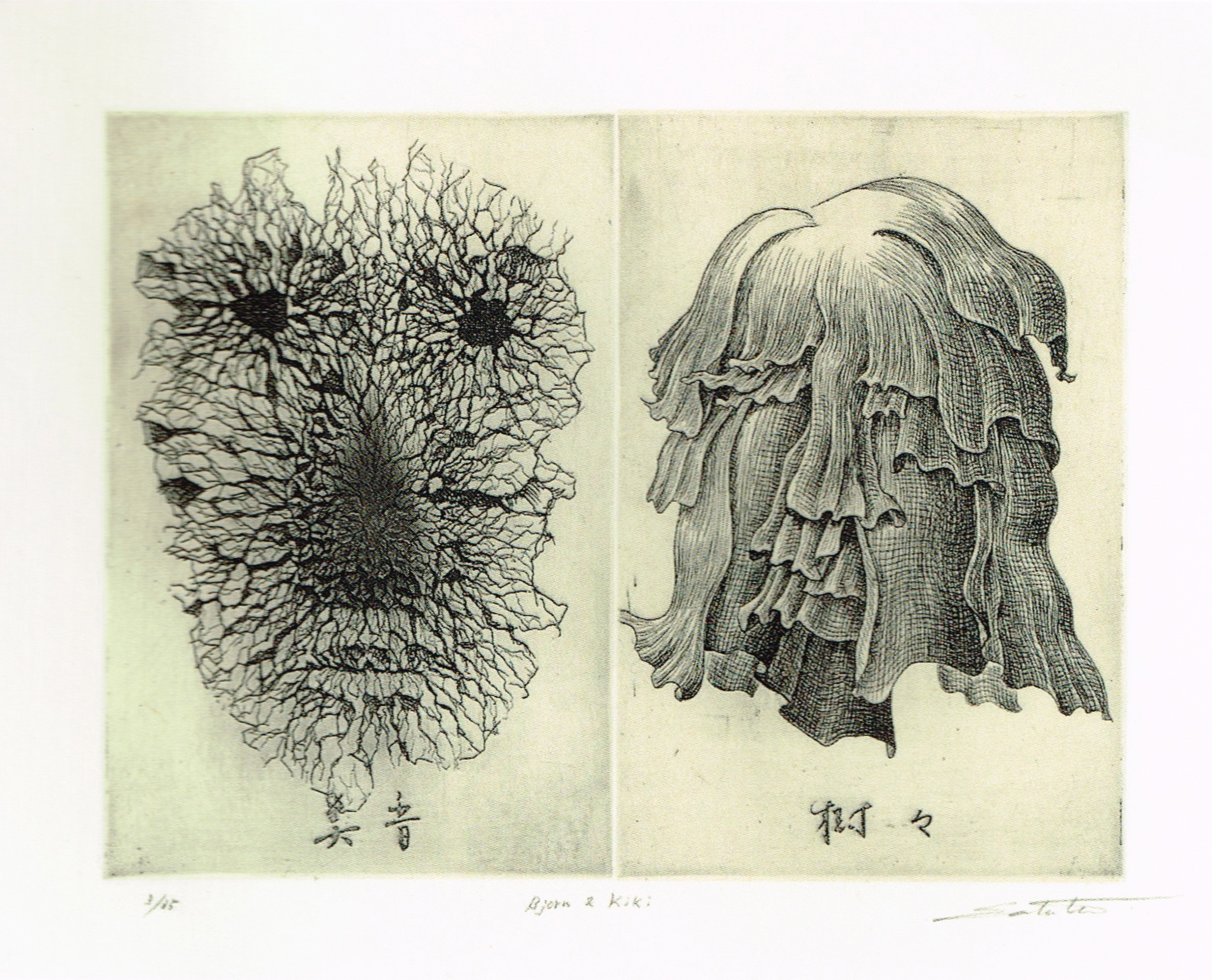
Last October I posted about the CWAJ Print Show and in particular, this print Nature story-(heaven), by the Young Printmaker Award Winner Kyung Sun Kim. It is an edition of only 3 prints and at the time I knew that the artist would keep one, the Daigaku Hanga Gakkai (Committee of Universities of Art for Print Studies in Japan) where it was originally displayed would keep one, leaving only a single print for sale at the CWAJ show. At the time I thought it would be fun to try to follow where it ended up and while I wanted it very much, I was sure a donor or VIP would buy it at the opening reception before I had a chance to.  Little did I know that my true competition would come in a much closer and more personal form – my mother!
My mom never worked as a professional designer, but her house was famous for its perfection in our neighborhood growing up. While everyone else of her generation was falling prey to the excesses of faux French Provincial in the 1970s, my mom held tight to her modernist ideals and her Paul McCobb bedroom set (walnut mind you, not the blond stuff). She suffered the disappointment of a so-called “friend” who stole her long-planned decorating scheme, but triumphed in the end by doing it better. And who can forget the year of the “Great Flood”? No, not Noah’s flood, but the year the pipes burst in our house during Christmas vacation. Water ran for days before it was discovered and I recall crossing the Verrazano Bridge at midnight on New Years Eve, racing to get home. The flood ended up being a blessing in disguise, allowing her to pull out all the original ceilings and raise high the roof beams, realizing a creative vision she had for a simple development house. Nowadays, besides a bad back, her biggest problem is all the neighbors coming over to question and copy her best ideas!

My mom often reads the blog and sends me emails on the side wondering what I like so much about a particular room. We can be such opposites – color and clutter versus bare and beige. But over the years her palette has expanded and she has squeezed in a few good Louis pieces too. (And the famous family saying “all antiques are just firewood” was actually coined by my dad.) Having seen my post on the Print Show, she promptly called me and said she “had to have it,” and a good girl never argues with her mom. But truthfully, it is so rare that our taste intersects so exactly and so difficult to find things that she truly wants that I was thrilled. So this YPA winner’s print has traveled from Tokyo to Florida to take up residence with her.

Nature story-(heaven) now hangs above the bed, the color and size just perfect in the high-ceilinged room. She has come up with a few other ingenious ways of dealing with the huge volume of space, like the hanging night lights.

My mom likes to think things through (often at odd hours of the night, which works with a daughter halfway round the world) and get it right. Before she committed to the hanging night lights, she photoshopped some examples to be sure. That brings me to the first of her decorating and life rules – Positive visualization.

Continuing along with the list:

Mix custom with ready-made.

Strive for balance and scale.

No detail is too small. Arrange untill perfect.

Recycle when possible.

Buy souvenirs wherever you go.

My mom comes from a long line of knitters and she taught me that so many things in life are like a knitting pattern.  When you read it all at once, it makes no sense. The key is to start at the beginning and read one step at a time…Cast on 58 stitches…Decorating can be like that too.

And by the way, that isn’t the only large artwork from my life to make its way home with her. For more on Sakura in the Moonlight, click here.

Mom, thank you always and forever for everything! I love you!

Read Full Post »

Los Angelinos, take note. Peter Dunham’s Hollywood at Home, his one stop shop for some of the hottest hand-printed textile lines around (Carolina Irving, Lisa Fine, John Robshaw, Martyn Lawrence-Bullard and his own), custom furniture and vintage finds has opened a second branch, also on La Cienega Boulevard.

Of even bigger news in my book, Hollywood at Home will be carrying Rodman Primack’s new line of Japanese inspired fabrics, hand-printed on Belgian linen, simply called R.P. Miller. Since childhood, Primack has been influenced by his grandparents extensive collection of Japanese art and antiques gathered on their travels. Based on 18th and 19th century ukiyo-e (woodblock prints), his new textiles are modern interpretations of traditional patterns.  ”In the fabrics various themes and details have been abstracted to create something new that is meant to evoke, not literally replicate.” I am still waiting on some live samples, but the showroom did send me some close-up photos.

You can see the four main patterns in the indigo blue colorway stacked up here. The one I find particularly interesting is the second one down, hard to see in just this small bit. It is an expanded and simplified rendering of the angled and foreshortened perspective seen in the depiction of wooden fences, bridges and walkways in woodblock prints and folding screens (byobu).

Here you can see it much better on the sofa in this photo from the showroom via Stylebeat. A pattern like this works best for a large-scale project with a horizontal view like this.

Here ia a 17th century masterpiece by Ogata Korin in the collection of the Metropolitan Museum that has just the kind of bridge and perspective I was referring to.

And again, in a woodblock print by Kitao Shigemasa, you can even see the grain of the wood on the floorboards. For more on Japanese perspective and its influence on Western art, see here and here (and make sure to compare this print to Whistler’s Caprice in Purple and Gold shown there).

It would have been a perfect lead-in for the next fabric if the motif on the doorway in the print above had been asanoha (hemp) instead of sayagata (key fret), as the classic hemp pattern is the boldest of the graphic prints in the line. It comes in numerous colors including the red, grey, green and indigo shown here. The truth is, the hemp motif needs its own post one of these days!

The sweetest pattern is this petals in the river motif, shown in red below and blue up at the top.

I was trying to find a yukata (cotton kimono) photo in my files with a similar pattern, as I know I have seen them, but the best I could come up with was this grass pattern.  But it could easily be part of his collection, don’t you think?  You can see why I am always wishing the fabrics of traditional Japanese dress were upholstery weight!


There is also a cute pattern of tiny stars and perhaps some others, I am not sure. More when I get my samples!

Image Credits: 1, 5-6. courtesy of Hollywood at Home, 2. via Stylebeat, 3. via The Metropolitan Museum of Art, 4. via The Library of Congress, 7. me.

Read Full Post »

I am off to ski for a holiday weekend here, in the best powder anyone can remember for a long, long time. So, in honor of the wonderful snow here this year and the crazy snowy winter in the US, I will leave you with a series of Japanese woodblock images of snow falling. Viewed in chronological order, they give such a clear narrative of the development of the medium, changing artistic styles, and advances in print making technology. All have a marvelously realistic but magical quality to their depiction of the snowfall.

Hokusai, Fuji in Deep Snow, from 100 Views of Fuji, c. 1834

Hiroshige, Gion Shrine in Snow, from Famous Places in Kyoto, c. 1834

Hiroshige, Atagoshita and Yabu Lane from 100 Views of Edo, 1857

Kawase Hasui, Spring Snow at Kiyomizu Temple in Kyoto, 1932

Kiyoshi Saito, Winter in Aizu, 1969

Tomikichiro Tokuriki, Snow Over Kiyomizu Temple, 1983

Masao Ido, Nanzenji in Snow, 2003

Seiji Sano, Snow Falling Softly, 2004

Keisuke Yamamoto, Kiyomizu Temple Covered with Snow, 2010

And one more I can’t help but share, even though it is not a print at all, but a photograph from a series by Yuji Obata. It took Obata five years to figure out how to photograph the snowflakes directly as they fell from the sky. For more images and information see James Danzinger’s blog, The Year In Pictures.

Yuji Obata, Homage to Wilson A. Bentley #10, 2005 - 2006

Enjoy! I hope you all get some time on the slopes this year…

For more on Japanese prints see Hanga 101…a Quick Primer on Japanese Prints.

Image credits: 1, 3-6. via Ronin Gallery, 2. via Hiroshige.org.uk, 7 & 8. 50th CWAJ Print Show Catalogue, 9 55th CWAJ Print Show Catalogue, 10.via The Year In Pictures

Read Full Post »

Back in December I stopped by the Nogi Jinja sale and got “accidentally” pulled in by some 19th century Japanese botanical prints. They called my name (hollered actually) even though I was not out shopping for prints or anything particular at all. Much like ukiyo-e, they were mass printed on paper and probably bound in some sort of book or pamphlet originally. These are entitled “One Hundred Views of Flowers”, a typical naming device, and I am sure there were actually a hundred at some point. While the flowers depicted are all commonly grown in the West and easily recognizable, their presentation within the boundaries of the images is very Eastern and I loved that. Foolishly, I bought three. Foolish because I bought them? No, foolish because I only bought three. Upon further reflection at home I realized of course, I needed four, two to hang on each side of the window.  The difficulty was that there would not be a January sale held at Nogi shrine and I did not know where else to look for that particular dealer. I had never seen these prints elsewhere either.

What charmed me about them was that they felt like a cross between traditional botanical prints which I find more formal…

…and the framed herbiers (pressed flower and plant pictures) we have been seeing a lot of in recent years, such as in this Ginger Barber designed Texas guesthouse.

Or these, in Jeffrey Bilhuber’s Nantucket Cottage.

So imagine my surprise when I came across them early on as I browsed the huge Antique Jamboree out at Tokyo Big Sight in early January. Unfortunately, I had forgotten to get cash before going and was hoarding the little I had. I also could not quite remember exactly which three I had bought – which flowers and how they were arranged. It seemed important to have two consistent pairs, with the colors and orientations picked carefully. After a chat with the dealer about when and where I could find her in the coming month, I walked away to scope out the other 499 dealers. (Cue the dramatic tension inducing music)

Wait (even the most inexperienced among my readers) you cry out! Could I possibly be breaking the golden rule of antiquing, NEVER WAIT? As all antiques are unique you roll the dice walking away from anything you might want, even for a short time.  And this is Japan, which while officially in recession for the last 20 years or so, is the land of  “sold out”.  There is no inventory or stock of anything and hesitating before purchasing is sure to bring disappointment. Nonetheless, I was cocky and confident and walked on.

Two hours later, after a long a fruitless afternoon of over-priced and relatively uninteresting items, I was walking out to leave when I spied a Japanese couple looking at MY prints (note the capitals). I sauntered over, sure they would not be buying.  Not wanting to be rude, I held back and waited, only to slowly come to the realization that they were buying and perhaps buying deeply! I knew I would never find this set of prints again. All of a sudden the New Yorker in me stepped up to the plate – I was going to get my print no matter what. We began a dance as they realized I was interested – they were not giving an inch - no gaijin (foreigner) free pass. When they put one down, I picked it up. We both started scrambling. I could see they had the one I wanted in their hands as I realized I held one they desired. I tried to get the dealer to intervene, after all, she knew I had others and needed one more, but she was not going to help as they were buying many. I took a chance and set one down, the husband followed suit. Quickly I picked that one up as the wife seemed annoyed that he had relinquished it. He said something to her that calmed her and they settled and paid up, the dealer giving them a discount for a bulk purchase. As I went to pay, I realized I had been trumped. My print was torn and that was why they left it. Frustratingly, the dealer did not want to give me any discount, neither on the strength of my prior purchase nor the damage of the current one. Shoganai (nothing can be done), is never my favorite term, but in this case, it was true.  The matting would just have to cover the tear.

Luckily, the print I had managed to purchase worked perfectly with the others I had already bought. I called the framer, as key to bringing out the beauty in these would rest on their presentation.  Normally, I am not a colored mat kind of girl, but between everyone else’s obsession with colored mats these days and the fact that they looked blah with just a beigy tea-stained one, I decided to give color a try.

And what a color it is! Inky dark blue-green, with a very thin aged gilded frame. The key to the whole thing was having the inside edge of the mat darkened. I really love how these came out!

While this story has a happy ending, it might not have. Take it from me and remember, if you love something antique or vintage and the price is right, don’t wait, just BUY IT!

Antique Jamboree

Read Full Post »

Ballet: The Star 1878

So I’ll start with the eye candy – this Edgar Degas masterpiece from the Musee D’Orsay is the headliner of his exhibition at the Yokohama Museum of Art along with 50 or so other loaned works from that extraordinary French museum. It is the first major retrospective of Degas’ work to be shown in Japan in 21 years, totalling about 120 pieces. The exhibition has a large smattering of everything – the ballet, the horse races, the cafe singers, the nudes, portraits, sketches and some bronze sculptures. It is well worth seeing.

One of the more recent ideas about Degas’ nudes is that his painting style was highly influenced by early Japanese prints (ukiyo-e). Unpopular with the Academy when originally shown because they were so matter-of-fact and almost voyeuristic – in contrast to the idealized nudes in more traditional painting – Degas’ realism was quite shocking at the time.  But depicting women going about their bath is a common theme in 18th century ukiyo-e, particularly in prints by Hokusai and Kiyonaga. Care is not taken to make women look beautiful in these prints – they are shown naturalistically, as if through a peep-hole, washing themselves. The same can be said of Degas’ nudes, of which there are many in this show.

The Tub 1886

It is believed that Degas had a copy of Torii Kiyonaga’s Women at Bath, shown below. Degas uses these poses in many of his paintings of nudes, for instance, compare the crouching woman in the blue and white yukata (cotton kimono) in the forefront of the print to the woman in The Tub above.

Women at Bath, late 18th century

While there tends to be a lot of analysis of the stylistic influence of ukiyo-e on Degas, I actually think the subject matter of ukiyo-e is the more influential as it freed him from the typical subjects of late 19th century paintings. Degas painted the demi-monde - ballet dancers, jockeys, cafe singers – people who existed outside the realm of class structure but were patronized by the rich. Ukiyo-e depicts “the floating world” of much the same people – kabuki actors, geisha, courtesans, and sumo wrestlers. I am sure this is not a particularly new insight, but one that really stood out to me as I toured the exhibition.

  • Edgar Degas at Yokohama Museum of Art, until December 31, 2010. (03) 5777-8600, 3-4-1 Minatomirai, Nishi-ku, Yokohama; 3-min. walk from Exit 3, Minamomirai Station, Minatomirai Line. 10:00 a.m.-6 p.m. (till 8 p.m. on Fri.) ¥1,500. Closed Thursday. www.degas2010.com.
  • Interested in knowing more about ukiyo-e? Check out Hanga 101.

Image credits: 1. ibiblio, 2. Wikimedia, 3. Jim Breen’s Ukiyo-e Gallery

Read Full Post »

Older Posts »

Follow

Get every new post delivered to your Inbox.

Join 405 other followers

%d bloggers like this: