Feeds:
Posts
Comments

Posts Tagged ‘Japanese porcelain’

What does a girl do with unmade decisions hanging over her head? Sulk? Panic? Nope! Fantasy decorate is the answer!

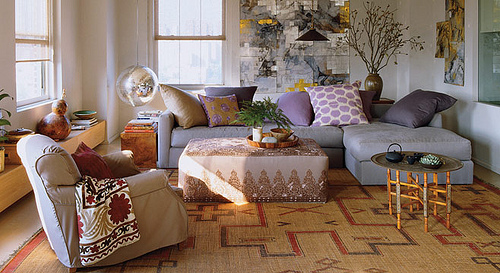
may-daouk-beirut-home-AD

Ever since this time last year, I have been obsessed with designer May Daouk’s Beirut home, which was featured in Architectural Digest, stunningly photographed by Simon Watson. The luminescent lavender living room, chock-a-block with blue and white porcelain, comfy seating and that divine 19th century Oushak spoke eloquently to me. And those arched windows – those windows! – maybe I really need to go back and start with them. The fact that her home was in the Middle East didn’t particularly register with me at the time and only came to seem like an important point much later. While I am only showing the living room in this post, the entire space is fantastic so click here to see the slide show over at AD.  And please be sure to click on the photos themselves in this post to see the enlarged versions which truly show the spectacular details.

Simon Watson May Daouk LR

I might not have imagined trying to apply the wonder of this space to my life before, even though it is my favorite color and holds so many favorite things. But it got me thinking…Many houses that I looked at in Doha had arched windows and large rectangular living spaces – granted not quite like this – but lovely nonetheless. So what in this photo don’t I already have? Neutral linen covered sofa? Check! A pair of velvet armchairs? Check? A big dark trestle table like the ones along the side of the room? Check! (That one is down in the garage for those of you wondering). Antique global textiles turned into pillows or throws? Check! Gobs and gobs of blue and white porcelain? Check! 19th century carpets? Check! (Although much smaller ones that could be laid over jute or seagrass perhaps). Could I be happy in Doha if I lived in a room like this? Somehow I think the answer to that is Yes!

may-daouk-beirut-home-03

I’ve even got a pair of antique slipper chairs with a bullion fringe and their original coral pink velvet fabric – definitely in the same spirit as these. And you all know I’ve got a gorgeous blue & white garden stool – just got to get it there. Should I be sure to put an IKEA Rand black and white striped dhurrie in my shipment? No, because IKEA opened in Doha just a month or so ago. Check!

may-daouk-beirut-home-04

Before you start scratching your head and thinking I am off my rocker, let me show you a few more inspiration examples, like this Moroccan fantasy from the late Domino magazine. Remember those pink chairs I just mentioned? And how divine is all that inlaid furniture? (More on that below). But the pièce de résistance has to be that armless settee upholstered a la suzani!

moroccan lavender Domino

Instead of blue & white, painted  and glazed earthenware is featured.  That would be a chance to start a whole new collection!

Moroccan lavender detail Domino

Perhaps a new collection isn’t the answer – after all I do love my porcelain. Maybe going a bit more formal – soft with a bit of whimsy actually – with the lavender and blue in the space would be lovely, just like at Aerin’s place?

Aerin lauder ED0709 pc Simon Upton

Tufted Chesterfield? Check! Queen Anne tea table? Check! (That one is in the garage too!)

APT_with_LSD_Aerin_Lauder_Vogue_

Katie Ridder gets the formal but whimsical combo down just right too.

Galbraith & Paul seeds-katieridderrooms

Another choice would be to use the fresh slate to steer off in a more modern direction. This is not my usual style but speaks to me nonetheless. The mix is outstanding! Orangey-toned tribal carpet? Check! Moroccan side table? Check!

lavender moroccan room coco kelley

It seems as if the flea market gods are having their say as well. Speaking of Moroccan side tables, I found this one at the market last week and had to buy it. Trying to decide if it should go to the beach or if I should take it with me.

IMG_2423

Kinda seems like carrying coals to Newcastle, no?

And breaking news…In the time it took me to write this post I got a fresh email in my inbox with my elder daughter’s acceptance into school in Doha. Looks like the pendulum may be swinging that way. Hello lavender!

Related Posts:
Major Life Changes Ahead…Shall We Let the Architecture Decide?
Colors of the Rainbow…Blue and White Porcelain is Neutral

Image credits: 1, 3-4. Architectural Digest May 2012, photo credit: Simon Watson, 2. via Simon Watson, 5-6. Domino magazine, further credit unknown, 7. Aerin Lauder in Elle Decor July 2009, photo credit: Simon Upton, 8. Aerin Lauder in Vogue, via Habitually Chic, 9. Katie Ridder via Galbraith & Paul, 10. via Coco & Kelley, 11. me.

About these ads

Read Full Post »

“…a young apprentice geisha must learn a new way of sleeping after her hair is styled for the first time. She doesn’t use an ordinary pillow any longer, but a taka-makura-which I’ve mentioned before. It’s not so much a pillow as a cradle for the base of the neck. Most are padded with a bag of wheat chaff, but still they’re not much better than putting your neck on a stone.”
Arthur Golden, Memoirs of a Geisha

It doesn’t sound to me like a very comfortable way to pass the night, but sleeping on a takamakura (tall pillow) was instrumental in preserving the elaborate coiffures worn by geisha.

geisha taking nap on pillow

These days, they make wonderful decorative collectibles, like this one tucked against the books in the side table of a room previously featured in my Provenance column on kasuri over at Cloth & Kind.

IMG_1612

The base is made of lacquered wood that is gently curved, to allow for some rocking movement while in use. A silk or cotton-covered pillow, filled with buckwheat hulls or chaff, crowns it and provides some limited comfort. Dark or orangey-red lacquer is most common and sometimes the pillows are made from interesting textiles, like in this case, covered with asa-no-ha (hemp leaf) pattern. And if you are thinking Kelly Wearstler’s Katana, now you know where she got her inspiration!

takamakura

A similar takamakura rests on the top shelf of a very large collection in a Westchester, NY bedroom. As you can see, most of the geisha pillows are either red or black and the finer ones have detailing in the lacquer. This collection also boasts a few wooden examples as well as some blue & white porcelain ones.

LJ geisha pillows

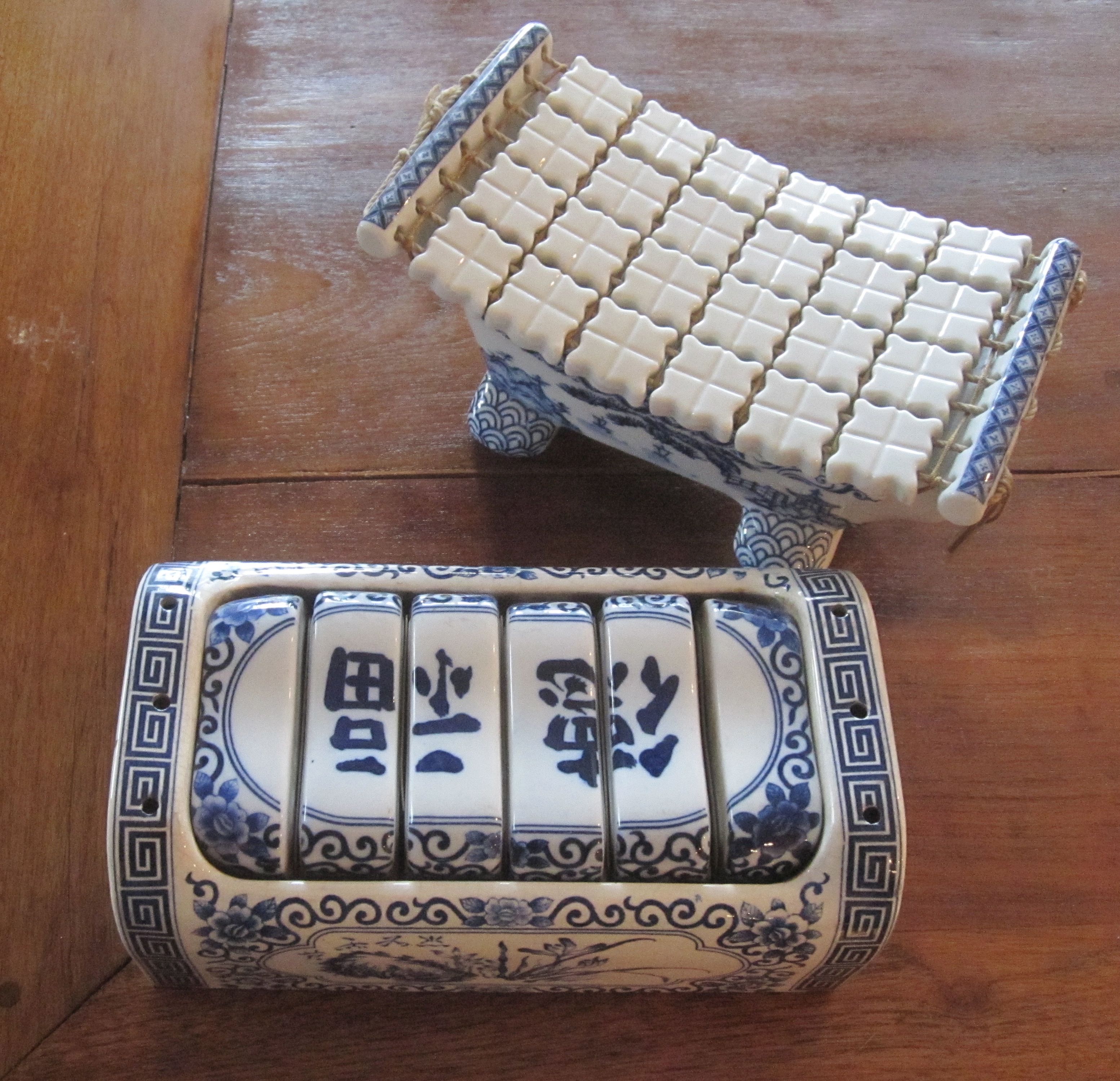
While many of the lacquer and cloth takamakura date from the 19th century, most of the porcelain ones commonly found are early to mid 20th century. The porcelain ones seem even less comfortable to me, although some are designed with special comfort features, like these two. The top one has small porcelain squares strung together almost like a hammock that allow for movement. The one with the kanji marking on top can accommodate hot water and/or medicines in its hollow cavity and the gaps in the top of the pillow let the steam or aroma rise. I’ve actually seen takamakura with pharmacy labels or stamps.

blue white porcelain geisha pillow

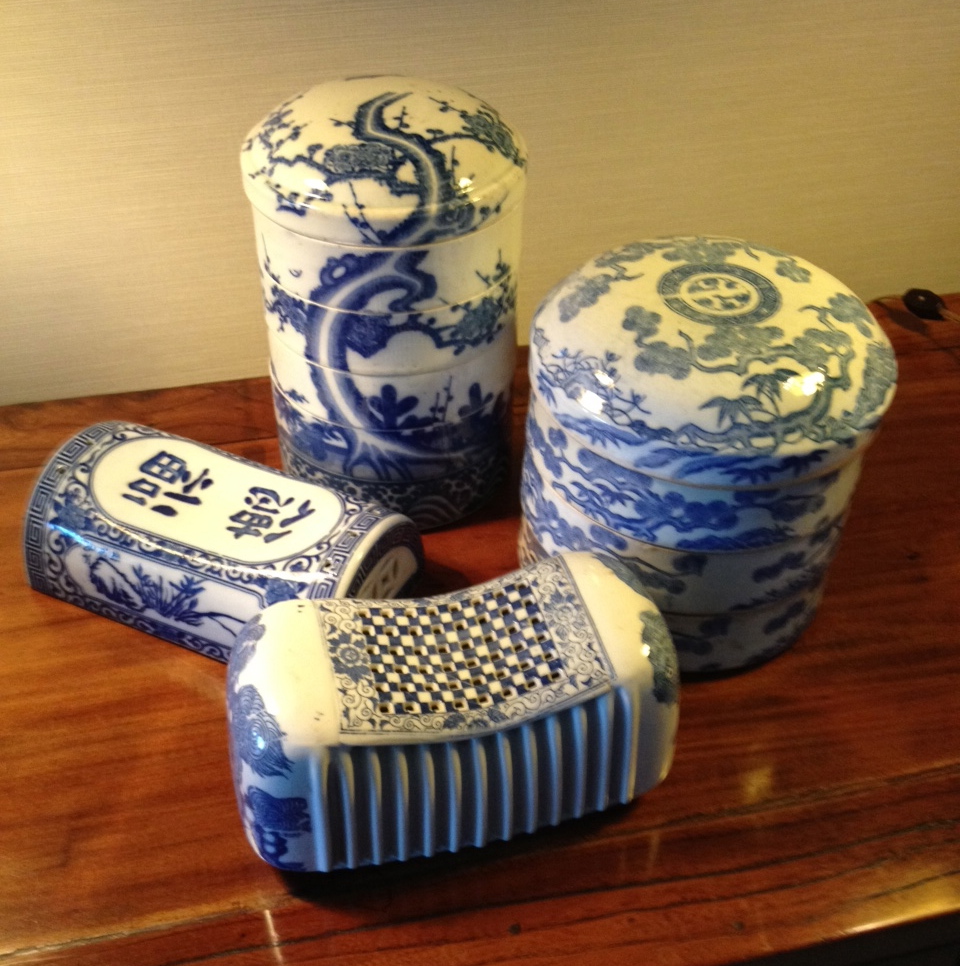
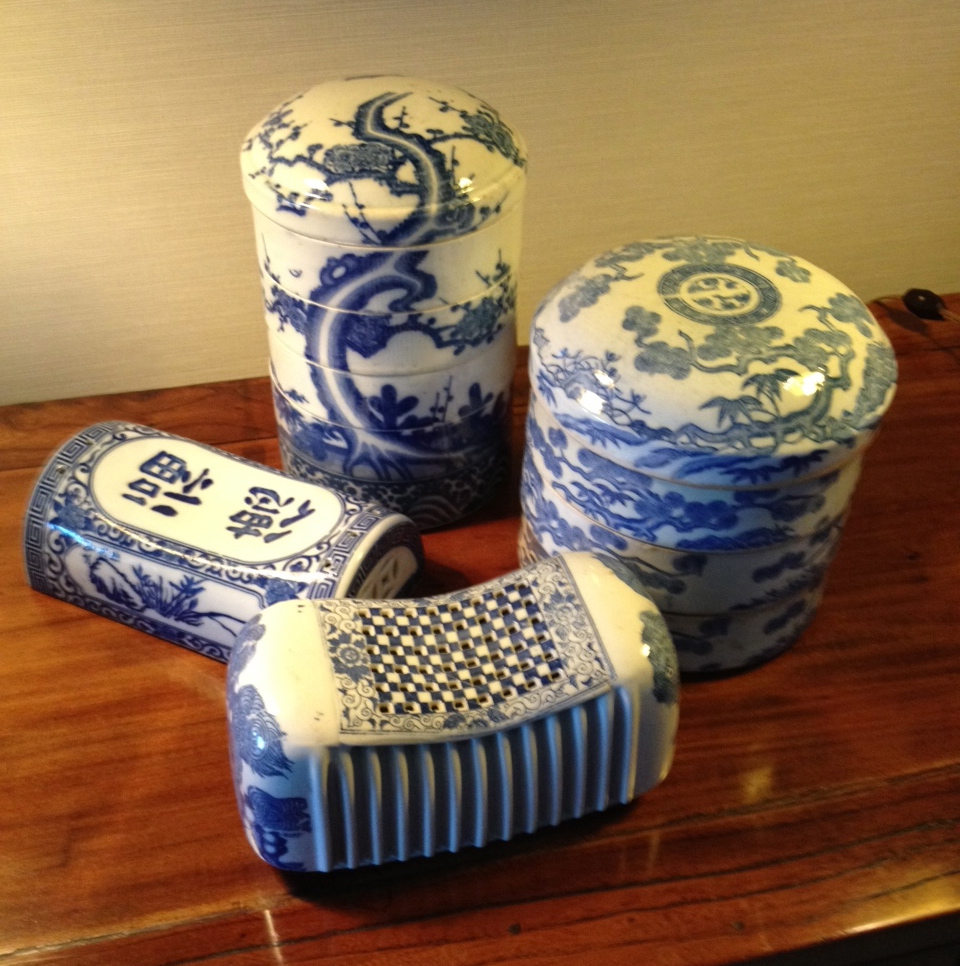
Regardless of their functionality, they are supremely decorative and look great mixed with books in shelves or on their own…

blue white porcelain pillow display

…or combined with other porcelain pieces like these jubako here in a Tokyo entryway…

cate geisha pillows

…or here in a cubbyhole in a girl’s bedroom in San Francisco.

photo

She should be happy they rest on a shelf and that she does not rest on one of them!

N.B. You’ll notice repeats in these photos, but it is not a styling trick. All of these takamakura belong to different people, it’s just that many models were produced on a large-scale. Hand painted ones tend to be older and more individual than the inban, or transferware, versions.

Vintage geisha photo, most probably by T. Enami via Geisha Moments Facebook page.  Thanks to everyone else who provided photos for this post.

Read Full Post »

I just got back from two quick but wonderful days in Kyoto, traveling with two dear like-minded friends.  We were worried it would be bare in winter, but in the absence of cherry blossoms or fall foliage, Kyoto was a study in green.

Green moss in gardens…

IMG_1260

…and temples everywhere.

IMG_1261

We were utterly and completely captivated by our subway car which felt straight out of the 1940s.  Mint green walls and deeper green velvet upholstery…

IMG_1268

…and even the silvery fretwork on the vents below.  How long would this fabric last in New York City?

IMG_1334

Day two changed hues as we spent most of it exploring the Fushimi Inari shrine and its thousands upon thousand of orange torii gates, each donated by Japanese businesses.

IMG_1309

Walking through the roughly two miles of gates was an extraordinary experience and the jolt of color against the winter landscape was intense.

IMG_1310

Later in the day green and orange joined together in some fretwork at Kiyomizu-dera, perched majestically at the edge of the mountains.

IMG_1311

Good luck offerings were everywhere, from the traditional kitsune (fox) messengers a the Inari shrine…

IMG_1305

…to garlands of rainbow origami cranes.

IMG_1312

Our hotel was most conveniently located in Gion, right along Shinmonzen Street, the main antiques drag of Kyoto.  Imagine that?! As we shopped, our color palette turned to blue from all the porcelain we were seeing, particularly at a shop I believe is called Akando, run by a darling older couple…

IMG_1321

…the proprietor having his likeness on their adorable business card.

IMG_1338

My friend almost bought these amazing Nabeshima dishes, but when we did the math they were well over $400.

IMG_1342

The other shop we spent serious time in I recall from my last trip. R. Kita Old Imari & Kutani has been in its location for over 70 years. They had me at the sign alone.

IMG_1327

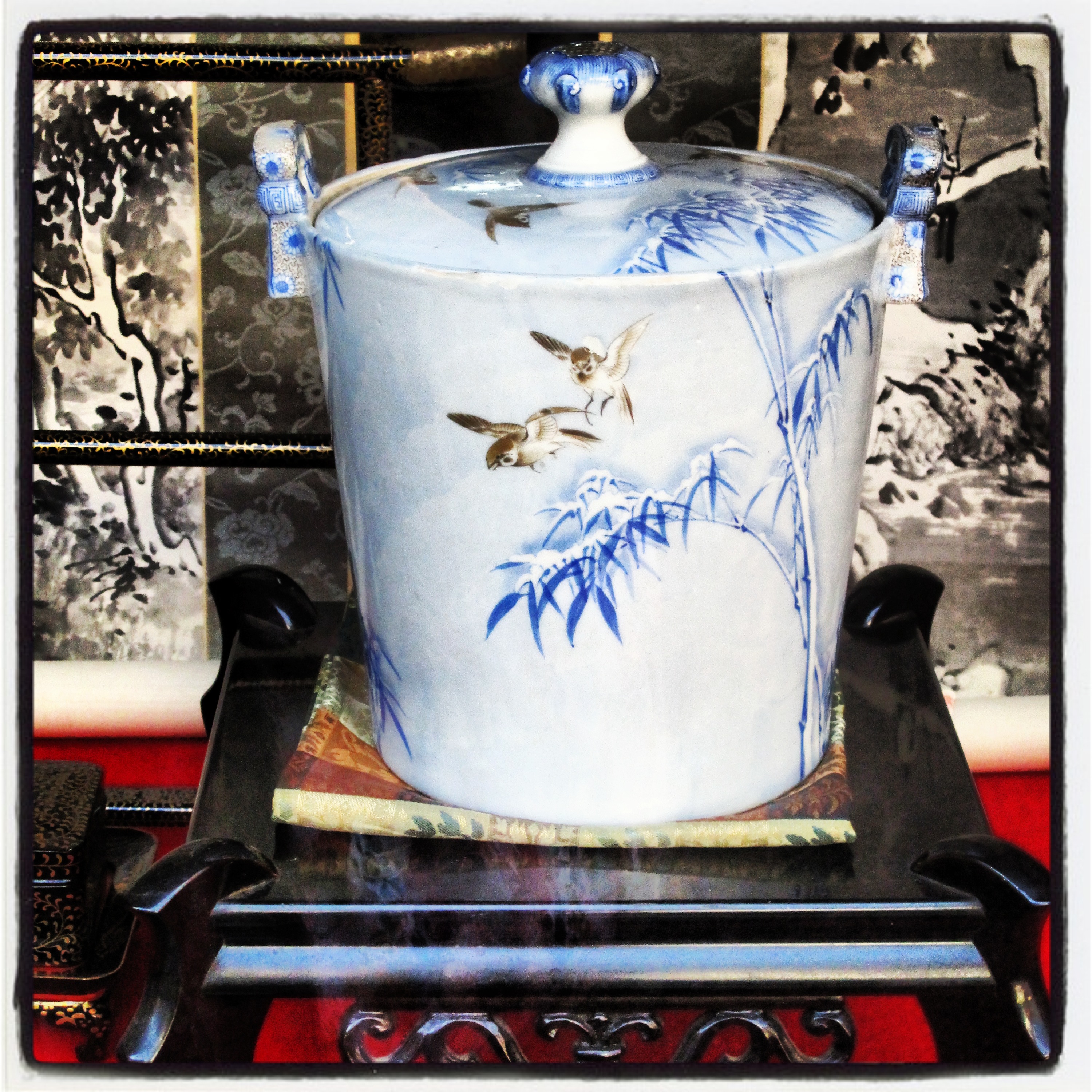
In the window was this amazing 19th century Seto porcelain ice bucket, clearly made for the export market. It was the only Seto piece to be had amidst all the Old Imari & Kutani and I really wanted it. Unfortunately, it was a cool 1000 bucks.

IMG_1328

In general all the porcelain and other antiques were extremely expensive. Prices were way higher than in Tokyo and way way way higher than at the shrine sales. That is exactly what I remembered from previous visits.

IMG_1329

So once again, I looked – in this case instagrammed – and didn’t really buy.

IMG_1323

We did better in the soft goods department and my friend Maja of Alegria Design bought some lovely pieces of indigo kasuri to make bolster pillows. I’ve got kasuri on the brain these days, and you’ll see why quite soon as the ASIJ Gala quilt is almost complete!

kasuri

I managed to pick up a very unusually colored plum piece of kasuri.  I am nothing if not predictable! And at a year and a half out, it is starting to seem as if I will never be getting my lampshades from the custom vendor I ordered them from, so perhaps I might use this in another attempt elsewhere or a DIY!

IMG_1320

Gold was also one of the colors of the trip, as you can see from this lucky sun shot in the late afternoon at Kinkaku-ji, the Golden Pavillion.  A piece of Kyoto advice – always go there late in the day so that the sun is setting in front of the building if you want the lighting to be just right.

IMG_1258

One hidden gem we hit was the house and garden Murin-an near Nanzen-ji. Built just before the turn of the century it had that wonderful Anglo-Japan mix that I adore. The wall murals painted in the sitting room were just divine and the garden was a perfect oasis of peace and quiet in the bustling city.

IMG_1333

The Hotel Mume where we stayed was charming, in particular the sudare canopied bed area.

IMG_1335

The vending machines were particularly creative in Kyoto – Cup of Noodles anyone?

IMG_1259

That reminded me of the really interesting exhibit currently running in the Frederick Harris Gallery at the Tokyo American Club. A riff on Hokusai’s Thirty-Six View of Mt. Fuji, Peter MacMillan’s witty prints are well worth a viewing. If you are in Tokyo, it runs until February 24. If you are not, more of them can be found in my Instagram stream.

IMG_1219

And finally to wind down, a bit of black and white. It is quite common for ordinary folk to go to Kyoto and rent kimono for the day along with hair and make-up services.  These girls were not geisha (or maiko and geiko as they are called in Kyoto) but instead just having fun. You’d think they would look better in color, but it took away from their expressions.

kimonogirls

And the most modern white of all? That streamlined shinkansen, pulling in to take us home.

shinkansen

Read Full Post »

Seto jubako

An absolute favorite of mine, porcelain jubako, stacked tiered food boxes, are harder to come across than more standard porcelain shapes such as plates and bowls. That being true, it hasn’t kept me from accumulating quite a few and helping others do the same. I always refer to them as jubako, but it may be that the porcelain ones should be called danju, while the lacquer ones are officially jubako. Shrine sale dealers call them jubako, so for now I will use the terms interchangeably. Personally I’ve never put food in mine. Instead I like to use them for trinkets on night stands, spices in the kitchen and anywhere you need to stash some small valuables.

In my entryway they hold extra keys to the house and car, buttons and hooks that have fallen off jackets and other odds and ends. Mine are unusual in that they are square, much less common than round ones, and the larger one has lovely scrolled feet. The bright cobalt and densely pigmented karakusa (scrolling arabesque pattern) are typical of Seto porcelain, and although purchased at very different times, seem to have been painted by the same artist.  I have enough Seto ware these days that I can see the hand of distinct artists on certain pieces. As for the cloth dolls on the right, they have their own extraordinary tale to tell and will be featured in an upcoming post for Hinamatsuri or Girls Day.

Seto jubako

Over the years I have helped to put together numerous collections.  It seems once bitten by the jubako bug that one is never enough. They look wonderful grouped together or mixed in with other porcelain. It’s always important to vary shapes and heights as well as the density of pigment and painted motif. This collection of five hand painted Imari jubako has a lovely balance of stylized and naturalistic motifs.

Imari jubako

This collection is used in the bathroom to hold cotton balls, Q-tips, make-up, make-up brushes and jewelry. Again note the variety of height, shape and painting style. The three outer cases are inban, Japanese transferware, while the two center ones are painted in a naturalistic style.

jubako

This trio represents three very different styles and eras and you can see those differences reflected clearly in the various shades of blue pigment.

jubako2

Here jubako are mixed with two geisha pillows, the porcelain neck rests used for preserving elaborate coiffures when lying down. I think there will have to be a post on those in the near future too.

jubako and geisha pillow

Blue and white jubako aren’t the only porcelain types out there.  I have a weakness for the prettily painted Kutani ones. This style of Kutani ware isn’t the densely pigmented and almost brocaded paint commonly associated with the best pieces from that region. (It occurs to me that I have never properly written about Kutani porcelain, so that will be added to my check list for spring.) Instead, they have a soft painterly naturalistic style.  The little sake cup warmer in the center makes a great votive candle holder.

kutani jubako

For all the thousands of ginger jars we see each month in the design press, I have almost never seen jubako featured, other than this one in John Anderson’s New York home.

jubako John Anderson

But recently I spied a lacquer one in this Vincente Wolf designed apartment on the January cover of AD – you can just see it on the table in the center of the room. While I am drawn to the porcelain jubako, the most common material they are made of is lacquer and examples of antique and new ones can be found everywhere.

architectural-digest-january-2013

They are used for traditional osechi ryori (New Year’s food) which is served room temperature in the layered lacquered boxes. For more details on the food in this photo check out Savory Japan.

osechi2012.21

The contents and the containers are things of beauty both!

Read Full Post »

One of my favorite “so ancient and simple that it’s modern” Japanese motifs is ami or fish net pattern. I’ve been tracking blue and white porcelain pieces here at shrine sales and antique shops for years, like this beautiful sake cup washer and hire (like a small hibachi from a smoking set). The sake cup washer has a very linear version of the pattern, while the hire looks almost Middle Eastern in its curvilinear painting, reminding me of these floor tiles! The pattern is common, but rare at the same time, so I always notice it when I see a piece. Not an unexpected motif if you think about how much life in Japan revolves around fish!

Unlike the rounded pieces above, these rectangular dishes show the star-like pattern at the center of the nets and the larger of the dishes even has an open and loosely linked rendition, versus the tighter nets.

Here on this small dish the net is softly and irregularly painted.

Imagine my surprise when ami cropped up in a slightly different form at a recent ladies luncheon with the renowned Japanese food expert Elizabeth Andoh that focused on the art of mixing dishes and plating food.  Out came a rustic but elegant Mashiko pottery plate in the fish net pattern in a glossy copper and verdigris. She called the pattern ajiro, but I think that is actually more of a traditional herringbone style basket weave and that this too is ami.

Just a week or so later, I finally got to visit the Mashiko pottery festival myself, which I haven’t been to in years! I came across a few examples of that same style, perhaps even the same potter to my eye, including this huge spectacular vessel. From my lack of posts lately you can tell life has got me by the ankle and isn’t letting go, but I hope to write more about my experience there soon.

Shortly after that I came across this formal lacquer ware version from my friend Mizue Sasa’s shop Okura Oriental Art - haute couture fish net!

Fish net pattern can be found on much more than just dishes, whether stylized in sashiko embroidery as well as realistically patterned directly in textiles and art. There are a few very famous ukiyo-e featuring actual nets, but I quite like this one by Utagawa Yoshiiku, called  “A Parody of Goldfish with Actor’s Expressions.” It seems the public in the day would have recognized these fish faces for whom they were meant to represent. I quite like that the title is written against a background of fish net.

While I can do without the silly faces on those fish, all this talk (writing?) of fish and fish nets has got me thinking about another project I am working on, the 2013 ASIJ Gala Quilt. Using a background of vintage blue kasuri (the Japanese version of ikat) pieced in a neat but kinda boro style, we are planning on appliqueing a grouping of koi.

The koi will be varying shades of orange and white silk shibori (tie-dye). Here’s a first glimpse of a mock-up to whet your appetite.

We had been talking about some water pattern quilting but now I am thinking that perhaps we want to use the fish net motif, picked out in white quilting thread.  Just loving this idea! What say you Julie Fukuda and Kendra Morgenstern?

Related Posts:
After the Earthquake…Help Rebuild the Kilns at Mashiko
Guest Post…Visiting the Mashiko Pottery Festival
The ASIJ Quilt…Summer Breezes: Furin in the Rock Garden
Coming Full Circle…A History of the ASIJ Gala Quilt

Read Full Post »

So, if a picture paints a thousand words, what does this one paint for you? Do you see antique blue and white porcelain umbrella stands and plant holders? Or do you see three squatty potties and two urinals? If you chose the latter, then you have chosen correctly. Antique blue and white toilets called benki were popular in the late Meiji and Showa periods, often installed in fine ryokan (inns) or wealthier people’s homes. Fairly rare as singletons, to see an entire collection of five all together is almost unheard of, but this dealer at Kawagoe shrine sale last month bucked the odds. I assume he salvaged them all at one place, perhaps as an old building was being torn down.

Most of these painted pieces are in the Seto style, my favorite, although some seem to be Imari as well. And they were definitely produced on some kind of large organized scale as I have noticed there are only a few basic shapes and patterns that are repeated in all the ones I have seen.  The toilets tend to be rectangular, with a squared off front or oval, with a rounded front. The rims always have a tiny detailed painted pattern, quite often traditional karakusa (scrolling arabesque), while the under hood area has a large bunch of flowers.

The urinals fall into one of two categories, either the more tubular umbrella stand shape on the right or the more cornucopia shaped one laying on the ground on the left. Older examples, both of the toilet and the urinals, like the one I saw before here, are hand painted, while the later versions are often more heavily transfer printed.

Somushi Tea House in Kyoto looks as if it has been around for ever, but actually was renovated to look old. To give it that Meiji feel they installed vintage bathroom fixtures. If you were at all confused about how this functioned as a toilet, here’s your answer. And note how similar this one is to two of the toilets above.

On the left is the urinal at Somushi which is more of a cornucopia shape and looks like an earlier hand painted Seto piece. The photo on the right is not as finely painted and looks to be Imari, but it is quite similar to the one laying on the left in the Kawagoe photo above. Umbrella stands seem to be the standard use du jour of retired urinals. The toilets make good planters and I have even seen one turned vertically and used as a garden fountain.

Now for those of you who don’t know, there is complicated toilet etiquette in Japan. In addition to taking off your shoes upon entering any home and putting on slippers, there are special separate toilet slippers kept inside the bathroom. Normally these are ordinary slippers, but I have actually seen painted porcelain ones on a few occasions, out in the markets that is, not in someone’s home. Were these really worn? Or are they just ornamental? I’m not sure, but I didn’t buy this pair last May because their condition wasn’t great. I think they’d make a witty addition to a vignette.

I have seen a few other pairs in my travels and they have always been similar to these, with that distinct feathery Seto style painting.

Without any formal knowledge on the subject, my instincts tell me that the idea for the painted fixtures comes straight from the West. It was not unusual to have painted and transfer printed toilets in the 19th century, like these Victorian versions from Great Britain. There was a tremendous amount of cross-fertilization in the porcelain industry going on in the late 19th century, with ideas, motifs and techniques (such as transfer printing) winging their way back and forth.

And the title of this post? It roughly translates as “feels good toilet,” but maybe “looks good toilet” would be even better. And I know my Japanese grammar isn’t actually correct, but I couldn’t resist the rhyme…

Related Posts:
Made for Export and in My Basement…Seto Porcelain Garden Stool
Shop Talk…Discovering Antique Treasures in Nishi-Ogikubo

Read Full Post »

Today was slim on the ground for shrine sales being the second Sunday of the month, but Tomioka Hachiman did not disappoint. It was a day full of friends from out-of-town and extraordinary porcelain, including a few cute and very atypical Japanese pieces bought for the beach house. The small green iris pickle dish will be perfect on the dresser or night table in the beach house guest room for holding jewelry and other trinkets.

It reminded me of the Korin Ogata screens and the garden at the Nezu Museum.

The small Imari-meets-lustreware dish has all the pretty colors in the downstairs rooms of the beach house. Don’t know how I’ll be using it – perhaps as part of a wall display, perhaps on a stack of books on the coffee table to hold olive and cherry pits.

But the person who had the most fun today was my elder daughter who happened upon a stall selling vintage matchbooks from the 1930s-1950s. We have often seen matchbox covers mounted on pages, but not often the entire matchboxes. The dealer had hundreds of them in three big boxes and she spent significant time sorting through them and putting together a charming collection which we plan to place in a shadow box frame. You’ll note her signature colors of lavender and blue.

The story comes as she was choosing her boxes. Much to her chagrin, another man came up behind and offered to buy zenbu – everything – from the dealer. It hadn’t occurred to us and we were immediately sad to see the entire collection go! Luckily, the dealer offered us a few as “service” gifts for making a purchase before he sold off the boxes. We managed to grab a few historical gems.

The first matchbox, dated 1939, features Frank Lloyd Wright’s famous Imperial Hotel, with its stylized logo on one side and Mt. Fuji and an early version of the Shinkansen (bullet train) on the other.

Finished in 1923, the hotel was one of Wright’s masterpieces, famously surviving the Great Kanto Earthquake that year, and in use as the premier Tokyo hotel until 1968 when it was deemed outdated and tragically torn down.

The other matchbox could not have been more timely, featuring the 1948 London Olympics on one side and the 1952 Helsinki Olympics on the other.

Wondering what they might fetch among collectors. Ebay maybe?

Image Credits:  Iris photo by Joseph Keating, via Atsuko & Joe, Imperial Hotel postcard via Old Tokyo, all other photos by me.

Read Full Post »

“In Japan, sake has always been a way of bringing our gods and people together. In some of this country’s oldest texts the word used for sake is miki, written with the characters for ‘god’ and ‘wine.’ People would go a shrine festival and be given rice wine to drink, and they would feel happy and closer to the gods.”
-Tetsuo Hasuo of the Japan Sake Brewers Association in The Japan Times

Komokaburi, the straw-wrapped cypress kegs used for transporting sake are a common enough sight in Japan, especially the stacks and stacks of empties found at shrines, the only remains of ceremonial donations.

The shape, rope and ornamentation have remained pretty constant over the centuries, with the main difference between them being the logos of the different breweries.

While I like the regular barrels, I am particularly fond of the much rarer porcelain ones, modeled for all intents and purposes to look just like the wooden ones, including simulated molded ropes holding the straw wrapping in place. During the Edo period, rural sake brewers needed a method of transporting their brew to the large cities. These large porcelain casks could be carried on pack horses or transported on special ships called taru kaisen or cask ships. Until the 1940’s, they continued to be used to dispense draft sake in shops. Customers would come into the shop with their own smaller ceramic bottles and have them refilled with their favorite brand.

On this beautiful pair you can really see the simulated wrapping and ropes raised in the porcelain.

Here the molded ropes are a different woven style.

Good examples will have their original stopper tops and perhaps their bamboo wrapped handles. Decoration tends to be simple blue on white, with occasional additional details picked out in color, like the green pine needles above, or even occasionally other colors added to simple images related to the brewery, as in the case of the jug below with its charming waterfall.

The back sides tend to be pretty simple, with additional information picked out in blue kanji. I have never seen color on the reverse.

Large jugs are the most common, but I have found some smaller ones, including these two decorated with very graphic stars. I have been experimenting with photographing objects lately and I really like how these play off against the indigo blue background.

Porcelain sake barrels look great nestled into arrangements with other casual porcelain pieces.

A common modern-day adaptation is to wire the jugs and turn them into lamps, which is very attractive and functional.

Sig Bergamin, whose eclectic interiors chock-full of color I have featured here before, has a sake jug lamp interspersed with other blue and white treasures. We can only see the simple back side of his jug in this photo. Try as I might, I couldn’t come up with a picture from the other side.

Another sake jug lamp peeks from the corner in a very differently styled room by Jeffrey Bilhuber.


Tokkuri, the smaller Japanese stoneware sake bottles, decorated with not much more that the names of their distillers are also wonderful accents when grouped in a vignette.

They too make excellent lamps. Which do you prefer? A dark shade…

…or light ones?

Tsunodaru, the red lacquer ceremonial horn/two-handled barrels used at wedding ceremonies are less commonly found, but out there nonetheless. Again, note the mock “ropes” carved from wood. They often are offered as a gift to the bride and groom together with lacquered cups as sake is always drunk to mark important occasions. Because it is meant to be enjoyed with friends and family, tradition holds that a person must never pour their own sake; instead another person pours for you, and you do the same for them, which is such a lovely custom.

Can you spy the pair of ceremonial jugs in this London home?

So would you rather drink sake or illuminate your room?

Image credits: 1-3. courtesy M. Wilce and L. Border, 4-9, 14 & 17. me, 10. courtesy M. Small, 11. via Joseph Joseph & Joseph, 12. via Once Upon a Tea Time, 14. The Way Home by Jeffrey Bilhuber, photo credit: William Abranowicz, 15. via Antique Lamp Shop, 16. via 1st dibs, 18. World of Interiors July 2010, photo credit: Bob Smith

Read Full Post »

A few great shrine sale finds and a good friend’s decorating plans got me to thinking about blue and white porcelain again last night – as if that is an uncommon thing for me to think about…

I had long been saving photos of groupings of porcelain on brackets or corbels, a classic way to present a collection en masse. For example, this 1959 photo of Jayne Wrightsman’s Palm Beach library designed by Maison Jansen, with a grouping of what looks to be Meissen figurines.

Figurines not withstanding, Asian porcelain, whether Chinese or other, blue and white or polychrome, tends to be the most commonly presented in this fashion. Aerin Lauder inherited this collection as well as the house from her grandmother Estée…

…and it still looks fresh today in that East Hampton home.

Carolyne Roehm went completely blue and white in her bedroom, even painting the brackets to fit in with the decor. Can’t imagine doing this in Japan, as the earthquakes would be sure to give you an unpleasant surprise one night.

Thomas Burak went with an all out chinoiserie theme in this Bridgehampton bedroom, pagoda bed, and all.

And another view.

Designer Mary Watkins Wood simplifies the look with a white background, white linens and white brackets, using mainly Chinese ginger jars. I think Japanese jubako (stacked lunch boxes) would give a similar effect. Gotta love that fantastic Portuguese bed!

Did Dallas store owner Betty Gertz have this niche custom designer for this amazing grouping of Chinese vases or was it already there? The vases themselves are Ming dynasty antiques, part of the Hatcher trove. Now how’s that for provenance?

I had never seen this show house hallway by Mary McDonald before – thanks to Jennifer at The Peak of Chic for the photos.

I love the blue and white against the grey.

Not limiting the post to blue & white, here Robert Goodwin uses a collection of Blanc de Chine figurines in a similar fashion. The fabulous wall color is Benjamin Moore’s Iron Mountain.

Miles Redd turns up the modernity a notch in this celadon dining room with a grouping of simple celadon vases on plainer matched brackets.

Here Oscar de la Renta does the same with coral in his Punta Cana home.

And perhaps the most tongue in cheek is this simple bathroom with the grandest of porcelain displays.

My question for you readers, is whether you like this look? Do you find it traditional? Elegant? Fussy? Do you like the brackets to all be the same? Or a variety? Painted like the wall color, contrasting or gilded? I am thinking on it too, considering it for an upcoming project…

Related Posts:
Colors of the Rainbow…Blue and White Porcelain is Neutral

Image credits: 1. via The Peak of Chic, , 2-3. Elle Decor, 4. Veranda via Chinoiserie Chic,  5. via The Enchanted Home, 6. House & Garden via Chinoiserie Chic, 7, 11-12. House Beautiful, 8. scanned by me from magazine tear sheets, but credit unknown, 9-10. via The Peak of Chic, 13. via Habitually Chic, 14. Martha Stewart Living via The Enchanted Home.

Read Full Post »

Follow

Get every new post delivered to your Inbox.

Join 423 other followers

%d bloggers like this: