Feeds:
Posts
Comments

Posts Tagged ‘Japan earthquake’

IMG_0654

In my recent post about jubako, I mentioned that there was quite a story to tell about the soft cloth dolls displayed next to the porcelain in the photo above. As the second anniversary of the Great Japan Earthquake approaches and this Sunday, March 3 is Hinamatsuri, Doll’s Festival or Girl’s Day, I think now is the perfect moment to tell it.

Hinamatsuri is a festival that celebrates the healthy and happy growth of girls. Families with daughters everywhere set up very large traditional displays, with the hina-ningyo (dolls) placed along a red felt covered tiered stand with the Emperor and Empress at the top and the other dolls placed progressively lower based on their hierarchy. The dolls wear costumes of the Imperial Court during the Heian period (794-1192). Realistic furniture, lanterns and toy food complete the display and golden byobu (screens) provide a backdrop just like the real Imperial throne of the ancient court.

hinamatsuri

Charming miniature two doll displays are also very common as not everyone has room for a full display. The small peach blossoms are always included as it can also be referred to as Momo no Sekku, or Peach Festival, based on its seasonal calendar date.

tinyhinamatsuri

These huge displays are very expensive to purchase and I am always amazed when I see families buying them new as I come across them at shrine sales all the time. I have to keep myself from buying them as they are so adorable. A little tip – they are great candidates for Western style repurposing as they make really unusual doll house furniture – great gifts for friends back home.

hinamatsuri furniture at shrine sale

Last year around this time – actually a bit later in March – my daughters and I, along with some friends, traveled up to Tohoku in Northern Japan to volunteer with a great grassroots organization called It’s Not Just Mud. Headquartered in a few partially destroyed houses, with little electricity and no heat, it was quite an experience for us as we had never suffered such a level of discomfort before. Just realizing that people had been living like this for over a year was an incredible eye opener.

its not just mud P cold

INJM makes it very easy to come and volunteer and they run a number of service projects that range from heavy labor (rebuilding playgrounds) to lighter but no less important social work.  We were lucky to be involved in the launching of their ‘Tsuna Cafe,’ in which informal tea parties were organized in the communal space of the “temporary” housing complexes (which look more semi-permanent by the day). The parties are a chance for residents to communicate with each other and meet volunteers who bring cheer and friendship.  One of the post-tragedies of the earthquake and tsunami is that village and neighborhood links were lost as residents were assigned to housing units on an ad-hoc basis. No attempts were made to keep communities together and the majority of those unable to rebuild or move elsewhere are quite elderly.

tsuna cafe photos

As this was one of the first times the Tsuna Cafe was being held, the kids went around to all the units and rang door bells and distributed flyers announcing the party. My younger daughter, who was 8 at the time, rang one bell, but as no one was home, she began to walk away. A woman opened the window and beckoned for her to come over. She handed her the flyer and the woman gave her a bag of small bean paste filled donuts and told her that she had very beautiful eyebrows – which happens to be true. She thought no more about it.

We assembled for the tea party, putting out snacks and getting ready to use our best Japanese. My elder daughter had made many friendship bracelets in advance, expecting the children to want them. Ironically, many of the older women were clamoring for them!

friendship bracelets at the Tsuna Cafe

After a while, an elderly woman came in carrying a paper bag and approached my younger daughter. It was the same woman who had complimented her eyebrows! She opened the bag and took out what appeared to be folded cloth. Her Japanese was so colloquial that we couldn’t begin to understand her so one of the very fluent volunteers came to help translate.

hinamatsuri in tohoku

Basically, she told us how after the war, when everything was destroyed and she had nothing, an American soldier gave her an American doll and that changed everything in her life because she had something to play with and love. She never forgot this moment of kindness and sewed these small fabric Hinamatsuri dolls many, many years ago, with a plan in mind to give the Japanese dolls in turn to an American child. She had been waiting and waiting for the right child to come along. As she presented them to my daughter – we were all crying by now – my sweet little one said “Mommy, it’s a miracle!”

IMG_5842

Somehow, in all the excitement and bustle we never got her name. But my daughter will have those dolls and that memory forever.

We are hoping to go up again this spring and perhaps we can find the doll lady. Please remember that the work here in Northern Japan is nowhere near done, even though it has faded from the news. And for a small organization like It’s Just Not Mud, every donation helps.  For more information on volunteering, please click here. For more information on making a donation, please click here.

Related Posts:
The Porcelain is Alright (Kids Too)…My Tale of the Big Japan Earthquake
Hands On Tokyo…A Taste for Volunteering 2012

About these ads

Read Full Post »

While Dalia was off visiting the Mashiko Pottery Festival last week and checking on post-earthquake progress there, I was busy visiting Kimiake and Shin-ichi Higuchi, two of the world’s foremost Pâte de Verre glass artists up at their newly rebuilt studio at the northern end of Nikko National Park. As you might recall from a previous post, much of the Higuchis’ studio and about 40% of their artwork had been destroyed in the Great East Japan Earthquake. The weekend of November 5-6 was their joyous open house – a celebration of their rebuilding and faith in going forward – and we were lucky enough to be invited. Ironically, they had set up their entire exhibit by Thursday afternoon the 3rd, only for there to be a fairly strong quake that evening, which many of my local readers will remember. For safety, they took everything back down and only put it in place just before the weekend open house.

Simple linked buildings flooded with light house their bedroom, living quarters and studio, all surrounding their gorgeous garden which is the main source of inspiration for their work as well as much of their actual food. Upon arrival we were greeted by giant cabbage leaves spread about the grass. They were so life-like, we weren’t sure if they were glass or not!

Everything in the studio was back to being ship-shape and orderly. The rows and bins of glass powders and frits were a modern installation all their own. In the spirit of recycling, all the broken glass works are being ground down and re-used.

We got to see their process from sketch…

…to detail demonstration…

…to finished installation.

Their renderings of the everyday vegetables and flowers around them are so life-like as to almost be surreal. The asparagus looked so delicious that I was ready to pick it up and eat it.

The bearded irises were amazing.

Color and detail, here on a cyclamen panel…

…and here on a trumpet vine.

The little boxes and vessels made me swoon – I wanted this little sakura box…

…or the wisteria.

Some boxes had secret surprises inside.

Can you see the snail and the water droplet on the hydrangea leaf?

I don’t often include pictures of my kids on the blog, but here she provides a sense of scale. Keep in mind she just turned 8. Largest glass cabbage known to man – perhaps the original was the largest ever grown too.

Speaking of the girls, the younger ones had a ball catching praying mantids in the garden. They strongly suggested that Shin-ichi remake his praying mantis sculpture which had been broken in the earthquake.

And the pièce de résistance, which I cannot resist showing is this…

…their bathroom counter, covered in glass roses, and even including clear glass water drops and a few small insects.

Warm thanks to the Higuchis for hosting us and to Debra for introducing us!!

The previous week, Keiko Iishi, a former assistant to the Higuchis during a Corning Museum of Glass education program and a glass blowing artist in her own right, held a charming solo exhibit in a small Ginza gallery. She had been so disheartened by the loss of family and friends in the earthquake and subsequent tsunami that she had planned to cancel this long-awaited show. With strong encouragement from her supporters, she decided to go forward and it was a treat of color and pattern.

Having just made butterbeer with my elder daughter and her friends, the piece in the center rear, entitled “Honeydukes,” caught my eye. Keiko, a huge Harry Potter fan, said I was one of the only ones to get the reference.

Congratulations to Keiko on a very successful exhibition!

The net result of viewing all this modern glass art? I think we might need to sign up for classes at Hot Sand on the Asbury Park boardwalk this summer.

Read Full Post »

For my first ever guest post, Dalia Gold reports on a shopping excursion to the famous Japanese pottery town of Mashiko. The destruction of the kilns after the Great East Japan Earthquake was featured earlier on the blog here and updates on the situation here

The forecast called for and delivered clear, sunny skies for my first trip to the legendary Mashiko pottery festival. I’d been waiting almost a year for the day to arrive, having heard stories about rows upon rows of pottery stands.

Originating in 1966, the fair is now held twice a year – in the fall and spring – and draws approximately 150,000 people and 400,000 people, respectively. Last spring, the Great East Earthquake destroyed the ancient kilns used for generations to bake the clay works. Donations and support came from around the world to help rebuild the kilns and November 4, 2011 marked the second pottery fair after the devastation. More than 500 artisans displayed their work, including many from Mashiko and areas beyond, as well.

Much more information about the history of Mashiko pottery can be found at: www.mta.mashiko.tochigi.jp

I expected to be overwhelmed and had brought a small, wheelie suitcase, as I’d been advised, to store my purchases as I strolled. I had no particular agenda nor strategy for the expedition. I only knew that I didn’t want to leave thinking, “Why didn’t I buy that when I had the chance?”

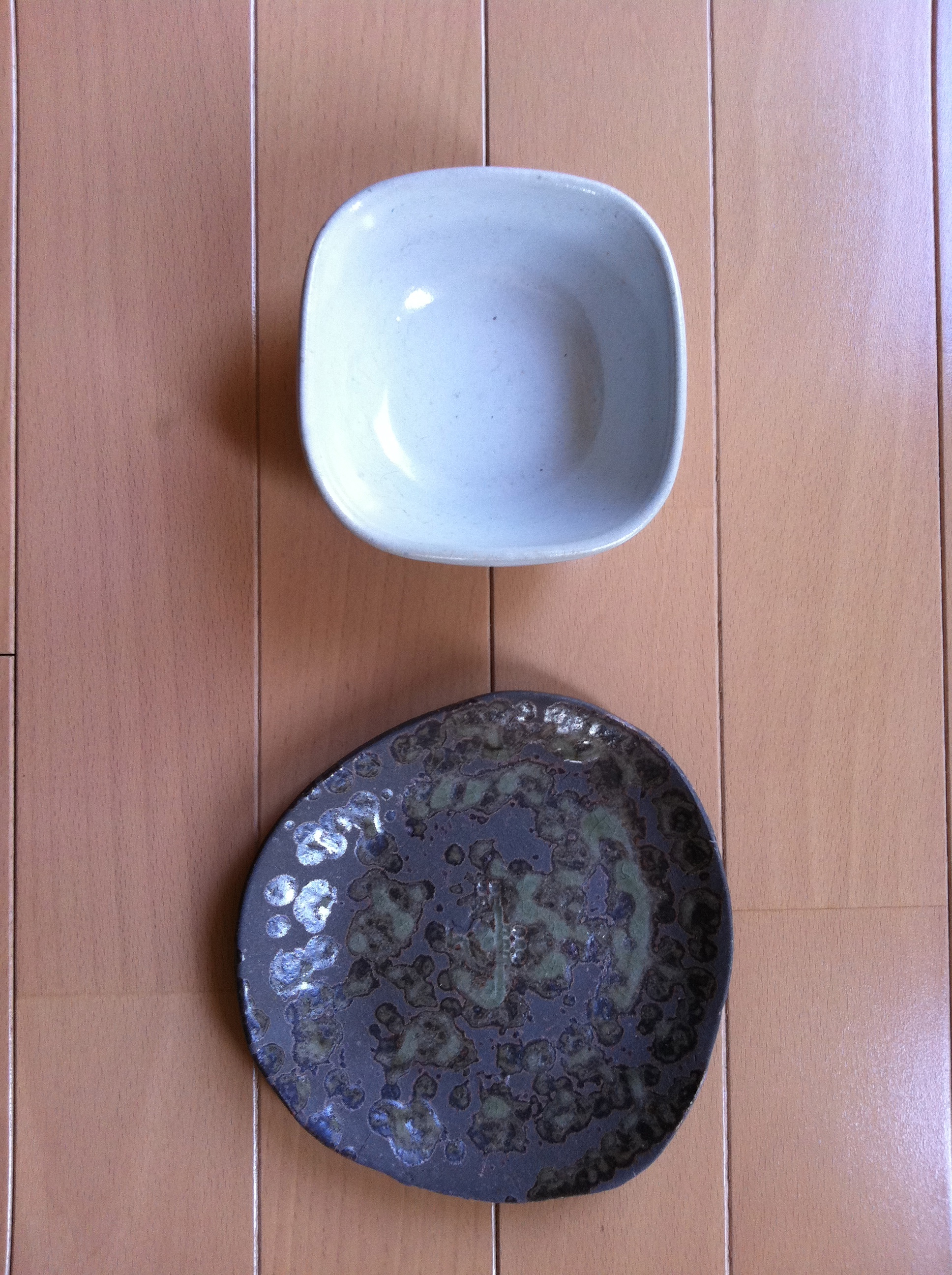
The vendors at the beginning of the fair had mostly functional, primitive pieces. I bought these small bowls, finished in Nuka White (rice husk ash) glaze and paired them with these funky, unfinished green chargers.

As I moved deeper into the stalls, I found myself drawn to pieces featuring spouts, irregular shapes and almost anything white.

I think these oval pieces may be intended for ikebana, but I bought one to use as an everyday fruit plate.


Loved the simplicity of, and so purchased, both of these, which look great with the fruit bowl.

Though I didn’t buy one, I love the utilitarian grater featured in these spouted works.

As with so many things I’ve seen in Japan, the elegant simplicity of some displays rivaled the artistry of some of the goods being sold.

Other collections for sale besides pottery included glass, incense and shoes.

Given the huge piles of rubble within, I think these warehouses may be the sites of some of the kilns which were destroyed, although they had certainly been cleaned up from last spring,

After exhausting myself among the stalls, I finally arrived at the main street, where many finer pieces of art were for sale. The glaze on this vase looks as if there are layers of mosaic tiles beneath the smooth surface. The photo doesn’t do justice to the gorgeous tones of blue, grey and green held within.

My wheelie bag was full, and I had a couple of shopping bags draped over my arms as I returned to the parking lot before heading home. I’d been true to aim – not to leave any beloveds behind – and yet, I already knew I would need to return next year.

Read Full Post »

So I guess the truth is, I am not tough. Along with much of the rest of the expat community, I am leaving (fleeing?), ostensibly just early spring break, as school is now closed this week as power and train service is unclear.  I shrug and tell myself next week was spring break anyway, but still I feel guilty to be going. There has been so much panic mongering (I don’t think I will ever be able to trust CNN again after watching their coverage), and I don’t want to join that train, but nonetheless, I can’t seem to keep myself off it. Unfortunately, my husband is staying behind to work. The constantly difficult piece of my expat life is being so often separated from him, but as soon as I find myself getting lachrymose, I just think of the suffering being endured by so many here in Japan and I get my perspective back. We are so lucky to be headed out to vacation!

I’ll be blogging on the road (the Mac seems to have come back to life after drying out), bringing you art and antiques from Singapore and Thailand. I need something to get my mind off the situation at home! I have also been featured on an Ocean Grove blog called Blogfinger. The writer of the blog, Paul Goldfinger contacted me for more information about our experience here in Japan and wrote an article about us. Check it out here if you are interested.

I just wanted to remind everyone of options for donations towards relief and rebuilding. Here’s a great link with information on multiple agencies working to help.

Thank you all again for your wishes, comments and prayers on our behalf.  And to make you smile, here is a photo of the Japanese Self Defense Force rescuing a 4 month old baby!

Read Full Post »

“Because of the great earthquake, his house, studio, and storage house were devastated: 
the pillars of the house were snapped, all window panes were smashed.
on the floor in the studio, all colors of frits were scattered. 
the heavy kilns moved unbelievably away. 
To my sorrow, it seemed like all of their glass works in the storage house were damaged.”
-Keiko, friend of Kimiake and Shin-ichi Higuchi
 
 
This is just one small story of many in the aftermath of the great Japan earthquake of March 11, 2011. Kimiake and Shin-ichi Higuchi are masters of the art glass technique known as Pâte de Verre, in which glass powder is packed into a mold and then fired in the kiln. Glass Art Magazine has said ”many see Kimiake and Shin-ichi Higuchi as the King and Queen of Pâte de Verre. Their work in this medium possesses luster, translucency and shine that seems unfathomable.” Both artists are fine after the quake, but their studio, home and much of their work has been destroyed.

The Higuchis are both inspired by items from nature. Kimiake often works with flowers or vegetables she grows herself in her extraordinary gardens and creates works of such startling clarity and color one can almost believe they are real. “I pick each bloom or leaf in the moment of its prime, and in my hands the plants become glass.”
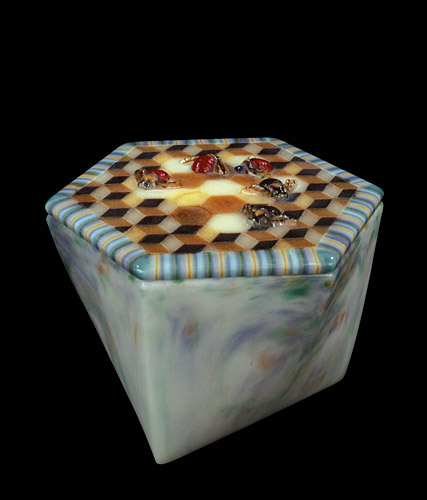
Shin-ichi uses insects as a common theme in his work to express his concern for the environment and the loss of so many small creatures. “In our civilization, human ego is destroying so much of nature,” he explains, “Some of the most victimized are the smallest creatures. My pieces convey a warning about the insects and also my feelings about their loss.” I love how modern and yet quintessentially Japanese the honeycomb pattern is on his mosaic Bees Casket in the collection of the Corning Museum of Glass, where they had planned to do their annual workshop this summer.  Unfortunately, it looks as if this will have to be cancelled.

Photo credits: 1. via GlassFacts.info, 2 & 3. via Corning Museum of Glass

Read Full Post »

Humour might not be appropriate right now, but sometimes it is all you’ve got. As I type this, another aftershock reverberates through the house, smaller that the 30 or so full-sized earthquake ones that continued yesterday afternoon and evening in the wake of the 8.9 epic earthquake off the coast of Sendai. I feel like I am in limbo. All here in Tokyo is well with my family and friends, but not so up along the north coast of Japan.

My personal experience was terrifying.  When you have lived here as long as I have (almost 7 years now), you have experienced many earthquakes. They are always scary, but this one was different.  All of my family was scattered, fairly far and wide. I had made a spur of the moment decision, about 40 minutes before the quake, to drive to the mall at Odaiba, an American style mall with a Toy “R” Us built on a small landfill island in Tokyo Bay. My cellphone battery was low so I didn’t call to tell anyone where I was going. I parked up on the 5th floor of the parking structure and went inside. Just as I got there, people began streaming out of the store, clutching their children. At first I thought something crazy was happening inside, but then quickly realized my mistake.  We all fled from the building out to the roadway along the small beach while the quake finished. The ground shook so I could barely stand up or keep my balance. I felt that the sidewalk beneath my feet was made of shifting sand. As the daughter of a water/ground systems/structural engineer and I know that man-made land can basically liquefy in an earthquake.  During the great Kobe earthquake of 1995, the landfill islands around Kobe sunk. And the noise! Everything even sightly unsecured joined in the cacaphony…

After the first earthquake, waves of others began coming. And then the tsunami alarms went off, advising people to seek higher ground. Well, there simply is no higher ground in Obaiba - it is about a mile square – surrounded by water on all sides. I did not know yet that the epicenter was in Sendai, I just knew that I was on the flattest, most vulnerable piece of land in all of Tokyo and that nobody knew I was there! I don’t know why dying alone seems so much scarier than dying with the people you love around you, but it does. Odaiba is linked by a giant suspension bridge (think Verrazano or Golden Gate) to the mainland and I could see that cars were still moving briskly across it. I couldn’t bear to stay where I was. They were not prohibiting people from re-entering the building, simply from using the elevators, so I ran up the five flights of stairs and tore down the ramp of the garage. I had met a Canadian man and his Japanese girlfriend while waiting and they wanted to go with me, so they jumped in the car and we drove across the bridge. Once we were on the other side, it was not even 10 minutes to home and I could have walked if necessary. I think if I had not left so quickly, I would have been stuck there all night!

Gathering my chicks was the next step, although I had been sustained through my ordeal by knowing they were in safer places than I. While cell phones were not working at all, the land lines at home were and I was finally able to speak with my husband, safe on the still swaying 25th floor of the brand new Marunouchi Trust Building. All new construction in Tokyo is built on rollers so that the buildings can move with an earthquake. My husband said looking out the window he could see all the buildings swaying, like trees in the wind. My younger daughter was on a playdate with a friend in the park when it happened and they quickly went home. But my older daughter was out at school, normally a 45 minute ride on the school bus. The quake had hit about 15 minutes before dismissal, and the school’s excellent emergency procedures clicked quickly into place. Around 4:30 they sent the buses out, driving on local roads, as the highways were all closed. The traffic was basically at a standstill and she did not get home until after 12:30, exhausted, but in good spirits.

Our damage at home was minimal. The fish tank overflowed everywhere, trashing my new Mac laptop, but worse (in the eyes of the children at least), sweeping our newest family member, the rainbow guppie named WW by our guests last week, to an early demise. Things were thrown around the house and quite a few regular dishes and glasses broke in the cupboards, but not a single piece of antique porcelain was broken. My beloved blanc de chine was toppled and tossed about, but is all intact.

Blue and white porcelain rattled to the edge, but did not go over…

For those of you who have been reading this blog for a while, you know it is a blog about stuff, and while it may seem silly to write about material goods which are not intrinsically important, they do bind us to our own histories and lives. I would have been crushed had the porcelain all been broken instead of the computer, although that having been said, a computer can contain an irreplaceable history of photographs and correspondence. In my case, it was new and relatively unused. For those most affected by the quake and tsunami, the loss of their belongings and connections must be devastating, even while they are grateful for their lives, as not all were so lucky. In that spirit, I encourage everyone to make a donation towards rebuilding. An easy way is to go online to the Red Cross and donate directly to the International Disaster Relief Fund. Personally, I am so thankful for the wishes and prayers that have poured in from friends, family and readers all over.

Ironically, devastation is not limited to big events like these.  While we are fine here, the very same day there was a huge fire up the street from us in our beloved beach town Ocean Grove, where we have been renovating and furnishing an 1880s Victorian that I have been chronicling on the blog. Our dearest friends there have lost their home, as have numerous others.

So my rebuilding efforts and my heart are split in two directions…

Photo of fire in Ocean Grove from Asbury Park Press, photo credit: James J. Connolly.

Read Full Post »

Follow

Get every new post delivered to your Inbox.

Join 424 other followers

%d bloggers like this: