Feeds:
Posts
Comments

Posts Tagged ‘indigo’

blue and white sashiko sign

So it occurred to me in writing my last post on LuRu Home that Claire and Liza are possibly at the beginning of a similar journey to that started some time ago by Amy Katoh, author, shop owner and flame keeper of all Japanese things handcrafted, indigo and folk art. When Amy Katoh moved to Japan in the 1960s, the local mood was to jettison everything Japanese and traditional in favor of things western and modern. This wasn’t a new trend – it had been happening since the Meiji Restoration – where seemingly overnight Japan went from an agrarian culture to an industrial one. But pockets of the old ways remained for those who sought them out and at the forefront of this group was Amy and her perfectly named shop Blue & White.

blue and white

It seems ironic that it takes an outsider to shine the light into the corners of a culture, pulling out and saving the pieces that are about to be discarded, both figuratively and literally. Amy went to markets and bought up old indigo work clothes, almost warm from their former owners backs, tools considered defunct and pottery no longer wanted. She started out by saving things and went on to re-invent and help create new things from the old. She has been instrumental in bringing outside interest to the folk arts of Japan and it is that very outside interest that has helped the Japanese see the magic of their traditional arts culture themselves.

Amy Katoh

It is not just her knowledge that makes her so compelling, but also her very personality. She is never still, never bored and always interested in seeing and learning more. Whenever I am with her she is engaged and excited about something – a new exhibition or experience – and her vibrancy is infectious. Many a new expat wanders into her shop only to be seduced by the charm of the goods and their proprietor. In fact, I’ve head from numerous people that they chose their neighborhood and apartment because it was near Blue & White.

Lately Amy has been very involved in working with handicrafts fashioned by the handicapped, a group that can often be overlooked. Her committment to numerous groups is strong and the wares in the store reflect that. In May, after Golden Week an exhibition featuring handcraft by the handicapped from Tohoku will be on display. The regions hit by the tsunami were known for their traditional arts and much was destroyed. It has been hard to get those small industries up and running and particularly so for handicapped artists. Money raised from the sale of the genki tenugui (written about here) will also be put towards this cause.

IMG_1071

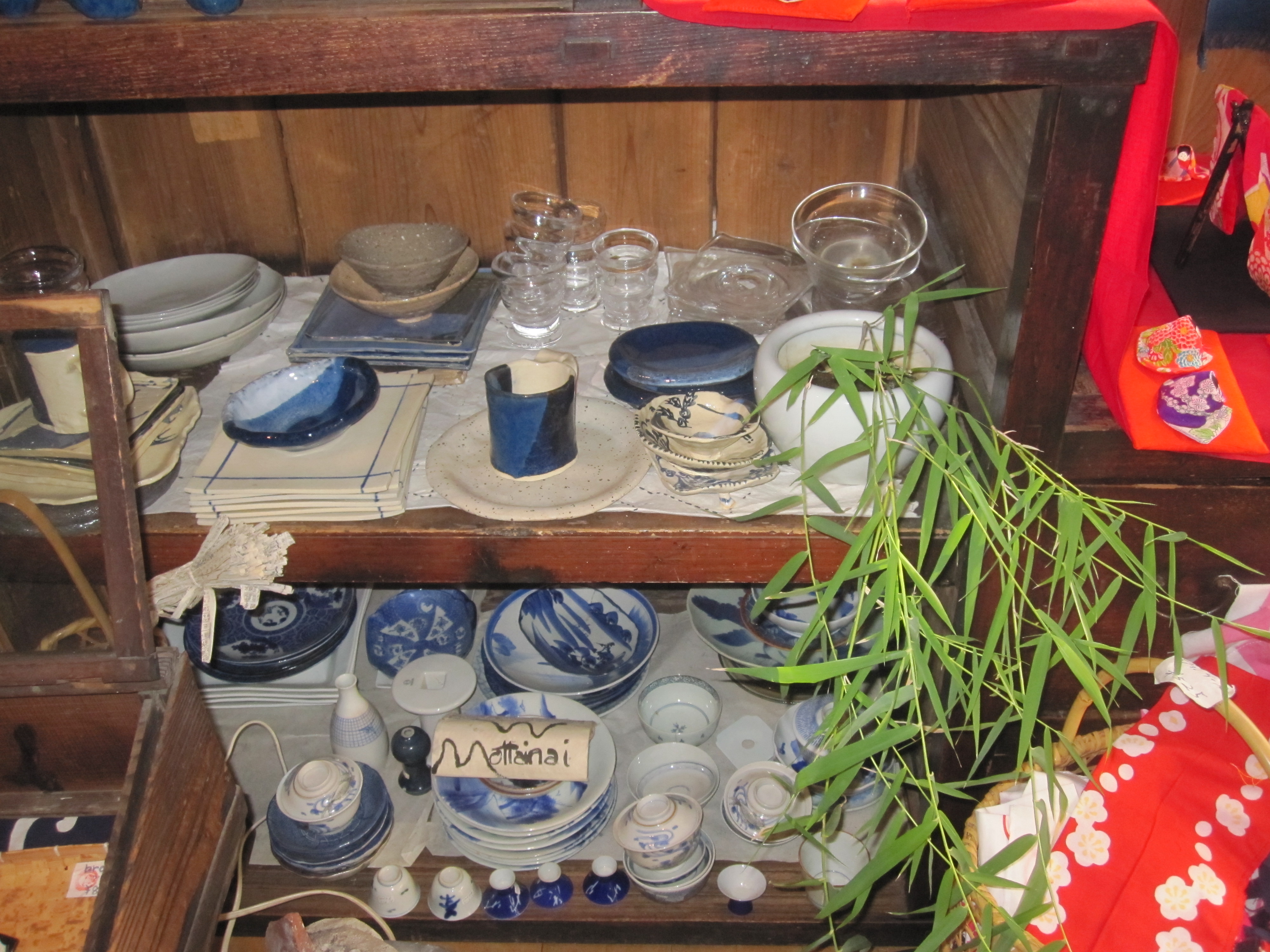
The Blue & White shop is an atmospheric hodge-podge and has bits of everything, from antiques and modern ceramics…

IMG_1053

…to charming little chopstick rests. Do I spy Otafuku?

IMG_1073

It’s the kind of place where at any moment, an itinerant indigo peddler may show up and stark unpacking his wares. I’ve been lucky enough to be there on one of those days. He should be coming back quite soon, perhaps in the next week or two.

IMG_1068

Kasuri slippers anyone? Not to jump the gun, but you’ll be hearing a lot about kasuri from me in the coming days.

IMG_1056

While there is no formal lesson schedule posted, Kazuko Yoshiura does teach sashiko there…

sashiko throw pillows

as does Akiko Ike, who teaches the rough and primitive form called chiku chiku, which is the sound a sewing needle makes when going thru cloth. I can’t imagine actually using these charming dust cloths for their said purpose.

IMG_1069

And Amy has almost single-handedly kept traditionally dyed yukata fabric from Tokyo Honzome (a consortium of dyers) in production.  No one can afford to buy the handmade rolls anymore for making yukata, but she sells it by the meter, perfect for projects like quilting.  You all know how often we have turned to her for the fabric in the ASIJ quilt borders. These days the dyers are surviving by making tenugui – the Japanese equivalent of a dish cloth – with the traditional techniques and stencils and Blue & White has a large selection of those too.

IMG_1953

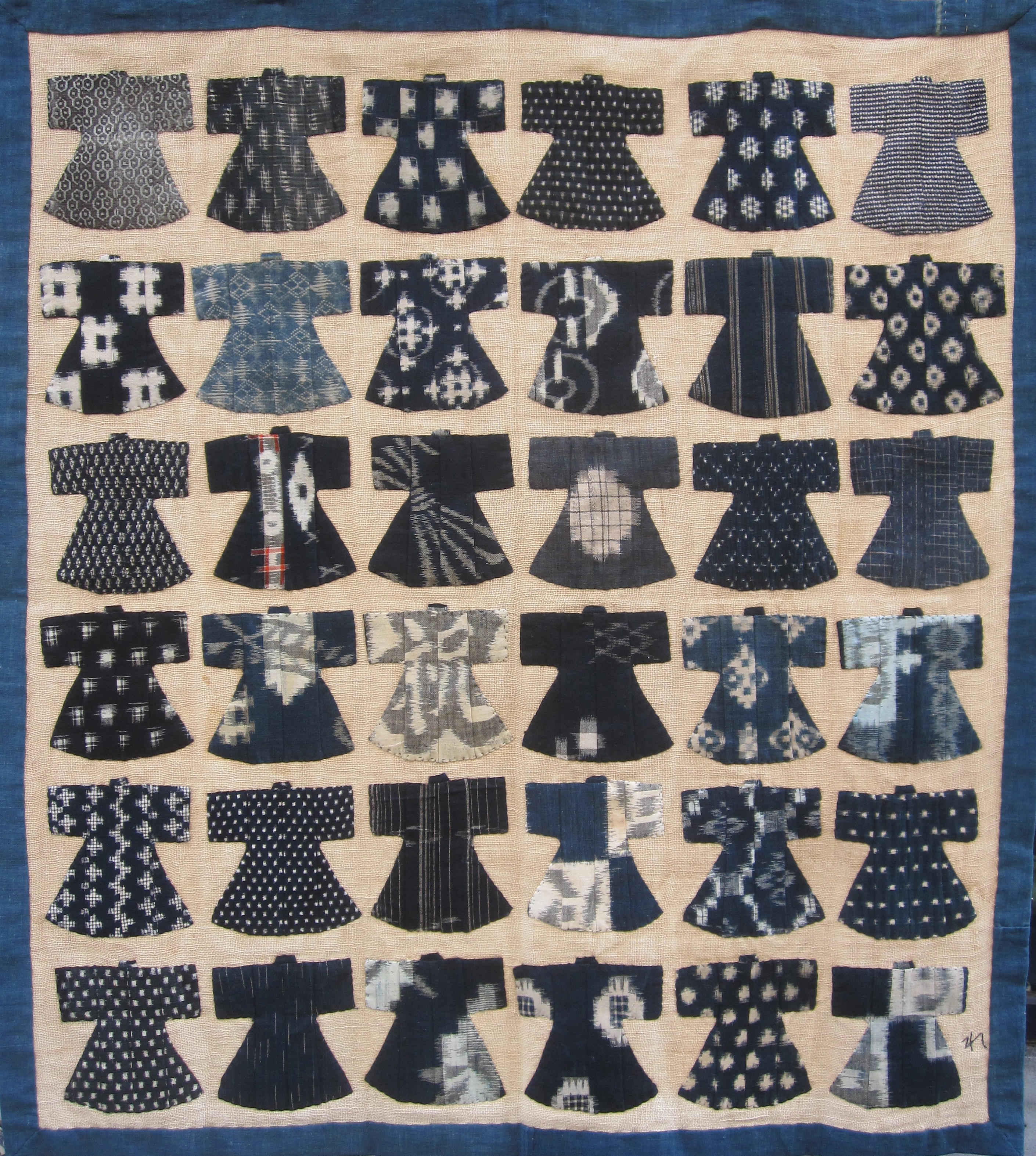
One of the most beloved things sold at Blue & White are the small quilts and hangings by Reiko Inaba. She uses vintage mosquito netting, kasuri and other fabrics to turn out her charming kimono and fish quilts, something she started doing as cancer therapy.

IMG_1057

For those of you who can’t just pop in and visit, Amy’s books have been reprinted a million times and still feel as fresh as ever.  She is currently working on a fifth – I’m not sure that I can give away any details on it!

Blue-and-White-Japan-hardcover japan country living

japan the art of livingotafuku amy katoh

For me personally, Amy has been an inspiration, a teacher and a wonderful example of how to live a life full of constant discovery. She sees the wow! in everything.

Put Blue & White on your bucket list….

Blue & White
2-9-2 Azabu Juban.
Telephone: 03-3451-0537

http://blueandwhitetokyo.com/

On a related note, the giveaway for an indigo and white nankeen pillow from LuRu Home has closed. I’ll have a winner for you by the end of the week.

Related Posts:
Artist Spotlight…Kazuko Yoshiura and Sashiko Fever
Feeling Fresh…Indigo Textiles and Tenugui
LuRu Home…Keeping the Folk Art of Chinese Nankeen Alive And a Giveaway!

About these ads

Read Full Post »

With the development of economy and progress of industrialization, more and more machine-made cloth has been taking the place of calico, home-made and hand-imprinted and dyed in the country. Therefore, blue calico, as a work of folk art, has been gradually losing its practical value.

Indigo Textiles: Technique and History, Gosta Sandberg

slideshow_3

What do you see in this photo? Japanese yukata (cotton summer kimono) hanging on a line perhaps? It wouldn’t be an unreasonable guess based on the color and pattern, especially if you were just looking at the rolls of yukata fabric in Amy Katoh’s Blue & White store, like I was the other day. Hand-dying is a dying art everywhere, and we are lucky when people like Amy step up to help keep it alive.

IMG_1953

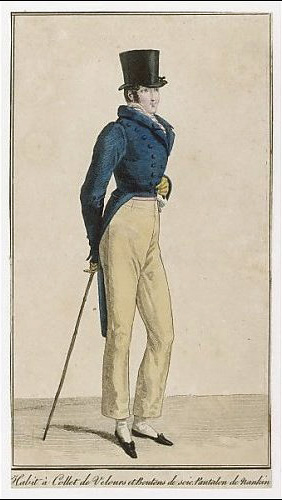
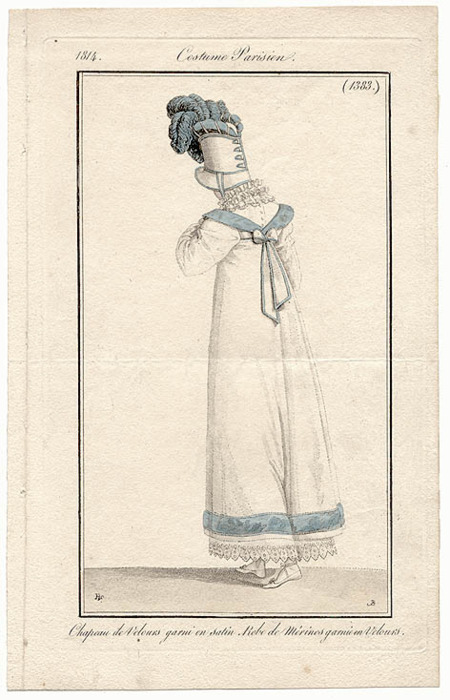
But the answer to my question above is actually not Japanese at all – it is Chinese nankeen, stencilled and dyed in an indigo bath. Originally, the word nankeen was used to indicate the very dense and unrefined hand-woven cotton fabric itself, but over time has come to be used interchangeably with its patterned and colored counterpart. Often referred to as blue calico, it was the main component of peasant clothing in China for centuries and in its plain form came to be an important export. A staple of British clothing from the late 18th century onwards, any Jane Austen fans among my readers will recognize it as a common fabric used for half boots worn for walking, as well as for mens breeches and pantaloons – the modern-day equivalent of chinos. Even its signature pale yellow color is often mentioned.

Nankeen_Trousersournal des Dames et des Modes, 1814

Ironically, while the upper classes in Europe were wearing nankeen, in China it was the fabric of the rice farmers, who used it for warm padded winter clothing. In Indigo Textiles: Technique and History, Gosta Sandberg writes “The jacket of the Chinese rice-farmer has been coloured with indigo since time immemorial. The reason for this is said to be that cloth dyed with indigo is many times stronger than undyed cloth and that it keeps insects and snakes at a distance, which is a considerable advantage for those working in open fields.” I don’t know if that is actually true, but it is consistent with work clothes in many cultures around the world, including our very own Levi’s.

Enter into our story – and there is nothing I like better than a good old-fashioned expat tale - Claire Russo and Liza Serratore, the founders and designers of LuRu Home, a new-ish textile based home design company working with modern versions of nankeen, based out of Shanghai. Selling pillows, napkins, place mats, tea towels and bags, all made from the custom hand dyed fabric in their versions of traditional Chinese patterns, it is good to see others taking up the banner of preservation, while innovating at the same time.

slideshow_7

Liza and Claire had been friends since high school and kept in touch, planning to go abroad for work in response to the poor economy in the United States. After a few twists and turns, both ended up in Shanghai. One day they came across bits of old blue and white Chinese fabrics that they found in a tiny shop at end of long alley way – one of those magical moments that if we are lucky, we stumble across a version of, sometime in our own lives. The store was jam-packed with textiles, many sun bleached around the edges, and they came home with a few individual meters, recent but vintage.  Their original impetus was to make things for their own apartment, and then for gifts, and from there the demand began to grow. They found they had passion for the fabric and as they investigated the printing process, a desire to rejuvenate the industry and bring patronage back to the artist.

Fabric Hanging in Yard

The technique for making nankeen is a rice paste stencil resist technique almost identical to that of Japanese katazome. Just like the two countries currently arguing over the Senkaku Islands, they also argue over whose technique it was first. Frankly, I think it truly originates elsewhere in Asia, but I am not about to enter the scrum.

 Antique Chinese nankeen…

Antique table cloth patchAntique Nankeen

Does it look familiar? Antique Japanese katazome.

katazome

Both techniques use a paste glue to cover the open patterned area of a stencil, keeping it from absorbing the dye. In Japanese these stencils are called katagami – and I have written about them as decorative devices as well as a functional ones before. The Chinese nankeen artists do all their screen cutting by hand using simple craft paper that has been oiled. I can’t help but hear their Japanese counterparts whispering in my ear “They just use plain craft paper?” and the Chinese reply being “Why do they bother glueing all those layers of washi paper together with persimmon extract? Boy, that is a laborious waste of time!” While the Japanese use rice paste, the Chinese use soybean and lime paste mixed with water.

Paper Screen : Paste on Fabric

The base cotton is no longer hand loomed, but it is still very size limited based on the traditionally sized dying vats. It is also quite difficult to work with screens beyond a certain length so the largest screen possible is 32 inches and the rolls of fabric are 12 meters long. This automatically insures that all LuRu Home’s pieces are small batch made and variations are part and parcel of the product, depending upon the whims of the dyer and even the weather for drying.

Nankeen dye dipping

The fabric is finished by using frosting-style knives to scrape away the paste after printing and then the fabric is put through a wash cycle with no soap and dried.

Scraping the paste post-dye

Their patterns have been inspired by historical patterns in An Overall Collection of China Blue Calico Vein Patterns compiled by Wu Yuan Xi, although not everything in the book is a traditional pattern (zebra anyone?). While Claire and Liza want to starting designing their own prints, the nankeen artisans will have none of it until the women build up more guanxi (relationship currency).

Wu Yuanxin 11cropWu Yuanxin 8crop

They have been extrapolating and changing the old prints and ironically that has helped them build guanxi as it shows their respect and appreciation for the process. A perfect example is the Flower pattern, which was too small and tight as it appeared originally. They enlarged the size and added white space to up its graphic punch. So for now, they are going to continue playing with tradition and plan to introduce a new pattern every season, which is twice a year, by adding one and pulling one, keeping 6-7 prints available at all times.

Flower Prints

Their gorgeous website shows all their products and they also have a lovely lookbook with great styled shots. This outdoor view, also shown above previously, is my favorite.

Table Setting 2

I’m dying for a few of the adorable tea towels, pun untended! They make great gifts too.

DSC_9252

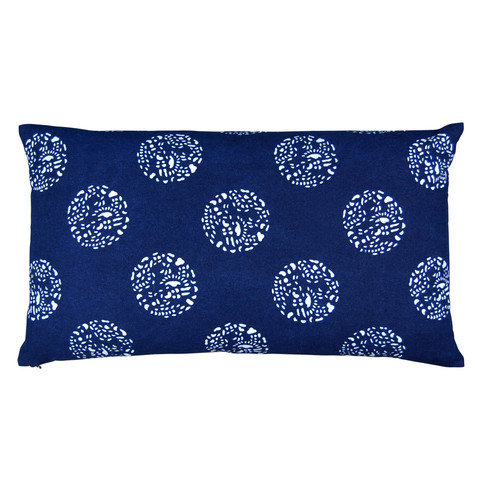
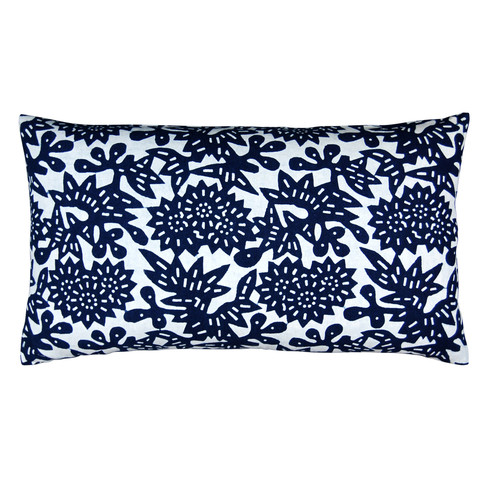
So now for the fun part! Liza ad Claire have generously offered one 13 x 22 lumbar pillow (insert included!) in one of their four most popular patterns On The Fence, Babyteeth, Dot Dot Dot and Flower - the giveaway winner’s choice. All you need to do to enter the giveaway is leave a comment below. If you like LuRu Home on Facebook, I will enter you in the giveaway a second time, doubling your chance to win. They can ship to the winner anywhere in the world as they have stock in both the USA and China. The giveaway closes Monday night at 12 EST. I am crushed, of course, that I can’t enter myself!

on the fence pillowbabyteeth pillow

dot dot dot pillowflower pillow

Their pillows look great styled with other indigo and blues, as seen here at Nicky Kehoe

luru at Nicky Kehoe

…as well as with an assortment of other colors, like here at Black & Spiro.

luru at Black & Spiro

Although record prices are being set for fine antique at auctions by wealthy Chinese looking to repatriate lost treasures, the locals LuRu works with are a bit bewildered by the women’s’ fascination with nankeen. Anything folk art based is undesirable these days in China. Louis Vuitton or (even Luois Vitton) is what is hot. But Claire and Liza have stiff competition from other buyers in procuring their fabric. From whom, you may ask? Can you guess?

The Japanese!

Image credits: All images credited to LuRu Home or the publications listed with the exception of #2 (me) and the 19th century fashion plates from Lady’s Repository Museum.

Read Full Post »

Was it this room in the October 2010 issue of Lonny that started it?

Or this one in the November 2010 issue of Elle Decor?

Either way, I don’t know the answer, but it is no longer just my own selective perception. I figure everyone must be tired of ikat and suzani throw pillows, as every time I turn around (or actually, click on a link) I come across indigo pillows, new and vintage, shibori or tie dyed, sashiko stitched, wax-resist dyed, printed and other techniques, all reminiscent of or actually made from Japanese textiles. Not a new topic for me at all, but I do think they have gone from being a rarely seen item to being prevalent and readily available. So if you are not here in Japan where you can stop by a shrine sale and pick up Japanese textiles to sew into pillows, or if you like your pillows ready-made, here’s a look at what’s out there.

There are certain places you’d expect to find them of course…John Robshaw for instance (his room is the top one above).  The website has tie dyed pillows for sale which I won’t call shibori as I believe they are made in India, not Japan.

Jayson Home & Garden still stocks the Zoe tie dyed pillow in the second photo, but unfortunately they are out of the blue and only have it in sage and plum. Don’t despair as Roni over at The Loaded Trunk has a nice selection of hand tied indigo pillows as well as a full assortment of Moroccan, Kuba cloth, Hmong, Afghan, Mexican, Indian – you name it – pillows from around the world.

Here’s a close up of the big 24 inch pillow on the floor in the photo above. It would make a good substitute for the ones in the Elle Decor photo.

Anupama also has a wide range of global pillows, including this typical shibori circles pillow…

…and this more unusual beehive shibori pattern.

Big shibori furoshiki (wrapping cloths) make great floor pillows as shown here by these from Ouno Design. I recently sourced a great furoshiki that designer and friend Maja Smith is making into one for her Lake Tahoe home. Looking forward to photos of that!

One Kings Lane has had some very authentic looking pillows from a shop called Viridian made from vintage tsutsugaki (literally, tube drawing) textiles, a paste resist method of decoration…

…as well as others made using the katazome (stencil paste resist) method from Erin Taylor of Botanik.

There are also some boro (tattered rags) styles too.

Even mainstream retailers are getting into the game. While Anthropologie is no longer stocking the Japanese inspired bedding and pillows they had last year, Serena and Lily, normally so preppy and demure, has been stepping up their game with an online bazaar filled with vintage accessories as well as their line of linens and furniture. They have also caught a bit of that boro fever…

…and have some new Japanese inspired textiles.

Even Ralph Lauren isn’t being left out with his Indigo Modern Stripe Collection, a dip dyed pillow and sheeting set.

Related Posts:
Tie Dye Heaven…Painterly Effects from Monique Lhuillier and Eskayel
A Little Shibori Feeling From Eskayel and Anthropologie
Selective Perception…Maekake at the Heiwajima Antiques Fair and Kawagoe Shrine Sale

Read Full Post »

I am having another round of selective perception. Do you know the feeling when you notice something once and then next thing you know it is just everywhere? That has been the case with vintage Japanese maekake, the heavy cotton aprons, usually dark indigo in color, historically worn by staff at small manufacturers and breweries. These days they are retro-chic with the young set, being worn by staff at cool izakayas (simple food and bar restaurants). They have almost a denim feel and the waist ties are a thick woven double-sided cotton, often bright orange. Their simple but strong graphics caught my eye again and again at the Heiwajima Antiques Fair last week.

Many are around the fifty year old mark. You can often tell more specifically by the old-fashioned telephone numbers or styles of writing.

One idea on how to reuse the maekake, besides the obvious original intention, is to turn them into visually graphic pillows like these in Paul Ludick’s living room made from simple kamon (japanese crests) banners.

But the best idea by far is one I don’t have a photo of. Aaargh! Much to my chagrin, I was too busy talking to a lovely gentleman at the fair about his handmade maekake tote bag that I forgot to take a photo. (Hmmm….seem to be doing a lot of that lately). Anyway, he (or actually his wife) had sewn a bag out of a vintage apron and it was great looking. The zipper pocket in this one got me thinking about making one for myself – perfect for a cellphone or a couple of bucks (or should I say yen?). I didn’t end up buying any but went home stewing on the idea.

A few days later the Kawagoe market was full of aprons too.

I found a fabulous and unusually colored faded green one too, but another young woman browsing seemed to want it so desperately that I gave it to her. I found more joy in her happiness than I would have had in purchasing it.

My favorite dealer was wearing one exactly as it should be worn! I noticed other dealers wearing the sturdy aprons too.

So if fate was surrounding me with aprons, then I was clearly meant to buy one. I found a really cute small one with an outside pocket and a great design. I am pretty sure it is from a sake brewery.

Stay tuned to see the finished project!

Speaking of indigo bags, my friend Jane Farrell has been sewing absolutely beautiful patchwork and sashiko totes. I am going to try to have her work for sale sometime soon!

And speaking of selective perception, the aprons are not the only things that have been clubbing me over the head. Remember those great vintage shoyu (soy sauce) bottles I just wrote about?  I had never particularly noticed them before either, yet I saw them everywhere at the Oedo fair with Peri Wolfman and also at Heiwajima. Definitely different bottles and different dealers too!

Continuing off the topic, but still kinda on it, hop over to the post I wrote this summer about Wedgwood jasperware cheese keepers. Had a huge spate of selective perception there too so I added a big addendum to the post!

Image credits: all photos mine with the exception of the Elle Decor December 2006, photo credit: William Waldron, and Jane Farrell bags courtesy of the artist.

Read Full Post »

Shiboru in Japanese means “to wring, squeeze, press.” Although shibori used to be designated as a particular group of resist- dyed textiles, the verb root of the word emphasizes the action performed on cloth, the process of manipulating fabric. Rather than treating cloth as a two-dimensional surface, with shibori it is given a three-dimensional form by folding, crumpling,stitching, plaiting, or plucking and twisting.
-Shibori Textile Museum

Everywhere I turned this summer, Brooklyn based design studio Eskayel was featured, from apartment therapy, to House Beautiful and Lonny. Artist Shanan Campanaro’s unusual abstract patterns drawn from her paintings and then digitally manipulated and expanded as wallpaper and fabric are utterly riveting. I received numerous emails from friends and readers who also had noticed it in the press and wanted to alert me to its beauty.

While her textiles and papers are not in any way shibori (tie-dye) related, every time I looked at them, I couldn’t help but be reminded of it.

Perhaps it is the rich indigo blue colorways?

Or the Rorschach quality the patterns share with shibori?

Here are two classic shibori patterns, tegumo and hinode for comparison with the pillows above. Are you feeling it too?

Even this Galileo basket feels Japanese in shape and nature.

If you are loving her patterns but not interested in indigo, be sure to check out the full website as there are other gorgeous colors and designs.

Last June, the design team at Anthropologie, fascinated by an antique piece of Japanese cloth, traveled to Kyoto in search of more information and inspiration. The result was their “Arimatsu” bedding line.  The history of Arimatsu, a town known as the center of shibori, dates back to 1608 and it has been a dyeing center ever since.

A room view of the bedding from the catalog.

You know me, I cannot ever resist an interesting lamp shade. This Arashi shade has classic shibori details. Love the pleating too! Hmmm…where could I use it?

Shibori is not Anthro’s only inspiration. Their Nightbloom bedding series is based on a few Japanese motifs. The central medallions are stylized chrysanthemums, the kamon of the emperor. And the circular pattern is a complicated version of shippou-tsunagi (seven treasures pattern), just recently shown here.

The sheet set reverses the colorway.

The bolsters would make a great accent anywhere.

This spliced shibori throw pillow is both dyed and pleated.

And this long thin swatch bolster has to be my favorite. It is a little smörgåsbord of everything.

Hey my quilting friends, doesn’t it make you want to gather our yukata fabric scraps and make some pillows?

Related Post: Feeling Fresh…Indigo Textiles and Tenugui

Read Full Post »

Lately I seem to be passing up amazing indigo textiles at markets all over town, like this antique katazome futon cover, with scrolling floral and arabesque design.

This giant furoshiki (wrapping cloth) with sashiko stitched corners was purchased by someone else, perhaps at my urging. Am I turning into my grandmother if I am talking to strangers and pushing them to buy things?

And it is fairly rare to see such a fantastic boro futon cover. This one was so artistically patched that I went back and looked at it numerous times before leaving Kawagoe. I am sure purists would decry that tiny bit of red, but I think it is the perfect touch.

My reasoning for not purchasing, besides the usual “I can’t have everything,” is that I am not sure what to do with them. Not usually my problem…

But lately, I have been seeing indigo textiles in design projects everywhere and I have been craving some of that organic deep blue as it has such a cooling effect in warm weather. Many of the textiles in these projects are not Japanese but are instead Indonesian batik or even French Provencal fabrics, but they all have the same visual effect. In the best spaces, textiles from all over the world have been blended together!

I spied what looks to be a Japanese textile thrown over the sofa on the cover of the newest House Beautiful.

April’s Elle Decor featured the Brazilian beach house of designer Sig Bergamin, always a master of the global textile mix. The most unusual fabric placement? The indigo piece on the wall, serving as a backdrop/frame to the painting!

One guest room has beautiful batiks as extra coverlets at the foot of the beds.

Another is such a riot of color, country and pattern all piled on an amazing antique Chinese bed. Click the photo to enlarge and you will see textiles from almost every continent!

Stylist Peter Frank’s house was featured last fall, but I had to include his living room. That perfect blue patchwork pillow, made from antique Japanese textiles, the blue grasscloth on the walls and the amazing 18th century Korean screen, all on a woven paper tatami mat rug from Merida, exude an elegant cool. His entire Hudson Valley house is well worth looking at here.

Interested in cooling down and adding a bit of indigo to your life? I have been cruising the internet for throw pillows and found these made from vintage kimono at Jayson Home & Garden. That might be a good DIY!

Want a bigger swath of blue? Madeline Weinrib, famous for her ikat pillows and Moroccan motif flatweave rugs, also does a denim patchwork line, combining the look of patched Japanese textiles and vintage dhurries.

While we are mentioning Ms. Weinrib, here are a few photos of her New York apartment, resplendent with her textiles and also a great collection of Japanese inban (transfer printed porcelain) and other porcelain.

For those of us in Japan, it is easy to add a bit of indigo to our lives, and what better way to do it than by helping those up north in Tohoku? Amy Katoh’s Azabu Juban shop Blue & White is selling special “Genki Japan” tenugui. The checkerboard motif (remember it here?) is interspersed with encouraging kanji phrases, such as “Let’s Join Hands” and “The Power of Everyone.” All profits from sales will be donated to relief agencies. I think everyone needs one!

And speaking of tenugui, I promised to devote some time to them in my last post, but my dear friend and quilting master Julie Fukuda has beaten me to it and written a great piece on her blog My Quilt Diary. Take a look! Julie often pieces tenugui to create the backs of her quilts and while it may look random, there is always a masterful artistic hand at work. Julie, don’t be angry with me, but sometimes I love the tenugui backs as much as the amazing quilt fronts!

Which brings me to one last indigo image from recent press – this bedroom in Maine by Tom Scheerer. The quilt on the bed must be American, but it is reminiscent of a patched Japanese textile or even Julie’s tenugui quilt back.

Stay cool wherever you are! And stop in to Blue & White for your “Genki Japan” tenugui!

Image credits: 1-3 & 14. me, 4. House Beautiful June 2011, photo credit: Francesco Lagnese, 5-7. Elle Decor April 2011, photo credit: Simon Upton, 8. House Beautiful October 2010, photo credit: William Abranowicz, 9. Jayson Home & Garden, 10. Madeline Weinrib Atelier, 11-13. Elle Decor December 2008, photo credit: Simon Upton, 15. Julie Fukuda at My Quilt Diary, 16. House Beautiful April 2011, photo credit: Francesco Lagnese.

Read Full Post »

Sashiko is a traditional form of needlework that has been practised in Japan for centuries.  Born out of necessity, it was a way to make layers out of thin garments in cold climates. Sashiko was also method of patching textiles to extend their life in times of hardship. Like other needlecrafts (such as quilting or knitting Aran sweaters), the sashiko embroidery that developed from functional patching became an art form in itself.

As textiles became cheaper and more readily available, sashiko embroidery began to be used for decoration as well as practicality. Traditional Japanese patterns and motifs were incorporated into the sashiko syllabus of stitches and more intricate designs developed. Today, although sashiko is used primarily as a decorative accent, its functional purpose remains:  to reinforce, strengthen and make warmer, and in the process to create a useful cloth where beauty visits as an unintended consequence.

Sashiko artist Kazuko Yoshiura’s exhibition is being presented at Amy Katoh’s legendary shop Blue & White in Azabu Juban through October 15, 2010. The wall hanging above, in a patchwork “cracked-ice” pattern, is an incredible sampler of different sashiko patterns. The word sashiko itself means “little stabs” and key to its methodology is the tiny regular stitches.  While results can look elaborate, the basic technique consists of simple running stitches sewn in repeating tate-jima (vertical lines) or yoko-jima (horizontal lines) and combinations of the two . 

Ironically, Yoshiura first learned sashiko at Blue & White 30 years ago!  Since then she has carried her art far and wide, publishing books and being featured in magazines, including Japanese Vogue.  She lives on the Izu Peninsula and teaches sashiko at Blue & White on the 2nd Thursday of each month. One of her quilts is even included in the collection of Paul McCartney!

Items on display include table runners and decorative bags. Traditional sashiko is white thread against an indigo dyed fabric, but red thread can be used as well, as seen on this small bag.

This embroidered vest hangs in front of a giant furoshiki (a traditional Japanese wrapping cloth) in classic karakusa pattern. It would be perfect to use as a small tablebloth.

My pick? These charming throw pillows were very reasonably priced and a perfect way to catch a little sashiko fever.

Blue & White is located at 2-9-2 Azabu Juban. Telephone: 03-3451-0537.  Many thanks to Amy Katoh for her assistance with his post.

Read Full Post »

Follow

Get every new post delivered to your Inbox.

Join 405 other followers

%d bloggers like this: