Feeds:
Posts
Comments

Posts Tagged ‘fishing floats’

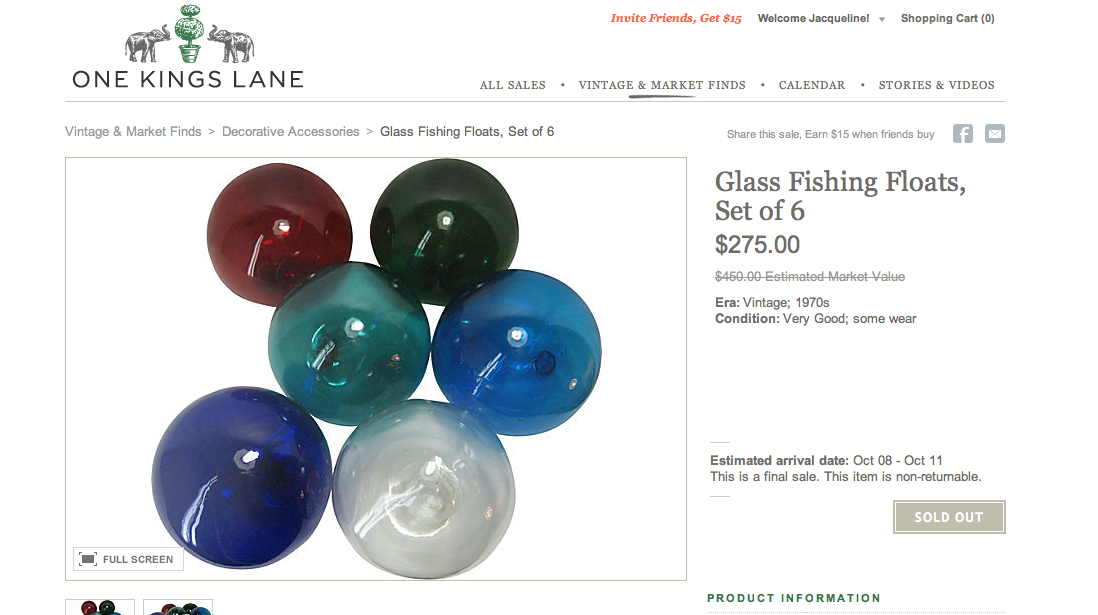
So both the summer issues of House Beautiful and Elle Decor feature a styling accessory that will be dear to my glass obsessed readers hearts – slag glass, lumps of leftovers from the glass blower’s furnace at the end of the day. Like Japanese glass fishing floats and bottles, they are essentially found objects that brings in that translucent watery blue-green color just perfect for beach house interiors.

Both spaces feature a ton of interesting details, like the knotted rope window treatments and the upside down industrial baskets-turned coffee tables in the Marin County, California house below. This space is full of fabulous re-purposing! The rest of the house is no less fascinating – a must view – including a fabulous bunk room and kitchen window-deck pass through. You’ll be seeing more of it here on the blog in coming weeks.

The Amagansett home in Elle Decor is the very best kind of casual warm modern, but it is the slag glass on the table that pulls this room together and links the inside to the exterior. The soft shimmery colors and rustic curiosities lift the house out of an ordinary mid-century modern design – be sure to see the rest of it here.

What is it about water colored glass that speaks to us so strongly? And why am I so sure there are going to be lots of google, eBay and Etsy searches for it in the coming months?

Related Posts
Glass Insulators Can’t Protect Me From Jet Lag
A Few (Glass) Jewels For My One Year Anniversary
Buoys, Bottles and Bargains…the Rainy Day Special at Kawagoe
The Mail is Always Late…more on Japanese Glass Fishing Floats and Sudare
Send Me to Rehab…I Have a Glass Bottle Addiction
Everyone Loves Japanese Glass Fishing Floats…A Follow Up
Sheer Simplicity…More Japanese Glass Fishing Float Displays

Image credits: 1. House Beautiful July/August 2012, photo credit: Alec Hemer, 2. Elle Decor July/August 2012, photo credit: Jason Schmidt

About these ads

Read Full Post »

This is one of those posts in which I could have based entirely on photographs of local collections but unfortunately, everyone’s movers worked way faster than expected and most of my anticipated photos got packed up! But everything in this post, while geared towards styling Japanese vintage and antique accessories holds true for just about anything from anywhere. But don’t expect this post to be exhaustive in topic or example. Obviously I could write ten posts about groupings of blue and white porcelain (just look at this month’s House Beautiful) or Japanese glass fishing floats (and I have in the past here, herehere and here for example) as well as some of the more unusual decorative objects we find regularly in Japan (kashigata, katagami, hagoita, come to mind). The focus of this post is really not what you are displaying, but how. I have a few simple “rules” to go by, nothing particularly original, but if you use these, your displays will be better.

One of my most basic rules is the rule of multiples. You can display a single item of a kind, like this Japanese basket perched above the drinks cabinet…

…but beyond that, with the exception of matched pairs, you need a group a similar objects placed together, like these amazing ikebana (flower arranging) baskets on the side board of an apartment designed by Emily Henderson for Michael Reisz on an episode of HGTV’s Secrets of a Stylist. Like objects should always be grouped tightly together, not placed around a space separate and unlinked from each other. I call this the “anti-pimple” rule of display.

Also demonstrated by these baskets is the rule of odd numbers, with the exception of matched pairs again (more on that later). If at a glance you can instantly count the number of objects in a grouping an odd number will always look better. I am sure there is some organic mathematical or mystical reason for this, depending on your personal perspective, but in this case just take my word for it.

The next rule is is that of varied elevation. If the baskets were just lined up on the sideboard, they would look nowhere near as good as they do with some placed higher on wooden boxes. Even their own variety of height would not achieve the same effect.

The rule of containment is to use a single decorative object such as a tray or bowl to corral another collection. We find these roughly hewn soba bowls at shrine sales all over Japan and they are great for holding collections of glass fishing floats…

…floats plus shells and souvenir rocks (love this idea!)…

…or how about hard to store baseball paraphernalia?

Another rule demonstrated by these bowl displays is to use no more than 3 types of objects and ideally either 1 or 3 (odd numbers again). The grouping of all floats is cohesive, the combo of floats, shells and rocks is cohesive, and the mitts and balls work even though there are only two types of items because one of the mitts is very dark in color and reads as a third type of item. If you put too many kinds of items in the bowl, then it will just look like a bunch of junk.

Here Lauren Liess of Pure Style Home uses her bowl to hold magazines. Isn’t it amazing how attractive even the most mundane items can be when displayed correctly?

Another favorite local collectible I have not yet written about is kokeshi dolls, the simple armless painted wooden dolls which originated in northern Japan, but are now made and sold all over the country. Vintage examples from the last 100 years or so of different varieties are a shrine sale staple. They are charming, and easy to collect.

While cute, it is important to give enough gravitas to their display to keep them from looking insignificant. This grouping is crowded by the other unrelated objects on display…

…in comparison to this grouping, where the dolls have space to breathe and coordinate with the other objects nearby. This collector has also chosen to use the rule of strict palette/shape/style to limit which colors and types she buys to create cohesion through the simple black and red paint, while using a variety of heights to create dynamism in the vignette.

This shelf effectively boxes the collection much in the way the soba bowls did above. The enclosure helps to unify the variety of dolls collected.

And here the kokeshi have been literally “boxed” to create cohesion from their variety. Note this display follows the rule of odd numbers and the rule of varied elevation in a vertical format. I do love these cute washi (Japanese paper) lined boxes – they remind me of this and this. And if you are interested in making these there is a DIY tutorial on Poppy Talk too!

Here we have a beautiful grouping of antique iron teapots, but the collection is not yet complete. Imagine this grouping if you either added one or took one away. Imagine if all the teapots sat at the same height instead of having one raised. The plan for the fifth teapot to complete this vignette is for it to be a larger fairly horizontally volumed one. Perhaps another small kettle stand with shorter legs than the one pictured will also be added.

Summer calls, but I owe you some follow up posts on rule-breaking display, because if there are rules, they must be broken, as well one on matched pairs, which have their own display rules. Watch for upcoming related posts on a basket wall installation I did in Tokyo right before leaving for the summer and in contrast, some tiny decorative items that ingenious friends are putting to good use.

Related Posts:
Vignette Arranging With Shrine Sale Goodies at the Beach House
Ways to Display…Porcelain on Brackets
Mirror, Mirror on the Wall…Vintage Etched and Engraved Plateaus
En Masse…Iron Teapots, Vincente Wolf and the Art of Grouped Displays

Image credits: 1. Cottage Living via Bryn Alexandra, 2-3. via Emily Henderson, photo credit: Mark Champion, 4, 9 & 12. me, 5-6. M. Small, 7. via Pure Style Home, 8. Wendy Withers via Apartment Therapy, photo credit: Bethany Nauert, 10. via Decor Allure, 11. Janis Nicoay via Poppy Talk.

Read Full Post »

I have a question for my fellow bloggers out there…What do you do when you find you want to add to or update posts and topics you have already covered? There is the classic, oops, I forgot about that photo and also the selective perception issue, where after you write about something you see it everywhere.  Case in point, my brass drum stool

April’s House Beautiful brought this one in a stylish bathroom by Charlotte based designer Barrie Benson.

I had already discovered that I forgot to include this photo from Schuyler Samperton‘s portfolio in my post.

Love the complimentary brass balls warming this icy cool bedroom from Plum Pretty Sugar.

And then I found this one at Milk and Honey Home while looking for spring flower branches.

In the meantime, Joni at Cote de Texas had recently posted this absolutely perfect room which I had never seen before. I have a pretty encyclopedic memory for any space, but this one is new to me, so I need to write to her and find out where it is from.  But I am including it here both because I love it, but also because there is what looks to be a Japanese Seto porcelain garden stool sitting in front of the main sofa. Now that is something you never see!

Speaking of that Barrie Benson bathroom, here is the view across the room with its gorgeous campaign style vanity.

Which reminds me that I have been meaning to mention Jenny of Little Green Notebook‘s newest project. Remember the kitchen island she made out of a dresser that I showed in my repurposing furniture post?

Now she has changed it out for one she made from an old campaign dresser. Yowza, that girl is the best DIY decorator ever! Click here for the details…

I also ended up scrolling through Barrie Benson’s portfolio and came across these two old friends hanging on the walls…

And while we are at it, there is always room for more Japanese glass fishing float inspiration, whether it be subtle, as in this Scott Currie beach house (note the rope banister too)…

…or fairly over the top via The Enchanted Home! Floats with baskets, cut down altar table for a coffee table, giant planter and Madeline Weinrib rug, – gorgeous, no?

Don’t forget to click into my last post and enter the giveaway for the ZAK + FOX pillow! Simply leave a comment on my post and then hop over to Zak’s site and enter your name in the mailing list.

Related Posts:
Identify This…Brass Drum Stool
Kawagoe Shrine Sale Never Disappoints
Made for Export and in My Basement…Seto Porcelain Garden Stool
Feeling Fresh…Indigo Textiles and Tenugui
The Mail is Always Late…more on Japanese Glass Fishing Floats and Sudare
Everyone Loves Japanese Glass Fishing Floats…A Follow Up
Sheer Simplicity…More Japanese Glass Fishing Float Displays

Read Full Post »

My posts on Japanese glass fishing floats are some of my most popular posts. Lately I haven’t had to look far for photos featuring them as readers have been sending me their own displays or those they have seen elsewhere. Hawaii seems to be a common place to find them, which makes sense as they wash up on the beaches. This photo was taken at the historic Shipman House Bed & Breakfast in Hilo, a gorgeous Victorian house on the Big Island.

I also had a mention of the float display behind the bar at the Monkeypod Restaurant in Maui. Impressive!

Most of the recent examples have been charming in their simplicity, with a few floats grouped in a spare interior to great effect. This reader has placed hers under the simplest of lucite tables.

Glass floats and fuzzy sheepskin in the same space – kind of an oxymoron, don’t you think? But so lovely, nonetheless…

…reminding me of this reader’s simple modern arrangement.

South African designer John Jacob has used a few floats in this gorgeous project.  I have only pulled the photos that highlight the floats but his entire portfolio is drool-worthy and well worth perusing.

All stand out in contrast to the only floats I saw over the holidays – these in the gift shop window at Universal Studios (remember those family commitments that kept me from antiquing in Florida?) Ahoy matey!

Related Posts:
Buoys, Bottles and Bargains…the Rainy Day Special at Kawagoe
The Mail is Always Late…more on Japanese Glass Fishing Floats and Sudare
Everyone Loves Japanese Glass Fishing Floats…A Follow Up

Image credits: 1. L. Rogers, 2. via Monkeypod Restaurant, 3. S. Bloomer, 4. Moda Bagno & Interni Store by K-Studio via Design Milk, 5. M. Smith, 6-7 John Jacobs Interiors, 8. me.

Read Full Post »

Making sense of the misty ideas floating around my head can be hard, so I will do my best to make this post intelligible.  So much of what this blog is about and what I truly love is the hunt, the surprise, the excitement of a found object, a piece of art, or a moment or item of beauty in a place least expected. Along those lines it is no surprise that my family, led by my girls, but with the mantle well taken up by me, has become addicted to geocaching. If you haven’t heard of it, geocaching is an outdoor hobby in which the participants use a Global Positioning System receiver and other navigational techniques to hide and seek containers, called “geocaches” or “caches”, anywhere in the world (thanks Wikipedia). When you find a cache, you leave a tiny gift inside and choose one to take that has been left there previously. Sometimes there is even a special trackable item with a mission such as “travel around the globe” and the job of the finder is to move that item onwards in its journey. For the kids, the math, geography and the actual search are challenging and fun, but for me it is truly that eureka(!) moment that makes it so irresistible. The whole idea of it is like a net that binds a mass of strangers together, almost a form of performance art. We had just started in New Jersey this summer, but now have been working our way through our neighborhood here in Tokyo as well as further afield. I feel like I need to add it as a tip to my post on antiquing with kids – or actually just as plain old parenting advice. Add a geocache site to your day and it will keep any child happy doing even boring errands.

We are making sure to addict our friends too as there is no fun in going it alone. Recently, one of those friends whom we introduced to geocaching and who also happens to be from Corning, NY, glass capital of the world, introduced a glass artist to me - Josh Simpson - who makes tiny miniature worlds and then leaves them places for people to stumble upon, whether it be in a few weeks or hundreds of years. Josh writes, “In 1976 I discovered several handmade marbles outside my kitchen door. Probably left there by children a generation before, they were still just as bright and colorful as they were on the summer afternoon they were lost.” His fascination with them led him to begin his Infinity Project, making and hiding tiny glass worlds and then, through the help of a few thousand volunteers, hiding them all over the world. “I hope future archaeologists will be confused about the meaning and purpose of the little spheres, wondering what they are and how they got there.”

Simpson’s website is full of photos of these amazing worlds, some tiny and some very large. My kids think they are amazing and love to study them and make comparisons with our own planet. My littlest one even kind of believes there are tiny little people in them and asks if it is possible that we are really in a glass sculpture and don’t know it. Simpson says, ”the cores of Planets are full of bubbles, threads, and kaleidoscopic patterns evoking unseen landscapes and underwater worlds. I know I’ve succeeded when you feel like you have to look closer at one of my little worlds and then lose yourself in its textures and color.”

One of my favorite photos from his site shows the glass canes that must get embedded in the globes (forgive me if I am completely wrong about that technique). I find them very mysterious….What do you see when you look at them? (I see coral reefs).

Hunting for glass balls is something we are already very familiar with as we are also perpetually on the lookout for old Japanese glass fishing floats. My elder daughter has taken to this one in particular, learning the marks and history and begging to drive nine hours north to the tip of Japan for our vacation in order to look for them on the beaches there. Last weekend, we went out searching with friends as part of a jaunt along the nearby coast, only to discover a few beloved ”lucky” floats that no fishermen were willing to part with. Nonetheless, just finding things has a magic of its own.

Exploring by flashlight was quite exciting.

Our actual haul to date has been pretty good – this isn’t even all we have found. Like any enthusiasts, glass float collectors talk lovingly about bubbles, swirls and spindles. Rare marks and shapes are all the more collectible. Give her a minute and my daughter will be happy to talk your ear off.

Another friend turned me on the annual “Finders Keepers” event in Lincoln City, Oregon, in which local artists hand blow and hide roughly 2000 floats along the beach every winter for people to discover. It has become a huge tourist attraction that pulls folks in and gets them to tour the art galleries as well as hunt on the beach. Again, like Simpson’s tiny glass worlds, this is art that allows the viewer to participate in such that they become part of it.

Late this summer there was also a special glass drop in which 200 small antique Japanese glass floats were planted along the Lincoln City beaches. Won’t mention that to my daughter…

But perhaps the most unusual found items of late are these extraordinary and minutely detailed paper sculptures being anonymously left at numerous Scottish libraries. Each one is absolutely amazing in both its construction and wittiness, but it is a complete mystery as to who has been making them. I cannot resist showing them all, in the order they have been found, but for more information on the story and wonderful close-ups see Txikito Planet.

The tag on the first one left at the Scottish Poetry Library in March read:
It started with your name @byleaveswelive and became a tree.…
… We know that a library is so much more than a building full of books… a book is so much more than pages full of words.…
This is for you in support of libraries, books, words, ideas….. a gesture (poetic maybe?)

Next up was this gramophone over a coffin deposited at the National Library of Scotland:
For @natlibscot – A gift in support of libraries, books, words, ideas….. (& against their exit)

The third was found at the Filmhouse theater:
For @filmhouse – A gift in support of libraries, books, words, ideas….. and all things *magic*

I thought the one left at the Scottish Storytelling Centre was my favorite. The tag reads:
For @scotstorycenter – A gift in support of libraries, books, works, ideas….. Once upon a time there was a book and in the book was a nest and in the nest was an egg and in the egg was a dragon and in the dragon was a story…..

But in sentiment it may have been replaced by this one appearing at the Edinburgh International Book Festival which reads “Nothing beats a nice cup of tea (or coffee) and a really good BOOK, except maybe a cake as well“. The attached tag:
To @edbookfest ‘A gift’ This is for you in support of libraries, books, words, ideas…… & festivals xx

This one also appeared at the festival with the following tag:
To @edincityoflit ‘A gift’ LOST (albeit in a good book) This is for you in support of libraries, books, words, ideas…. “No infant has the power of deciding….. by what circumstances (they) shall be surrounded.. Robert Owen

The final one I have seen appeared at the Central Lending Library at the end of August.
For Central Library ‘A Gift’ @Edinburgh_CC This is for you in support of libraries, books, words, ideas…. LIBRARIES ARE EXPANSIVE. Note the letter change in the last word.

In late September the mystery was solved, with the Edinburgh News taking a poll as to whether or not to reveal the artist’s name. As far as I know, it is still not public knowledge. I think it is more fun to keep the mystery alive!

As for us, my girls are hoping to convince Josh Simpson that we should be the next participants in his Infinity Project. They want to hide one of his tiny worlds in a geocache and give it an assignment in the hopes that fellow geocachers will carry it from place to place, creating a traveling art exhibition of one.

Image credits: 1. G. Fukuda via Instagram, 2. Hector Rodriguez via Josh Simpson, 3-4. Josh Simpson, 5-7 & 9. me, 8. via oregon.com, 10-16. chrisdonia via Txikito Planet

Read Full Post »

Follow

Get every new post delivered to your Inbox.

Join 424 other followers

%d bloggers like this: