Feeds:
Posts
Comments

Posts Tagged ‘byobu’

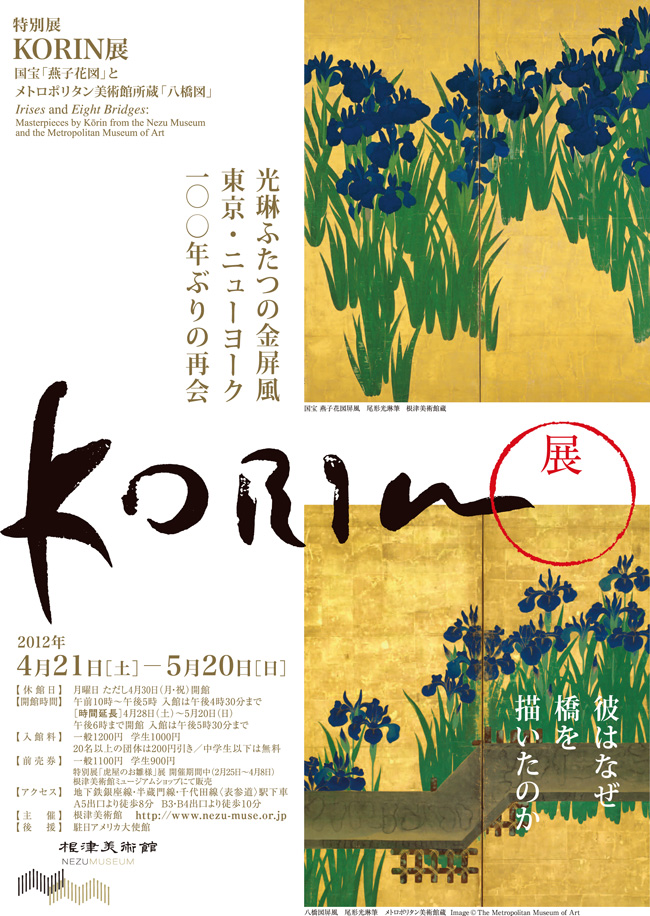
In honor of the just opened exhibit Irises and Eight Bridges: Masterpieces by Kōrin from the Nezu Museum and the Metropolitan Museum of Art, I have gathered some images of Japanese byobu (screens) in Western interiors. If you are looking for more details on these extraordinary screens, take a look at a post I wrote last year, Ogata Korin’s Iris Masterpieces Reunion Postponed, when the exhibition was originally supposed to have taken place. I didn’t think there was any reason to recreate the wheel, so this post is going to be pure eye candy.

Byobu literally means “wind wall”  which gives a clear sense of their original purpose – to block drafts. Over time their mobility and flexibility allowed them to be used almost anywhere, to block unsightly objects or repurpose a room, as well as serving as beautiful backdrops for tea ceremony and ikebana. Ornate screens and those using gold and silver leaf helped proclaim the status of their owner. Like much of Japanese artwork, screens originated in China but were slowly but surely domesticated and changed in Japan, with a high point being the introduction of paper hinges, allowing the artist a single large canvas to create an image, rather than completely divided panels.

Today, screens are more likely to be hung on the wall rather than stood on the floor and like blue & white porcelain, they work in almost any design style. Here John Saladino places a simple 2 panel screen with other traditional Japanese items – an incredible mon covered lacquer trunk and altar candlesticks.

In a completely contemporary room with a strong Japanese vibe (note the shoji screens) Jonathan Straley hangs an Edo period byobu above the bed.

Meg Braff uses an ukiyo-e style screen depicting everyday business in this room filled with modern casual Chinoiserie details.

In Renny Renolds and Jack Staub‘s dining room we also have some modern Asian touches like the quirky bamboo chandelier and woven chairs.

I adore Bruce Shostak‘s little banquet with its golden screen highlighted by moody colors.

Changing gears entirely, there are other byobu made with squares of silver leaf that tend to be very simple, sometime even entirely plain. This dining room by Windsor Smith positively glows with its fabric covered walls and silver screen.

Michael Smith uses a simple silver-leafed screen as a highlight behind his sofa, placed on the floor and used as a backdrop. I love that he has layered a small painting on top of it.

Jerry Jacobs uses a similar screen in a similar fashion in this San Francisco living room.

Caitlin Creer uses a Japanese screen on the wall behind her bed. While it functions to highlight the headboard and lamps, its real purpose in being there is to block an off-center and unsightly window. For more on her bedroom, click here.

This entry hall by Mallory Marshall and James Light uses a giant peacock screen in much the way it might have been used originally.

Here it is yet again, demonstrating its decorative power. I assume the stylist and the photographer couldn’t resist re-using it or it is blocking something they would rather not have in the photo.

Another John Saladino vignette with an amazing Edo period screen, this time mixed in with European antiques. For more of this amazing house, click here.

The placement of a screen on the wall allows a designer to alter the volume of the space, whether it be to enlarge it or make it smaller. This screen may not be Japanese, but I had to include it for its extraordinary placement in antique dealer Peter Hinwood’s giant high-ceilinged room. It unifies a disparate set of objects hung gallery style below and brings the ceiling down to make the room cozier. This is cluttered at its best!

Here stylist Peter Frank has hung not a Japanese screen but instead a Korean one, working in a similar but opposite fashion, pushing up a low ceiling.

This golden screen is such a focal point in this eclectic room by Lazaro Rosa-Violan you almost can’t look at anything else as it pulls your eye back and upwards. As a result, the volume of the space is what is emphasized.

Volume in Erin Fetherston’s loft bedroom is emphasized in the reverse, with the screen low down on the floor, the empty space above it is what you notice most.

I can’t say it enough, if you are in Japan over this next month, make the effort to get to the Nezu Museum as this exhibit should not be missed and the exhibit is only running until May 20. I don’t know if these National Treasures are likely to be reunited again anytime soon.

And speaking of those bridges, a few readers have had trouble understanding their depiction on the screens. Korin has painted them with that flattened perspective unique to Japanese art. I think this live example helps make it clear.

Let me know what you think of the exhibit!

Related Posts:
Ogata Korin’s Iris Masterpieces Reunion Postponed

Image credits: 1. & 12, House & Garden June 1998, photo credit: William Waldron, 2. via Jonathan Straley, photo credit: Matthew Millman, 3. House Beautiful June 2007, photo credit: Simon Upton, 4. Elle Decor March 2008, photo credit: William Waldron, 5. New York Spaces 12-1-11, 6. House Beautiful December 2010, photo credit: Victoria Pearson, 7. Metroplitan Home?, date unknown, 8. via Jerry Jacobs Design, 9. via Caitlin Creer Interiors, 10-11. House Beautiful January 1999, photo credit: William Waldron, 13. via Stylebeat, from Rooms to Inspire in the City by Anne Kelly, photo credit: Tim Street-Porter, 14. House Beautiful October 201o, photo credit: William Abranowicz, 15. via Lazaro Rosa-Violan, 16. Vogue May 2011, photo credit: Claiborne Swanson Frank

About these ads

Read Full Post »


For me, there are two perfect kinds of antique stores.  The first is a carefully curated small shop, while the second is a large unorganized warehouse that you have to search through.  Mizue Sasa’s Okura Oriental Art is the former and it is a jewel – my favorite in central Tokyo.  She and her husband Yasuhiro Shimizu are celebrating their 10th anniversary of owning Okura this year.

In addition to wonderful tansu and porcelain, Sasa-san has a great mix of hard to find items such as altar candlesticks…

antique maps of Tokyo and Japan, both framed and unframed…

ikebana baskets…

and lanterns.

She is also the only dealer I have found who carries traditional copper rain chains, which are the “gutters” of Japan. These are not antique, but they patinate quickly and easily. An amazing sayonara or housewarming gift!

Sasa-san’s pick? This Meiji period tai (sea bream) jizaikagi yokogi (decoration on hanging hearth pole) is a great piece of folk art. Used over a traditional irori (open sunken hearth) it held the kettle above the flame.

My current pick? This hard to find small size step tansu. Often they are very large and very deep and can be impractical if you don’t have the perfect space.

Sasa-san has a fully detailed on-line catalogue and a loyal customer base that visits often from around the world. She handles on-line sales easily, speaks English and ships just about anywhere. She also has a decorating site with staged rooms – you can purchase a whole look if you like or just browse for ideas. Sasa-san will also help her customers arrange their items and improve their decorating in their home. She is not afraid to tell clients to get rid of stuff (which is unusual here). She will also track down specific items for you – just give her dimensions or good descriptions.

I love the juxtaposition of the poured concrete wall with the tansu and the giant porcelain plate that she shows in the photo below. Sasa-san is interested in mixing antiques with modern furniture, a trend that is just getting off the ground here in Japan.

Here she stages vintage blue and white in the bathroom.

The shop is full of great gifts for the holidays!

Image credits: All shop photos taken by me, courtesy of Okura. Decorating photos by Mizue Sasa.

Okura Oriental Art

Read Full Post »

I am often asked for suggestions on buying antiques in Tokyo, so this is the first in a series called “Shop Talk”. One of my favorite antique shops, Kanarusha in Fuchu (near the American School) is the perfect mix of a beautifully arranged store with a dusty but treasure filled backroom and attic, providing the best of both worlds.  There are items for the immediate gratification folks to take home on the spot and lots to dig through for those who love to make their own discoveries. To clear up a bit of confusion on the name, Akariya is the name of the parent company and also of their high-end shop in the Yoyogi area, while this store is actually called Kanarusha. Rarely do I stop by the more polished shop in Yoyogi, preferring instead the more casual warehouse-style store. Drop in and let Ohashi-san and his staff help you chose just the right piece for your home.

Inside is a treasure trove of objects…

Tansu of every style and region…

An unusual golden mizuya (kitchen) tansu…

In the back rooms, there are shelves filled with everything imaginable, including these ikebana (flower arranging) baskets…

These shelves have iron lanterns, inlaid hibachi (small charcoal heaters) and vintage milk glass fixtures…

Speaking of hibachi, they have this gorgeous imperial lacquer one…

They also have a number of beautiful byobu (screens) including this unusual two-panel made of fabric using a wax resist dye technique and adorned with embroidered details. I think William Morris would have loved this piece.

Here’s a close-up of the detail on the spider web and thistles…

Cranes are lucky and represent long life in Japanese art. This 1930s copper vase inlaid with silver cranes is signed by the artist.  Frankly, Art Deco pieces can be rarer than 19th century ones.

Ohashi-san’s pick? This extraordinary choba tansu (merchants chest) from Yonazawa Prefecture made of solid keyaki wood.  The gorgeous burl wood has its original finish in dreamy condition. Inside is a shelf and small compartments.

My pick? It has to go to this amazing Meiji period mizuya tansu from the Biwa Lake region near Kyoto.  It is super long – a full 105 inches – and the staff have only ever seen one other like it in 30 years of antique dealing.  I can just imagine it lining a long wall of a kitchen instead of cabinets. Talk about a room-making piece of furniture.

In addition to the items mentioned above, Akariya specializes in antique doors and ranma transom panels, which can be customzied and used in new construction (building a house anyone?)

A few more great things about Kanarusha…They have their own workshop for repairs and customizations and their restoration is always sympathetic and natural.  They are also happy to work with international customers over email with photos and they will ship around the world.

The big news is that Kanarusha is having its big annual Autumn Sale next weekend from Saturday, October 30 – Wednesday, November 3. Everything is 20-35% off the already reasonable prices.  The shop is open 10a.m. – 7p.m. (an hour later than usual).

The really big news is that Tokyo Jinja readers can start shopping at sale prices now!! Just stop in between now and Wednesday, October 27 (Kanarusha is closed for set up on Thursday and Friday) and mention the blog and you can have first pick before the big sale starts. You may have to wade through as things are not fully set up for the sale, but isn’t that the best kind of antique shopping anyway?

Interested in tansu? You might want to read my post from last month “What’s Cooking? Tansu in the Kitchen”.

Driving directions from Tokyo: Take Shuto #4 (Chuo Expressway) to the Chofu exit and head towards Fuchu after the toll as if going to ASIJ. Pass the turn at Ajinimoto Stadium and keep going straight on Route 20 for 2 km. There will be a rise in the road (bridge over the train tracks) and at the next light called Shiraitodai Police Box intersection (Family Mart is on the right hand corner) take a right. Kanarusha is immediately on your left. Parking is available.

Image credits: All courtesy of Kanarusha and taken either by me or Ohashi-san.

Akariya Kanarusha

Read Full Post »

Sudare are bamboo blinds used to screen out the sun and stay cool during the hot summer months in Japan. The blinds keep out the sun’s rays, while letting the breeze blow through.  They also offer a modicum of privacy when doors and windows are thrown open (in a hopeful attempt to catch the aforementioned breeze). Traditionally hand-crafted, the art of making sudare has been lost to inexpensive imports from China, although craftsmen do still exist (particularly in Kyoto) and antique and vintage examples can be found at shrine sales and antique shops. Fancy sudare have decorative brocade trim around the edges, elaborate cording with tassels and engraved metal hooks to hold the blinds rolled open.

A typical view of a house in high sun in Kyoto, with sudare hanging over the veranda and front windows. 

The decorative arts offer proof of the use of sudare through the ages. One of the first images that springs to mind is this amazing 17th century byobu (Japanese screen) depicting “The Tale of Genji” in the collection of the Isabella Stewart Gardner Museum in Boston. If you click on it to enlarge, you can see sudare hanging in the doorways and windows.

More recent Edo and Meiji period byobu create a direct window view using a trompe l’oeil sudare. This charming screen was for sale at the Heiwajima Antiques Fair.

A second one, styled in an apartment filled with Japanese objects – split tansu, map of old Tokyo, and shoji lanterns.

Built in 1878, the Fujiya Hotel was the first hotel in Japan that catered to Western tourists.  It is an absolute fantasy of a building – all Victorianism and Japonism scrambled together and should not be missed by anyone interested in either. The grand dining room, built in 1930, has amazing botanical frescoes on the ceilings, carved ranma (transom) panels, and the loveliest decorative sudare I have ever seen. They are hard to see in the photo below, but I couldn’t resist the view of the building and the autumn foliage out the window.

The detail is a little easier to see in this photo.

So how to use my sudare in a modern interior? I have always loved the look of matchstick blinds hung behind curtains and if you open any decorating magazine today, it seems as if everyone else does too. Joni at Cote de Texas has an amazing post about curtains, both with and without blinds, and great suggestions on hanging curtains in all kinds of situations.  To hang the blind correctly, you mount it on the outside of the window, filling the space between the window frame and the curtain rod, which has been hung as close to the ceiling as possible to maximize the illusion of height.

So, the plan is to take this window in the den/extra bedroom of the beach house (sorry for the poor photo – room under renovation)…

and add this lovely Indian block print fabric (Cream Hibiscus Flower Buta) from Aleta Fabrics

or possibly this one (Aleta’s Cream Hibiscus Flower Branch), as floor length curtains hung from a slim aged brass curtain rod from Gracious Home (more on my love of aged unprotected brass another time)…

using the sudare from the top of the post as the blind.

Aleta’s fabrics were featured in the to-die-for apartment of Nancy Tilghman, designed by Daniel Sachs, in the October 2010 issue of House Beautiful, including the Cream Hibiscus Branch fabric which was used on a chair in the bedroom.  The bedroom has just the feel of what I want the den/extra bedroom to look like, although taking the children into consideration, perhaps a little darker color scheme.

Image credits: 1,4,6,7,9 &12. me, 2. from il-ne-kore, 3. Property of Isabella Stewart Gardner Museum, photo via The Curated Object, 5. Okura Oriental Art, 8. via Cote de Texas, 10 & 11. from Aleta Online, 13. October 2010 House Beautiful, photographed by Ngoc Minh Ngo


Read Full Post »

“Any fragments from the past, especially those that you can touch, connect you to the makers of those pieces, making you aware that we are threads in a great tapestry of time.”
John Saladino

Often referred to as the “designer’s designer”, John Saladino has been at the absolute top of the design field for over 30 years. He works not only as an interior designer but also as an architectural designer, landscape designer, and in this case, as a curator as well. This June 1998 House & Garden spread features the Colorado home of a couple with an extraordinary collection of antiques and art. Making sense of such a disparate group of items is something that only a master could achieve. Interspersed among the Greek, Roman and Egyptian antiquities are numerous Japanese antiques of all types.  I would be hard pressed to imagine more than one antique screen (byobu) in a house; somehow he manages to integrate three.  In testament to Saladino’s triumph, it feels neither like the hodgepodge of an antique store nor has the sterility of a museum, but rather a peaceful and lovely home.

The coffee table boasts a grouping of  bamboo letter boxes and what looks to be a bronze hibachi on the raised fireplace hearth.

The dining room/living room has a treasure trove of objects – the first of at least 3 byobu (screens) in the house on the back left hand wall, a kimono rack with an extraordinary brocade (or perhaps embroidered) robe up on the stair landing, a bowl-shaped bamboo ikebana basket between the columns and a rare lacquered trunk in the foreground.

This 17th century antique screen is coupled with an art deco Ruhlman chair, an Italian chest and a Roman bronze head.

Another view of the living room reveals that amazing lacquered trunk, a pair of bronze altar candlesticks and the third screen. The maki-e work on the trunk is covered in symmetrical circular designs called mon or kamon, circular crests used to identify a family, much like a European heraldic coat of arms. For instance, the kamon of the imperial family is the circular chrysanthemum and it’s use by others was prohibited.  Gradually mon became used by commoners and then later on as logos for merchants and products. The use of mon as a decorative device can be seen in lacquerware, porcelain and textiles and is one of my favorites. Looking for your own mon? This site has a full dictionary of them.  

The serene bedroom has a pair of  highly ornamental 18th altar tables being used as small side tables. Definitely use a coaster!

Can you date these rooms without looking back at the beginning of the post? Most likely not, as in addition to their extraordinary beauty, they are also timeless and will never look dated. For me, this agelessness is one of Saladino’s strengths. Another is that his spaces are places in which modernists, traditionalists, classicists, and the like can all agree.

Interested in seeing more? I recommend his books; Villa, which chronicles the renovation and restoration of his elegant 1920s California villa and Style, in which he reveals his design secrets.

Image credits: all from House & Garden, June 1998, Photographed by William Waldron

Read Full Post »

Follow

Get every new post delivered to your Inbox.

Join 406 other followers

%d bloggers like this: