Feeds:
Posts
Comments

Posts Tagged ‘baskets’

As a follow-up to my Provenance column on kasuri over at Cloth & Kind, I want to show more photos of one of the featured spaces, the apartment of a friend here in Tokyo who has an incredibly clear personal decorating vision. Eclecticism and constant change are the reigning monarchs of the design world, so every now and then it is nice to have a very different vision – in this case a specific and coherent viewpoint, a vintage Japanese lens so to speak – to compare with. Many people don’t have the rigor to be this consistent – I know I certainly don’t – but there is a peacefulness that comes with it.

I’ve shopped with and for this friend and I always know what will appeal to her. Authenticity and patina, along with a certain roughness of finish and a palette of browns, ochres, and greys, with variety picked out in texture. The photo below was meant to feature the homespun kasuri futon cover (purchased at Kawagoe), but it also highlights a very few pieces of an enormous collection of modern Japanese pottery, much of it bought up in Mashiko, the famous pottery village. Much to my chagrin, I didn’t think to photograph the insides of her cupboards – that may have to wait for some other post. Most everything else was accumulated at shrine sales around Tokyo and she is unabashed when I pick something up and say “this has your name on it!” She knows her own mind.

back-of-sofa

Heading back out to the entry way to start the tour properly, the tone is set for the entire space as you walk in. Everything shows its age, from the vintage silkworm basket hanging on the wall, to the abacus and sake jug on the rustic cabinet.  And here we see the beginning of one of the motifs in this space – the juxtaposition of squares and rectangles with circles, which the owner uses over and over again to great effect.

IMG_1587

As I was there to photograph the kasuri futon cover, the rest of the photo shoot was a bit ad hoc, so excuse wires and everyday items that would normally be put away or out of sight.  The truth is, seeing spaces as they are really used is more authentic anyway.

The television wall has a great collection of Japanese baskets including a big old rectangular silkworm tray.  I continue to think big baskets are a great trick for TV walls – they balance the large dark expanse of the equipment while posing no heavy threat to it. The owner is an insatiable collector of baskets, second only perhaps to pottery – she cannot resist them – adoring their texture and lightness. The use of baskets throughout the apartment is another constant motif.

IMG_1594

A corner of the living room gives pride of place to a beat up old tansu and a beautiful still life of finely woven basket mounted with a single branch. The limited color palette, augmented only by bits of natural green and a little blue, with texture for interest, is yet a third motif in the space.

IMG_1581

Another vignette repeats the patterns, small cabinet, fine baskets and branches and a sweet bird print tucked into a silver leafed cherry wood frame.

IMG_1574

This arrangement on the kitchen counter has lots of my favorites, including a glass senbei canister, a vintage sieve, some old signage and more pottery.

IMG_1571

It’s not only in Japan that the owner is so consistent. Not at all surprising to discover that she has a historically accurate and incredibly well-preserved 1830s home in Connecticut. From the outside you would never guess that parts of the house are an addition as they worked to keep a natural roofline, the kind that develops with additions over the years. The interiors blend the old and the new by using antique flooring and antique beams salvaged from an old barn found elsewhere in Connecticut. The old part of the house has all the original wide board flooring, beams, and horse hair plaster walls. The house itself is filled with Americana of the period, antique cupboards, dry sinks, blanket chests, quilts, crocks, and yes – pottery – lots and lots of pottery, but in this case classic American redware and yellowware.

DSCN3997

Adore this winter photo but I am looking forward to seeing it this summer! And whenever it is that she moves back, I’m even more interested in seeing the dialogue between the old Japanese and American pieces. I think it will be a lively conversation.

About these ads

Read Full Post »

Using baskets as wall art is certainly not a new idea and I imagine it came about fairly organically as a form of storage in which baskets were hung for easy access, ready to be grabbed off the wall for use.

More common modern styling tends to position a group of like baskets in a pattern, much like this set of African winnowing baskets, which are used to separate the grain from the chaff.

West Elm in particular has helped to make this look popular.

Part of the charm of baskets as wall art is that they are lightweight and often inexpensive, while covering large areas. Faced with a massive expanse of white in her new apartment and a desire to mitigate the dominance of the television, L asked me to help her solve her dilemma quickly and easily, as she is only in Tokyo on a two-year contract. Using vintage baskets was the perfect solution as they are readily available here, have loads of charm and will not damage the TV or more importantly, the people, in the event of an earthquake.

We had been collecting Japanese baskets for a few months, including this beautiful old winnowing basket dated either 1933, or much more likely Showa 33 (1958) on the back, which we were planning to highlight.

We had also collected some assorted round baskets including a typical silk worm tray…

…and a large rectangular one too, all dark and aged bamboo.

I am often asked exactly how these baskets were used. This photo dates to 1904 and in it you can see women in traditional dress feeding mulberry leaves to the silkworms growing on the trays. Stacks and stacks of them!

We also had some small scoopers sourced at the Kawagoe shrine sale

and a wooden and metal fish sign…

…as well as a beautifully carved and painted bamboo pole.

This is as far as we got before summer intervened. We saved a column of space to the left of the bamboo pole for a vertical row of framed prints.

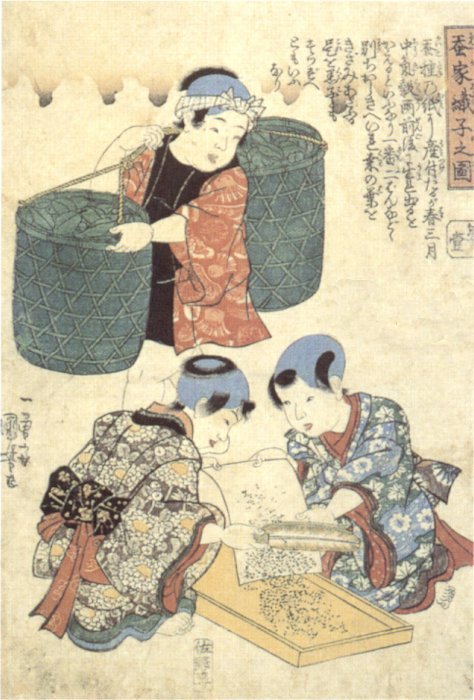
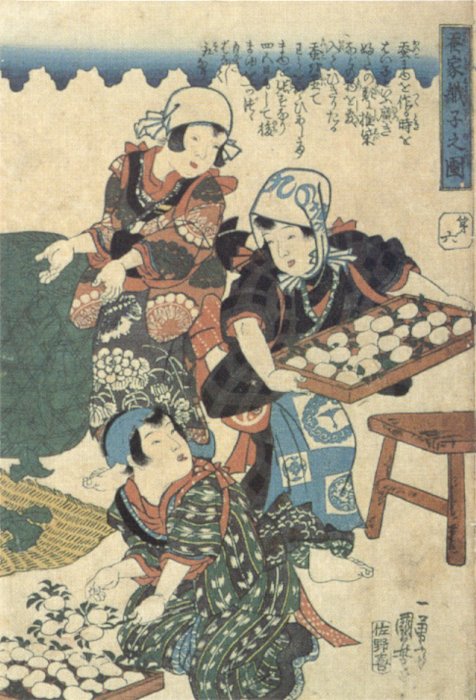
Wouldn’t it be funny to be thematic and hang an ukiyo-e series like this, Kuniyoshi’s Weavers’ Children in the Silkworm House, which depicts the entire process of making silk from start to finish?

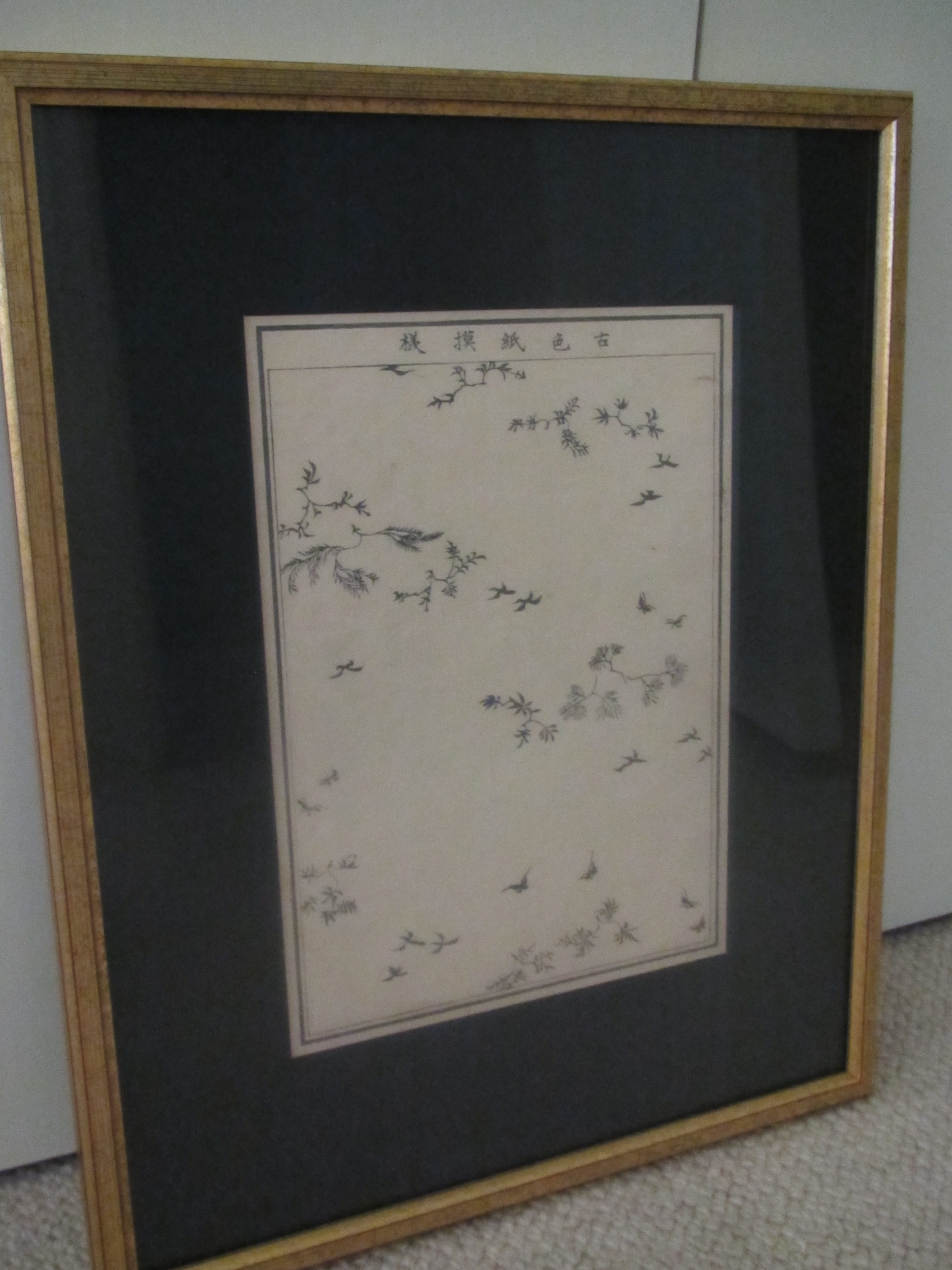
More likely to be this series of 19th century Japanese design plates we just had framed, although perhaps a little color might be nice, so on the other hand we might just save this group for the dining room.

The large rectangular tray got its own wall on the side.

Japanese silkworm trays aren’t commonly featured in Western interiors, in fact the only time I have seen one is in this photo below from an older Metropolitan Home that I featured in a previous post.

But the rectangular ones do remind me of another basket that has become very trendy to hang, in addition to the round African style winnowers above – the American tobacco basket. I feel like I had started seeing them in interiors regularly in the last two years, and now I feel I can’t turn around without noticing one hanging in living rooms with modern counterpoints like this one…

…and this one.

With neutrals…

… and pretty brights in a sunroom – you can see it peeking out of the left corner.

Even a recent post on Cote de Texas, on a completely different topic, managed to have a photo of an unexpected one in a rustic-luxe Mississippi kitchen.

The large size is quite commanding in an entryway.

Single large baskets also look great over beds in bedrooms and have the same advantage there as they do in Tokyo – lightweight if they fall down (although I have read that tobacco baskets are quite heavy).

I love this vignette with the vintage dress form, another favorite that I find in the markets here.  Hmm, might need to do a post on those soon.

And I stumbled across these two photos on Houzz from Katarina Tana Design featuring baskets by artist Jonathan Kline.

They make me wonder what my friend, artist Lisa George of Paper Glue Bamboo might do with some of the silk worm baskets we have been collecting for her.

And speaking of that, take a look at the ingenious way she does use one of her silkworm trays! Funkiest inspiration board ever!

And also sent in by friends, this photo of a round silkworm basket in the window of a shop out in the Hamptons selling for something like $250. Crazy!! If you are looking for any, just let me know by email. I have them all the time for a tiny fraction of the cost!

Related Posts:
Kawagoe Shrine Sale Never Disappoints
Artist Spotlight…Lisa George and the Modern Art of Ikkanbari at PaperGlueBamboo

Read Full Post »

This is one of those posts in which I could have based entirely on photographs of local collections but unfortunately, everyone’s movers worked way faster than expected and most of my anticipated photos got packed up! But everything in this post, while geared towards styling Japanese vintage and antique accessories holds true for just about anything from anywhere. But don’t expect this post to be exhaustive in topic or example. Obviously I could write ten posts about groupings of blue and white porcelain (just look at this month’s House Beautiful) or Japanese glass fishing floats (and I have in the past here, herehere and here for example) as well as some of the more unusual decorative objects we find regularly in Japan (kashigata, katagami, hagoita, come to mind). The focus of this post is really not what you are displaying, but how. I have a few simple “rules” to go by, nothing particularly original, but if you use these, your displays will be better.

One of my most basic rules is the rule of multiples. You can display a single item of a kind, like this Japanese basket perched above the drinks cabinet…

…but beyond that, with the exception of matched pairs, you need a group a similar objects placed together, like these amazing ikebana (flower arranging) baskets on the side board of an apartment designed by Emily Henderson for Michael Reisz on an episode of HGTV’s Secrets of a Stylist. Like objects should always be grouped tightly together, not placed around a space separate and unlinked from each other. I call this the “anti-pimple” rule of display.

Also demonstrated by these baskets is the rule of odd numbers, with the exception of matched pairs again (more on that later). If at a glance you can instantly count the number of objects in a grouping an odd number will always look better. I am sure there is some organic mathematical or mystical reason for this, depending on your personal perspective, but in this case just take my word for it.

The next rule is is that of varied elevation. If the baskets were just lined up on the sideboard, they would look nowhere near as good as they do with some placed higher on wooden boxes. Even their own variety of height would not achieve the same effect.

The rule of containment is to use a single decorative object such as a tray or bowl to corral another collection. We find these roughly hewn soba bowls at shrine sales all over Japan and they are great for holding collections of glass fishing floats…

…floats plus shells and souvenir rocks (love this idea!)…

…or how about hard to store baseball paraphernalia?

Another rule demonstrated by these bowl displays is to use no more than 3 types of objects and ideally either 1 or 3 (odd numbers again). The grouping of all floats is cohesive, the combo of floats, shells and rocks is cohesive, and the mitts and balls work even though there are only two types of items because one of the mitts is very dark in color and reads as a third type of item. If you put too many kinds of items in the bowl, then it will just look like a bunch of junk.

Here Lauren Liess of Pure Style Home uses her bowl to hold magazines. Isn’t it amazing how attractive even the most mundane items can be when displayed correctly?

Another favorite local collectible I have not yet written about is kokeshi dolls, the simple armless painted wooden dolls which originated in northern Japan, but are now made and sold all over the country. Vintage examples from the last 100 years or so of different varieties are a shrine sale staple. They are charming, and easy to collect.

While cute, it is important to give enough gravitas to their display to keep them from looking insignificant. This grouping is crowded by the other unrelated objects on display…

…in comparison to this grouping, where the dolls have space to breathe and coordinate with the other objects nearby. This collector has also chosen to use the rule of strict palette/shape/style to limit which colors and types she buys to create cohesion through the simple black and red paint, while using a variety of heights to create dynamism in the vignette.

This shelf effectively boxes the collection much in the way the soba bowls did above. The enclosure helps to unify the variety of dolls collected.

And here the kokeshi have been literally “boxed” to create cohesion from their variety. Note this display follows the rule of odd numbers and the rule of varied elevation in a vertical format. I do love these cute washi (Japanese paper) lined boxes – they remind me of this and this. And if you are interested in making these there is a DIY tutorial on Poppy Talk too!

Here we have a beautiful grouping of antique iron teapots, but the collection is not yet complete. Imagine this grouping if you either added one or took one away. Imagine if all the teapots sat at the same height instead of having one raised. The plan for the fifth teapot to complete this vignette is for it to be a larger fairly horizontally volumed one. Perhaps another small kettle stand with shorter legs than the one pictured will also be added.

Summer calls, but I owe you some follow up posts on rule-breaking display, because if there are rules, they must be broken, as well one on matched pairs, which have their own display rules. Watch for upcoming related posts on a basket wall installation I did in Tokyo right before leaving for the summer and in contrast, some tiny decorative items that ingenious friends are putting to good use.

Related Posts:
Vignette Arranging With Shrine Sale Goodies at the Beach House
Ways to Display…Porcelain on Brackets
Mirror, Mirror on the Wall…Vintage Etched and Engraved Plateaus
En Masse…Iron Teapots, Vincente Wolf and the Art of Grouped Displays

Image credits: 1. Cottage Living via Bryn Alexandra, 2-3. via Emily Henderson, photo credit: Mark Champion, 4, 9 & 12. me, 5-6. M. Small, 7. via Pure Style Home, 8. Wendy Withers via Apartment Therapy, photo credit: Bethany Nauert, 10. via Decor Allure, 11. Janis Nicoay via Poppy Talk.

Read Full Post »

Do you like your karakusa hot?

Or cool blue and white?

Your darumas bright?

Or modeled by the chef dressed in white?

Artist Lisa George of PaperGlueBamboo is having a sale this week of her new Spring 2012 line. For an extensive post about her modern take on the ancient craft of ikkanbari, take a look at Artist Spotlight…Lisa George and the Modern Art of Ikkanbari at PaperGlueBamboo. Her Tsukiji market shopping baskets would be great for toting stuff to the beach or having a summer picnic. Drop me a note at jacquelinewein[at]yahoo.com if you are interested in an invitation.

All this talk of baskets and ikkanbari has caused me to have an epiphany about a possible solution to the ceiling fan light at the beach house that I mentioned just the other day. Ceiling fans can be a necessary eyesore and I had been scouting ideas on improving them, finding posts over at Young House Love and Thrifty Decor Chick where they added a lampshade to give a fan light more style.

Those photos clicked in my memory with this photo from Kawagoe shrine sale last year in which a dealer had hung a basket upside down for eye level display. Even at the time it reminded me of a lampshade, but I didn’t put it all together.

Here’s another similar Japanese open-work basket, narrower and deeper than the one above, shown upside down to mimic a lampshade. It might just make a perfect lampshade for the ceiling fan, adding a bit of softening to the bright light and accessorizing the room. The basket has a great beachy feel too!

And if the open-work of the basket doesn’t camouflage the light bulbs well enough, we could always wrap it with a bit of washi paper ikkanbari style like this one…

George, are you listening?

Related Posts:
Artist Spotlight…Lisa George and the Modern Art of Ikkanbari at PaperGlueBamboo
Sweating the Details…A Round-Up of Brass Library Wall Sconces

Image credits: 1-4. Lisa George, 5. via Young House Love, 6-7. me, 8. via Lamps Plus

Read Full Post »

Thursday was the 28th of the month which means that it is time for the Kawagoe shrine sale. We have had a lot of rainy 28ths lately, so it was lovely to wake to a warm sunshiny day.  I went with every intention of not buying anything (ha!), which of course proved to be an impossible task. The market felt a bit quieter than usual, but there were plenty of Tokyo folks there.

The theme of the day was clearly baskets…

I was dying for these amazing huge winnower baskets, imaging them hung on a wall in the den of a country house. I know I’ve seen a recent photo of a similar basket display, but can’t remember where. When I do, I’ll add it in here.

Addendum: I didn’t find the photo I was thinking of, but I did find this one with a symmetrical display of Vietnamese fishing hats…

and this one from The Bootstrap Project (more on that in a later post) of handmade Zambian baskets displayed asymetrically.

These baskets would be perfect in a bathroom with one closed holding extra toilet paper and the other open with extra towels.

I didn’t buy any baskets, having just found this one last week. It is just perfect for holding magazines.

But there were some things I couldn’t resist…

I have a weakness for Japanese bellflowers, so this katagami stencil came home with me.

A couple of Tokyo friends got lucky and bought big Japanese fishing floats from this dealer. I got a bunch of small rolling pin or roller floats, all slightly different in shape and size, but roughly around five inches long. I figure I can’t get my big floats back to the US anytime soon, but a handful of these in a basket in the bathroom might do!

Speaking of the bathroom, I thought this kashigata looked like a sand dollar and a starfish and would be perfect to display alongside the bowls of the real things collected by the girls.

Gorgeous shape and color, but it was the glass screw top that sold me!

Is it a stool or a table? Either! This was my favorite find of the day.

Remember this post from a couple of days ago? Patina over perfection…antiques with flaws can be very affordable. I didn’t need this big Seto pot, but it was a lovely one, fishbowl style with a finished and glazed interior. At first glance a 30,000yen (about $300) piece…

…at second glance, this repair brought the price down to 10% of that.  For 3000yen ($30) it came home with me.

Friends scored big time too. The sake jug on the left came home with M, as her birthday present. I was so happy to find it after another friend got the one on the right last October.

M got this amazing roof tile cap from Nagano too.

And these 3 smaller inban hibachi (transfer printed charcoal brazier), probably from tobacco sets.

Another friend bought these gorgeous late-Edo period covered bowls. I want to research the unusual painted pattern as I know I have seen it in a museum collection somewhere.  Just so modern!

We finished with our usual post-antiquing repast. Indian food! Their keema curry is super-delish!

Read Full Post »

While not quite on par with Dixie Highway, relaxed Nishi-Ogikubo in Tokyo’s western suburbs has a grouping of 60+ antique and vintage shops gathered near the train station. Situated along the Chuo line, Nishi-Ogikubo (nicknamed Nishiogi) was a counterculture hotbed in the 1960s, then receded from notice, only to become popular in recent years as the “slow life” movement has gained steam in Japan. It seems like just the kind of place one would find a collection of quirky and individualistic antique shops.

Conveniently, a free map of the stores is available right in front of the koban (police box) on the left side of the station right outside the North Exit. The map seems fairly current but things can change overnight, so think of it only as a basic guide. Most stores do not open before 12p.m., they all seem to have variable hit-or-miss opening days, and there is not much spoken English to be had, but it is a lovely way to while away an afternoon. Hopefully this post will help steer you in the direction of the best shops!

Organized into four zones, NE, NW, SE and SW on the map, I’ll say right off the bat that the South side of the station has much less to offer than the North side, and can be skipped entirely when pressed for time. The NW zone is by far the best for traditional antiques, so I will start the tour headed in that direction, counter-clockwise around the rough rectangle the walking tour makes.  The shops are numbered numerically on the listing pages, but do not always appear in numeric order on the map.

Actually the first few shops don’t even seem to be listed on the map. After peeking in grape, a small but charming vintage kimono shop with two other locations in the area, our first stop is not Japanese at all. Filled to the brim with lanterns, poufs, silvered mirrors and embroidered slippers, Morocco Marché is one-stop shopping for adding a bit of middle-eastern flair to your decor.

Weaving up and down the small side streets along the main road, we pass a few small shops, including Baby Doll (#60), which is not open, but full of antique and vintage toys and dolls. Moving back towards the main road we come to Les Yeux Noirs (#42), the unquestionable star of the tour, deserving its own individual post (coming tomorrow). Owner Haruko Hasegawa has one of the best eyes I have seen for choosing unusual and rare pieces of porcelain. We were very excited and spent a long time (and quite a bit of money) in her shop. If you are interested in porcelain, this is one of the main attractions and it is well worth the train ride for this store alone.

As we continue along the main road we pass mood (#45), full of groovy 60′s looking used goods. We try to stop into Quilt & Old Textiles (#44) way hidden in a back lane, but they are closed – perhaps to go to the Tokyo International Great Quilt Festival. At the turn in the main road, we come to Kido Airku (#59), a great mixed shop full of smaller tansu, porcelain, textiles and odd and ends. Unusual things there include vintage spool threads, great for using as plant stands or display props. A collection of old iron tea kettles looks great on these.

Some modern shibori dyed textiles.

One of the most interesting finds for me personally were wood blocks, used to print patterns on textiles. I have been scouring eBay for Indian wood blocks for a DIY project I am planning this summer, but hadn’t considered using Japanese ones.  Frankly, I hadn’t realized that in addition to all the stencils, tie-dying and resist techniques used here, that wood blocks are too.  Definitely something to look into more.

Numbers 48,49 and 54 were all the same named shop, Antiques Jikoh, with mainly used modern furniture. The branch at the #49 location was full of heavy oak Victorian and Arts & Crafts era furniture.

My friend H spotted a gorgeous blue and white porcelain “umbrella stand” that she loved there. I was so sorry to have to let her know it was actually a late 19th century urinal. Needless to say, she could not look past its original use.

The next two shops were eureka! moments for me. I have been searching for the perfect vintage milk glass ceiling fixture for the bathroom in the beach house, passing up many individual pieces at shrine sales. Imagine my delight at stumbling across the Teardrop Club (#53). I’ll be dragging my patient husband back there soon. If you too are interested, please note they are open 12-6 and not on Wednesday. More photos here and here.

Rakuda (#51) which means camel, also had numerous vintage light fixtures in addition to ranma (transom) panels, old doors, stained glass and cut glass…

Turning the corner right after Rakuda completes the NW zone. The tour continues east, crossing a small river. Other than the charming Le Midi (#37) full of imports from the South of France, not much else was open. Any visit to Nishi-Ogikubo comes with that risk.

Continuing to the next major intersection the tour turns right to head south back to the station. Most of the shops along this NE section seem to specialize in vintage clothing and used goods. Perhaps because we were getting hungry, they didn’t hold our attention. In the grand tradition of antiquing outside of Tokyo, we ate Indian food for lunch at Ganesha Ghar, right near #31 and the bridge over the river on the map. As would be expected, it was packed! And following shortly thereafter was Amy’s Bakeshop, which billed itself as “NY Style Sweets & Things”. Of course we had to stop!

If you arrive hungry, it might be easiest to head the opposite direction (clockwise from the station) and eat first as shops don’t open until lunch time or afterwards.

We skimmed the shops listed on the map on the South side, but many were closed, perhaps permanently. None stood out this visit but perhaps they merit a second chance.

Nishi-Ogikubo is very easy to get to and quite close to central Tokyo. It is only 16 minutes from Shinjuku and 18 minutes from Yoyogi on the Sobu Chuo line. Taking the Toei Oedo line from Azabu Juban and changing at Yoyogi took a total of 32 minutes. I’d love to hear from anyone who goes, especially if you discover a gem I haven’t mentioned. Happy hunting!

Read Full Post »

Ikkanbari (literally, idly pasting) is the ancient Japanese art of recycling worn out baskets by wrapping them in washi (handmade paper), coating them in nori (rice glue) and sealing them with kakishibu (persimmon juice) for a waterproof finish. Original old baskets are hard to come by, as they were not preserved as precious art objects, but here is an antique example from Sri Gallery.

Artist Lisa George of PaperGlueBamboo (known permanently to all as George as the result of years of British boarding school)  has created a modern version of this venerable craft for the past 10 years. Using new bamboo baskets, hand-made unryushi (mulberry paper) and mingeishi (sugar paper) along with non-toxic glue and a low VOC varnish, she is custom making beautiful ikkanbari for modern interiors. Each season she creates a number of limited edition designs, hand tearing paper in shapes and motifs to decorate her pieces. Her inspiration is taken from Japanese textiles and items which she combines with a Western color palette. She is also inspired by the joy of the changing seasons, which is such an integral part of the Japanese outlook on life.

Items include kitchenwares such as bowls and platters, desk sets with trays, pencil holders and wastebins, small boxes and traditional shape baskets to hold everything from extra change on the nightable to rolled wash cloths in the bathroom. Items are finished in a clear varnish, giving them a durable finish. They may be cleaned with a hot damp cloth and then be left to air dry.

The photo gallery below has a wide range of designs from past seasons. The pictures don’t begin to show the handmade tactile quality of the pieces.

George is most famous for her shopping baskets, which take traditional Tsukiji fish market handled bamboo baskets and turn them into the chicest handbag, picnic basket, diaper bag, carry-on (they fit in the overhead compartment) or magazine rack around. After wrapping the exterior in traditional tenugui (cotton fabric), she hand paints a design on the outside.  Interiors are lined in paper, much like the ikkanbari pieces and decorated with hand-torn motifs and then sealed.

Unlike the brightly colored, more abstract patterns above, these shoppers have distinctly Japanese motifs and themes. Some are new designs this season.

In addition, George creates large-scale paper “paintings” on boards and canvas called chigiri-e.  Like ikkanbari, chigiri-e is an ancient Japanese art with the word chigiru meaning “tear” and e meaning “picture”. Traditional chigiri-e tends to be landscapes or still lifes, but George’s style is more whimsical and abstract. Technically, it is closer to collage or decoupage using hand colored papers that she has carefully torn into images and designs. She is always happy to discuss commissions.

So, the scoop on how to get some PaperGlueBamboo into your home?  George is currently living in Carmel, California, so US orders are easy. You can contact her via the PaperGlueBamboo Facebook page and you can find more information on her technique and materials as well as additional photos. She will also be posting the new Spring line there shortly. George will be back in Japan for a big show and sale in April and is currently taking pre-orders for delivery then. If you want to be on the invitation list for the sale (and have never received an invitation before) just drop me a note. Her Etsy shop is empty right now, but should be up and running soon (if we all keep poking her about it).

My new lilac ume (plum blossom) shopper (and a Christmas gift, I must disclose) is sitting under a table in New Jersey at the beach, just waiting to be filled with magazines…

All photos courtesy of Lisa George, except image 1 from Sri Gallery and the final image from me.

Read Full Post »


For me, there are two perfect kinds of antique stores.  The first is a carefully curated small shop, while the second is a large unorganized warehouse that you have to search through.  Mizue Sasa’s Okura Oriental Art is the former and it is a jewel – my favorite in central Tokyo.  She and her husband Yasuhiro Shimizu are celebrating their 10th anniversary of owning Okura this year.

In addition to wonderful tansu and porcelain, Sasa-san has a great mix of hard to find items such as altar candlesticks…

antique maps of Tokyo and Japan, both framed and unframed…

ikebana baskets…

and lanterns.

She is also the only dealer I have found who carries traditional copper rain chains, which are the “gutters” of Japan. These are not antique, but they patinate quickly and easily. An amazing sayonara or housewarming gift!

Sasa-san’s pick? This Meiji period tai (sea bream) jizaikagi yokogi (decoration on hanging hearth pole) is a great piece of folk art. Used over a traditional irori (open sunken hearth) it held the kettle above the flame.

My current pick? This hard to find small size step tansu. Often they are very large and very deep and can be impractical if you don’t have the perfect space.

Sasa-san has a fully detailed on-line catalogue and a loyal customer base that visits often from around the world. She handles on-line sales easily, speaks English and ships just about anywhere. She also has a decorating site with staged rooms – you can purchase a whole look if you like or just browse for ideas. Sasa-san will also help her customers arrange their items and improve their decorating in their home. She is not afraid to tell clients to get rid of stuff (which is unusual here). She will also track down specific items for you – just give her dimensions or good descriptions.

I love the juxtaposition of the poured concrete wall with the tansu and the giant porcelain plate that she shows in the photo below. Sasa-san is interested in mixing antiques with modern furniture, a trend that is just getting off the ground here in Japan.

Here she stages vintage blue and white in the bathroom.

The shop is full of great gifts for the holidays!

Image credits: All shop photos taken by me, courtesy of Okura. Decorating photos by Mizue Sasa.

Okura Oriental Art

Read Full Post »

I am often asked for suggestions on buying antiques in Tokyo, so this is the first in a series called “Shop Talk”. One of my favorite antique shops, Kanarusha in Fuchu (near the American School) is the perfect mix of a beautifully arranged store with a dusty but treasure filled backroom and attic, providing the best of both worlds.  There are items for the immediate gratification folks to take home on the spot and lots to dig through for those who love to make their own discoveries. To clear up a bit of confusion on the name, Akariya is the name of the parent company and also of their high-end shop in the Yoyogi area, while this store is actually called Kanarusha. Rarely do I stop by the more polished shop in Yoyogi, preferring instead the more casual warehouse-style store. Drop in and let Ohashi-san and his staff help you chose just the right piece for your home.

Inside is a treasure trove of objects…

Tansu of every style and region…

An unusual golden mizuya (kitchen) tansu…

In the back rooms, there are shelves filled with everything imaginable, including these ikebana (flower arranging) baskets…

These shelves have iron lanterns, inlaid hibachi (small charcoal heaters) and vintage milk glass fixtures…

Speaking of hibachi, they have this gorgeous imperial lacquer one…

They also have a number of beautiful byobu (screens) including this unusual two-panel made of fabric using a wax resist dye technique and adorned with embroidered details. I think William Morris would have loved this piece.

Here’s a close-up of the detail on the spider web and thistles…

Cranes are lucky and represent long life in Japanese art. This 1930s copper vase inlaid with silver cranes is signed by the artist.  Frankly, Art Deco pieces can be rarer than 19th century ones.

Ohashi-san’s pick? This extraordinary choba tansu (merchants chest) from Yonazawa Prefecture made of solid keyaki wood.  The gorgeous burl wood has its original finish in dreamy condition. Inside is a shelf and small compartments.

My pick? It has to go to this amazing Meiji period mizuya tansu from the Biwa Lake region near Kyoto.  It is super long – a full 105 inches – and the staff have only ever seen one other like it in 30 years of antique dealing.  I can just imagine it lining a long wall of a kitchen instead of cabinets. Talk about a room-making piece of furniture.

In addition to the items mentioned above, Akariya specializes in antique doors and ranma transom panels, which can be customzied and used in new construction (building a house anyone?)

A few more great things about Kanarusha…They have their own workshop for repairs and customizations and their restoration is always sympathetic and natural.  They are also happy to work with international customers over email with photos and they will ship around the world.

The big news is that Kanarusha is having its big annual Autumn Sale next weekend from Saturday, October 30 – Wednesday, November 3. Everything is 20-35% off the already reasonable prices.  The shop is open 10a.m. – 7p.m. (an hour later than usual).

The really big news is that Tokyo Jinja readers can start shopping at sale prices now!! Just stop in between now and Wednesday, October 27 (Kanarusha is closed for set up on Thursday and Friday) and mention the blog and you can have first pick before the big sale starts. You may have to wade through as things are not fully set up for the sale, but isn’t that the best kind of antique shopping anyway?

Interested in tansu? You might want to read my post from last month “What’s Cooking? Tansu in the Kitchen”.

Driving directions from Tokyo: Take Shuto #4 (Chuo Expressway) to the Chofu exit and head towards Fuchu after the toll as if going to ASIJ. Pass the turn at Ajinimoto Stadium and keep going straight on Route 20 for 2 km. There will be a rise in the road (bridge over the train tracks) and at the next light called Shiraitodai Police Box intersection (Family Mart is on the right hand corner) take a right. Kanarusha is immediately on your left. Parking is available.

Image credits: All courtesy of Kanarusha and taken either by me or Ohashi-san.

Akariya Kanarusha

Read Full Post »

“Any fragments from the past, especially those that you can touch, connect you to the makers of those pieces, making you aware that we are threads in a great tapestry of time.”
John Saladino

Often referred to as the “designer’s designer”, John Saladino has been at the absolute top of the design field for over 30 years. He works not only as an interior designer but also as an architectural designer, landscape designer, and in this case, as a curator as well. This June 1998 House & Garden spread features the Colorado home of a couple with an extraordinary collection of antiques and art. Making sense of such a disparate group of items is something that only a master could achieve. Interspersed among the Greek, Roman and Egyptian antiquities are numerous Japanese antiques of all types.  I would be hard pressed to imagine more than one antique screen (byobu) in a house; somehow he manages to integrate three.  In testament to Saladino’s triumph, it feels neither like the hodgepodge of an antique store nor has the sterility of a museum, but rather a peaceful and lovely home.

The coffee table boasts a grouping of  bamboo letter boxes and what looks to be a bronze hibachi on the raised fireplace hearth.

The dining room/living room has a treasure trove of objects – the first of at least 3 byobu (screens) in the house on the back left hand wall, a kimono rack with an extraordinary brocade (or perhaps embroidered) robe up on the stair landing, a bowl-shaped bamboo ikebana basket between the columns and a rare lacquered trunk in the foreground.

This 17th century antique screen is coupled with an art deco Ruhlman chair, an Italian chest and a Roman bronze head.

Another view of the living room reveals that amazing lacquered trunk, a pair of bronze altar candlesticks and the third screen. The maki-e work on the trunk is covered in symmetrical circular designs called mon or kamon, circular crests used to identify a family, much like a European heraldic coat of arms. For instance, the kamon of the imperial family is the circular chrysanthemum and it’s use by others was prohibited.  Gradually mon became used by commoners and then later on as logos for merchants and products. The use of mon as a decorative device can be seen in lacquerware, porcelain and textiles and is one of my favorites. Looking for your own mon? This site has a full dictionary of them.  

The serene bedroom has a pair of  highly ornamental 18th altar tables being used as small side tables. Definitely use a coaster!

Can you date these rooms without looking back at the beginning of the post? Most likely not, as in addition to their extraordinary beauty, they are also timeless and will never look dated. For me, this agelessness is one of Saladino’s strengths. Another is that his spaces are places in which modernists, traditionalists, classicists, and the like can all agree.

Interested in seeing more? I recommend his books; Villa, which chronicles the renovation and restoration of his elegant 1920s California villa and Style, in which he reveals his design secrets.

Image credits: all from House & Garden, June 1998, Photographed by William Waldron

Read Full Post »

Follow

Get every new post delivered to your Inbox.

Join 406 other followers

%d bloggers like this: