Feeds:
Posts
Comments

Posts Tagged ‘antiques’

I just got back from two quick but wonderful days in Kyoto, traveling with two dear like-minded friends.  We were worried it would be bare in winter, but in the absence of cherry blossoms or fall foliage, Kyoto was a study in green.

Green moss in gardens…

IMG_1260

…and temples everywhere.

IMG_1261

We were utterly and completely captivated by our subway car which felt straight out of the 1940s.  Mint green walls and deeper green velvet upholstery…

IMG_1268

…and even the silvery fretwork on the vents below.  How long would this fabric last in New York City?

IMG_1334

Day two changed hues as we spent most of it exploring the Fushimi Inari shrine and its thousands upon thousand of orange torii gates, each donated by Japanese businesses.

IMG_1309

Walking through the roughly two miles of gates was an extraordinary experience and the jolt of color against the winter landscape was intense.

IMG_1310

Later in the day green and orange joined together in some fretwork at Kiyomizu-dera, perched majestically at the edge of the mountains.

IMG_1311

Good luck offerings were everywhere, from the traditional kitsune (fox) messengers a the Inari shrine…

IMG_1305

…to garlands of rainbow origami cranes.

IMG_1312

Our hotel was most conveniently located in Gion, right along Shinmonzen Street, the main antiques drag of Kyoto.  Imagine that?! As we shopped, our color palette turned to blue from all the porcelain we were seeing, particularly at a shop I believe is called Akando, run by a darling older couple…

IMG_1321

…the proprietor having his likeness on their adorable business card.

IMG_1338

My friend almost bought these amazing Nabeshima dishes, but when we did the math they were well over $400.

IMG_1342

The other shop we spent serious time in I recall from my last trip. R. Kita Old Imari & Kutani has been in its location for over 70 years. They had me at the sign alone.

IMG_1327

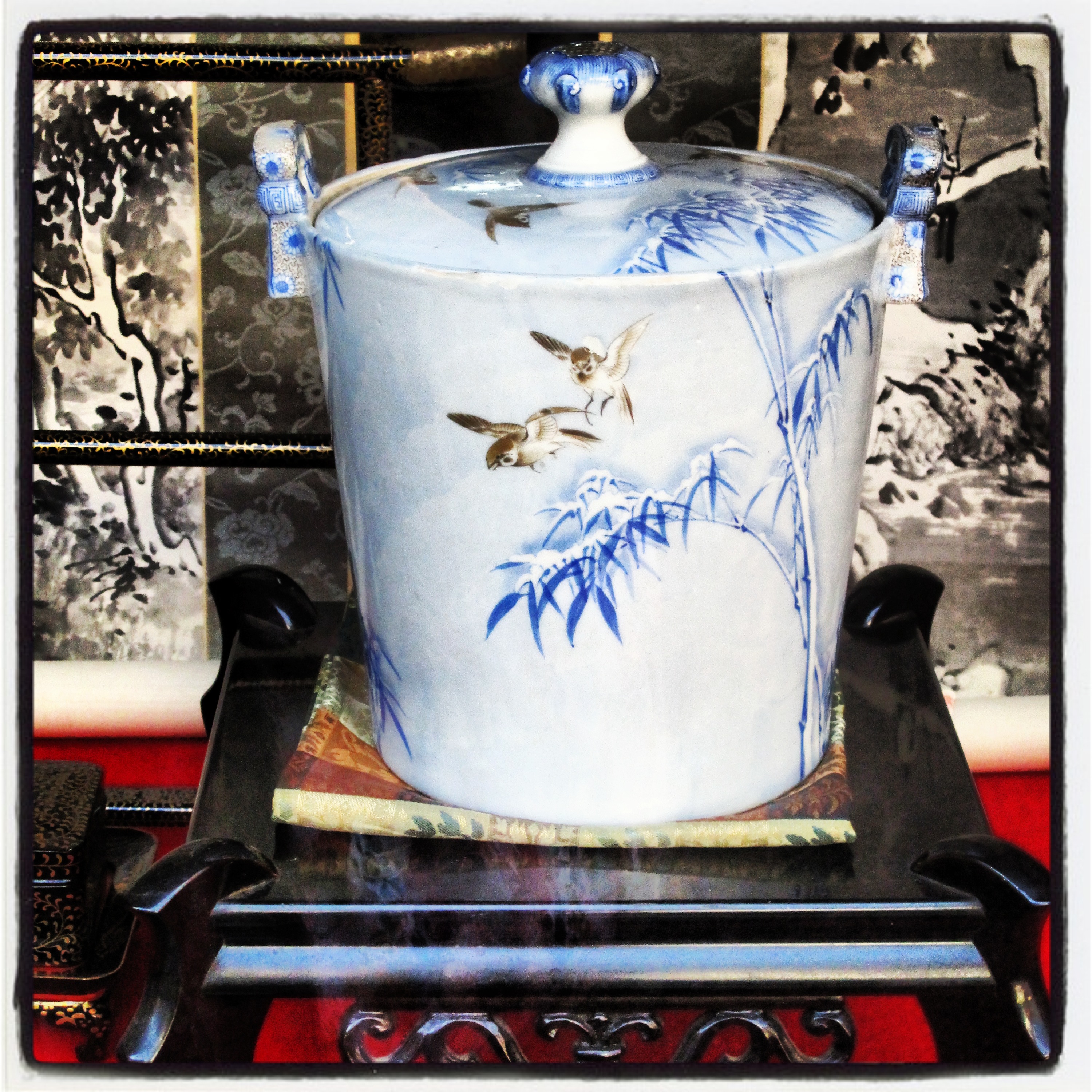
In the window was this amazing 19th century Seto porcelain ice bucket, clearly made for the export market. It was the only Seto piece to be had amidst all the Old Imari & Kutani and I really wanted it. Unfortunately, it was a cool 1000 bucks.

IMG_1328

In general all the porcelain and other antiques were extremely expensive. Prices were way higher than in Tokyo and way way way higher than at the shrine sales. That is exactly what I remembered from previous visits.

IMG_1329

So once again, I looked – in this case instagrammed – and didn’t really buy.

IMG_1323

We did better in the soft goods department and my friend Maja of Alegria Design bought some lovely pieces of indigo kasuri to make bolster pillows. I’ve got kasuri on the brain these days, and you’ll see why quite soon as the ASIJ Gala quilt is almost complete!

kasuri

I managed to pick up a very unusually colored plum piece of kasuri.  I am nothing if not predictable! And at a year and a half out, it is starting to seem as if I will never be getting my lampshades from the custom vendor I ordered them from, so perhaps I might use this in another attempt elsewhere or a DIY!

IMG_1320

Gold was also one of the colors of the trip, as you can see from this lucky sun shot in the late afternoon at Kinkaku-ji, the Golden Pavillion.  A piece of Kyoto advice – always go there late in the day so that the sun is setting in front of the building if you want the lighting to be just right.

IMG_1258

One hidden gem we hit was the house and garden Murin-an near Nanzen-ji. Built just before the turn of the century it had that wonderful Anglo-Japan mix that I adore. The wall murals painted in the sitting room were just divine and the garden was a perfect oasis of peace and quiet in the bustling city.

IMG_1333

The Hotel Mume where we stayed was charming, in particular the sudare canopied bed area.

IMG_1335

The vending machines were particularly creative in Kyoto – Cup of Noodles anyone?

IMG_1259

That reminded me of the really interesting exhibit currently running in the Frederick Harris Gallery at the Tokyo American Club. A riff on Hokusai’s Thirty-Six View of Mt. Fuji, Peter MacMillan’s witty prints are well worth a viewing. If you are in Tokyo, it runs until February 24. If you are not, more of them can be found in my Instagram stream.

IMG_1219

And finally to wind down, a bit of black and white. It is quite common for ordinary folk to go to Kyoto and rent kimono for the day along with hair and make-up services.  These girls were not geisha (or maiko and geiko as they are called in Kyoto) but instead just having fun. You’d think they would look better in color, but it took away from their expressions.

kimonogirls

And the most modern white of all? That streamlined shinkansen, pulling in to take us home.

shinkansen

About these ads

Read Full Post »

IMG_3147

IMG_3158On Bergen Street between Smith and Court Streets, hidden up a few stairs and behind a nondescript door, lies one of my favorite Brooklyn antique shops, Fork + Pencil. It is not the flagship location – which is right around the corner on Court Street – instead it is the newer warehouse store, focusing on furniture and artwork. And theoretically, it is not actually an antiques shop, but officially a consignment shop. The mix is eclectic, but there is always something interesting to be found. What makes the place special is the owner Alex and its mission – all profits after expenses go to charity. While this is good unto itself, I think it creates a unique shopping experience and better quality merchandise gets consigned there – people like to see their goods doing good.

The main floor is always a mix of large items with accessory displays covering every horizontal surface, artwork and mirrors on all the walls and chandeliers hanging everywhere. Eras and styles are all jumbled together in a highly enjoyable smorgasbord.

fork and pencil 1

Intriguing arched shelving unit mounted on a console table.

photo

Mid-century mixes with colonial.

fork and pencil 2

Such a variety of lamps, like the pottery one above and this book stack one below…

stack of books lamp

…and this nicely miss-matched pair of cobalt bottles can be found everywhere.

cobalt blue glass bottle lamps

One of F + P’s specialties is porcelain and pottery. Lots of Staffordshire, Asian ceramics, like the big Imari bowl here, lustreware, Sevres and other French porcelain, and the list goes on.

fork and pencil imari

A favorite find is this giant polychrome transferware bowl. Birds and blossoms in the same place!

IMG_0575

Their other great strength is art – etchings, engravings and all kinds of small works on paper, priced so well as to be worth more even than just their frames.

fork and pencil rose

Loved these antique carriage prints. Very Georgette Heyer!

photo

The basement is more of an adventure than the upstairs and usually looks something like this, but there are always treasures to be unearthed with a little effort.

fork and pencil basement

photo

A case in point – it doesn’t get better than this – a George Smith standard armchair found nestled in a back corner…

IMG_3154

…and now nestling right here. Fresh from a Southampton estate, that chair lists for somewhere in the $6000 range new and even on sale rings up around $4000. Planning to re-cover it, but for now it looks great.

IMG_0868

The artwork finds have been outstanding, including this Brooklyn view with its charming French mat and the small Chinese gouache below.

IMG_0573

And an art triple play over just 2 visits yielded these…

photo

…and this…

photo

…and these…

photo

…which mixed with this new offering from Dash & Albert, the Garden Path runner, and some beautiful antique lace curtains, has created an instantly decorated laundry room for about $500.

Garden Path Dash Albert hooked rug

There is a nice article about Alex and the founding of the stores in the South Brooklyn Post. And the original store around the corner is well worth checking out – many of the valuable “smalls” end up there.

Fork + Pencil
Warehouse: 18 Bergen Street
Main Store: 221a Court Street
Brooklyn New York 11201
718 488 8855  |  info@forkandpencil.com
Tuesday – Sunday 11 – 7

Read Full Post »

Today was a crisp and very cold day at the Oedo market at the International Forum, but as usual there was lots to see and plenty to buy. I have been wanting to find a way to start sharing what I am seeing at the markets every week, but when there isn’t a theme or cohesive feeling about the merchandise I find it fairly boring to post about. I have been thinking that real-time photos of what I am buying, both for myself and for sale, might be more fun and more interesting for both me and for my readers. So as of today, my plans are to start instagramming (is that a verb yet?) while I am out and about at shrine sales and antique shows. So if you would like to keep up with me, you can follow me on Instagram on your mobile device here.

One of the fun parts of Instagram if you haven’t tried it is playing with the filters and the framing to add special effects to your photos. Typical me, I like all the filters that give an aged feel…

IMG_0993

…and I am a sucker for those old-fashioned photo borders…

IMG_0994

…or burned edges.

IMG_0996

I already made a faux pas in editing this photo down so that it didn’t fit the Instagram format.  Won’t make that mistake again.

IMG_0997

The photos have the perfect format for a blog post – a nice big square. There is also a very effective exposure button, used to fun effect here.

IMG_0998

This art deco mirror glows like a jewel using one of the filters.

IMG_0999

Kasuri kimonos seem lit from within.

IMG_1001

As usual Oedo was full of European goods, these lace patterns being some of my favorites.

IMG_1002

No lack of British goods either. This collection rivals any I’ve seen in English antique shops.

IMG_1003

Couldn’t resist these door knockers – just for Steve at An Urban Cottage.

IMG_1004

And you know you want it…If you see items you want to buy, just let me know via email.

IMG_1005

I made a couple of wonderful scores for myself, including this handmade folksy heart chair. It has a beautiful grey-blue wash paint and is soooo much prettier than it looks in this photo – the only find of the day that the Instagram filters failed to enhance.

IMG_0992

I know just where this sweet little baby is going to go…

beach house living room

I have also been finding the most irresistible and inexpensive art lately which deserves a post of its own. But this little oval print (nothing better than a few art pieces with circles or ovals to break up a lot of rectangles) is headed to my youngest daughter’s room at the beach…

IMG_0995

…along with this chiyogami you may remember from here. She begged me to hold it back for her from the sale so I did.

chiyogami 5

Won’t they look so sweet in here?

miss p beach bedroom

I am going to try to add the Instagram button to my sidebar, probably right below the Pinterest one. But I am including the link here again, in case I am not successful.

Related Posts:
Like La Brocante…French Day at Oedo Antiques Fair
Paper for a Thousand Years…Vintage Chiyogami

Read Full Post »

I think it has been more than a year ago at least that I promised to do a full shopping guide to the vintage and antique stores in the Meguro neighborhood of Tokyo. Commonly referred to as Interior-dori, it stretches along both sides of Meguro-dori (dori meaning street), south-west of the Meguro train station from just past Yamate-dori, all the way down to the central post office. After my last post mentioning the lack of furniture available here, I got a few kind complaints as to the truth of that statement and thought it time to fully investigate and report on this unusual cluster of stores. These adhere to that “car dealership synchronicity” adage I have talked about elsewhere (here and here, for example) and numerous people, mostly couples, were browsing on the public holiday earlier this week. With a complete lack of parking and the train station a bit of a walk, the density of shops is needed to bring the public.

My tour starts at the intersection of Meguro-dori and Yamate-dori and heads along the south side of the street walking. I stop in at most of the shops on both sides, although there are a few I missed, so the list is not exhaustive.  There are also stores tucked away in the back streets near by, such as the lovely Found, but those are not on this tour. Many of the merchants are listed on the MISC (Meguro Interior Shops Community) webpage and the shopping map to the area that can be picked up at participating stores. Both for those really looking to furnish a home to those just looking for small gifts and Japanese styling, it is a fun outing.

While most of the stores are channeling that mid-century vibe or at the very least European shabby-chic, one of the first stores on the south side of the street is Chapter, featuring Japanese antiques.

One of their specialties is repurposing, so antique ranma (transom panels) are turned into consoles, dining tables and wall dividers. There is quite a collection of them at the back of the shop. They have great vintage milk glass fixtures too.

I thought this was ingenious – tucking a hard to use small tansu into a larger modern piece of furniture.

Brunch + SC was one of the first of five or six different Brunch outlets (Brunch Branch, Brunch Works, Brunch Time, etc.) all selling their modern versions of furniture inspired by the mid-century. You can see on their logo map below that they stretch all along the street and line both sides.

Each shop has their own particular pieces, but this photo gives a general sense of the style.  There was a western couple shopping here and the sizes of the furniture seemed normal and comfortable. Much of it is teak and order made. Really great chairs (think Wegner Wishbone) at these shops – and they are currently having a chair fest through September.

Brunch Branch nearby had charming garden items.

I had to go into chambre de nimes just based on that stacked luggage in the window.

Everything inside the shop seemed to be imported from France and the place had a real les puces vibe. This was the first of many places that also stocked vintage church pew chairs with a pocket in the back for prayer books. They are super popular here in Japan and I’ve seen them often elsewhere, particularly at the Penny Wise.

And the first, but not the last of the day, of the sewing machine base consoles. New Jersey to Japan – they are everywhere.

The next shop AMS seemed to be different owners on different floors, but the ground floor was full of vintage chandeliers and country-style antiques, including windsor, ladder back and the ubiquitous church chairs.

Next was Junks featuring all kinds of great vintage goods, mostly from the USA, including some favorites of mine such as wooden delivery boxes, printers drawers, old globes, authentic mid-century furniture…

…and this fabulous bottle drying rack for 39,800 yen ($509), which might seem expensive but…

…a similar one was for sale on OKL for the same price on the very same day.

And Becky at Buckets of Burlap just recently put her vintage zinc bottle dryer up for sale for $500.

Gallery S featured a combination of vintage and new furniture, but seemed to specialize in hats. Yes, hats. Love the wooden and painted iron desk and chairs on the right out front.

Tucked away upstairs across the small side street is Point No. 39 which looked promising just from the sign alone! And the word repair was quite intriguing as that is hard to find in Tokyo.

It did not disappoint, being stuffed full of great lighting, furniture and decorative pieces.

I loved the giant sunburst mirror. And by the way, it is also a bicycle store. Go figure!

File Home and Interior was full of gorgeous housewares and also boasted one of the prettiest kitchens I have ever seen in Japan.

Turns out there are a few more File shops across the street including one that actually designs and installs kitchens.

After File, things petered out and before reaching the big Meguro post office I decided it was time to cross to the north side of the street. Anchoring the end on the other side of the street is the giant four floor Geographica. The second floor is home to a charming Italian restaurant Il Levante where I stopped for lunch. There are not many choices for food along the main drag, so I recommend it for a rest or meal.

Geographica was stocked with English antiques – they even carry Sanderson’s line of William Morris Fabrics – and at times felt a bit like a gentlemen’s club. Lots of dark wood, bentwood chairs and framed engravings. One really useful thing they stocked was a full line of knobs and pulls and other hardware. And I love these brass train racks – how great would one of these be in a bathroom? They also have a Yokohama factory shop where they do their restorations.

Pour Annick had more of the golden wood mid-century inspired furniture as well as some fun quirky items.

What about one of these bright stools for the teen bedroom project I am working on?

Since the previous shop that involved climbing stairs was such a success, I made sure to go up to Blackboard.

I was rewarded with industrial chic and some real mid-century pieces.

The curated display of found objects was inspiring too. I forgot to check if they are actually for sale. Blackboard also had some great English language design books.

Roughly across the street from Junks on this side is their sister shop Moody’s full of more vintage furniture and lighting. Many of the pieces had big signs advertising their origins, whether it be Heywood-Wakefied or Eames. It felt like there might be a great find lurking in here.

Meister is one of the leading stores on the street carrying modern versions of those same mid-century design icons, including Nakashima style wood slab tables.

This Eames molded plastic rocker is available for order in a full range of colors and was about $650.

A new Eames rocker in the US is $549 at Herman Miller or Design Within Reach.

I didn’t go into Stanley, but just the idea that there might be somewhere to have custom upholstery, rehupolstery and slip covers made here in Tokyo was revolutionary. If anyone goes in to inquire about a project, I’d love to hear about it.

The De Mode shop felt the most American of all the shops, channeling the rough luxe thing. Check out those industrial light fixtures! They have Tolix style chair too. If you click into their website, they seem to have a number of other fabulous locations, including a warehouse. Definitely something to explore next!

I found it oddly reassuring to see that I can buy glass Ball jars here although I forgot to check the prices.

Lewis specializes in Danish modern.

And at the very end of the tour, almost back to Yamate-dori are three outlets of a recycle shop called Sone Chika. Japanese recycle shops are akin to thrift stores in America and are hit and miss like you would expect. There are definitely finds to be made, although no luck for me that day.

Most of the stores are open from 11am until about 8pm and Wednesday seems to be the closure day for the area. You might want to call ahead if you are interested in a particular spot. Be sure to click the Shop Talk tab in the category list on the right side of the blog for more store reviews and neighborhood strolls.

Related Posts:
On Dumbwaiters and Butler’s Trolleys…Non-Japanese Antiques in Tokyo at The Penny Wise and Found
Shop Talk…Discovering Antique Treasures in Nishi-Ogikubo

Read Full Post »

My last post finished up with a comment on charming vignettes of objects with handles, but as I lay in bed last night I kept feeling I had forgotten something. This morning I realized that I had – and not only from that post – but one prior as well. I had found this photo from Anne Kelly’s new book Rooms to Inspire by the Sea and meant to include it in the post on her book. After I had forgotten it there, I decided to use it in yesterday’s post as it was yet another example of display with handles, but I forgot it once again. So a double oops has spawned its very own post.

Anyway, to make a long story short, I love this image of grouped mirrors over the painted vintage dresser, although I am a little less excited by the heads.

Groupings of mirrors can be easy and inexpensive to create, adding a sense of jewelry to any room. Etched and engraved round plateaus are my favorites, made not only to hang on the wall, but also to place on dressing tables to hold bottles of lotions and perfumes, keeping wood surfaces safe. This tear sheet from Martha Stewart Living, dating to the early 1990s, shows a few beautiful examples up close. You’ll notice a little pen note written in the corner – I actually tracked down the dealer of the small oval mirror and tried to buy it – but I couldn’t wrest it away from one of the stylists on the shoot who bought it for themselves.

About ten years later, the magazine featured plateaus again in this stunning bathroom lined with shelves to hold the largest collection I have ever seen. The variety of shapes and sizes just takes my breath away!

I have been collecting similar antique etched mirror plateaus for years and I am hanging them on the wall in our bedroom at the beach house. I have placed the mirrors so that they reflect the ocean and the beach back into the room. The larger one engraved with stars is one of my very early antique purchases, which I believe I bought in 1992 in Annapolis, Maryland. Unfortunately, I can’t seem to find the others, only two have surfaced so far, so I am hunting for some more, both in my own boxes and out in the marketplace.

I have my eye on this one…

…and this one.

A few years ago Williams Sonoma sold modern versions of the mirrors, but they lack that certain something that you only get with an antique. Call it patina, call it personality, call it whatever, but definitely missing.

The round plateaus are not the only etched mirrors to catch and keep my attention. I love the long floral engraved ones common to old medicine cabinets and bathrooms. I love the tongue in cheek placement of this pretty vintage one.

Etching or engraving isn’t even necessary – just a great bevelled edge will do – especially if you have the little glass star bolts. You can reinvigorate an old mirror by adding them, easily found at hardware stores according to this article. I have passed up many mirrors in my day because they were missing them.

A scalloped or ruffled bevelled edge paired with an unusual shape makes this one a winner too. I bought this for my hall bath, but it was the wrong size so I am using it in my daughter’s bedroom instead.

Small decorative mirrors like these are wonderful on dressing tables and in the bath. They are commonly found in Asia, so keep your eyes open at the shrine sales.

Irregular gallery walls filled with a variety of old mirrors are another favorite.

Love the hanging chains on all these frameless ones.

The variety and coloration here are outstanding. Love the mix in with other objects and images.

Image credits: 1. Rooms to Inspire by the Sea, by Anne Kelly, photographs by Tim Street-Porter, 2-3. Martha Stewart Living, photo credits unknown, 4. me, 5-6, 10. via Etsy, 7. Williams Sonoma Catalog, 8.House Beautiful April 2009, photo credit: Lisa Romerein, 9. Country Living Magazine November/December 2001, 11. New York Magazine October 7, 2002, 12.  Haskell Harris in Southern Living, April 2009, photo credit: Charles Walton IV, 13. Ben Brougham in Lonny Magazine Aug/Sept 2010, photo credit: Patrick Cline, 14. via Pinterest.

Read Full Post »

In the Entryway?
Perfect for hats and scarves, keys and keeping other clutter out of view, this iron strap isho dansu is mixed with other Asian antiques and objects in this elegant entry by Vincente Wolf.

Even shoes or rainboots can fit if the tansu is big enough. Love the similarity between the spare Shaker-like English rush-seat chairs and the simple mizuya tansu.

In the Living Room?
The gilded doors and elaborately grained wood on this early 20th century tansu dresses up a corner of Chris Barrett’s tiny home.

In the Dining Room?
Designer and blogger Lauren Liess uses the bottom half of a tansu as a sideboard in her dining room. The big sliding doors and deep cabinet make storage easy.

In the Kitchen?
I know I’ve shown this Michael Smith photo before, but I love it so much I’ll show it again. He is a master at using Japanese antique furniture in his designs. For more great examples from him click here.

In the Family Room?
This example is a bit of a cheat as it actually a Korean bandaji (blanket chest), a family heirloom of Ally’s of From the Right Bank.

In the Bedroom?
A big tansu, perfect for clothes, blankets and pillows in the Chelsea bedroom of Ray Booth and John Shea…

or a small one on raised metal legs, making a perfect nightstand in this gorgeous Madeline Stuart designed bedroom.

Smaller chigai dana with their open staggered shelves, often laquered and decorative, are incredibly versatile too. Besides the most famous one residing in the White House, you can find them tucked in numerous interesting spaces. Check out the one in the left corner of this Markham Roberts designed living room…

…and another hidden in the left corner of Celerie Kemble‘s bedroom.

I’ve had a few questions lately from readers on how to blend Japanese antique furniture into Western interiors, so this post proves my adage that a tansu can work in almost any design style, whether modern, traditional or eclectic. Perpetually underused in the design world, tansu are great for storage and display as well as gorgeous in their own right.

So friends and readers, where do you tansu? I’d love to do a follow-up post showing photos of tansu in your rooms! Get out your cameras, do a little styling if you want and send me photos of tansu in your homes!

Related Posts:
What’s Cooking? Tansu in the Kitchen
Sourcing Antiques for Michael Smith Interiors
A Masterful Modern Mixmaster…John F. Saladino
An Artistic Reflection…The 1860 Japanese Envoy to America and Yokohama-e

Image credits: 1. Metropolitan Home November/December 1995, photo credit: Simon Watson, 2. credit unknown, perhaps Kelly Hoppen, 3. House Beautiful July/August 2011, photo credit: Victoria Pearson, 4. via Pure Style Home, 5. via Chinoiserie Chic, 6. via From the Right Bank, 7. Elle Decor September 2007, photo credit: Eric Piasecki, 8. Elle Decor January 2007, photo credit: unknown, 9. House Beautiful May 2011, photo credit: Thomas Loof, 10. Lonny October/November 2010, photo credit: Patrick Cline

Read Full Post »

The Oedo Antiques Market is a jewel. While it lacks the charm of being on the grounds of a temple or shrine, it makes up for it by being held in the shady courtyard of the Tokyo International Forum at the convenient junction point of Hibiya, Marounouchi and Yurakacho. While it tends to be higher along the antiques food chain and thus higher priced than a conventional shrine sale, it makes up for it by having some of the best quality merchandise to be found. Held on the first and third Sundays of the month, and the fifth Sunday is there is one (like there will be this October), it is one of the most pleasant antiquing experiences to be had in Tokyo.

Luckily for me, Peri Wolfman of Wolfman-Gold & Good fame was in town visiting her niece, my friend D. For more on Peri, see my previous post. This past Sunday I took them to shop the Oedo market and we all had a wonderful time and bought lots of goodies. The entire day was colored by Peri’s aura, meaning it was black and white. We looked at and bought nothing frou-frou or fancy. No blue and white porcelain, nothing gilded. Everything was simple, streamlined, functional and lovely because of it. I did mean to take so many more photos chronicling the day. Photos of what we looked at, what we liked, you name it.  But sometimes you have to live just to live, not live to blog, and Sunday was such a day. I was too engaged to even remember to pull out my camera half the time, so I can only show you a record of what we actually bought.

First up were these bowls by ceramicist Ando Masanobu. As I am not familiar with his work, I did a little research and found this description in the online edition of Kateigaho magazine (which you should be reading if you are at all interested in Japanese arts and culture). ”Perhaps the most fitting description of his pottery, reflecting a balance of sensibility and philosophy, is the word refinement. The striking forms of his solid white or black semi-matte vessels bear minimal ornamentation.”  No way to say it better than that. I do wonder how these bowls ended up down in Tokyo, but the karma was perfect because they were meant for Peri. As a pair, they also display one of her golden rules, which is never buy ”onesies”. Multiples are king!

Ando also runs a gallery called Momogusa in an old minka (farmhouse) that he moved to in Tajimi and rebuilt. Besides his own work he exhibits ceramics, glass, washi, textiles, and so on by other artists. Looks like it is worth a visit!


These were quintessential Peri – a group of Edo period pottery stacking bowls – albeit the largest one was the size of a golf ball. Scale is hard to show in this kind of close-up but consider the grain of the matting underneath and it gives you a sense of their tiny-ness. Peri is currently developing a line of tableware for Restoration Hardware –  the reason for her visit – and stacking items are definitely a part of it.

We almost overlooked the military dealer – you know the one who has all the Japanese army uniforms and sometimes other creepy stuff – there is always one like that at every market. Luckily these caught our eye and we stopped. These are old mess hall dishes made of white ironstone from the days before plastic. The small deep bowl is meant for tea.

And of course it wouldn’t be Peri without some white ironstone pitchers.  These look French, but the marks are actually Japanese. Wonderful shapes! And shown perched on one of a pair of rustic children’s chairs bought too.

We both got amazing little black and white woodblock prints. One for her…

…and one for me.

These metal clip on sconces may not look like much here, but let me tell you they are dynamite! Painted green metal with wonderful patina and best of all, they don’t require any holes drilled to hang them (which is a big issue in Japanese rentals, let me tell you). Just clip ‘em where you want ‘em.

Imagine them like these in this dreamy Jill Brinson designed bedroom.

Simple bargain frames made of sakura (cherry) and bamboo came home with us too. Peri thought the speckled paper under the glass of the rectangular one was so pretty it could be used as a tray instead.

Peri is all about storage (just peek back at that Oprah magazine article) and both D and I got some of these charming vintage apothecary drawers to stack on my desk and in her entryway.

What a great day! Peri looking fabulous in her usual black and white while I look as goofy and over excited in this photo as I felt.

Oh, and last but not least, I need to report that the marble-topped pastry table in Peri’s earlier kitchens was sold along with the house…

Read Full Post »

For so long, antiquing along the Jersey Shore has been my well-kept secret, or so I like to believe. Numerous shops, particularly a few large group ones, sell the contents of homes in the most densely populated state in the country, so you name it and it can be found. Being far from New York City has kept them more insulated than Westchester or Connecticut, where you might add hundreds to the prices and certainly Manhattan, where you would need to add an entire digit. More recently a few television shows on HGTV have highlighted some, resulting in greater traffic and its incumbent increased business. In this post, I am going to mention of few more of my favorites, knowing that it will be a double-edged sword. I want exposure for these great people and places, but worry that exposure will cause the supply of items to go down while the prices go up. But I honestly can’t resist singing their praises. So over the last few days I have been making my final visits in anticipation of my departure for Japan on Monday.

I started at the very north end of the “shore” in Red Bank, NJ. Along with numerous individual shops, there are two major antique centers, the Antique Center of Red Bank which has more than 100 dealers and the 40 dealer Monmouth Antique Shoppes across the street. Both are excellent, but for me the latter edges out the former in the way in which the dealers curate their stalls and the outstanding service the salespeople provide. Yesterday was no exception and we had a grand afternoon perusing everything from architectural remnants to fine linens.

Our haul included all the small decorative items below plus a wicker chair and amazing foldable Moroccan carved coffee table.

You can see the top of the table in this photo, with its lovely copper inlay, but it doesn’t begin to do it justice. I have always had a predilection for this style furniture and I hope its current uber-trendiness doesn’t spoil it for me. This one is actually for a project in Brooklyn, but I have a gorgeous brass tray table version as the coffee table in the beach house. Stumbling across these locally yields huge bargains as they really do get pricey as they move up the antiques food chain – just check out 1stdibs and you’ll see.

Directly across Front Street is the larger and better of the two buildings of the Antique Center of Red Bank. While definitely more of a mish-mash than the Monmouth Shoppes, it is a wonderful place to scour. Earlier purchases this summer include the gorgeous dresser I found at half price (plus even more discount for cash) for my bedroom.

I forgot to photograph yesterday’s treasures, but they included a small painted French bench with a kilim covered seat and a wicker plant stand. I had been hoping to check out a fabulous set of framed Vogue covers from around 1915 seen earlier this summer, but they had sold. No surprise there…

Heading south to Allenhurst, a small hamlet just north of Asbury Park, you come to my absolute favorite haunt, Shore Antique Center, run by lovely proprietors Chris and Rose. I haven’t walked out of there all summer without buying something for myself, whether big (think china cabinet) or small (think galvanized RR bucket) or something for someone else.

My girls had scored there too, including this mismatched pair of Maund prints we are calling their sister prints, each just the right color for their bedrooms.

Today was lucky for them too – a vintage straw hat for one daughter (just right for displaying on the hat racks bought the day before) and a hat box for the other (just right for organizing storage). I am sure those who know us personally can guess which one was which! Those items came from a shop within the larger center called “Time Was Antique Clothing” which happens to be the nicest vintage clothing shop I have visited in years. Nineteenth century wedding dresses, 1940s men’s bathing suits and 1970s platform boots all co-mingle in the artful displays.

Also still available at Shore Antiques Center are these fabulous green painted shutters. Try as I might, I can’t come up with a use for them. There are six of them…Somebody please buy them!

Heading 20 minutes further south, having passed the Antique Emporium of Asbury Park which I wrote about here the other day, brings you to Point Pleasant, another town chock full of antique and housewares dealers. My long time haunt Point Pleasant Antique Emporium is just off the main drag of town, although I have made finds like this and this at many of the other stores nearby. I honestly think I have been shopping there for 20 years! Unfortunately, this is the first year I have not had much luck in Point Pleasant, so other than the glass insulator photos taken earlier this summer, I don’t have photos to post. But I recommend it as highly as the others mentioned…

To simplify matters, here is a map showing the relationship of all the locations. With basic 10am-5pm opening times, it is impossible to visit these all in a day, even though the total distance from A to D is just 21 miles. But it would be well worth a long weekend visit…

A.
Monmouth Antique Shoppes
217 West Front Street
Red Bank, NJ 07701
732.842.7377

Antique Center of Red Bank
226 West Front Street
Red Bank NJ 07701
732-842-4336

B.
Shore Antique Center
413 Allen Avenue
Allenhurst, NJ 07711
(732) 531-4466

C.
Antique Emporium of Asbury Park
646 Cookman Avenue
Asbury Park, NJ 07712
(732) 774-8230

D.
Point Pleasant Antique Emporium
622 Trenton Avenue (At the corner of Bay Ave. and Trenton Ave.)
Point Pleasant Beach, NJ 08742
(732) 892-2222

A little postscript…As I was getting ready to publish this post a neighbor brought by the recent “The Best Of” issue of NJMonthly magazine. Listed for “Best Antiques” are Antique Center of Red Bank, followed by runners-up Point Pleasant Antique Emporium and Antique Emporium of Asbury Park. I guess they are not actually such a well-kept secret after all. The final runner-up was Kanibal Home in Jersey City which I have never heard of. Makes me want to check it out…

Read Full Post »

It all started during a visit to a friend’s place in Lake George. In talking about rebuilding her lake house (more on that later), we looked through photos of her sister’s place on Shelter Island. Leslie Hoffman, my friend’s sister, has built an extraordinary sustainable house there and the photo below caught my particular attention. She is waiting for her deck to age to the color of an antique galvanized coal bucket. Read more about her living laboratory for sustainable principles here or follow her on Facebook.

I couldn’t shake that image of the old galvanized metal bucket – the color and texture had captivated me. Later that same visit I was reminded at Lakeview Antiques in Bolton Landing…

Returning south to New Jersey, my interest was unabated…

Culminating in the most amazing find…

The logo makes me think I have made a great discovery. I don’t know much about Pennsylvania Railroad memorabilia, but I am sure someone else out there does. I’ll report back when I know more.

In the meantime, how should I use it?

To hold shoes near the entryway?

For a huge floral arrangement à la Rebecca Cole?

If not flowers, maybe plants? Or perhaps as a giant ice bucket for cooling summer beverages?

This just in…I am thinking it might look best atop my newest find – this china cabinet. And if I win the Annie Sloan Chalk Paint giveaway over at From the Right Bank, I’ll have just what I need to paint it! Stay tuned for more on this fixer-upper…

Image credits: 1. via Gimme Shelter, 2-6 & 10. me, 7. Martha Stewart Living, 8. Rebecca Cole Designs, 9. Pottery Barn

Read Full Post »

Some antique stores always have primo stock while others are of the hit-or-miss variety. Yamamoto Syoten, a neighborhood antiques shop in Yoyogi-Uehara is the latter. A few visits will yield nothing of interest, and then “kapow!” and you want to buy the whole place. I had been hearing about it from local friends for years, but not actually visited until these past weeks, when I went with friends who are leaving Japan this year and want to stock up on memories. The key to visiting such a shop is a discriminating eye to help you sort through the mixture of vintage, truly antique, not actually old and just plain junk. Japan is not the only country that abounds with shops like these – they can be found all over the world -and they make for some of the most fun shopping around.

One thing found in abundance at Yamamoto Syoten is tansu (Japanese chests). Stacked 3 high in some places in the shop and arranged in tight rows, it is difficult to get a good look at them. I was happy there were no aftershocks while we were in there because I worried they would topple over on us. In addition to large mizuya tansu (kitchen cupboards) and iron strap isho tansu (clothing chests), they also have a large selection of smaller decorative burlwood tansu from the 1930-1940s era. Prices are reasonable and condition is good, although perhaps not excellent. In addition they had lots of vintage lighting, wonderful bevel-edged framed mirrors, piles of porcelain hibachi and many other bits and bobs. The tight quarters made photos difficult, but you can get the flavor of the place from these.

Perhaps the best way to show you what can be found is to highlight my friend’s purchases. She came through and plucked the best pieces and that is the way it always works with stores like this. It will take a while for them to recharge, at least on items like the ones below, but remember, every customer has their own eye, so you may see your own jewels there.

Neither of the light fixtures show to advantage sitting around back in her house. The wooden one on the table cast a soft glow when lit, with patterns coming through the fretwork. The larger iron and glass chandelier will be perfect hanging in her breakfast nook back in Atlanta. And the ceramic geisha pillow (used to preserve elaborate coiffures) is a great conversation piece.

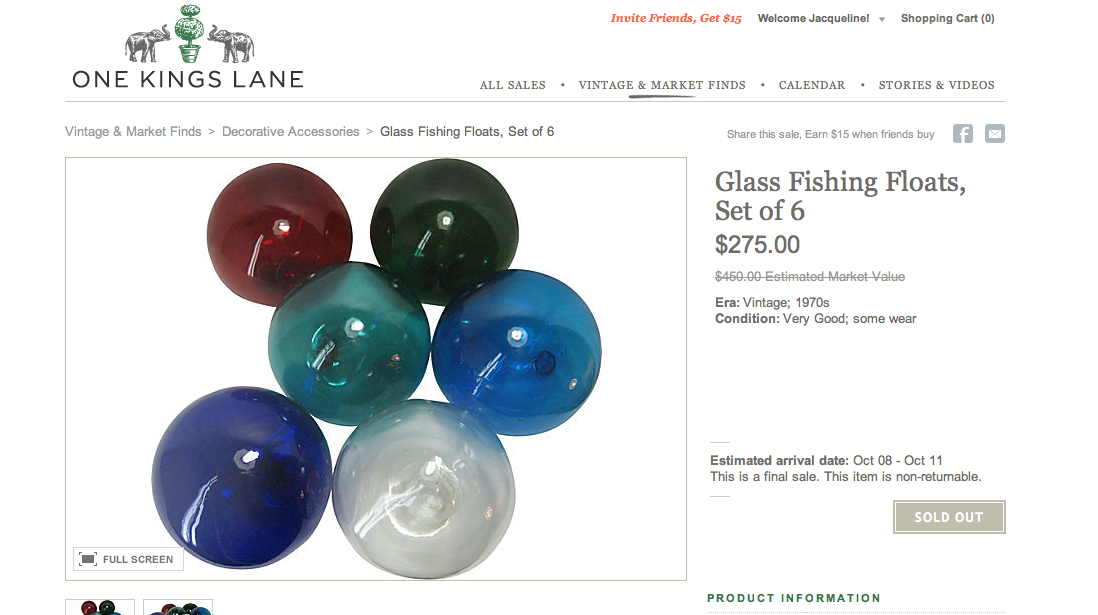
My friend also purchased a big mizuya tansu with some nice details, a rustic ladder on which she is planning to display her vintage quilt collection from India and two huge blue-green glass bottles like mine that she will have turned into lamps when she gets home. And of course there is the requisite glass fishing float too. Sometimes I wonder if I have accomplished anything with this blog other than to turn all of the Tokyo expat community fishing float crazy!

She bought two huge senbei (rice cracker) canisters as well which I forgot to photograph, but they looked much like the big rounded ones in this photo. And don’t forget, I got my fabulous and funky green lamp shade there too!

Read Full Post »

Older Posts »

Follow

Get every new post delivered to your Inbox.

Join 406 other followers

%d bloggers like this: