Feeds:
Posts
Comments

Archive for the ‘Jewelry and Accessories’ Category

As a quick follow-up to last week’s DIY post, for those who are not into sewing and want a purse right now, Katie Gordon of Cheeky Leopard is making lovely clutch bags out of vintage Japanese textiles too.  There has been a spate of birthday gifts circling my friends right now and this is the lovely one I received.  My friends had no trouble picking as it actually screamed my name!
cheeky leaopard mine

Some others recently given include this one…

cheeky leopard jill

…and this one. One of her signatures is the contrast lining found inside the bags.

il_570xN.394783328_4b2y

She even makes them out of Japanese indigo fabric for a more casual feel.

cheeky leopard boro indigo

Tiny coin purses, eyeglass cases and small cosmetic bags are also available in cheeky little prints!

cheeky leopard teapot coin purse

Cheeky Leopard is based out of Tokyo, but she has an Etsy shop and sells all over the world!

Related Post:
Modern and Ancient Collide…Obi iPad and Kindle Case DIY

All photos via Katie Gordon of Cheeky Leopard
About these ads

Read Full Post »

IMG_0155 obijime

Let me stop and praise the humble obijime. As the outermost belt on traditional Japanese dress, it provides that final bit of color and contrast. Usually made of woven silk, it can also serve as a base to a jeweled obidome, which looks like a tiny belt buckle. But in its own right it is a beautiful thing, soft and silky, often with much detail in the fine weave.

Every market I visit has at least one stall piled with used obijime, usually available for a song. Better quality and/or unused ones are often displayed with obidome and tend to be more expensive. I invariably pick up a few here and there, with an eye towards a project (like the one I wrote about yesterday) or for my favorite new use!

obijme

The irony is that the use, while a bit irreverent, is actually quite appropriate really. Lately, I’ve been wearing them as casual belts with jeans and trousers. They perk up the most ordinary combination. And while midriff selfies are brutal, I want you to see how they really look on.

pink and green obijime belt

obijime belt

So cute, no? I’m also planning on pulling some out for spring dresses – I see lots of possibilities.

I haven’t been the only one doing some serious repurposing around here. Visiting friends from Doha came to the Tomioka Hachiman shrine sale last weekend and made a beeline for the dealer with all the high-end samurai gear. My friend’s excellent eye went straight for the antique sword portepee, a woven cord that wrapped around the sword handle to keep it from slipping away during a fight. Now you know how I normally avoid all the “male” antique stuff – and frankly I could not tell you the name of this item in Japanese – but I just love what she did with it.

IMG_2210

Her fresh view saw it as a necklace and it can even be worn two ways, or maybe even more with thought put into it. The detail work on the weaving is absolutely spectacular and it almost feels like it is made of metal but I believe it is actually silk.

IMG_2209

Talk about irreverent repurposing!

Related Posts
Modern and Ancient Collide…Obi iPad and Kindle Case DIY
The Magpie Gene…Vintage Kimono and Judyth van Amringe
Saving Coral…Finding Treasure in Shrine Sale Junk

Read Full Post »

Each year after the ASIJ Quilt is completed, I am left with a crafting hole in my life. Last year, the lovely and talented Erin Leong brought her hand sewn iPad case to one of our last quilting sessions and the oohs and aahs were deafening.

IMG_6119

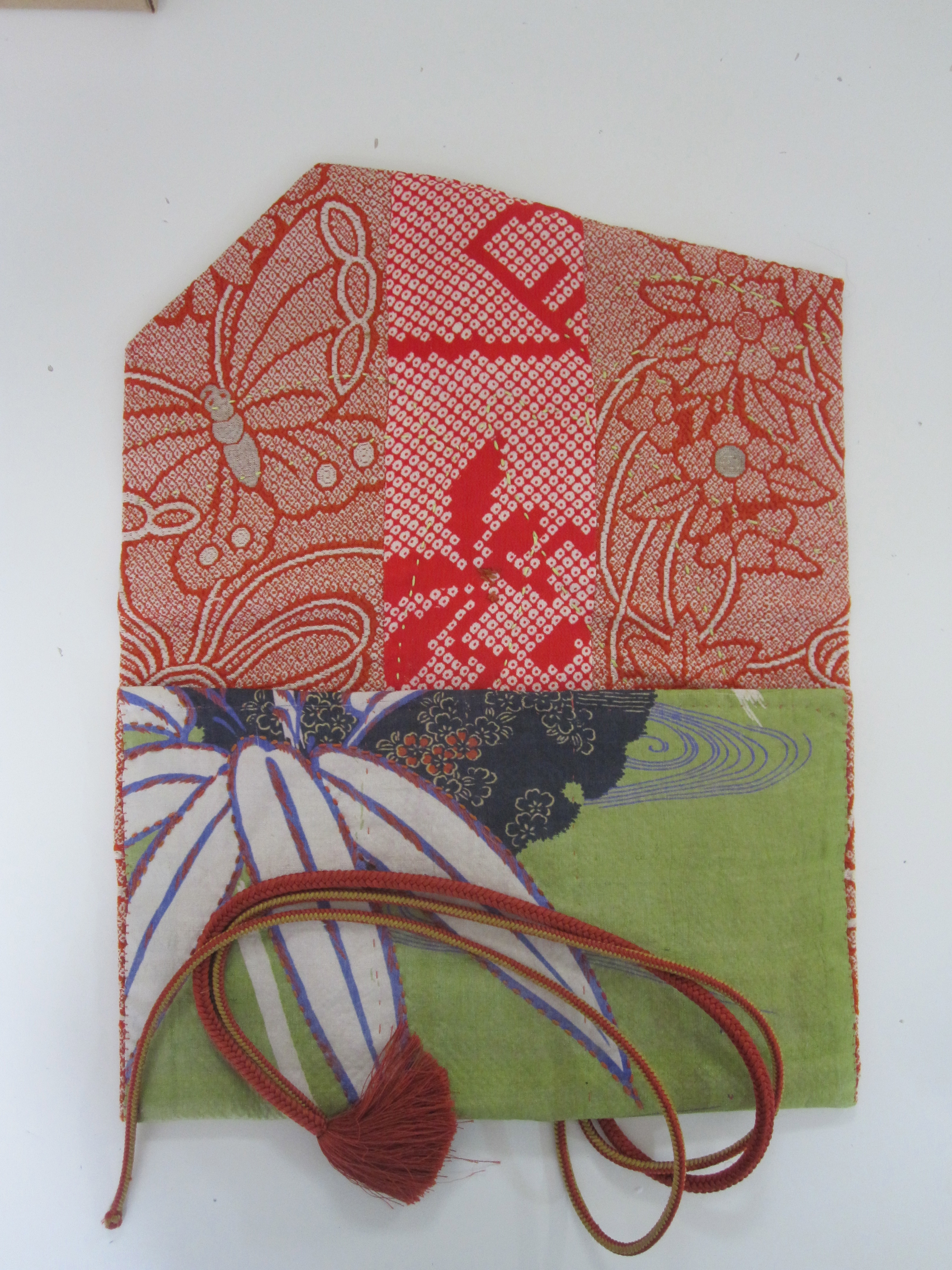
Using vintage and antique obi, kimono and haori lining fabrics, coupled with obijime as closure ties, she fashioned cases pretty enough to stand on their own as small clutches in addition to their proscribed use.

IMG_6120

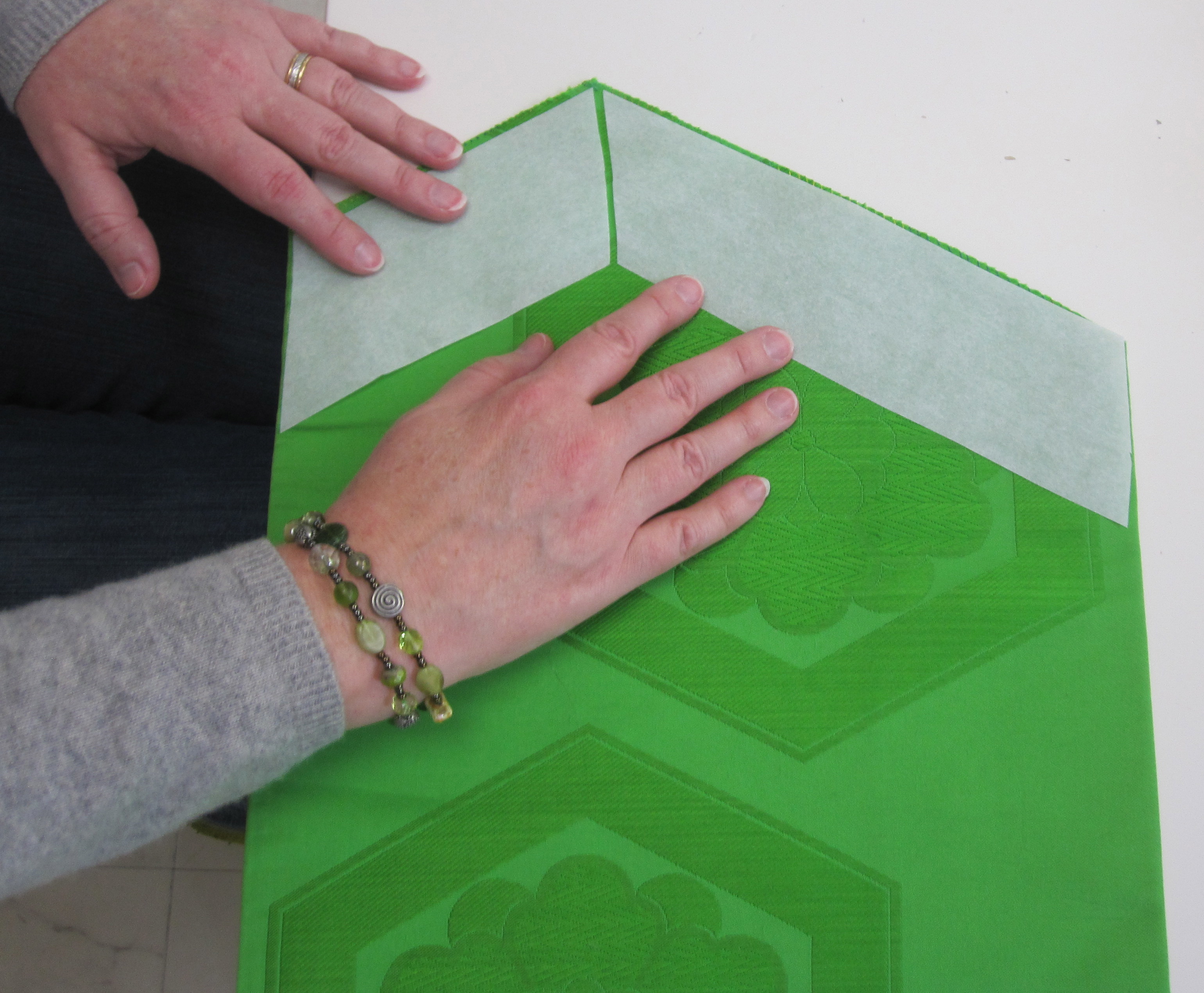
We decided to meet and all make a case or two for ourselves. Erin brought a sample that she had just begun (click on photos throughout this post for details). Obi brocades are just thick enough to provide some soft cushioning for electronics and they are just the right width for a standard large iPad. For a Kindle or iPad mini, the width needs to be cut down to fit. Since obi are thick and reinforced inside, she takes them apart to cut the outside layer of the bag. Soft silk, rayon or cotton lining fabric is perfect for the inside.

Each one is simply a long rectangle of fabric, folded in thirds, with two sections sewed together to make the pocket and the third section left free as the flap.

IMG_6124IMG_6123

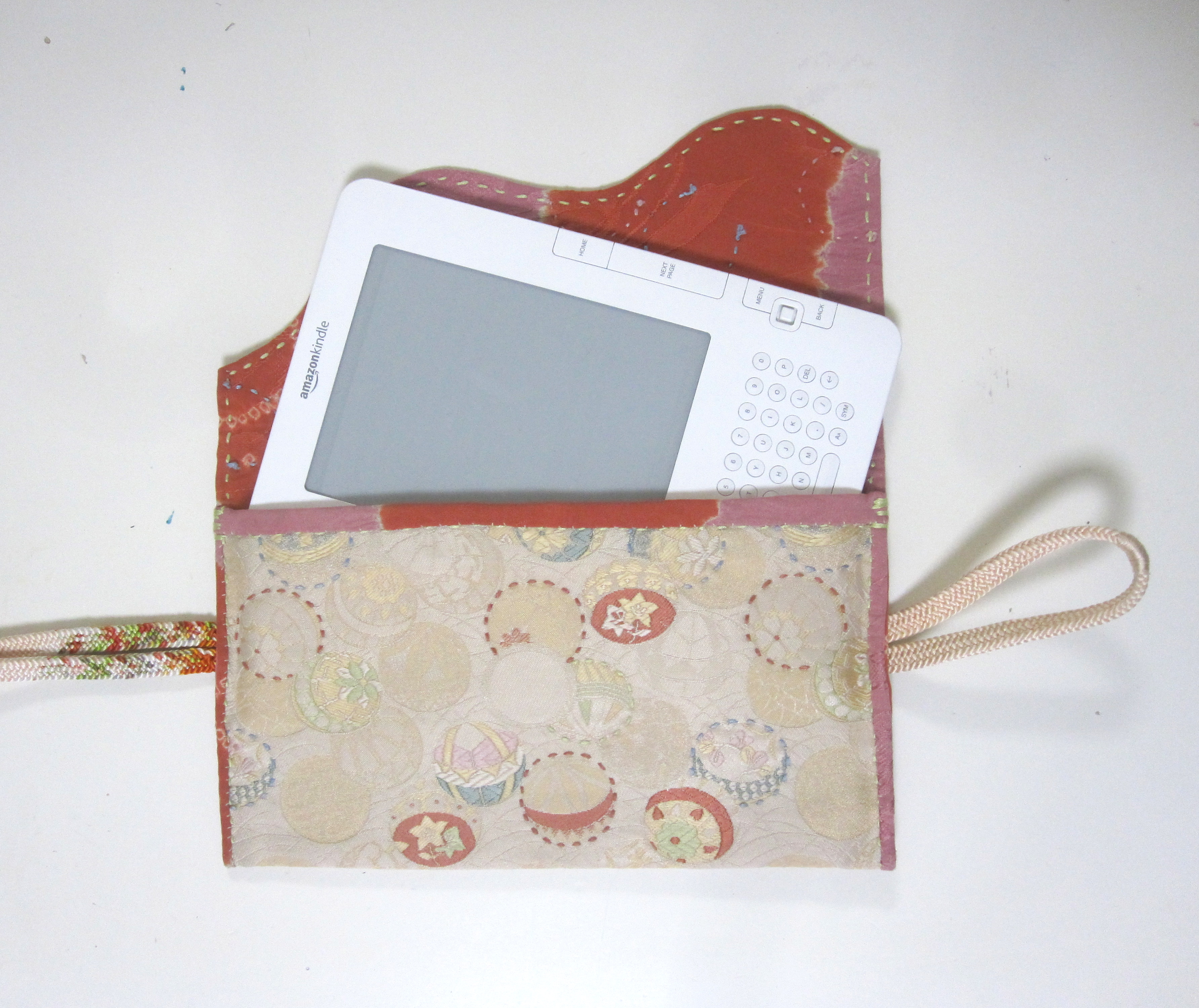
The play between the colors of the wrapped detail edge of the lining and the obijime, contrasted with the outer obi fabric is what makes these bags so fun to design. Erin has also included a bit of sashiko embroidery on her two bags, giving them extra depth and detail.

IMG_1294

This one was custom sized for a Kindle.

IMG_1298

She and I pooled our stash of non-valuable obi for the group and the creativity began. Combinations were tried out and tested.

IMG_6130IMG_6128

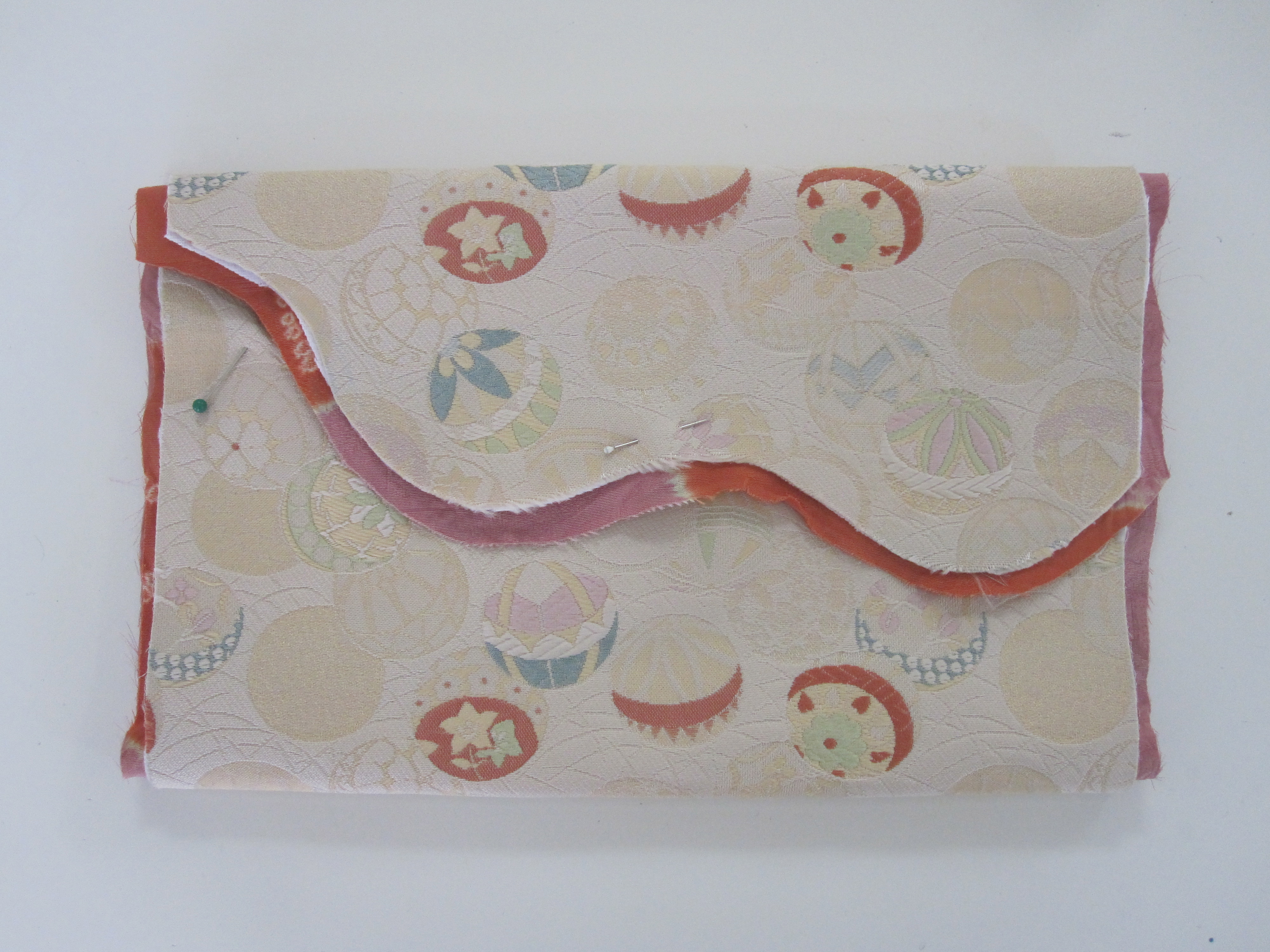
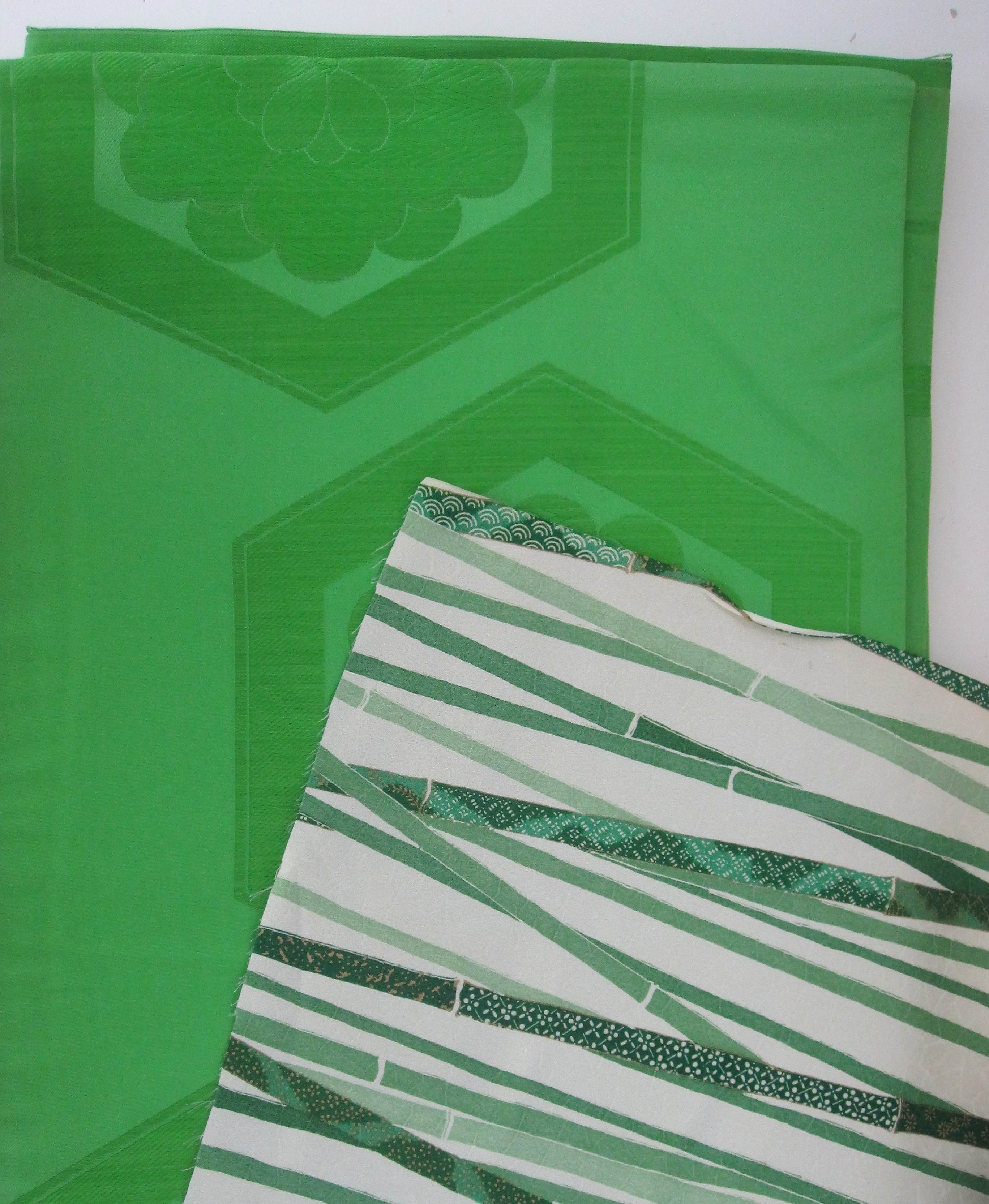
In the end, this traditional brocade on the left looked best paired with the indigo cotton in a stylized bamboo pattern on the right. We decided that a curvy flap went best with the pattern too. If you compare Erin’s two bags above, one has an angular flap, while the other a soft scroll similar to this one.  Aesthetic decisions were left to each person and dependent on the fabric and taste.

The outer fabric is cut to be about half an inch wider on each side than the object you want stored in it. The lining is cut with about an additional quarter-inch seam allowance. If you cut it too big, it is too bulky to sew along the outside edge.  Cut it too narrow and you can’t fold it under to make a clean edge before sewing. There are no exact instructions for this project – it is kinda do as you go.

IMG_6135

This case looked a little blah when finished and closed, so a bright orange obijime and some sashiko stitching were added. You’ll notice that small cases look and work best with the obijime running horizontally, while on the large size it is best vertically.

IMG_1296

Erin’s detail work is lovely – she did all the sashiko stitching on this one.

IMG_1297

This is another that I made and love the play of the watery green lining and the bold mauve obi. The cases are designed to look handmade, and to counteract the formality of this piece I sewed the lining edge with a blanket stitch, done in a very casual style.

IMG_6132IMG_6136

In the end, the case had some issues.  I had decided I wanted the extra thickness of the obi and did not dismantle it.  The net result was that it was almost impossible to get the needle through to sew it. Does that sound familiar? Without Erin’s assistance it would never have been done! As it is quite formal and very pretty, I think it will be kept to use as an evening clutch – I can’t quite see dragging it around as a case.

IMG_1295

Another friend could not resist the idea of making an evening bag and chose a formal silk obi and silk lining that matched and contrasted at the same time.

IMG_6126

IMG_6134

She never got around to finding an obijime for it so I believe she simply used a hidden interior fastener. I think that one green flower in the lining is what makes this so perfect and so Japanese!

obi ipad caseobi ipad case inside

Yet another friend went all green – fancy brocade exterior with silk lining in a realistic bamboo pattern. After taking apart her obi, she found the fabric to be too soft, so she reinforced it with some iron-on interfacing. You can see how each project evolved a bit differently. She also chose to follow the shape of the hexagon in the brocade when cutting the shape of her flap. I’m not sure she has progressed much beyond this point.  Like I said, sewing through obi fabric is a huge pain!

IMG_6125IMG_6133

We are trying to convince Erin to start making these for sale, so if you would be interested, please give a shout out in the comments or send me an email.  They are absolutely gorgeous – the combination of antique and vintage textiles with the hand sewing is so unusual.

Related Posts:

A Not Quite DIY…An Obi and Quilt Block Pillow Tale
The Magpie Gene…Vintage Kimono and Judyth van Amringe
Saving Coral…Finding Treasure in Shrine Sale Junk

Read Full Post »

As a quick follow-up to my post on styling rules and accessories, I just realized I never included the adult party favors from my daughter’s Bat Mitzvah! At a shrine sale this spring I had found a set of karuta, antique game pieces in which a half of a poem was painted on a small wooden tile and the other half painted on a different one. The goal of the game is to pair up all the poems.

Obviously my predominantly English-speaking crowd wasn’t going to be able to do that, but I thought they looked lovely as part of the table setting and would make a sweet souvenir for people to take home. Not the best photo as this was before the lights were dimmed and you can’t see the lovely painting on the lanterns, but look here for more party details.

What has been really fun is seeing the ways in which people have used them once they got them home. One friend has placed hers in a glass bowl in her entryway, along with some woven straw balls and palm fronds. The natural textures and colors are complimentary and the placement with larger objects in a contained space keeps them from getting lost, both literally and figuratively. Note too, the rule of three holds here as well.

Another friend took hers, added some shells and bits of broken pottery, and framed them in a shadow box which now resides on the counter of her friend’s sushi bar. Again, containing small decoratives in an enclosed space helps to highlight them and limiting the variety of objects to three creates the correct balance.

Other friends have them displayed in a witty take on size – big, medium and small. Can you see a pair of them in this photo? Probably not, but I can’t resist showing you the long view, with the amazing antique map of Japan that I found for them.

Here they are close-up, topping a stack of books, which again serves to highlight and corral them.

I still have some left over. Suggestions on how to use them?

Related Posts:
Sayonara Series…Styling Rules and Japanese Accessories
A Little Bat Mitzvah Inspiration…Sakura Season in Japan
A Little Bat Mitzvah Inspiration…Yoko Ono’s Wish Tree

Read Full Post »

Expat circles here in Tokyo are all abuzz about a new jewelry artist named Lynn Cooper and her line of handmade silver charms, as are her growing base of Etsy customers too. Kanoa Pure Silver, romantically named after the Hawaiian word for wanderer, is the name of her new company and fast becoming the sayonara gift of choice!

Cooper makes all her charms by hand using gin nendo, a malleable silver clay, and her techniques include hand hammering and texturing, stamping and carving. Each and every piece is physically individual, even when using the same stamp, as the hand work creates slight variations. She burnishes them to have an aged glow, with oxidation left in the crevices, giving them a feeling of age.

Her goal is not only to make fine jewelry, but to create a talisman for each wearer. So in that sense each grouping is emotionally different – perhaps representing the shared experience of a gift giver, the memory of an adventure or a connection to a culture different from one’s own.

Before we launch into all her lovely work, I must show you her ship-shape (no pun intended!) colorful work space. She has all the tools of her trade at hands reach, displayed with other sentimental objects. And look how she has chosen to use her vintage enameled laundry hanger – part lamp shade, part display rack.

The kamon stamps are the same vintage ones spied at the Setagaya Boro-ichi. And talk about re-purposing! The black cubbies are actually the old telephone cubby holders from the American Embassy that she spray painted and lined with washi paper. Reminds me of another great display case I have written about before.

Cooper uses the kamon stamps to make her larger charms which can stand alone on a chain or cord.

Her other technique involves hand carving her own blocks, often including a kanji, in this case tomodachi – the word for friend – on a cherry blossom. She adds vintage beads sourced from shrine sales and other semi-precious stones too.

Nostalgic images, an onigiri (rice ball) and Mt. Fuji, are also popular.

I just love the little stone lantern and teapot on this grouping. Customers can mix and match their own charms and beads and she can even custom carve (when she isn’t crazy busy) a specific image. She’s not limited to Japanese icons either!

Here’s my own little cute grouping – those who know me well will not be at all surprised about the accent beading color!

And last night I got this charm – another one featuring the tomodachi kanji- from a friend to add to my collection. You can really see the woodblock-like carving on these kanji charms.

Lynn’s packaging for gifts is also just adorable, she has such an eye for colors – like the card above using two contrasting traditional Japanese patterns, or her standard gift box, shown below.

And if you think only ladies can get in the fun, think again! With Father’s Day coming up, she also has gifts for men, like these fun cufflinks. Inspired by everything from katagami to woodblock prints, they allow your menfolk to wear their hearts on their sleeves.

You can contact Lynn directly on Luckycheri@gmail.com or visit her Etsy shop. You can also follow her on Facebook too. Thanks to Lynn Cooper for all her spectacular photos!

Read Full Post »

“How objects are handed on is all about story-telling. I am giving this to you because I love you. Or because it was given to me, Because I bought it somewhere special. Because you will care for it. Because it will complicate your life. Because it will make someone else envious. There is no easy story in legacy. What is remembered and what is forgotten? There can be a chain of forgetting, the rubbing away of previous ownership as much as the slow accretion of stories.”

Have you ever read a book, assuming you would like it but not expecting it to completely rock your world? Well that is the way it was for me upon reading Edmund de Waal’s family biography The Hare With Amber Eyes. Numerous friends had recommended it to me, assuming I would be interested in the collection of 264 antique Japanese netsuke that are the theoretical protagonists of the book, which I was, but I had not realized how every bit of it would seem to tie in with my own writing and collecting and that reading it would become a very personal journey.

The story itself is like an onion, with layers that peel away, yet link back up with each other. Sometimes it feels almost too fantastical to be true, impossible that such detailed records remain, that the life of these tiny objects can be tracked so clearly. The netsuke themselves are a conceit, used to tie a multi-generational, multi-national story together. Edmund de Waal, the renowned British potter (who makes Japanese inspired pieces himself) inherits an extraordinary collection of Edo period netsuke from his Viennese Uncle Iggie, who actually lived out his adult life in Tokyo. Yet the netsuke were originally acquired by Iggie’s father’s cousin in Paris in the 1870s, then given as a wedding present to Iggie’s father in Vienna at the turn of the century. As we read, we know that war is coming, so it becomes hard to imagine how they eventually make their way onward, and I will not spoil that surprise. But there is also a kind of magic in knowing from the very beginning of the book that these netsuke are a sort of sick punch line, in that they survive even when people don’t, and that somehow they even make it back to their country of origin over 100 years later.

Netsuke, the tiny toggle sculptures used to anchor small carrying cases called sagemono to a kimono sash (obi) are extremely coveted and collectible, and thus by default, quite valuable. Most commonly made of ivory, wood or bone, these lifelike inch long sculptures are detailed works of art, depicting everything from people engaged in everyday rituals of every sorts, to animals, plants and even mythological creatures. I occasionally see them at shrine sales, more often at the better antique shows - Heiwajima would be a good place to look this weekend – but I think of them in the same category as obidome (the jeweled belt clips which I adore) and tsuba (sword guards). In other words, small and beautiful, but somewhat useless. In the last few days I have been to a few shrine sales and really kept my eyes peeled for them, getting lucky with one dealer who had some in complete sets, strung on cords with their inro (a stacked compartment carrying case) and ojime closure bead. The two examples below demonstrate the range of netsuke, from the simplest disk on the left, to a detailed, although fairly crudely carved figure on the right. Both inro are made of lacquer, with maki-e sprinkled gilding.

The original collector of the netsuke, Charles Ephrussi, the cousin of De Waal’s great-grandfather, was at the heart of the art and salon scene in late 19th century Paris. Originally from Odessa, the Ephrussi’s were one of the great Jewish banking clans, second perhaps to only the Rothschilds, that fanned their way out through Europe in the 19th and early 20th century, establishing places of business and grand houses in France, Austria, England, Greece and elsewhere. Charles was a writer and editor of art magazines and collector of fine works of art. Like many of his contemporaries, he became enthralled with the Japonisme craze sweeping through Europe in the 1860s and 1870s. In addition to his 264 netsuke, he had a collection of 33 black and gold lacquer boxes and an extraordinary group of Impressionist paintings, supporting artists whose names we all know now at the very start of their careers. The list of Charles’ paintings reads like the home runs of the Impressionist world, a forty piece collection accumulated in just three short years. Solidifying his fame, Charles himself appears in Renoir’s masterpiece Luncheon of the Boating Party, the man in the top hat towards the back, and served as inspiration for Proust’s Charles Swann in Remembrance of Things Past.

“I want to know what the relationship has been between this wooden object that I am rolling between my fingers – hard and tricky and Japanese – and where it has been. I want to be able to reach to the handle of the door and turn it and feel it open. I want to walk into each room where this object has lived, to feel the volume of the space, to know what pictures were on the walls, how the light fell from the windows. And I want to know whose hands it has been in, and what they felt about it and thought about it – if they thought about it. I want to know what it has witnessed.”

Just like de Waal, I too want to see exactly where and what the netsuke lived with, to imagine them all crowded into his rooms on the rue de Monceau in Paris, so I could not resist pulling up the images of his paintings, now scattered in the world’s finest museums, to share in just that way. All of the paintings below, and many more that I do not show, had places of pride in Charles’ home.

The most charming story centers on Charles’ purchase of Edouard Manet’s Une botte d’asperges, for which Manet charged 800 francs but Charles sent 1000.

In grateful response to his over-payment, Manet sends on second small painting of a single stalk of asparagus!

The influence of Japanese prints on the Impressionist perspective can clearly be seen in Degas’ portrait of Edmund Duranty, painter and subject both friends of Charles, that hung in his study.

Charles also owned Monet’s Les Baines de la Grenouillère that now hangs in The National Gallery in London.

A personal moment for me, as this painting is the sister to the Monet below – La Grenouillère - which has been hanging in the Metropolitan Museum of Art and long been my favorite Monet. I wrote a huge paper about it for an art history class in college. I wonder if it is packed up in a box somewhere?

He also owned Manet’s Portrait de Constantin Guys…

…and General Mellinet and Chief Rabbi Astruc by Degas. I imagine them all hanging (out) on the wall together, chatting, like the portraits at Hogwarts.

I am not sure if this Degas pastel At the Milliner’s is the actual one Charles owned…

…or this one, or perhaps even both.

Charles owned many works by Degas including In a Cafe, better known as L’Absinthe. Their friendship, and many others, ended over the Dreyfus Affair, as the roots of anti-Semitism in French society became exposed.

At the turn of the century, Charles packed up the netsuke and sent it to his nephew Viktor in Vienna on the occasion of his marriage.  Viktor’s new home, the Palais Ephrussi, was so grand that one cannot imagine these tiny figures making any statement there. And they do not. The netsuke were no longer displayed publicly, instead they were kept in Viktor’s wife Emmy’s dressing room, where the children took them out and played with them as they watched her dress.

Here I will stop the tale for a while and recommend that anyone planning on reading the book should not research any further into the story. As we know who and what is coming, in the form of Hitler and the Anschluss, I will leave that tale to de Waal. I find it all too painful to write about anyway.

And so we return full circle, as not only have the netsuke made their way back to Japan with Uncle Iggie and his partner Jiro as the book opens, but de Waal himself studies Japanese ceramics as a young man, a result of that historical Leach-Yanagi friendship that ties British and Japanese pottery together. In the aftermath of the earthquake last year, the Leach Pottery was quick to start a foundation to help rebuild the historic kilns at Mashiko. And ironically for me, the book opens with de Waal taking Japanese language courses at the very school here in Tokyo that I currently attend for the same reason.“Iggie and Jiro’s life was lived in another kind of Real Japan,” and I like to think that we do too.

Just like Charles and Viktor, Iggie keeps the netsuke in a glass vitrine, a display case, which is another conceit for de Waal’s story and one that influences his own work highly. At first, he thinks vitrines ”exist so that you can see objects, but not touch them.” But what he comes to realize is that “the vitrine – as opposed to the museum’s case – is for opening. And that opening glass door and the moment of looking, then choosing, and then reaching in and picking up is a moment of seduction, an encounter between a hand and an object that is electric.”

I have not been able to find any formal writing on the influence of the netsuke and his family’s history on de Waal’s own work, but it clearly has played a major role. He creates huge installations, full of similar but different pots, often grouped on shelves. Does that sound familiar?

“He is an interesting example of a potter who has not left the studio but has been determined to escape that solitary plinth with its unique object atop. You will all be familiar with his move from domestic porcelain to a series of installations that ‘animate’ (his word) particular interiors and to interventions in museum collections. 1999 was the decisive year in which de Waal arranged his pots in cupboards and on tables in Howe and Lescaze’s High Cross House at Dartington in Devon; he described this as a ‘personal conversation with iconic modernism’. De Waal’s post-plinth strategy is based in part on massing. Thus he references the richesse and generous display of the eighteenth century porcelain room.” (quote from a lecture by Tanya Harrod in 2009)

Edmund de Waal’s place in the lexicon of British ceramics is confirmed by his centrally located Signs & Wonders installation in the new ceramic galleries at The Victoria & Albert Museum. To learn more, there is a great 5 minute video and a wonderful article by A.S. Byatt about them.

De Waal will not allow himself any “melancholy” or “nostalgia about all that lost wealth and glamour from a century ago,” he doesn’t want “to get into the sepia saga business.” But after reading the book I find that I am angry for him and I am surprised at the strength of my feelings. My forebears came from the same places as his. I had a great-grandfather from Vienna on one side and a grandfather from Odessa on the other. My grandfather left Russia in 1917 to avoid the Revolution as he was from well-heeled family – he spoke French and was studying to be an architect – and he worked his way across Turkey, through France and onward to America. But I know little more than that about his story and have no objects to tie me to him. In fact, there are no family objects that tie me to any of my ancestors – the little bit of jewelry that remained was stolen out of a parking lot sometime in the 1960s before I was even born. And the truth of the matter is that I sometimes believe that lack of connection through items is what propelled me into being an antiques dealer. As a girl my favorite books were those where the characters explored their grandmother’s attics, opening trunks filled with clothes and talismans from long ago, feeding a fantasy of connection with those long gone. If you think about it, so many books for kids and teens, even the Harry Potter series, rest on those kind of connections.

I did have an exciting inheritance moment last year though, not long after buying the beach house in New Jersey. I was at my in-laws in Florida, packing to fly up to New York and then home to Japan. I looked up in the guest bedroom closet and saw a group of quilted dish protectors, clearly stacked full of a china service. In the back of my mind a little voice said “those are yours” but I couldn’t imagine what they were. I took one down and unzipped it, while simultaneously remembering that my grandmother had a set that no one needed or wanted when we were forced to move her out of her apartment and into a home. At the time, I couldn’t bear to get rid of them while not having enough space in my New York apartment to take them, so I left them in Florida and forgot about them. As I lifted the dish out of its case, I couldn’t believe it – they were absolutely perfect – having just the colors and soft feel I wanted in the beach house. It was as if my beloved grandmother was right there with me in that moment!

When asked by a neighbor if really the netsuke should stay in Japan, de Waal answers no. “Objects have always been carried, sold, bartered, stolen, retrieved and lost. People have always given gifts. It is how you tell their stories that matters.”

Related Posts:
Artist Spotlight…Dancers, Degas and the Demi-Monde in Yokohama
Artist Spotlight…A Final Dose of Japonisme for the New Year
Artist Spotlight…William Merritt Chase’s Japonisme Interiors

Image credits: 1. de Waal’s netsuke, photo credit unknown, 2.via AW Antiques and Collectibles, 3. me, 4. via The Phillips Collection, 5. via Impressionism Art Org, 6. via Musée D’Orsay, 7. via Glasgow Museums, 8. via The National Gallery, 9. via The Metropolitan Museum of Art, 10. via Wiki Media, 11. via Wiki Paintings, 12. The Metropolitan Museum of Art, 13. via Wiki Paintings, 14. via Musée D’Orsay, 15. via Planet Vienna, 16. via The Economist, 17-18. via My Mama’s Table, 19. via The Victoria & Albert Museum, 20. me.

Read Full Post »

OK, OK, I know this is not quite my regular type of post, but what’s a girl to do when she is sick, the kind of sick that leaves you with no working brain cells at all, laden with stressed out children (must they have 10 tests in one week?) and none of the shopping for the holidays done?  We are headed out to the northeast in just two days and I know it is going to be cold there and I am dreading that part of it. So here is a post to getting cozy!

In searching for the perfect gift for my soon to be teenaged daughter, I stumbled across these Kimono patterned Ugg boots. I still don’t really see the charm of Uggs, but the girls all love them and they certainly are warm and snuggly. Adding the great Japanese inspired pattern has somehow made them more interesting to me and they are available in different colors and heights.

Another short model has a stylized Japanese flower on the front, instead of the all-over pattern, but seriously, Ugg boots with shorts? That is about 50 climate degrees apart.

Anyway, to really make this a valid post I should whip out some interior with Japanese inspired wallpaper or fabric or something, but I feel like I have shown lots of those rooms before and if you want to see some gorgeous examples, go out and buy Katie Ridder’s Rooms (Thanks Wendy!!!!). Instead, I am going to focus on the boots being made from sheepskin, as we have been seeing a big trend over the last few years of skins casually, but most deliberately, being thrown over chairs to warm up interiors. There was that great room of Julianne Moore’s a few years ago in Domino  - finally found the photo at apartment therapy

These days you can’t turn around without spotting one!  I do particularly remember Design Sponge featuring Emma Reddington’s gorgeous Toronto townhouse not that long ago where there were examples to be found in almost every room, from these Bertoia style chairs in the parlor…

…to this cozy spot in her study.

Notice how they always look best with a classic modern chair! For more great ideas, check out a recent post on the subject at Remodelista.  A great idea for those of us in uninsulated chilly Tokyo houses!

Finding this post a little weak? Sorry, I know! But I have to get back to packing and internet shopping, my hot tea and attempting to provide study help in a language I don’t really speak…

Read Full Post »

The quilts, my new wallet and the exhibition Second Lives: the Age-Old Art of Recycling Textiles at the Textile Museum in Washington, D.C. have me thinking about the ways in which living with antiques and crafts can be sound environmental choices and one of the oldest forms of “green living”. While I am not a jewelry designer by any means, I have been doing a bit of recycling myself these days, with bits of vintage coral from hair ornaments and obi belts and it is slowly turning into quite a little collection.

At every shrine sale or antiques show there are many dealers selling obidome, the jeweled ornament worn on the narrow obijime cord as an over belt on a kimono’s wide obi. They are often made with semi-precious stones such as jade, coral, amethyst and others, ivory, enamels and cloisonné, silver and other metals and even Bakelite.

Hairpins and combs also abound, with similar ornaments

In general, they are very expensive, so I don’t allow myself to buy any, especially since there is not much you can do with them and they don’t display easily. Nonetheless, I am a bit obsessed and have taken to buying little pieces of coral that I find, often lying at the bottom of a box. I’ve set myself a really low price ceiling and I stick to it!

The earrings were found as is, in their lovely vintage box, and they were a bargain I couldn’t walk away from, especially as I have such a fan fetish.

These beads were found together and I had a friend string them into a pretty necklace.

The coral daisy had a pierced hole at the top, so I used an O ring, given to me by the lovely ladies at Helen Ficalora jewelry to turn it into a pendant. As for the obidome, I am not sure what to do with it….

The silver mount on the back is almost as pretty as the flowers on the front. You can see it has 2 bands to string the obijime through.  Perhaps I should run a silken cord through it and turn it into a necklace?

Anyone have any other ideas?

Read Full Post »

Yesterday, my dear girl friends surprised me with a birthday lunch and gave me an amazing wallet from the Japanese leather goods company Inden-ya. Coming on the heels of the quilt post, I think you would all agree it has my name on it!

The wallet is an absolute cornucopia of classic Japanese patterns – dragonflies (tonbo), plum (ume) and cherry(sakura) blossom, chrysanthemum (kiku), hemp (asanoha), key fret (sayagata), hexagon or tortoiseshell (kikko), stylized wave (seigaiha) and naturalistic wave, and even a little pine/plum/bamboo (sho chiku bai). I can’t stop staring at it, turning it over and searching out new details I hadn’t noticed the previous time.

Inden-ya has been making its traditional deerskin goods since 1582! How many other companies can you think of that have been in business that long? Everything is still completely handmade and they have an unusual technique of using lacquer to create the patterns. There is a great video on their website showing how it is done.

What makes my wallet so unusual is that it is a compendium of bits and pieces of all their different patterns. As their regular items tend to be made from just one pattern, it is only available when they have enough left over to make one. The perfect present for someone who quilts and loves to make things from patches of nothing…

Read Full Post »

Today was the first day of three at the Heiwajima Antiques Fair.  A huge antiques show with hundreds of dealers, there is always something for everyone and today did not disappoint.

It was porcelain heaven.

It was soba choko heaven.

It was kimono heaven.

It was kokeshi doll heaven. Big…

…and small.

It was tansu heaven. (This is Akariya’s wonderful booth)

It was obi dome heaven.

It was scroll painting heaven.

It was indigo heaven.

The show continues tomorrow and Sunday and is open from 10-5. It is well worth a visit.

Quick Addendum…What I Bought

In response to an email, I wanted to follow up with my purchase (only 1 thing! shocking!) from Heiwajima. Because I was so busy thinking about the blog and taking photos, I didn’t really shop for myself. Also, I made a solemn vow to myself that the beach house I am furnishing back in the USA will not have any Japanese or Asian antiques, so I am not really in the market for much right now. That said, I did buy some beautiful silk ikat kimono pieces with a floral pattern in just that wonderful plum I love.  I am thinking it would make some great small cushions. (The color is less bright than it appears in the photo.)

Driving directions for folks in Tokyo: Head out on the Shuto #1 towards Haneda (as if you were going to the Kawasaki Costco). The Heiwajima exit is a few after Shibaura. Take the Heiwajima exit and continue straight for about a mile at most. There will be a left turn sign that says Ryutsu Center. Turn left there. Turn left again into the loading dock area and drive to the end. Turn left at the end and you will see P1 parking ahead on your right.   The M3 level sends you straight in and there is a good tonkatsu place for lunch.

Read Full Post »

Follow

Get every new post delivered to your Inbox.

Join 405 other followers

%d bloggers like this: