Feeds:
Posts
Comments

Archive for the ‘Housewares’ Category

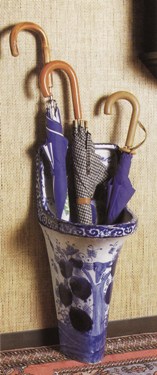
So, if a picture paints a thousand words, what does this one paint for you? Do you see antique blue and white porcelain umbrella stands and plant holders? Or do you see three squatty potties and two urinals? If you chose the latter, then you have chosen correctly. Antique blue and white toilets called benki were popular in the late Meiji and Showa periods, often installed in fine ryokan (inns) or wealthier people’s homes. Fairly rare as singletons, to see an entire collection of five all together is almost unheard of, but this dealer at Kawagoe shrine sale last month bucked the odds. I assume he salvaged them all at one place, perhaps as an old building was being torn down.

Most of these painted pieces are in the Seto style, my favorite, although some seem to be Imari as well. And they were definitely produced on some kind of large organized scale as I have noticed there are only a few basic shapes and patterns that are repeated in all the ones I have seen.  The toilets tend to be rectangular, with a squared off front or oval, with a rounded front. The rims always have a tiny detailed painted pattern, quite often traditional karakusa (scrolling arabesque), while the under hood area has a large bunch of flowers.

The urinals fall into one of two categories, either the more tubular umbrella stand shape on the right or the more cornucopia shaped one laying on the ground on the left. Older examples, both of the toilet and the urinals, like the one I saw before here, are hand painted, while the later versions are often more heavily transfer printed.

Somushi Tea House in Kyoto looks as if it has been around for ever, but actually was renovated to look old. To give it that Meiji feel they installed vintage bathroom fixtures. If you were at all confused about how this functioned as a toilet, here’s your answer. And note how similar this one is to two of the toilets above.

On the left is the urinal at Somushi which is more of a cornucopia shape and looks like an earlier hand painted Seto piece. The photo on the right is not as finely painted and looks to be Imari, but it is quite similar to the one laying on the left in the Kawagoe photo above. Umbrella stands seem to be the standard use du jour of retired urinals. The toilets make good planters and I have even seen one turned vertically and used as a garden fountain.

Now for those of you who don’t know, there is complicated toilet etiquette in Japan. In addition to taking off your shoes upon entering any home and putting on slippers, there are special separate toilet slippers kept inside the bathroom. Normally these are ordinary slippers, but I have actually seen painted porcelain ones on a few occasions, out in the markets that is, not in someone’s home. Were these really worn? Or are they just ornamental? I’m not sure, but I didn’t buy this pair last May because their condition wasn’t great. I think they’d make a witty addition to a vignette.

I have seen a few other pairs in my travels and they have always been similar to these, with that distinct feathery Seto style painting.

Without any formal knowledge on the subject, my instincts tell me that the idea for the painted fixtures comes straight from the West. It was not unusual to have painted and transfer printed toilets in the 19th century, like these Victorian versions from Great Britain. There was a tremendous amount of cross-fertilization in the porcelain industry going on in the late 19th century, with ideas, motifs and techniques (such as transfer printing) winging their way back and forth.

And the title of this post? It roughly translates as “feels good toilet,” but maybe “looks good toilet” would be even better. And I know my Japanese grammar isn’t actually correct, but I couldn’t resist the rhyme…

Related Posts:
Made for Export and in My Basement…Seto Porcelain Garden Stool
Shop Talk…Discovering Antique Treasures in Nishi-Ogikubo

About these ads

Read Full Post »

I think it has been more than a year ago at least that I promised to do a full shopping guide to the vintage and antique stores in the Meguro neighborhood of Tokyo. Commonly referred to as Interior-dori, it stretches along both sides of Meguro-dori (dori meaning street), south-west of the Meguro train station from just past Yamate-dori, all the way down to the central post office. After my last post mentioning the lack of furniture available here, I got a few kind complaints as to the truth of that statement and thought it time to fully investigate and report on this unusual cluster of stores. These adhere to that “car dealership synchronicity” adage I have talked about elsewhere (here and here, for example) and numerous people, mostly couples, were browsing on the public holiday earlier this week. With a complete lack of parking and the train station a bit of a walk, the density of shops is needed to bring the public.

My tour starts at the intersection of Meguro-dori and Yamate-dori and heads along the south side of the street walking. I stop in at most of the shops on both sides, although there are a few I missed, so the list is not exhaustive.  There are also stores tucked away in the back streets near by, such as the lovely Found, but those are not on this tour. Many of the merchants are listed on the MISC (Meguro Interior Shops Community) webpage and the shopping map to the area that can be picked up at participating stores. Both for those really looking to furnish a home to those just looking for small gifts and Japanese styling, it is a fun outing.

While most of the stores are channeling that mid-century vibe or at the very least European shabby-chic, one of the first stores on the south side of the street is Chapter, featuring Japanese antiques.

One of their specialties is repurposing, so antique ranma (transom panels) are turned into consoles, dining tables and wall dividers. There is quite a collection of them at the back of the shop. They have great vintage milk glass fixtures too.

I thought this was ingenious – tucking a hard to use small tansu into a larger modern piece of furniture.

Brunch + SC was one of the first of five or six different Brunch outlets (Brunch Branch, Brunch Works, Brunch Time, etc.) all selling their modern versions of furniture inspired by the mid-century. You can see on their logo map below that they stretch all along the street and line both sides.

Each shop has their own particular pieces, but this photo gives a general sense of the style.  There was a western couple shopping here and the sizes of the furniture seemed normal and comfortable. Much of it is teak and order made. Really great chairs (think Wegner Wishbone) at these shops – and they are currently having a chair fest through September.

Brunch Branch nearby had charming garden items.

I had to go into chambre de nimes just based on that stacked luggage in the window.

Everything inside the shop seemed to be imported from France and the place had a real les puces vibe. This was the first of many places that also stocked vintage church pew chairs with a pocket in the back for prayer books. They are super popular here in Japan and I’ve seen them often elsewhere, particularly at the Penny Wise.

And the first, but not the last of the day, of the sewing machine base consoles. New Jersey to Japan – they are everywhere.

The next shop AMS seemed to be different owners on different floors, but the ground floor was full of vintage chandeliers and country-style antiques, including windsor, ladder back and the ubiquitous church chairs.

Next was Junks featuring all kinds of great vintage goods, mostly from the USA, including some favorites of mine such as wooden delivery boxes, printers drawers, old globes, authentic mid-century furniture…

…and this fabulous bottle drying rack for 39,800 yen ($509), which might seem expensive but…

…a similar one was for sale on OKL for the same price on the very same day.

And Becky at Buckets of Burlap just recently put her vintage zinc bottle dryer up for sale for $500.

Gallery S featured a combination of vintage and new furniture, but seemed to specialize in hats. Yes, hats. Love the wooden and painted iron desk and chairs on the right out front.

Tucked away upstairs across the small side street is Point No. 39 which looked promising just from the sign alone! And the word repair was quite intriguing as that is hard to find in Tokyo.

It did not disappoint, being stuffed full of great lighting, furniture and decorative pieces.

I loved the giant sunburst mirror. And by the way, it is also a bicycle store. Go figure!

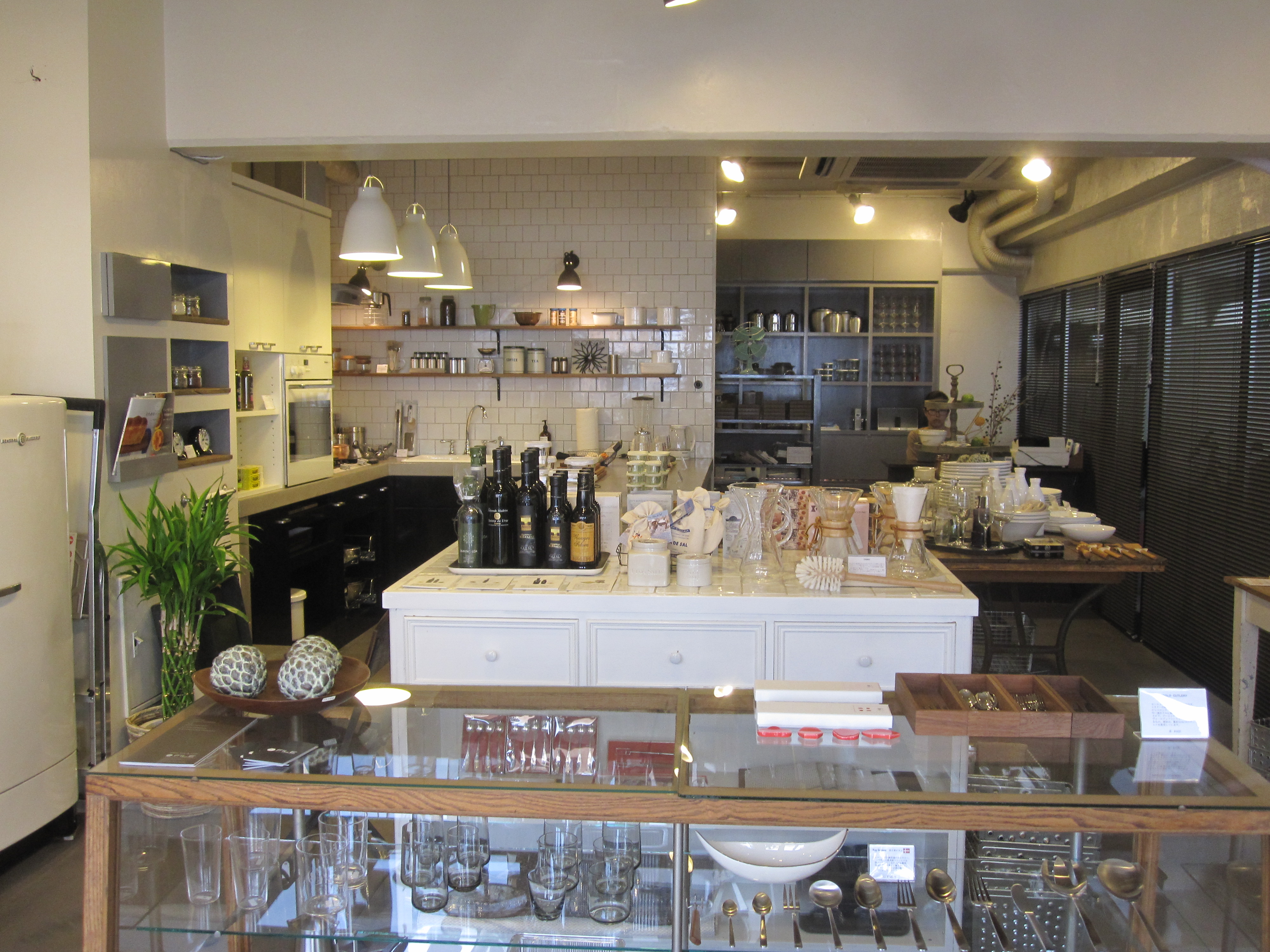
File Home and Interior was full of gorgeous housewares and also boasted one of the prettiest kitchens I have ever seen in Japan.

Turns out there are a few more File shops across the street including one that actually designs and installs kitchens.

After File, things petered out and before reaching the big Meguro post office I decided it was time to cross to the north side of the street. Anchoring the end on the other side of the street is the giant four floor Geographica. The second floor is home to a charming Italian restaurant Il Levante where I stopped for lunch. There are not many choices for food along the main drag, so I recommend it for a rest or meal.

Geographica was stocked with English antiques – they even carry Sanderson’s line of William Morris Fabrics – and at times felt a bit like a gentlemen’s club. Lots of dark wood, bentwood chairs and framed engravings. One really useful thing they stocked was a full line of knobs and pulls and other hardware. And I love these brass train racks – how great would one of these be in a bathroom? They also have a Yokohama factory shop where they do their restorations.

Pour Annick had more of the golden wood mid-century inspired furniture as well as some fun quirky items.

What about one of these bright stools for the teen bedroom project I am working on?

Since the previous shop that involved climbing stairs was such a success, I made sure to go up to Blackboard.

I was rewarded with industrial chic and some real mid-century pieces.

The curated display of found objects was inspiring too. I forgot to check if they are actually for sale. Blackboard also had some great English language design books.

Roughly across the street from Junks on this side is their sister shop Moody’s full of more vintage furniture and lighting. Many of the pieces had big signs advertising their origins, whether it be Heywood-Wakefied or Eames. It felt like there might be a great find lurking in here.

Meister is one of the leading stores on the street carrying modern versions of those same mid-century design icons, including Nakashima style wood slab tables.

This Eames molded plastic rocker is available for order in a full range of colors and was about $650.

A new Eames rocker in the US is $549 at Herman Miller or Design Within Reach.

I didn’t go into Stanley, but just the idea that there might be somewhere to have custom upholstery, rehupolstery and slip covers made here in Tokyo was revolutionary. If anyone goes in to inquire about a project, I’d love to hear about it.

The De Mode shop felt the most American of all the shops, channeling the rough luxe thing. Check out those industrial light fixtures! They have Tolix style chair too. If you click into their website, they seem to have a number of other fabulous locations, including a warehouse. Definitely something to explore next!

I found it oddly reassuring to see that I can buy glass Ball jars here although I forgot to check the prices.

Lewis specializes in Danish modern.

And at the very end of the tour, almost back to Yamate-dori are three outlets of a recycle shop called Sone Chika. Japanese recycle shops are akin to thrift stores in America and are hit and miss like you would expect. There are definitely finds to be made, although no luck for me that day.

Most of the stores are open from 11am until about 8pm and Wednesday seems to be the closure day for the area. You might want to call ahead if you are interested in a particular spot. Be sure to click the Shop Talk tab in the category list on the right side of the blog for more store reviews and neighborhood strolls.

Related Posts:
On Dumbwaiters and Butler’s Trolleys…Non-Japanese Antiques in Tokyo at The Penny Wise and Found
Shop Talk…Discovering Antique Treasures in Nishi-Ogikubo

Read Full Post »

OK, I actually wanted to call this post “I’m A Genius” but out of love my best friend wouldn’t let me. Do you know when you are so excited about the smallest accomplishment that you want to crow about it ridiculously? Home almost two weeks, I still feel sluggish and am beating myself up for not getting more done at the house. The truth is that the more you near completion, the harder it is to find and finish those details, as in, “will I ever have night tables in my bedroom?” because they need to be such a specific height and size and work with everything else in the room.

So my moment of joy comes from a good idea mixed with some luck. I am slowly organizing and styling the Sonoma bookcase in the TV room that I wrote about previously here. One conundrum concerned the cable box, DVD player, modem and the millions, yes millions, of cords that connect them all (which are even worse than they look here). As you can see in the photo below, even stacked one on the other, the components look skimpy and the cords are an eyesore. I had thought of hiding the players in a basket, but the remotes don’t work.

Yesterday I made the rounds at all my Point Pleasant antique shops and found this vintage delivery box, much like the one I featured here last year, but larger, at what I believe was the Summerhouse booth of Joanna Madden, who I wrote about here last summer. I forgot to take a photo of her display at Canvas House Antiques, but it was just what you might expect – peely paint furniture and glass bottles, lots of charm and patina. An idea of how to use the box was forming in my mind, but I wasn’t sure if it could be done. I stopped off at the local hardware store for some twist ties – no black, only green gardening ones which will have to do right now – and set to work.

Voila! How fabulous is this? The box was just the right size to sit the cable box on top of the open side. This gives the electronic components enough vertical lift that they fill the shelf space nicely (and keeps the “Fancy Print Butter” label right side up). Better yet, all the power cords have been bundled inside the box at the back. The ones stretching down from the TV have been tied to the iron X bar that supports the shelves – I’ll need to improve on those but I was in a hurry.  I plan on disguising the modem on the shelf below with a storage basket on one side and some large books on the other, or perhaps I will stumble across some other fun and funky object.

I promise the whole bookcase soon. I just have to get to the Ladies Auxiliary Book Sale next week to beef up on my reading material!

Related Posts:
A Television Solution From My Notting Hill and Ballard Designs
Living Large in Small Spaces…FDR, Home Relief and Cream Cheese Boxes at the Tenement Museum of New York

Read Full Post »

Back in the USA for about 48 hours and as usual, jet lag has me a bit out of commission, but as usual, I have been to a few of my favorite local antique haunts before making it to the supermarket. As usual I have dragged a bunch of decorative finds from the last year with me, this time in a giant box that I was lucky enough to manage to check on the plane. Many of the things in it you have seen in posts before but there are a few fabulous things that you won’t have seen…

A pair of vintage fans.

A lacquer wagashi (Japanese sweets) covered case, a vintage brass and porcelain iron (can you spot the kanji character?) and a favorite blue and purple transferware bowl forgotten and recently found.

And the piece de resistance, a brass and tin-lined film reel canister, designed to protect old movie reels from fire and damp. It is from a theater in Ginza and seals tightly. I am not sure this photo does it justice, but I am sure you’ll be seeing more of it as I am thinking of using it for recycling in the kitchen. I also brought back this huge wire basket – no purpose in mind yet – but so lovely and sculptural. You can see another one in the background of the photo – I seem to be collecting them!

I am getting the house in order and starting to make a list of everything that needs to be done, but finding the key pieces I still need to be elusive (remember, I have already done a pass through my favorite antique stores with no luck). I might need to travel further afield, and on that note, I am dying to visit Privet House in Connecticut.

Billed as “an Emporium of Home Goods, Antiques and Curiosities” giving it a John Derian-esque air, I first heard about it through a post on the wonderful Good Bones Great Pieces blog written by Lauren and Suzanne McGrath, whose eponymous new book is also on my must read this summer.  Privet House is the baby of Richard Lambertson and Suzanne Cassano, two well-known design industry professionals and neighbors who joined forces to open the shop. Everything in their photos looks interesting, but I am thinking I am so riveted by it because of the paint color - Benjamin Moore Sweet Innocence 2125-50 - so similar to my own beloved Benjamin Moore Pelican Gray 1612. Shopping there would almost be like trying everything out at home!

Vintage leather suitcases – you all know where I stand on those!

Funky swing arm lighting – you know where I stand on that too. And doesn’t the shade remind you of these from here?

I have the feeling it all may be very pricey, so I might just have to content myself with some of these Turkish hammam towels. Dreamy colors, don’t you think?

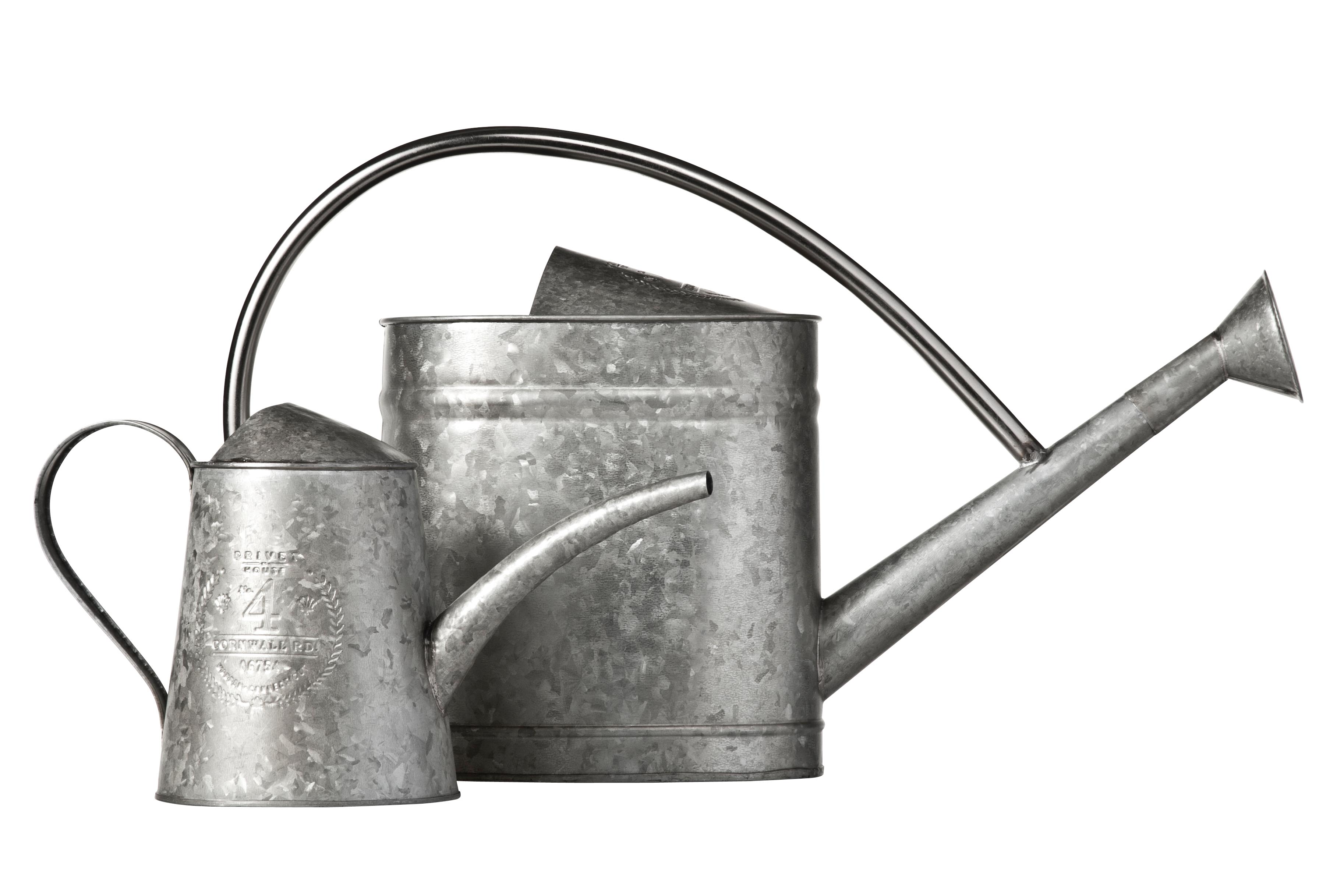
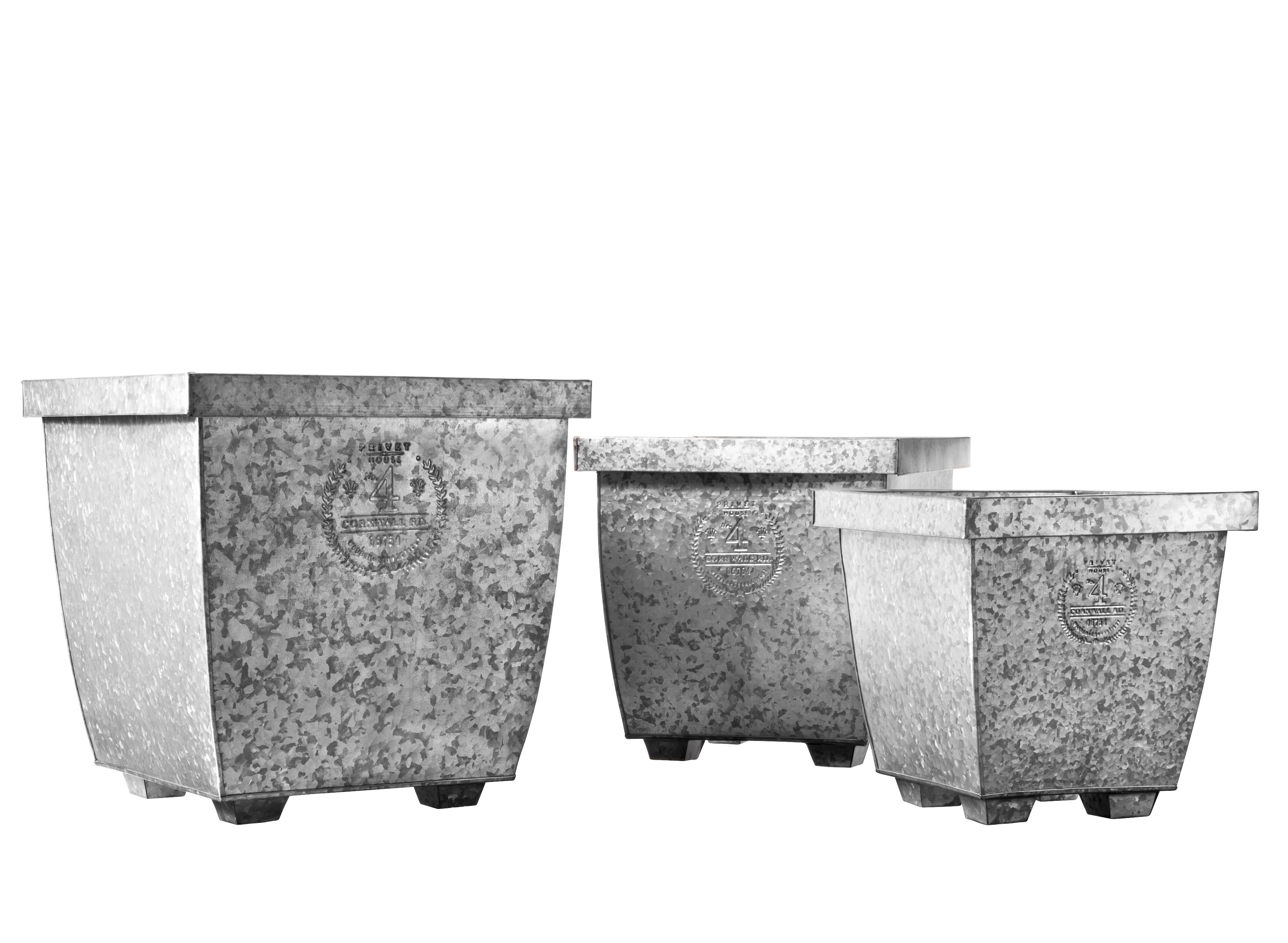
But the good news is that the Privet look is available to the masses at The Shops at Target - they have a branded line there right now full of lots of things I love including galvanized tin garden supplies.

Dishes galore, including many funky pattern melamine ones, perfect for patio meals…

…and these embossed white china ones which may be my perfect summer home basics!

So in addition to the antique shops, I have also managed to make it over to Target (but still not the supermarket) and loaded up on Privet House items – all on sale too!

Jet lag fugue state closing in so it is time to go sit on the porch. And my children want dinner – the nerve of them! Here’s one more image of wonderful things here at the house – my hydrangeas are gorgeous and look so pretty in the transferware bowl. And you can see how similar the wall paint color is too!

Happy Summer!

Image credits: 1-4 & 14-15. me, 5-7 & 9. via Privet House, 8. via Good Bones Great Pieces, 10-13. via Target

Read Full Post »

Do you like your karakusa hot?

Or cool blue and white?

Your darumas bright?

Or modeled by the chef dressed in white?

Artist Lisa George of PaperGlueBamboo is having a sale this week of her new Spring 2012 line. For an extensive post about her modern take on the ancient craft of ikkanbari, take a look at Artist Spotlight…Lisa George and the Modern Art of Ikkanbari at PaperGlueBamboo. Her Tsukiji market shopping baskets would be great for toting stuff to the beach or having a summer picnic. Drop me a note at jacquelinewein[at]yahoo.com if you are interested in an invitation.

All this talk of baskets and ikkanbari has caused me to have an epiphany about a possible solution to the ceiling fan light at the beach house that I mentioned just the other day. Ceiling fans can be a necessary eyesore and I had been scouting ideas on improving them, finding posts over at Young House Love and Thrifty Decor Chick where they added a lampshade to give a fan light more style.

Those photos clicked in my memory with this photo from Kawagoe shrine sale last year in which a dealer had hung a basket upside down for eye level display. Even at the time it reminded me of a lampshade, but I didn’t put it all together.

Here’s another similar Japanese open-work basket, narrower and deeper than the one above, shown upside down to mimic a lampshade. It might just make a perfect lampshade for the ceiling fan, adding a bit of softening to the bright light and accessorizing the room. The basket has a great beachy feel too!

And if the open-work of the basket doesn’t camouflage the light bulbs well enough, we could always wrap it with a bit of washi paper ikkanbari style like this one…

George, are you listening?

Related Posts:
Artist Spotlight…Lisa George and the Modern Art of Ikkanbari at PaperGlueBamboo
Sweating the Details…A Round-Up of Brass Library Wall Sconces

Image credits: 1-4. Lisa George, 5. via Young House Love, 6-7. me, 8. via Lamps Plus

Read Full Post »

Each year for the past 434, a market has been held in the Setagaya neighborhood of Tokyo on December 15th & 16th and again on January 15th & 16th. With over 750 vendors selling everything from apparel to electronics to antiques, things both old and new, as well as food stalls, flowers, and just about anything else you might imagine, the market defines what a “flea market,” as opposed to a “shrine sale” is in Japan. Called the Boroichi, or rag market, there is much to buy beyond rags, although trade in vintage and antique textiles continues to be one of its main draws.

The prices on vintage kimono and obi are unsurpassed, as demonstrated by the free-for-all at this stall selling obi for 500 yen.

New indigo dyed textiles and clothing is also available.

Perhaps my favorite thing was this dealer selling Japanese kamon (family crest) stamps. Easy to pick one up and use it to customize your correspondence, regardless of whether or not you actually have a family crest.

I also loved all the handmade housewares and baskets.

I made a few good finds, including some antique blue and white porcelain platters and interesting textiles. But by far the find of the day belonged to my sweet husband. He picked up a fancy brand, gortex coat with zip-out fleece, list priced here at 68,000yen and found on google in the USA for about $550, for all of 13,000yen. And as a result, it made him perfectly happy to carry my packages!

There is still time to visit tomorrow! Maybe it won’t be so terribly crowded on a weekday…

For more on the history of the Setagaya Boroichi, directions and maps, take a look at this 2009 article in The Japan Times or the Time Out Tokyo listing.

Read Full Post »

Found at almost any antique show and many shrine sales, Tsuba, the ornate metal sword hand guards, a key component of any good samurai’s sword uniform, are one of those things that befuddle me a bit. While I adore Japanese metal work and its incredible influence on my original specialty, 19th century American silver, I seem to lack enough testosterone to find the tsuba themselves fascinating. And buyer beware, they (along with inro and netsuke) are one of the few areas of Japanese antiques in which fakes, or recent copies abound. Real ones should be crazy expensive, as in 5 digit yen at least, so if you find one at a flea market for the equivalent of $50, most likely it is too good to be true. And like obidome, which I adore, they are beautiful, no doubt, but what are you actually going to do with them?

Enter November’s House Beautiful and an ingenious design by Josie Natori – this Tsuba inspired napkin holder – gorgeous holding paper napkins on a drinks bar, or even for an outside party, so that they won’t blow away.

A perfect house or holiday gift, no?

Read Full Post »

I am having another round of selective perception. Do you know the feeling when you notice something once and then next thing you know it is just everywhere? That has been the case with vintage Japanese maekake, the heavy cotton aprons, usually dark indigo in color, historically worn by staff at small manufacturers and breweries. These days they are retro-chic with the young set, being worn by staff at cool izakayas (simple food and bar restaurants). They have almost a denim feel and the waist ties are a thick woven double-sided cotton, often bright orange. Their simple but strong graphics caught my eye again and again at the Heiwajima Antiques Fair last week.

Many are around the fifty year old mark. You can often tell more specifically by the old-fashioned telephone numbers or styles of writing.

One idea on how to reuse the maekake, besides the obvious original intention, is to turn them into visually graphic pillows like these in Paul Ludick’s living room made from simple kamon (japanese crests) banners.

But the best idea by far is one I don’t have a photo of. Aaargh! Much to my chagrin, I was too busy talking to a lovely gentleman at the fair about his handmade maekake tote bag that I forgot to take a photo. (Hmmm….seem to be doing a lot of that lately). Anyway, he (or actually his wife) had sewn a bag out of a vintage apron and it was great looking. The zipper pocket in this one got me thinking about making one for myself – perfect for a cellphone or a couple of bucks (or should I say yen?). I didn’t end up buying any but went home stewing on the idea.

A few days later the Kawagoe market was full of aprons too.

I found a fabulous and unusually colored faded green one too, but another young woman browsing seemed to want it so desperately that I gave it to her. I found more joy in her happiness than I would have had in purchasing it.

My favorite dealer was wearing one exactly as it should be worn! I noticed other dealers wearing the sturdy aprons too.

So if fate was surrounding me with aprons, then I was clearly meant to buy one. I found a really cute small one with an outside pocket and a great design. I am pretty sure it is from a sake brewery.

Stay tuned to see the finished project!

Speaking of indigo bags, my friend Jane Farrell has been sewing absolutely beautiful patchwork and sashiko totes. I am going to try to have her work for sale sometime soon!

And speaking of selective perception, the aprons are not the only things that have been clubbing me over the head. Remember those great vintage shoyu (soy sauce) bottles I just wrote about?  I had never particularly noticed them before either, yet I saw them everywhere at the Oedo fair with Peri Wolfman and also at Heiwajima. Definitely different bottles and different dealers too!

Continuing off the topic, but still kinda on it, hop over to the post I wrote this summer about Wedgwood jasperware cheese keepers. Had a huge spate of selective perception there too so I added a big addendum to the post!

Image credits: all photos mine with the exception of the Elle Decor December 2006, photo credit: William Waldron, and Jane Farrell bags courtesy of the artist.

Read Full Post »

The Oedo Antiques Market is a jewel. While it lacks the charm of being on the grounds of a temple or shrine, it makes up for it by being held in the shady courtyard of the Tokyo International Forum at the convenient junction point of Hibiya, Marounouchi and Yurakacho. While it tends to be higher along the antiques food chain and thus higher priced than a conventional shrine sale, it makes up for it by having some of the best quality merchandise to be found. Held on the first and third Sundays of the month, and the fifth Sunday is there is one (like there will be this October), it is one of the most pleasant antiquing experiences to be had in Tokyo.

Luckily for me, Peri Wolfman of Wolfman-Gold & Good fame was in town visiting her niece, my friend D. For more on Peri, see my previous post. This past Sunday I took them to shop the Oedo market and we all had a wonderful time and bought lots of goodies. The entire day was colored by Peri’s aura, meaning it was black and white. We looked at and bought nothing frou-frou or fancy. No blue and white porcelain, nothing gilded. Everything was simple, streamlined, functional and lovely because of it. I did mean to take so many more photos chronicling the day. Photos of what we looked at, what we liked, you name it.  But sometimes you have to live just to live, not live to blog, and Sunday was such a day. I was too engaged to even remember to pull out my camera half the time, so I can only show you a record of what we actually bought.

First up were these bowls by ceramicist Ando Masanobu. As I am not familiar with his work, I did a little research and found this description in the online edition of Kateigaho magazine (which you should be reading if you are at all interested in Japanese arts and culture). ”Perhaps the most fitting description of his pottery, reflecting a balance of sensibility and philosophy, is the word refinement. The striking forms of his solid white or black semi-matte vessels bear minimal ornamentation.”  No way to say it better than that. I do wonder how these bowls ended up down in Tokyo, but the karma was perfect because they were meant for Peri. As a pair, they also display one of her golden rules, which is never buy ”onesies”. Multiples are king!

Ando also runs a gallery called Momogusa in an old minka (farmhouse) that he moved to in Tajimi and rebuilt. Besides his own work he exhibits ceramics, glass, washi, textiles, and so on by other artists. Looks like it is worth a visit!


These were quintessential Peri – a group of Edo period pottery stacking bowls – albeit the largest one was the size of a golf ball. Scale is hard to show in this kind of close-up but consider the grain of the matting underneath and it gives you a sense of their tiny-ness. Peri is currently developing a line of tableware for Restoration Hardware –  the reason for her visit – and stacking items are definitely a part of it.

We almost overlooked the military dealer – you know the one who has all the Japanese army uniforms and sometimes other creepy stuff – there is always one like that at every market. Luckily these caught our eye and we stopped. These are old mess hall dishes made of white ironstone from the days before plastic. The small deep bowl is meant for tea.

And of course it wouldn’t be Peri without some white ironstone pitchers.  These look French, but the marks are actually Japanese. Wonderful shapes! And shown perched on one of a pair of rustic children’s chairs bought too.

We both got amazing little black and white woodblock prints. One for her…

…and one for me.

These metal clip on sconces may not look like much here, but let me tell you they are dynamite! Painted green metal with wonderful patina and best of all, they don’t require any holes drilled to hang them (which is a big issue in Japanese rentals, let me tell you). Just clip ‘em where you want ‘em.

Imagine them like these in this dreamy Jill Brinson designed bedroom.

Simple bargain frames made of sakura (cherry) and bamboo came home with us too. Peri thought the speckled paper under the glass of the rectangular one was so pretty it could be used as a tray instead.

Peri is all about storage (just peek back at that Oprah magazine article) and both D and I got some of these charming vintage apothecary drawers to stack on my desk and in her entryway.

What a great day! Peri looking fabulous in her usual black and white while I look as goofy and over excited in this photo as I felt.

Oh, and last but not least, I need to report that the marble-topped pastry table in Peri’s earlier kitchens was sold along with the house…

Read Full Post »

American reality shows other than Idol don’t translate well in Japan, so I have been missing the proliferation of design content on HGTV and other networks. No Design Star or Million Dollar Decorators have been able to tempt me to watch them. That is, until they all started to visit my decorating backyard, better known as Asbury Park, New Jersey. Asbury has many famous associations, perhaps Bruce Springsteen and The Stone Pony being the most obvious to my generation, but it is also a historic beach community that has been riding a roller coaster of redevelopment as of late. The boardwalk and the downtown area along Cookman Avenue are in an upswing of renewal, filled with delicious restaurants and design shops joining long-standing antique stores (more on those in my next post). By far the best of these new shops is Gene Mignola and Scott Hamm’s Shelter Home, as the three lucky episode winners on HGTV’s Design Star discovered.

Design Star has a basic Project Runway type format. Each week a challenge is offered up and the designers compete to impress judges. One participant wins, one loses and leaves the show and the rest remain to compete the following week. Last week’s episode had the designers redecorating a bed and breakfast in nearby Spring Lake, NJ, either paired up or in one case, tripled up. While the pairs got regular bedrooms to work with, the trio of Meg, Mark and Karl got a suite. They had a slow start in making a cohesive plan, but got off and rolling as the show progressed.

Here’s the before photo of the winning room. Not much to work with, other than the expansive layout of the larger suite.

And here is the winning after view. Almost everything of note in the room is from Shelter Home – the couch, Buttercup chair, throw pillows, print, rug and more. You see now why I called the winners lucky. They were the only ones to shop at Shelter Home and the room would be nothing without it. Karl did do a beautiful job with his free form painted “paneled” walls, subtly evoking the beach and skyline. And I also enjoyed the very Tom Scheerer-like rope sculpture and arrangement Mark put together.

Here is a photo of the winning trio. Ironically, the thing I liked least was the favorite of the judges, the sleeping area designed by Meg, using fabric from Designer Fabrics on Route 35 in Ocean, an unassuming but great fabric store I use all the time.

Currently, Shelter Home has the same couch as the one featured above, a queen size sleeper called “One Night Stand” in the shop in grey.

Meg, Mark and Karl used the octopus print in green and it is also available in red. Not shown in any of the photos above is their use of the Algues wall sculpture, designed by the Bouroullec brothers, and here hanging on the wall of the store.

In addition to the items used on the TV show, Shelter Home has so much more to offer. They have a sample of every Dash & Albert pattern, which is lovely as the colors are so hard to judge on the website, as well as many of the rugs for sale in the smaller sizes.

There is also lots of John Derian decoupage, hard to find outside of his eponymous store in NYC.

Every color Point A La Ligne candle.


The largest selection of Alessi in the state.

The Chin Family of timers and salt shakers, designed by Stefano Giovannoni and Rumiko Takeda, is the result of a collaboration between Alessi and the National Palace Museum of Taiwan. While these little fellas are Chinese…

Don’t they remind you of modern Japanese kokeshi dolls?

Shelter Home is also stocking a shin-hanga inspired line of cards, like this one, by Ryo Takagi, particularly at their secondary location, a seasonal kiosk shop in the grand arcade of Convention Hall along the Asbury boardwalk.

If you can’t visit, take a look at their website as many of the items mentioned above are available for sale.

Shelter Home
704 Cookman Avenue
Asbury Park, NJ 07712
Phone: 732.774.7790
Fax: 732.774.7799
info@shelterhome.com

Watch for my next post as Design Star isn’t the only HGTV show to visit Cookman Avenue recently…

Read Full Post »

Older Posts »

Follow

Get every new post delivered to your Inbox.

Join 405 other followers

%d bloggers like this: