Feeds:
Posts
Comments

Archive for the ‘History’ Category

french campaign bed

Since we were recently talking about daybeds I’d love to share one of my own family flea market stories. Years ago, my husband and I started the tradition of visiting Paris for his birthday very early on in our marriage. February was low season and you could always pick up a super cheap air ticket from New York. My motivation for going was yes, to celebrate his birthday, but really to head out to one of my absolute favorite places in the world - Les Puces de Saint-Ouen – the huge multi-shop market at Porte de Clignancourt commonly referred to as The Paris Flea Market. There really is no place to rival it in the world, and although it has become more expensive these days, there are still always treasures to be found. Definitely a bucket list destination for any antiques scavenger.

While I had bought small items in the past, I had never bought furniture there (something that has since changed dramatically) before that visit. Nor had my husband ever been with me – actually, he hadn’t been my husband prior. For some reason he knew that I loved campaign furniture, in particular the small folding iron beds of the mid 19th century and he spied a beautiful one in a cute stall. Our bed wasn’t particularly special, one of probably thousands of Napoleon III era iron beds that were made for officers to be able to live in comfort while on military campaigns. We asked the price and began negotiations. Now remember, we were newly married and fairly poor, so price was a big issue. Perhaps he wanted to show off his newly minted lawyerly skills, but he ended up negotiating for hours (or it least it seemed that way). In the end he got an amazing deal (and has never bargained for me since), but we almost had a last-minute snafu as the shipping agent was an expensive issue. So he actually managed to talk the dealer into packing it in a bicycle shipping box (oh the joys of collapsible traveling furniture) and inexpensively freighting it straight to JFK where we could just pick it up. As we left the stall, the dealer told me that I had “caught a good one!”
I don’t know if he had a premonition in that moment of two daughters or what, but the bed ended up being ideal for small spaces – New York and Tokyo bedrooms fitting that description. Personally, I’ve always imagined that when my daughter outgrew the bed (which so far she is not willing to give up), that I could use it for myself as a place to lounge, read, nap and dream. Since we bought our beach house, I’ve fantasized about having it outside on the porch, all comfy and inviting, like this…

porch with iron bed

…or this.

Kurgan iron daybed wicker porch CL0312pc Max Kim-Bee

Just imagine the joys of pillow options!

Myra Hoefer HB0606

But now that moving to Doha is on my horizon, I am thinking it might be a perfect piece for our garden there. It never rains, so the rust issue is avoided and hopefully we will have some sort of covered patio that we can hang out on.

iron daybed outside via little emma english rose

iton daybed outside via little emma english home

Amelia Handegan iron daybed on porch

Our shipment is going to be a tight fit in the container, so it’s a good thing that the bed frame folds up flat. I wonder if this bed will end up traversing the globe? Paris-New York-Tokyo-Doha and maybe back to New York some day…

About these ads

Read Full Post »

“…a young apprentice geisha must learn a new way of sleeping after her hair is styled for the first time. She doesn’t use an ordinary pillow any longer, but a taka-makura-which I’ve mentioned before. It’s not so much a pillow as a cradle for the base of the neck. Most are padded with a bag of wheat chaff, but still they’re not much better than putting your neck on a stone.”
Arthur Golden, Memoirs of a Geisha

It doesn’t sound to me like a very comfortable way to pass the night, but sleeping on a takamakura (tall pillow) was instrumental in preserving the elaborate coiffures worn by geisha.

geisha taking nap on pillow

These days, they make wonderful decorative collectibles, like this one tucked against the books in the side table of a room previously featured in my Provenance column on kasuri over at Cloth & Kind.

IMG_1612

The base is made of lacquered wood that is gently curved, to allow for some rocking movement while in use. A silk or cotton-covered pillow, filled with buckwheat hulls or chaff, crowns it and provides some limited comfort. Dark or orangey-red lacquer is most common and sometimes the pillows are made from interesting textiles, like in this case, covered with asa-no-ha (hemp leaf) pattern. And if you are thinking Kelly Wearstler’s Katana, now you know where she got her inspiration!

takamakura

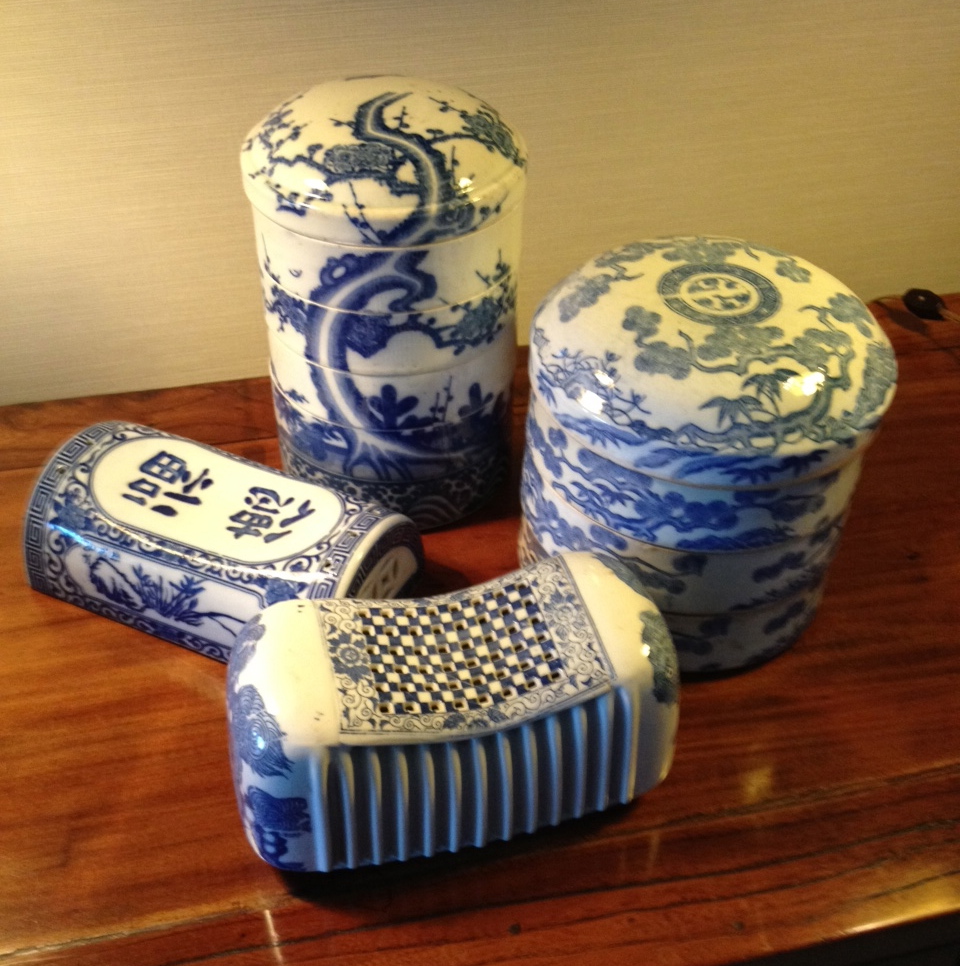
A similar takamakura rests on the top shelf of a very large collection in a Westchester, NY bedroom. As you can see, most of the geisha pillows are either red or black and the finer ones have detailing in the lacquer. This collection also boasts a few wooden examples as well as some blue & white porcelain ones.

LJ geisha pillows

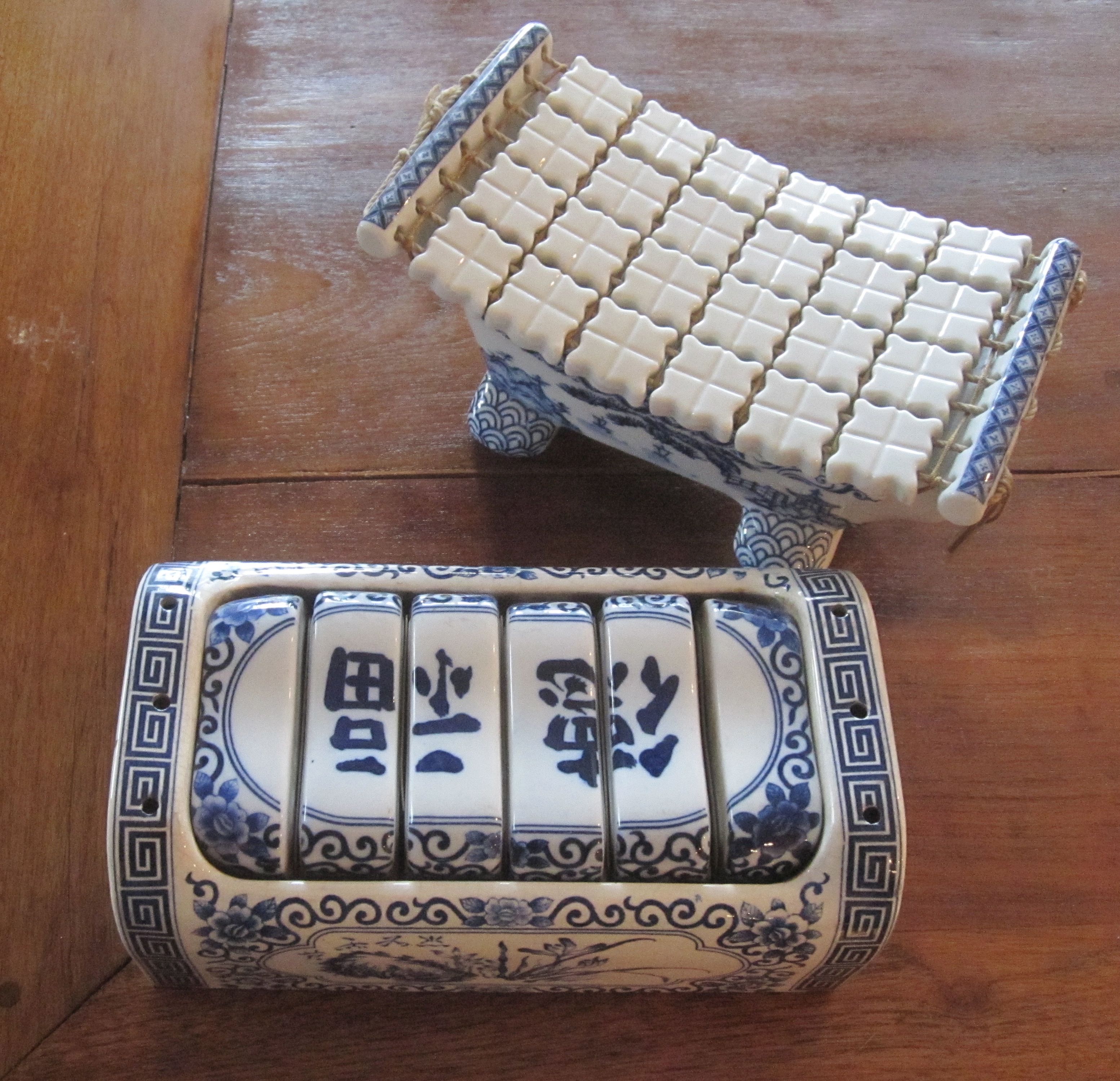
While many of the lacquer and cloth takamakura date from the 19th century, most of the porcelain ones commonly found are early to mid 20th century. The porcelain ones seem even less comfortable to me, although some are designed with special comfort features, like these two. The top one has small porcelain squares strung together almost like a hammock that allow for movement. The one with the kanji marking on top can accommodate hot water and/or medicines in its hollow cavity and the gaps in the top of the pillow let the steam or aroma rise. I’ve actually seen takamakura with pharmacy labels or stamps.

blue white porcelain geisha pillow

Regardless of their functionality, they are supremely decorative and look great mixed with books in shelves or on their own…

blue white porcelain pillow display

…or combined with other porcelain pieces like these jubako here in a Tokyo entryway…

cate geisha pillows

…or here in a cubbyhole in a girl’s bedroom in San Francisco.

photo

She should be happy they rest on a shelf and that she does not rest on one of them!

N.B. You’ll notice repeats in these photos, but it is not a styling trick. All of these takamakura belong to different people, it’s just that many models were produced on a large-scale. Hand painted ones tend to be older and more individual than the inban, or transferware, versions.

Vintage geisha photo, most probably by T. Enami via Geisha Moments Facebook page.  Thanks to everyone else who provided photos for this post.

Read Full Post »

With the development of economy and progress of industrialization, more and more machine-made cloth has been taking the place of calico, home-made and hand-imprinted and dyed in the country. Therefore, blue calico, as a work of folk art, has been gradually losing its practical value.

Indigo Textiles: Technique and History, Gosta Sandberg

slideshow_3

What do you see in this photo? Japanese yukata (cotton summer kimono) hanging on a line perhaps? It wouldn’t be an unreasonable guess based on the color and pattern, especially if you were just looking at the rolls of yukata fabric in Amy Katoh’s Blue & White store, like I was the other day. Hand-dying is a dying art everywhere, and we are lucky when people like Amy step up to help keep it alive.

IMG_1953

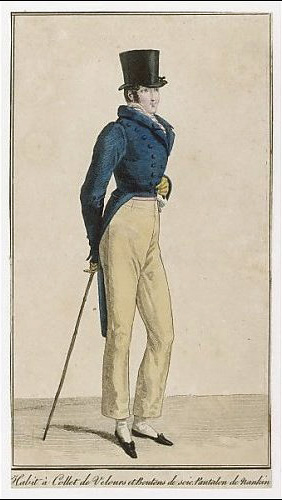
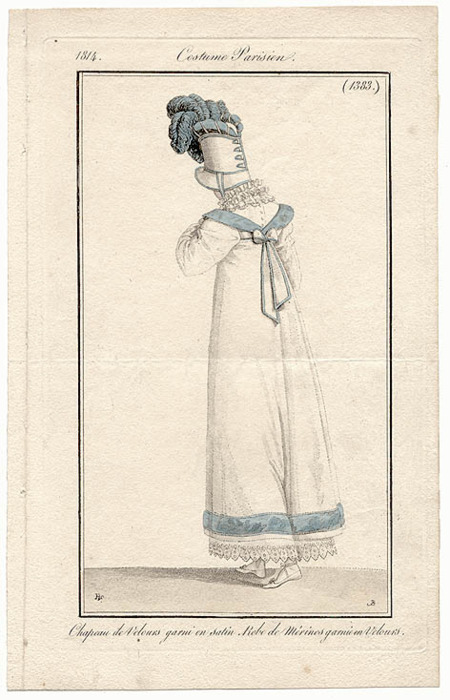
But the answer to my question above is actually not Japanese at all – it is Chinese nankeen, stencilled and dyed in an indigo bath. Originally, the word nankeen was used to indicate the very dense and unrefined hand-woven cotton fabric itself, but over time has come to be used interchangeably with its patterned and colored counterpart. Often referred to as blue calico, it was the main component of peasant clothing in China for centuries and in its plain form came to be an important export. A staple of British clothing from the late 18th century onwards, any Jane Austen fans among my readers will recognize it as a common fabric used for half boots worn for walking, as well as for mens breeches and pantaloons – the modern-day equivalent of chinos. Even its signature pale yellow color is often mentioned.

Nankeen_Trousersournal des Dames et des Modes, 1814

Ironically, while the upper classes in Europe were wearing nankeen, in China it was the fabric of the rice farmers, who used it for warm padded winter clothing. In Indigo Textiles: Technique and History, Gosta Sandberg writes “The jacket of the Chinese rice-farmer has been coloured with indigo since time immemorial. The reason for this is said to be that cloth dyed with indigo is many times stronger than undyed cloth and that it keeps insects and snakes at a distance, which is a considerable advantage for those working in open fields.” I don’t know if that is actually true, but it is consistent with work clothes in many cultures around the world, including our very own Levi’s.

Enter into our story – and there is nothing I like better than a good old-fashioned expat tale - Claire Russo and Liza Serratore, the founders and designers of LuRu Home, a new-ish textile based home design company working with modern versions of nankeen, based out of Shanghai. Selling pillows, napkins, place mats, tea towels and bags, all made from the custom hand dyed fabric in their versions of traditional Chinese patterns, it is good to see others taking up the banner of preservation, while innovating at the same time.

slideshow_7

Liza and Claire had been friends since high school and kept in touch, planning to go abroad for work in response to the poor economy in the United States. After a few twists and turns, both ended up in Shanghai. One day they came across bits of old blue and white Chinese fabrics that they found in a tiny shop at end of long alley way – one of those magical moments that if we are lucky, we stumble across a version of, sometime in our own lives. The store was jam-packed with textiles, many sun bleached around the edges, and they came home with a few individual meters, recent but vintage.  Their original impetus was to make things for their own apartment, and then for gifts, and from there the demand began to grow. They found they had passion for the fabric and as they investigated the printing process, a desire to rejuvenate the industry and bring patronage back to the artist.

Fabric Hanging in Yard

The technique for making nankeen is a rice paste stencil resist technique almost identical to that of Japanese katazome. Just like the two countries currently arguing over the Senkaku Islands, they also argue over whose technique it was first. Frankly, I think it truly originates elsewhere in Asia, but I am not about to enter the scrum.

 Antique Chinese nankeen…

Antique table cloth patchAntique Nankeen

Does it look familiar? Antique Japanese katazome.

katazome

Both techniques use a paste glue to cover the open patterned area of a stencil, keeping it from absorbing the dye. In Japanese these stencils are called katagami – and I have written about them as decorative devices as well as a functional ones before. The Chinese nankeen artists do all their screen cutting by hand using simple craft paper that has been oiled. I can’t help but hear their Japanese counterparts whispering in my ear “They just use plain craft paper?” and the Chinese reply being “Why do they bother glueing all those layers of washi paper together with persimmon extract? Boy, that is a laborious waste of time!” While the Japanese use rice paste, the Chinese use soybean and lime paste mixed with water.

Paper Screen : Paste on Fabric

The base cotton is no longer hand loomed, but it is still very size limited based on the traditionally sized dying vats. It is also quite difficult to work with screens beyond a certain length so the largest screen possible is 32 inches and the rolls of fabric are 12 meters long. This automatically insures that all LuRu Home’s pieces are small batch made and variations are part and parcel of the product, depending upon the whims of the dyer and even the weather for drying.

Nankeen dye dipping

The fabric is finished by using frosting-style knives to scrape away the paste after printing and then the fabric is put through a wash cycle with no soap and dried.

Scraping the paste post-dye

Their patterns have been inspired by historical patterns in An Overall Collection of China Blue Calico Vein Patterns compiled by Wu Yuan Xi, although not everything in the book is a traditional pattern (zebra anyone?). While Claire and Liza want to starting designing their own prints, the nankeen artisans will have none of it until the women build up more guanxi (relationship currency).

Wu Yuanxin 11cropWu Yuanxin 8crop

They have been extrapolating and changing the old prints and ironically that has helped them build guanxi as it shows their respect and appreciation for the process. A perfect example is the Flower pattern, which was too small and tight as it appeared originally. They enlarged the size and added white space to up its graphic punch. So for now, they are going to continue playing with tradition and plan to introduce a new pattern every season, which is twice a year, by adding one and pulling one, keeping 6-7 prints available at all times.

Flower Prints

Their gorgeous website shows all their products and they also have a lovely lookbook with great styled shots. This outdoor view, also shown above previously, is my favorite.

Table Setting 2

I’m dying for a few of the adorable tea towels, pun untended! They make great gifts too.

DSC_9252

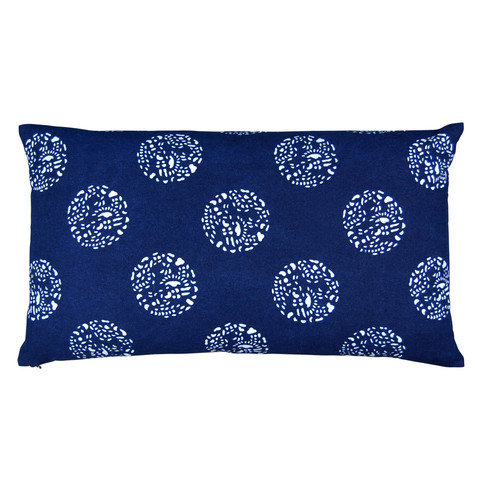
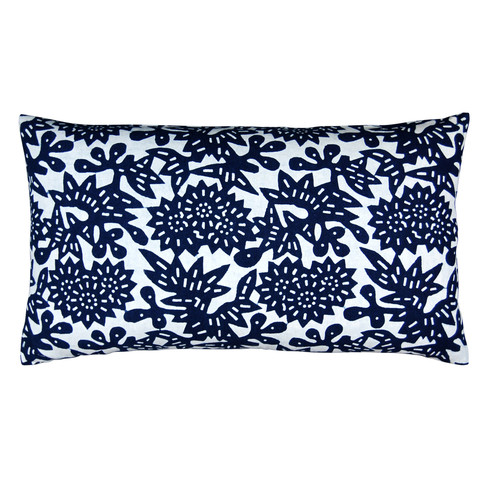
So now for the fun part! Liza ad Claire have generously offered one 13 x 22 lumbar pillow (insert included!) in one of their four most popular patterns On The Fence, Babyteeth, Dot Dot Dot and Flower - the giveaway winner’s choice. All you need to do to enter the giveaway is leave a comment below. If you like LuRu Home on Facebook, I will enter you in the giveaway a second time, doubling your chance to win. They can ship to the winner anywhere in the world as they have stock in both the USA and China. The giveaway closes Monday night at 12 EST. I am crushed, of course, that I can’t enter myself!

on the fence pillowbabyteeth pillow

dot dot dot pillowflower pillow

Their pillows look great styled with other indigo and blues, as seen here at Nicky Kehoe

luru at Nicky Kehoe

…as well as with an assortment of other colors, like here at Black & Spiro.

luru at Black & Spiro

Although record prices are being set for fine antique at auctions by wealthy Chinese looking to repatriate lost treasures, the locals LuRu works with are a bit bewildered by the women’s’ fascination with nankeen. Anything folk art based is undesirable these days in China. Louis Vuitton or (even Luois Vitton) is what is hot. But Claire and Liza have stiff competition from other buyers in procuring their fabric. From whom, you may ask? Can you guess?

The Japanese!

Image credits: All images credited to LuRu Home or the publications listed with the exception of #2 (me) and the 19th century fashion plates from Lady’s Repository Museum.

Read Full Post »

IMG_0654

In my recent post about jubako, I mentioned that there was quite a story to tell about the soft cloth dolls displayed next to the porcelain in the photo above. As the second anniversary of the Great Japan Earthquake approaches and this Sunday, March 3 is Hinamatsuri, Doll’s Festival or Girl’s Day, I think now is the perfect moment to tell it.

Hinamatsuri is a festival that celebrates the healthy and happy growth of girls. Families with daughters everywhere set up very large traditional displays, with the hina-ningyo (dolls) placed along a red felt covered tiered stand with the Emperor and Empress at the top and the other dolls placed progressively lower based on their hierarchy. The dolls wear costumes of the Imperial Court during the Heian period (794-1192). Realistic furniture, lanterns and toy food complete the display and golden byobu (screens) provide a backdrop just like the real Imperial throne of the ancient court.

hinamatsuri

Charming miniature two doll displays are also very common as not everyone has room for a full display. The small peach blossoms are always included as it can also be referred to as Momo no Sekku, or Peach Festival, based on its seasonal calendar date.

tinyhinamatsuri

These huge displays are very expensive to purchase and I am always amazed when I see families buying them new as I come across them at shrine sales all the time. I have to keep myself from buying them as they are so adorable. A little tip – they are great candidates for Western style repurposing as they make really unusual doll house furniture – great gifts for friends back home.

hinamatsuri furniture at shrine sale

Last year around this time – actually a bit later in March – my daughters and I, along with some friends, traveled up to Tohoku in Northern Japan to volunteer with a great grassroots organization called It’s Not Just Mud. Headquartered in a few partially destroyed houses, with little electricity and no heat, it was quite an experience for us as we had never suffered such a level of discomfort before. Just realizing that people had been living like this for over a year was an incredible eye opener.

its not just mud P cold

INJM makes it very easy to come and volunteer and they run a number of service projects that range from heavy labor (rebuilding playgrounds) to lighter but no less important social work.  We were lucky to be involved in the launching of their ‘Tsuna Cafe,’ in which informal tea parties were organized in the communal space of the “temporary” housing complexes (which look more semi-permanent by the day). The parties are a chance for residents to communicate with each other and meet volunteers who bring cheer and friendship.  One of the post-tragedies of the earthquake and tsunami is that village and neighborhood links were lost as residents were assigned to housing units on an ad-hoc basis. No attempts were made to keep communities together and the majority of those unable to rebuild or move elsewhere are quite elderly.

tsuna cafe photos

As this was one of the first times the Tsuna Cafe was being held, the kids went around to all the units and rang door bells and distributed flyers announcing the party. My younger daughter, who was 8 at the time, rang one bell, but as no one was home, she began to walk away. A woman opened the window and beckoned for her to come over. She handed her the flyer and the woman gave her a bag of small bean paste filled donuts and told her that she had very beautiful eyebrows – which happens to be true. She thought no more about it.

We assembled for the tea party, putting out snacks and getting ready to use our best Japanese. My elder daughter had made many friendship bracelets in advance, expecting the children to want them. Ironically, many of the older women were clamoring for them!

friendship bracelets at the Tsuna Cafe

After a while, an elderly woman came in carrying a paper bag and approached my younger daughter. It was the same woman who had complimented her eyebrows! She opened the bag and took out what appeared to be folded cloth. Her Japanese was so colloquial that we couldn’t begin to understand her so one of the very fluent volunteers came to help translate.

hinamatsuri in tohoku

Basically, she told us how after the war, when everything was destroyed and she had nothing, an American soldier gave her an American doll and that changed everything in her life because she had something to play with and love. She never forgot this moment of kindness and sewed these small fabric Hinamatsuri dolls many, many years ago, with a plan in mind to give the Japanese dolls in turn to an American child. She had been waiting and waiting for the right child to come along. As she presented them to my daughter – we were all crying by now – my sweet little one said “Mommy, it’s a miracle!”

IMG_5842

Somehow, in all the excitement and bustle we never got her name. But my daughter will have those dolls and that memory forever.

We are hoping to go up again this spring and perhaps we can find the doll lady. Please remember that the work here in Northern Japan is nowhere near done, even though it has faded from the news. And for a small organization like It’s Just Not Mud, every donation helps.  For more information on volunteering, please click here. For more information on making a donation, please click here.

Related Posts:
The Porcelain is Alright (Kids Too)…My Tale of the Big Japan Earthquake
Hands On Tokyo…A Taste for Volunteering 2012

Read Full Post »

“Female workers in cotton spinning mills, silk reeling plants, cotton and silk weaving factories and sheds formed a large and vital part of the Meiji industrial labor force. In 1882, textile plants employed about three-quarters of all factory employees in Japan. In 1909 female workers, mostly in textiles, made up 62 percent of the Japanese factory labor force. This pattern continued for many years — as late as 1930 the majority of Japanese factory workers were women……”

— E. Patricia Tsurumi; Bulletin of Concerned Asian Scholars, Vol. 18, 1986

thread spool silk reel itomaki

Itomaki, antique Japanese silk reel bobbins or thread spools are a common enough sight around Japan. You can be sure some dealer at a shrine sale will have empty ones lying around in a basket…

itomaki

…or even stacked neatly on a bamboo pole.

IMG_0299

The medium size 4 spoke ones are the easiest to come by, while the more unusual large and small sizes less so. Occasionally you can find a big 6 spoke spool, like the one here, or even a folding one, like this one below.

collapsible itomaki

Silk production was a widespread cottage industry in Japan throughout the Edo period and many traditional Japanese farmhouses were designed with special attic rooms for raising and harvesting silkworms. With the advent of the Meiji-era, silk production became industrialized, with women being the main workers. Factory conditions in Japan were awful, much like those during the Industrial Revolution in the West. Girls were forced to work long hours in dangerous conditions in factories and dormitories surrounded by fences. Photographs inside the heavily fenced workplaces were hard to come by, but this c.1915-23 silver print photograph by T. Enami shows the thread being drawn from the cocoons and spun.

SILK FACTORY GIRLS DRAWING THREAD FROM COCOONS in OLD JAPAN

Other Enami photos from the same period show independent cottage workers spinning their silk.

REELING SILK FROM THE RAW COCOON

I love this one of a little girl working outside.

the little silk winder

What is unusual nowadays is to find them with vintage kimono silks still on them, like I did recently.  I found a large grouping of medium size reels (and one small one) with gorgeous peacock colors in great condition.

IMG_0508

The silken threads are luminescent and the unusual color combinations so typically Japanese.

IMG_0504

I wasn’t the only one to get some – a good friend took a few too. They are great at pulling colors out of artwork and textiles elsewhere in the room. Both of us have placed ours on altar tables, although I am not sure I have room to keep them there.

photo

Empty itomaki make fantastic stands for porcelain or plants…

Boston fern and Ballard Designs bench

…or even Japanese fishing floats. This one helps to display the lovely pontil and mark on this float.

glass float on itomaki

See why I said it is all too crowded?

IMG_0318

Readers, I’d love to see how you use your itomaki. Please post photos on my Facebook page!

These and more great Meiji period photographs of Japan by T. Enami can be found on Okinawa Soba’s Flickr photostream.

Related Posts:
Finding the Thread…Between Boston Ferns and Japanese Spools
Woven Wall Art…Japanese Silk Worm Trays, Winnowers and American Tobacco Baskets
En Masse…Iron Teapots, Vincente Wolf and the Art of Grouped Displays

Read Full Post »

Spitalfields then – and we are talking twenty years ago – felt like a place that time and tide had forgotten. The world of early 18th century London collided with crazy, hectic 20th century Brick Lane, and I learned that I loved each as much as the other.
-Ben Pentreath

It is important to note that the present boundaries of the proposed district encompass the remains of a small district which has always been, since its beginning, a distinct and separate neighborhood. Charlton, King and Vandam Streets are not only linked physically, but by a common history…The aesthetic quality of this happily surviving chapter of the early Nineteenth Century architecture is heightened by its unexpected juxtaposition to commerce and traffic. Its sudden revelation to the eye of the passerby from teeming Varick Street and rushing Avenue of the Americas is one of the most surprising visual treats in store for New Yorkers.
- From the 1966 NYC Landmarks Preservation Commission Historic District Designation Report

I have spent a lot of time over the last week thinking about my home – my special New York neighborhood perched between Greenwich Village, Soho and the Hudson River – the Charlton-King-Vandam Historic District. Intensely threatened by Superstorm Sandy, I was worried not only about my own property, but about the potential for loss, or really for change, in a pocket of New York that looks like time forgot it. Those three blocks have always been a magical place for me, even before I lived there, as they almost have the ability to transport you back to the past.

Around the same time, one of my favorite bloggers, architect-author-shop owner Ben Pentreath, put up a post on the Spitalfields neighborhood of London, special to him in its preservation of 18th century Georgian buildings and memorable as it represented his early youth in the city. Opening tomorrow, November 7, at his eponymous store on Rugby Street (which I visit whenever I am in London) is a collaborative group exhibition between Ben’s shop and The Gentle Author, representing Spitalfields artists. The Gentle Author’s blog has been featuring profiles of the artists all week and I can’t stop reading them!

While I won’t be making it to London, at least much of the work is available online, including Alice Patullo‘s fabulous poster for the group exhibition. It was the first piece to catch my eye, reminding me of a papercut, which the girls and I became obsessed with two summers ago.

And then there is artist Rob Ryan, with actual papercuts and some very funky Staffordshire dogs. I would love to buy this for my husband for our wedding anniversary.

Artist Laura Knight deconstructs familiar china patterns like blue willow…

…in her mixed media illustrations.

She even reimagines pink lustreware…

…which you already know is dear to my heart.

Justin Knopp‘s letterpress print is graphically riveting, but it is his printing studio that I am swooning over.

The exhibition features many other artists and details can be found here and here - it is really worth taking a look!

Personally, I am not familiar with the Spitalfields neighborhood, but it has rocketed to the top of my next time in London list (which will be this summer) as it is full of 18thc Georgian buildings, like this one on Fournier Street…

…the precursors to the Federal homes, built in the 1820s in New York City, on King Street…

…Charlton Street…

… and Vandam Street.

The district is so consistent as the majority of the remaining homes were erected in roughly the same period on the grounds of the former 26 acre Richmond Hill estate, which had been built in 1767 with a view over the Hudson River. George Washington and Vice Presidents John Adams and Aaron Burr all had turns living there but it was Burr who saw the economic opportunity in the changing residential tides of the city and planned to sub-divide it. He named the streets Burr for himself; King for Rufus King, a fellow U.S. senator; and Vandam for Anthony Van Dam, a wealthy importer and city alderman. Forced to leave the city after his duel with Alexander Hamilton, John Jacob Astor took over the property, paying Burr handsomely for it. Burr Street was re-named in memory of Dr. John Charlton, former president of the New York Medical Society and a trustee of Columbia University, who had died months earlier.

As the Landmarks Preservation Commission report states: The old houses on these streets are all that remain of a city plan, conceived and mapped in 1797, but almost completely developed between the years 1820 and 1829. The boundaries of this neighborhood were, originally, from the Hudson River (then at Greenwich Street) to MacDougal Street, and from Vandam to King Streets. This small enclave was a piece of “instant city” developed from one large country estate, by the great real estate operator of the day, John Jacob Astor.

The development of these streets in common gave them a continuity and homogeneity which still survives today not only visually, but in spirit as well. This is not Greenwich Village; this is not “downtown”; this is the Charlton-King-Vandam area.

In contrast to the almost pristine preservation of Charlton Street and a bit of grittiness on Vandam, the Landmarks Preservation Commission said it best: King Street has a different sort of charm; it has an infinite variety, the unexpected juxtaposition of Federal houses, Greek Revival houses, Anglo-Italianate, Roman Revival and eclectic buildings of the late Nineteenth Century. The early apartments and the public school still have a certain grandeur while the little Federal houses look cozy by comparison and the Greek Revival houses maintain their own distinct dignity.

Built in 1886-1887, my beloved Queen Anne style interloper at 29 King Street was once Public School Number 8 and served an absolute melting pot of immigrant nationalities. The rumour in the building was that it had become a school for wayward girls in the 1950s and in researching this post I found that to be true (I can’t wait to tell my girls – I think they’ll get a kick out of that). In the early 1980s the building was converted to condos and we were lucky enough ten-odd years later, to be at the right place at the right time at the bottom of the last major downturn in the real estate market, which was a long time ago now. To this day, older visitors will often call from the street, lost, asking where our apartment is in relation to the school building.

While the link between Spitalfields and the C-K-V Historic District is tenuous, in my head they became woven together, as both are places where the past informs the present. Funnily enough, Ben Pentreath lived in New York for five years, much of that time right down the block from us on King Street, although I never had the good fortune to meet him. As he said in a recent article in The Financial Times, his apartment there was the place where he “first experimented with a few strong fabrics and some contemporary furniture alongside old brown tables and chairs, and loved the results.” Here’s a tiny view of said apartment. In the face of so many eschewing traditional “brown” furniture these days and painting everything, I still love some of the old-fashioned brown stuff in the mix and I find it reassuring that he does too.

I am hoping for more views – or at least a bigger photo – in his brand new book English Decoration: Timeless Inspiration for the Contemporary Home, which I have seriously put on my holiday list. All the reviews have been just as good as I would expect (like the one here) and I cannot wait to get my hands on a copy.

If you are interested in reading more about the Charlton-King-Vandam Historic District there is so much information out there and I used the following sites in preparation of this post: The Greenwich Village Society for Historic Preservation1966 NYC Landmarks Preservation Commission Historic District Designation Report, The Story of Charlton Street, and the amazing Daytonian in Manhattan, including this, this and this.

All artist’s works via Ben Pentreath and Spitalfields Life.

Read Full Post »

Happy Birthday America! There is nothing like being an expatriate to make you enjoy celebrating the 4th of July!

Is this my beach house? Well no, and if you read my last post you knew that already. But this extraordinary dwelling is across the street from my little cottage and I get to look at it everyday. One of the most amazing hotels from the hey day of Ocean Grove, it has been turned into a giant single family residence. With its bilateral gull-wing roof and carpenter gothic detailing, it is almost exactly as it appeared when it was built in 1884.

A view from a postcard sent in 1944.

Wanna see the details under the flag?

It really is the largest flag I have ever laid eyes on!

Image credits: 1 & 3. me, 2. Ocean Grove in Vintage Postcards

Read Full Post »

Today was slim on the ground for shrine sales being the second Sunday of the month, but Tomioka Hachiman did not disappoint. It was a day full of friends from out-of-town and extraordinary porcelain, including a few cute and very atypical Japanese pieces bought for the beach house. The small green iris pickle dish will be perfect on the dresser or night table in the beach house guest room for holding jewelry and other trinkets.

It reminded me of the Korin Ogata screens and the garden at the Nezu Museum.

The small Imari-meets-lustreware dish has all the pretty colors in the downstairs rooms of the beach house. Don’t know how I’ll be using it – perhaps as part of a wall display, perhaps on a stack of books on the coffee table to hold olive and cherry pits.

But the person who had the most fun today was my elder daughter who happened upon a stall selling vintage matchbooks from the 1930s-1950s. We have often seen matchbox covers mounted on pages, but not often the entire matchboxes. The dealer had hundreds of them in three big boxes and she spent significant time sorting through them and putting together a charming collection which we plan to place in a shadow box frame. You’ll note her signature colors of lavender and blue.

The story comes as she was choosing her boxes. Much to her chagrin, another man came up behind and offered to buy zenbu – everything – from the dealer. It hadn’t occurred to us and we were immediately sad to see the entire collection go! Luckily, the dealer offered us a few as “service” gifts for making a purchase before he sold off the boxes. We managed to grab a few historical gems.

The first matchbox, dated 1939, features Frank Lloyd Wright’s famous Imperial Hotel, with its stylized logo on one side and Mt. Fuji and an early version of the Shinkansen (bullet train) on the other.

Finished in 1923, the hotel was one of Wright’s masterpieces, famously surviving the Great Kanto Earthquake that year, and in use as the premier Tokyo hotel until 1968 when it was deemed outdated and tragically torn down.

The other matchbox could not have been more timely, featuring the 1948 London Olympics on one side and the 1952 Helsinki Olympics on the other.

Wondering what they might fetch among collectors. Ebay maybe?

Image Credits:  Iris photo by Joseph Keating, via Atsuko & Joe, Imperial Hotel postcard via Old Tokyo, all other photos by me.

Read Full Post »

Hanetsuki, Chikanobu 1896

Art can tell us a particular cultural and historical tale.  If you look up the origins of badminton, surprisingly enough, Wikipedia credits its founding to British Army officers stationed in mid 18th century India. Somehow they forget to mention its much earlier roots in similar games throughout Asia, such as a game called hanetsuki in Japan. If you click on the ukiyo-e print above, you’ll see that the characters are all holding a wooden paddle, called a hagoita, used to hit a shuttlecock in a game much like badminton, although without a net.  Traditionally played by girls and women on New Years, the gaily decorated paddles are still sold today, and vintage and antique ones can be found by hunting around markets and shrine sales.

Because of their quick turnaround time, mass production and inexpensive prices, ukiyo-e prints depict just about anything and everything in Japanese society, hanetsuki not withstanding, and examples abound. I love the pale Edo period examples, such as this Utamaro print from 1804.

Women Playing Hanetsuki at New Year, Kitagawa Utamaro I, c. 1804

None of the women seem to be playing very actively.

Hanetsuki, Musume shichihenge no uchi, Utagawa Toyokuni I

Although, here she really does seem to be getting into her game.

Hanetsuki, Kunisada-Utagawa-Toyokuni-III

Make sure to look at all the textile details on the kimono too.

Girls Playing Hanetsuki (Battledore and Shuttlecock), Kitao Shigemasa 1775

A little photographic proof is nice. I love the way the photographer modeled this picture as if it was a print.

Young women playing hanetsuki, hand colored albumen 1880s by Kusakabe Kimbei

And a late 19th century page from The Illustrated London News has a joyful New Years Day in Yokohama full of hanetsuki and kite flying.

The later prints seem to depict children playing more often than women.

Battledore from Series Life of Children, Shuntei Gyoshi 1896

They are really sweet.

Shuttlecock and Battledore from the series 'Children's Games', Kobayashi Eitaku 1888

There has always been a great connection between kabuki actors and ukiyo-e, with many different artists depicting those characters and stories. I always imagine that the prints were the equivalent of modern posters of pop stars and the like.

Three Kabuki Actors Playing Hanetsuki, Utagawa Kuniyasu, c. 1823

Toyohara Kunichika literally got his start painting the designs for hagoita before going on to become a great Meiji period ukiyo-e artist. Born in 1835, he was demonstrating his artistic talents by the age of 10, working in a shop near his father’s bathhouse where he helped in the design of Japanese lampshades called andon (the same kind of lantern as shown here) and around the age of 12 he began more formal apprenticeship with Toyohara Chikanobu while at the same time designing actor portraits for actual battledores. As he started as a child, it is no wonder to me that his interest in this form never waned.

Rather than designing a scene in which people play hanetsuki like the prints above, these three prints of his depict kabuki actors actually within the frame of a hagoita and date from the 1880s.

These small koban (5 x 7) sized prints show his use of the bright aniline dyes imported into Japan from Germany in the 19th century. They feel almost garish to our modern eye, but the color red signified progress and enlightenment in Meiji Japan. Many thanks to Alex of Toshidama Gallery for sharing these images from an upcoming Kunichika exhibition.

Recently, at the newly re-opened Oedo Market at the International Forum, I have spotted some truly excellent hagoita. Its fun to compare them with the prints above.

It is rare that you see so many unusual old ones together. Prices were quite steep as a result.

And of course I can’t resist adding a modern decorative application. A friend has been collecting vintage hagoita for a wall display in her daughter’s room. You’ll notice she has stuck to sweet kewpie-pie girls – no scary kabuki actors found here – as it might very well give her nightmares.

What is it about decorative display with handles? It is always charming…see the fans and kashigata below.

Related Posts:
Hanga 101…a Quick Primer on Japanese Prints

Image credits: 1. via Ukiyoe-art, 2-5. collection of Museum of Fine Arts Boston, 6 & 9.via Floating Along, 7. The Illustrated London News, source unknown, 8. via Ronin Gallery, 10. via The Metropolitan Museum of Art, 11-13. via Toshidama Gallery, 14-15. me, 16. L. Jardine, 17. via Little Emma English Home, 18. Amy Katoh Japan: The Art of Living, photo credit: Shin Kimura.

Read Full Post »

As a child in Japan, I used to go to a temple and write out a wish on a piece of thin paper and tie it around the branch of a tree. Trees in temple courtyards were always filled with people’s wish knots, which looked like white flowers blossoming from afar.”

Yoko Ono: “All My Works Are A Form Of Wishing”

Yoko Ono has picked up on and modernized a 2000 year old tradition called tanabata wherein people write their wishes on tanzaku (colorful, small strips of paper) and hang them on trees. These temple wishes can be seen throughout Japanese art history, from this circa 1675 byobu (screen) by Tosa Mitsuoki now held by the The Art Institute of Chicago, to this 1852 woodblock print by Hiroshige, from his Thirty-six Views of Mt. Fuji series.

Ono’s project, begun in 1996, is to have wish trees placed all over the world and those wishes for peace gathered together for her Imagine Peace Tower. From the courtyard of the Museum of Modern Art in New York City…

… to the United States Ambassador’s residence here in Tokyo. It was my first viewing of this wish tree that inspired me to do something similar for my daughter’s Bat Mitzvah. How about a wish tree for her, and while we were at it, why not have it be cherry blossoms, in tune with both the season and event?

As the idea progressed in my mind, I thought it would be lovely to actually have the tags be shaped like sakura blossoms. Unfortunately, no matter where I looked I could not find any already made and thus this became a DIY project. Luckily for me, the uber-talented Alisha of Felt So Cute had moved to Tokyo this year and become a great friend! She is a crafting maestro and has all the tools that go with the title including some kind of vinyl cutter called a Silhouette. She found a cherry blossom shape and set the program to cut out the blossoms from three shades of pink cardstock.

We used a pretty hemp twine to make the tie strings and put a sign (using our logo again) in a silver photo frame.

I used one of my antique Seto porcelain planters to hold the pot and bought some moss to cover the not-so-attractive soil.

Here’s what it looked like set up before the party.

And here is what it looked like about halfway through the evening.

So pretty!!

We are going to harvest the wishes tomorrow and plant the tree behind our house. I thought about sending them to Yoko, but we may just have to keep them for our scrapbook.

Related Posts:
A Little Bat Mitzvah Inspiration…Sakura Season in Japan

Image credits: 1. via The Art Institute of Chicago, 2. via Wikipedia, Dominique Browning, Slow Love Life, all other photos by me.

Read Full Post »

Older Posts »

Follow

Get every new post delivered to your Inbox.

Join 424 other followers

%d bloggers like this: