

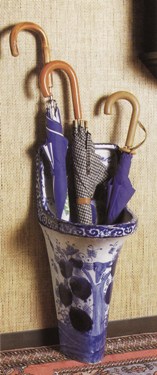
So, if a picture paints a thousand words, what does this one paint for you? Do you see antique blue and white porcelain umbrella stands and plant holders? Or do you see three squatty potties and two urinals? If you chose the latter, then you have chosen correctly. Antique blue and white toilets called benki were popular in the late Meiji and Showa periods, often installed in fine ryokan (inns) or wealthier people’s homes. Fairly rare as singletons, to see an entire collection of five all together is almost unheard of, but this dealer at Kawagoe shrine sale last month bucked the odds. I assume he salvaged them all at one place, perhaps as an old building was being torn down.
Most of these painted pieces are in the Seto style, my favorite, although some seem to be Imari as well. And they were definitely produced on some kind of large organized scale as I have noticed there are only a few basic shapes and patterns that are repeated in all the ones I have seen. The toilets tend to be rectangular, with a squared off front or oval, with a rounded front. The rims always have a tiny detailed painted pattern, quite often traditional karakusa (scrolling arabesque), while the under hood area has a large bunch of flowers.
The urinals fall into one of two categories, either the more tubular umbrella stand shape on the right or the more cornucopia shaped one laying on the ground on the left. Older examples, both of the toilet and the urinals, like the one I saw before here, are hand painted, while the later versions are often more heavily transfer printed.
Somushi Tea House in Kyoto looks as if it has been around for ever, but actually was renovated to look old. To give it that Meiji feel they installed vintage bathroom fixtures. If you were at all confused about how this functioned as a toilet, here’s your answer. And note how similar this one is to two of the toilets above.

On the left is the urinal at Somushi which is more of a cornucopia shape and looks like an earlier hand painted Seto piece. The photo on the right is not as finely painted and looks to be Imari, but it is quite similar to the one laying on the left in the Kawagoe photo above. Umbrella stands seem to be the standard use du jour of retired urinals. The toilets make good planters and I have even seen one turned vertically and used as a garden fountain.

Now for those of you who don’t know, there is complicated toilet etiquette in Japan. In addition to taking off your shoes upon entering any home and putting on slippers, there are special separate toilet slippers kept inside the bathroom. Normally these are ordinary slippers, but I have actually seen painted porcelain ones on a few occasions, out in the markets that is, not in someone’s home. Were these really worn? Or are they just ornamental? I’m not sure, but I didn’t buy this pair last May because their condition wasn’t great. I think they’d make a witty addition to a vignette.

I have seen a few other pairs in my travels and they have always been similar to these, with that distinct feathery Seto style painting.

Without any formal knowledge on the subject, my instincts tell me that the idea for the painted fixtures comes straight from the West. It was not unusual to have painted and transfer printed toilets in the 19th century, like these Victorian versions from Great Britain. There was a tremendous amount of cross-fertilization in the porcelain industry going on in the late 19th century, with ideas, motifs and techniques (such as transfer printing) winging their way back and forth.


And the title of this post? It roughly translates as “feels good toilet,” but maybe “looks good toilet” would be even better. And I know my Japanese grammar isn’t actually correct, but I couldn’t resist the rhyme…
Related Posts:
Made for Export and in My Basement…Seto Porcelain Garden Stool
Shop Talk…Discovering Antique Treasures in Nishi-Ogikubo
I love blue and white but will happily take a heated TOTO over these! Love the post though….had never seen the porcelain toilet slippers.
Once again a great week for readers of TJ!
They are beautiful and I definitely would use them as plant pots but as an umbrella stand, I’m not so sure…Now as you’ve probably noticed 99.9% of toilets of in Japan are either a Toto or an Inax! Well, it just so happens that Inax has a museum complex in Aichi Prefecture of which part is devoted to the blue and white benki (you knew there had to be one somewhere, right!!!)) If you click on this link you will be able to check out the museum’s website
http://www1.lixil.co.jp/kiln/
And if you click here, there are some nice photos of benkis in the museum taken by a blogger.
http://ameblo.jp/papakiti1/entry-11152321479.html?frm_src=thumb_module
I like the one with the waves :)!
From looking at photos, I think those slippers would have been a permanent fixture in front of the urinal and the user would have stepped out of his shoes and into them. I don’t think you could walk in them as they would eventually break. It says on the museum website that these fixtures started appearing in the middle of the Meiji period but the popularity for them really gained momentum after the Mino Owari earthquake of 1891, which was Japan’s biggest inland earthquake (about an 8 on the Richter scale). When rich people and ryokan owners in Aichi and Gifu began to rebuild their homes and inns after the earthquake, the installation of these blue and white benkis became popular. And from there the the trend spread throughout the rest of Japan. It also mentions that some of these benkis were custom ordered designs. By 1905 these benkis had become mainstream. But around that time, celadon glazed fixtures started to be produced and were gaining popularity, especially in the Kanto area. The public started to become more conscious of cleanliness (about 1912) and hard paste porcelain fixtures took over.
Leave it to you Mary to suss out the scoop! Thanks so much for these links – I am still cracking up because OF COURSE there is a museum in Japan devoted to their history! The timing of the earthquake and the popularity of the benki makes perfect sense as the models in Europe are mid-19th C. And I think you have finally explained the slippers, which having held them, could never have been walked in.
The porcelain slippers are very unusual. I wonder if someone can actually walk wearing them? Wouldn’t they be heavy and slippery to grip? They are beautiful, and look like a cross hybrid between Delft tiles an Dutch clogs 🙂
Loi
A dear reader did some more research Loi and it turns out that the slippers were mostly likely kept right in front of the toilet and the person simply stepped into them. There is no way they were walked in – they would certainly break.
________________________________
I actually like the thought of someone trying to walk around in them 🙂 haha!
I am wondering if we could purchase the Benki sets seen from the first image of O Genki Benki…Antique Blue & White Porcelain Potties
posted by Tokyo Jinja on October 19, 2012.
Looking forward to hearing from you.
Meihua from Taiwan
Unfortunately those benki are sold and I do not currently have any in stock. I will let you know if I find any!
I have the set – if ineterested please send me a
personal email.
I have the set – if interested please send me a
personal email.
I am living in Japan and just bought a toilet like the one with the umbrellas in it not sure what it’s worth but its for sale if you are interested.
I have one I use for umbrellas. Curious as to how much it is worth. I paid around $300. About thirty years ago.
I am stationed here in Japan and bought the one they are using for an umbrella stand for 10000 ¥ about 80 dollars at the time and the slippers for 5000¥ about 40 dollars I would add a picture but don’t see how to add one but if interested
Michael.valentine214@yahoo.com I can send pictures
I loved the information and posts about the Benki. I was fortunate to live in Japan for several years with my husband during the early 1970’s. I found my benki in the woods at the neighborhood dumping spot. Not knowing what it was I lugged it home, cleaned it up, and ceremoniously placed it on our front porch with a plant. I was impressed with the honesty of my neighborhood, that no one stole it! Years later we moved to upstate New York and it found a home as an umbrella stand in the entryway of our family owned funeral home. No one ever knew it’s original purpose, but my husband and I enjoyed the silent joke. Now, it’s back in California residing on my patio and appreciated with much respect and love. Thanks again for the fun posts and the education on this unique item.