Feeds:
Posts
Comments

Archive for October, 2012

Jenny’s post the other day on the great Warhol print she got for her little girls’ room reminded me of something – another kind of print – a vintage Japanese woodblock one called chiyogami, that looks a lot like her Warhol on a much smaller scale.

Chiyogami (chiyo meaning “a thousand years” or “through eternity” and kami/gami “paper”) has been made since the Edo era and continues to be popular today. Early papers, like these examples from the Taisho period between the wars were block printed much in the same way as traditional ukiyo-eI think their bright colors and stylized prints, based originally on kimono fabric patterns, would look wonderful hung en masse in a child’s room. While based on traditional designs, these patterns skirt the edges of Art Nouveau and Art Deco.

Simple frames of the IKEA variety are one inexpensive and easy way to complete a wall display…

…while wrapping canvas stretchers is a bit more unusual. These are covered in modern chiyogami examples.

New chiyogami is available all over Japan and online at all the paper sites, but the new pieces are silkscreened or machine printed and don’t have quite the same feel. Maybe it’s because the patterns have become ubiquitous to me, but framed they look too much like scrapbook paper – one-dimensional with no heft to the paper. But actually, still pretty…

I love framing and hanging things that were never meant for that purpose.

Related Posts:
Hanga 101…a Quick Primer on Japanese Prints

Image credits: 1. via Little Green Notebook, 2-9. me, 10. via Style at Home, 11-12. via Apartment Therapy.

About these ads

Read Full Post »

It all started with this painting of the Eiffel Tower. A Japanese artist tourist had painted it along with a whole portfolio of Paris scenes in a kind of sumi-e (ink brush painting) meets watercolors style. It was the first of many items on an unofficial “French Day” at the Oedo Antiques Fair at the International Forum in Yurakacho. A big trend I have been noticing at the markets, but most particularly at Oedo, is the influx of Western antiques, most particularly French or French style, and a distinct style of displaying, even curating them. Unlike the regular flea market jumble you usually get, wares are set up neatly on a blanket or table and sometimes styled even further with props that are not actually for sale. This European shabby chic aesthetic is immensely popular here and for those of us who love a global mix, it is fun to have a change up from the usual Japanese items.  Oedo is about 50% non-Japanese these days and that area seems to be growing.

We saw lace, thread spools and buttons.

Vintage enamel ware, canisters and luggage.

Printing stamps.

Pewter, grainsack hemp and antlers.

Lace, buttons in a hatbox and ephemera.

White faience (better known as ironstone in English).

Herbiers and boots.

The Alexander Platz booth had more of a German bent and no, that vintage mannequin was NOT for sale!

Botanicals, German candy molds and vintage teddy bears.

There were stacks of French textiles too.

We spied an antique red toile curtain under dishes and some cool accordion sconces. Turns out there were two – making a pair – and the dealer (who lives in Belgium but travels to the French markets regularly) seems to have misplaced a zero on the price. While many of the European antiques can be overpriced, these were an utter bargain. Antique toiles are normally so pricey! In a moment, my friend had reimagined her yet to be purchased Maine cottage to include these as a core of the design plan.

They are trimmed out with the prettiest ruffle and have a charming seersucker lining. I am still wondering if the dealer got his English numbers confused, but he happily took the bills she handed him!

Faded red toile always reminds me of the amazing Penelope Bianchi‘s California bedroom, with its 18th century toile coverlet…

…and ottoman across the room. I really need to add this one to my post on favorite pink bedrooms.

And my own purchases this weekend? Well I scored the mommy mirror to the baby version I found here.

And right before the CWAJ Print Show closed Sunday night I went back for WATANABE Kanako’s amazing print. I had been dreaming about it all weekend which finally meant I had to have it. No idea where it will hang, but the mysterious Alice/Red Riding Hood figure caught me and would not let go!

I am always a sucker for an atmospheric woodcut.

Read Full Post »

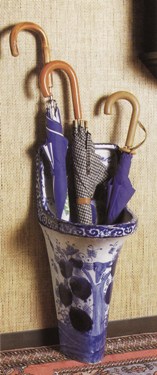
So, if a picture paints a thousand words, what does this one paint for you? Do you see antique blue and white porcelain umbrella stands and plant holders? Or do you see three squatty potties and two urinals? If you chose the latter, then you have chosen correctly. Antique blue and white toilets called benki were popular in the late Meiji and Showa periods, often installed in fine ryokan (inns) or wealthier people’s homes. Fairly rare as singletons, to see an entire collection of five all together is almost unheard of, but this dealer at Kawagoe shrine sale last month bucked the odds. I assume he salvaged them all at one place, perhaps as an old building was being torn down.

Most of these painted pieces are in the Seto style, my favorite, although some seem to be Imari as well. And they were definitely produced on some kind of large organized scale as I have noticed there are only a few basic shapes and patterns that are repeated in all the ones I have seen.  The toilets tend to be rectangular, with a squared off front or oval, with a rounded front. The rims always have a tiny detailed painted pattern, quite often traditional karakusa (scrolling arabesque), while the under hood area has a large bunch of flowers.

The urinals fall into one of two categories, either the more tubular umbrella stand shape on the right or the more cornucopia shaped one laying on the ground on the left. Older examples, both of the toilet and the urinals, like the one I saw before here, are hand painted, while the later versions are often more heavily transfer printed.

Somushi Tea House in Kyoto looks as if it has been around for ever, but actually was renovated to look old. To give it that Meiji feel they installed vintage bathroom fixtures. If you were at all confused about how this functioned as a toilet, here’s your answer. And note how similar this one is to two of the toilets above.

On the left is the urinal at Somushi which is more of a cornucopia shape and looks like an earlier hand painted Seto piece. The photo on the right is not as finely painted and looks to be Imari, but it is quite similar to the one laying on the left in the Kawagoe photo above. Umbrella stands seem to be the standard use du jour of retired urinals. The toilets make good planters and I have even seen one turned vertically and used as a garden fountain.

Now for those of you who don’t know, there is complicated toilet etiquette in Japan. In addition to taking off your shoes upon entering any home and putting on slippers, there are special separate toilet slippers kept inside the bathroom. Normally these are ordinary slippers, but I have actually seen painted porcelain ones on a few occasions, out in the markets that is, not in someone’s home. Were these really worn? Or are they just ornamental? I’m not sure, but I didn’t buy this pair last May because their condition wasn’t great. I think they’d make a witty addition to a vignette.

I have seen a few other pairs in my travels and they have always been similar to these, with that distinct feathery Seto style painting.

Without any formal knowledge on the subject, my instincts tell me that the idea for the painted fixtures comes straight from the West. It was not unusual to have painted and transfer printed toilets in the 19th century, like these Victorian versions from Great Britain. There was a tremendous amount of cross-fertilization in the porcelain industry going on in the late 19th century, with ideas, motifs and techniques (such as transfer printing) winging their way back and forth.

And the title of this post? It roughly translates as “feels good toilet,” but maybe “looks good toilet” would be even better. And I know my Japanese grammar isn’t actually correct, but I couldn’t resist the rhyme…

Related Posts:
Made for Export and in My Basement…Seto Porcelain Garden Stool
Shop Talk…Discovering Antique Treasures in Nishi-Ogikubo

Read Full Post »

The New York Times recently featured the apartment of British expats Hilary Robertson and Alastair McCowan in Brooklyn, laden with great repurposed objects in the softest of palettes. Robertson is a stylist who has worked with the furniture company Ochre and their secondary line Canvas among others, and the Ochre influence is clearly seen in this space. She even took their fantastic Chesterfield in the living room in lieu of payment for a job.

Elsewhere the couple has been ingenious with inexpensive found objects. The light fixture is a $2 trash can spray painted white and a vintage pool measuring board hangs between the windows.

Robertson is clearly a magpie and shells, glass bottles and vintage chocolate molds are gathered on this side console. A woman after my own heart!

Robertson marries old metal bases and marble tops to make consoles and will sell these in her new Brooklyn shop, Mrs. Robertson. I think this would make a great kitchen island in my beach house.

McCowan collects vintage mirrors and they are used like jewelry throughout the space. This series of arches has me humming.

The chairs were spruced up with paint, shoe polish and stapled on muslin upholstery. They look fresh from les puces, but were actually bought at Brimfield.

In a typical brownstone layout, the rooms are an enfilade and the bedroom would actually have been the back parlour.

Remember I called her a magpie? Love this!

The bedroom has another great “chandelier” – a birdcage in this case.

More mirrors on the mantle. Reminds me of these I just saw. Great to see others are addicted to aged silvered glass.

I have found numerous amazing clothing forms here in the markets. One of these days I’ll get to a post on them!

While the parlour floor is all light, bright and frothy, the English basement below has the usual brownstone drawbacks of low ceilings and minimal light. Rather than fight it, they embraced it, painting the room in chalkboard paint. It turns the mirror collection in here to sparkling jewels while also disguising the irregularities of the walls and making them disappear. Camille just posted on a similar trick in the kitchen.

I love it all! What about you?

All photos by Trevor Tondro for The New York Times. The article is here and more photos here.

Related Posts:
The Magpie Gene…Vintage Kimono and Judyth van Amringe
Shrine Sale Scorcher…Vintage Mirrors on an Extremely Hot Day
So Long Summer…Vignettes and Views Around the House
Mirror, Mirror on the Wall…Vintage Etched and Engraved Plateaus
Pale & Interesting…More Mirrors From Dave Coote and Atlanta Bartlett
Perfectly Pale…Megan Morton’s Australian Home
More Pale Grey From Abroad

Read Full Post »

So once again it is that time of year. Starting on Friday, October 19th and running through the weekend, the College Women’s Association of Japan‘s annual exhibition and sale of modern Japanese hanga is on at the Tokyo American Club. Admission is free and open to everyone. Tokyo American Club members can also attend a pre-sale on Thursday night from 8-9 pm. Whether you go every year or this is your first time, I recommend that you do not miss this show. It is a chance to view and purchase top quality original art, whether you are looking for a souvenir of time in Japan, are a serious art collector or are simply tired of looking at your bare white walls. If you are not familiar with the history of Japanese printmaking I recommend that you read my Hanga 101 primer for history and context.

Featuring 201 prints by 200 artists, including the foremost printmakers in the field as well as 42 debut artists, the show gives viewers a real taste of the breadth of print work being created today. The prints span the full range of different printmaking techniques, from traditional woodblock to intaglio to silkscreen, as well as variety of subject matter. This year a newcomer to the show graces the cover, which is a rare event and it inspired me to highlight prints by artists appearing for the first time this year. Some are young, recent graduates of Japanese art programs, while many others have been working in their medium for sometime and have only recently applied and/or been admitted to the show, which is the case for YOSHIDA Hideshi and his dramatic cover print, The Strength to Destroy This Restraint. Reading like a mini sci-fi story, Yoshida has been conceptualizing this image since his 1993 reading of a story about an angel trapped in a hypercubic prison in The Fourth Dimension: Toward a Geometry of Higher Reality. The angel, turned into a sort of super hero/power ranger, escapes, symbolic of Yoshida’s emergence from an artistic slump. Having the prestige of the cover image would confirm that.

IWAKIRI Yuko describes her woodcut The Quartette very melodically: “As I was drawing the rows of trees of a virgin forest, I came to see a five-line staff score and it seemed to me like the cold autumnal wind which blew through it was playing a harmony…From oppressing low-pitched bass to sharp high-pitched notes that gradually vanish, and the sound of a bow scraping against the strings to a dry pizzicato – I described a field of the weaving sounds of the four string instruments.” Iwakiri uses 15-16 layers of water-based ink to produce a soft toned but dense image. She compares it to “drawing and painting with plates rather than just pulling out prints.”

TOHIGUCHI Toru’s silkscreen entitled Jaguchi is a bit of a mystery to the English language viewer. What do you see? I saw a face, until I translated the title, which means faucet in Japanese. A witty take on the art of the everyday, don’t you think?

Born in 1932, INOUE Katsue may be the oldest and most famous of this year’s printmakers to have a debut at the CWAJ Print Show this year. Her deceptively simple black and white woodcuts depicting flowing grasses and blowing flowers are both intensely graphic through their contrast of negative and positive space and atmospheric in a Georgia O’Keeffe way. Personally, I like her Flower in Wind poppy print because it would look good hung anywhere, with anything else, while keeping its own integrity. Practicality shouldn’t really figure in to art purchases, but sometimes its hard not to consider it. I think this one makes a lovely gift too.

A really sweet print is SOMEYA Mayumi’s Greeting Summer Solstice and her description of her working process corresponds with her imagery. “Block print is sometimes called blind work: You can’t visualize the result of your work until you see the final print. I always throb with excitement when I carefully turn over the final copy. You see, the paper comes out from under the plate which itself comes out through the press machine — all mysteriously and nonintuitively removed from the appearance of the final product. Whenever the result exceeded my expectations, I felt like joining hands with someone, anyone, and setting off on a journey somewhere far away. Now, that’s celebration! I work alone, yet I often feel as if I were collaborating with others, and then my atelier feels lively.”

The bargain print of the show is KAMATA Yuki’s small world lithograph with its subtle coloration and abstract photographic quality.

Numerous artists have layered in political and environmental thought to their works this year in response to the Great Japan Earthquake and the subsequent nuclear crisis. Amongst them are TAGO Hiroshi’s Murmuring Planet, a mezzotint on gampi paper with a drowning Earth in an upside down glass…

…and JUNG Il’s The Property of the Earth, a classic woodcut which looks almost computer pixellated yet has a very thick painting like texture. The whimsical nature of the print enforces his message that we need to cohabit our wonderful planet in harmony.

The souvenir print for those living in Asia has to be ARAI Keiko’s Temple of Daybreak as it has scenes of Angkor Wat and India all tied up in a glowing morning scene.

And for sheer decorative power take a look at lithographs from UENO Tomoko Time Plant

…and SAKAI Junji Lluna de febrer ’12-I. Both are very painterly – Ueno’s has such a sense of brush stroke and Sakai is masterly at color block work.

And again this year, the Young Printmaker Award winner is an absolute stunner! TAKEUCHI Hidemi’s Harvest Day quadtych touches on themes of time and life, representing “the day of fruition, the day of accomplishment honoring time well spent.” It certainly looks like a successful harvest – in more ways than one!

All of these new CWAJ Print Show participants join a historic event that has taken placed uninterrupted since its inception in 1956. CWAJ volunteer members have worked tirelessly through the decades to produce one of the most prestigious hanga shows, using the proceeds to fund their respected scholarship program.

And as an additional incentive to get you out to the show, a few little birdies have told me there is a special surprise this year – an opportunity not to be missed – so I am looking forward to seeing you there! I’ll be working as a docent most of Friday and intermittently through the weekend. Please stop by and say hello.

Related Posts:
Artist Spotlight…55th CWAJ Print Show
Artist Spotlight…56th CWAJ Print Show
Hanga 101…a Quick Primer on Japanese Prints

Read Full Post »

The new issue of Lonny is out and it has some lovely features on top designers including Charlotte Moss and Miles Redd, both of whom have books coming out this fall, both of which look to be spectacular. Redd’s The Big Book of Chic is his first and looks to be a more typical decorating tome, if you can call anything he does typical, while Charlotte Moss: A Visual Life: Scrapbooks, Collages, and Inspirations seems more like a personal pathway into her creative mind and process. As a master of the single room showstopper, her ability to mix disparate things has always amazed me and I would love a chance to see what inspires her. Her office featured in Lonny is no exception and as it is a working space, it is more casual and livable than some of her more formal projects.

Charlotte Moss has a particular flair for one of my favorite colors – green – and in this case has pulled off the magic perfect green wall color in her office. It is exactly the shade that I have always dreamed of for my own living room, an ambiguous watery color that makes you ask, is it green? is it grey? She has mixed in a variety of fine antiques, all sturdy and workable, with great art, simple lighting and floor covering. But it is the elusive color of those walls that has caught me and I am dying to know what it is!

I know this is her office but it reads like a modern-day dining room, multitasking as no one seems to need a devoted dining room anymore.

She is a master of the gallery wall and this one is truly amazing. You know there are a lot of very fine pieces up there too. And this color green looks so good with old gilded frames.

The details are all there – custom colored Arbre de Matisse curtains and a lampshade of Les Indiennes.

I love fabrics with silhouette reverse colorways like many of the China Seas fabrics.

And speaking of green, gallery walls and one room showstoppers, who can forget her Kips Bay sitting room/bedroom in 2009 that is on the cover of her previous book Charlotte Moss Decorates. One of the best gallery walls ever and again the use of green with elusive shades of grey and old gilt. There are numerous items here, including the desk and some artwork, that are now in her office.

And for those of you who are up to your ears in hearing about ticking, this is the last time for a while. Upcoming posts on blue and white porcelain, the CWAJ Print Show and a new shrine sale schedule are in the works, I promise. But in the meantime, I can’t help myself! Look at the bathroom in Moss’s office! Ticking plus Chinoiserie and a little gilding – that great casual/fancy mash up.

And on One Kings Lane today a French settee covered in silk ticking – yum!

Now the challenge is to find out the name of that paint color. You know (and I know, sigh) that it is the quality of the light in the room that makes the color so perfect and there is no guarantee that it would look the same elsewhere, but you can’t blame a girl for trying.

Related Posts:
Gorgeous Green…Rooms Inspired by a Bamboo Forest
Views To a Room…Green Guest Bedroom at the Shore
Ticking Takes The Stuffiness Out
The Mail is Always Late Part II…More Ticking From Carolina Herrera Baez


Read Full Post »

All this writing and talk of ticking has helped me to my own small personal epiphany. I have been stalling on making the window valances in my elder daughter’s room at the shore for a while now, but have finally found the right person to construct them.

I have quite a few yards of Bennison‘s gorgeous Lilac linen earmarked for the project as the room has six windows – two sets of bays. The windows and the incredible light are really the focal points of the space and I only want something simple to frame them.  In general, I don’t use curtains in the bedrooms at the beach, preferring plain roller shades for light control hidden behind the valances during the day.  The rooms are all so petite that curtains just take up space and seem heavy for the lightness of the environment. I never understand beach projects with yards and yards of heavy curtains! It is also a great way to use less yardage of beautiful and thus expensive fabrics. I have been searching for the right person to make these as sometimes the fabric is so dear – both emotionally and/or financially – that the expense of the fabricating is less important than the fabric itself. The thought of them coming out wrong is unbearable because I simply couldn’t buy the fabric again, either because it was one of a kind vintage or just plain old costly.

The ceiling in the front bay behind the headboards is quite easy to deal with because it is just straight, but the side bay has a complicated ceiling and the corners of the window molding are cut off. I can’t tell you how many people came through my door and couldn’t or weren’t willing to work with me on solving the problem of those cut corners, suggesting ridiculous things like having the molding show above the valence.

My plan for the valances has been simple scallops which mimic the curvature of the headboards and the clover shaped night table in between the twin beds. The valence below is in Cath Kidson‘s bedroom in another wonderful Bennison roses pattern called Daisy Chain (you already know how much I love their Faded Floral and I’ll be showing how I used their monochrome blue Roses on beige linen soon). Kidson’s window is flat, so she is able to run a single piece valence with small scallops. My bays require a bit of a different treatment, with each window having one single large scallop.

Luckily my lovely new curtain lady understood exactly what I want, where I want them to start from and how I want them to hang.  She took some iPhone photos and created this rendering. While lovely, it is a bit too fancy for me (and my daughter) with the green ruffle in between the scallops – too “decorator-y” if you know what I mean. That said, without some kind of border or contrast the Lilac fabric might look diffused, without punctuation, and I think that issue was what she was trying to solve by adding the secondary fabric. If you look back at the Cath Kidson photo, you’ll see there is a contrasting edging.

So in all these recent posts on ticking fabric I keep coming up with examples that mix well with Bennison florals and scallops. And it got me thinking…

Don’t I have some great lilac ticking put away in my magic fabric closet? And ridiculous me, don’t I have a photograph of it stored somewhere in my files?

Yes!

I don’t remember how much I have but this is real vintage ticking. What if the scalloped Lilac fabric was piped or bordered in it? I think that might be just the bit of sporty casualness it needs while also defining the edge of the large print. What say you all? For a little visual assistance, here is a mock-up, but keep in mind the scale and color is off.

I really enjoy these great monthly newsletters from Bennison – its easy to sign up for them if you are interested. There are always prettily styled photographs, like this one featuring the Lilac in this post as well as the newest Bennison design information. The most recent newsletter features the same photo of a room with ticking plus a Bennison floral pattern that I just used in my ticking post!

Related Posts
Ticking Takes The Stuffiness Out
More on Paint and Pictures

Read Full Post »

I don’t buy things because they’re fashionable, I buy only what I love. And I don’t get tired of the things I have, because they are not gimmicky.
-Carolina Herrera Baez

As always, my magazines are so late! Imagine my distress at finally seeing the October Elle Decor featuring the spectacular apartment of Carolina Herrera Baez in Madrid and it is full of ticking stripe fabrics! International mail is my Achilles Heel!

So I don’t normally start posts in the bedroom, but couldn’t help myself here. Her bedroom had me at hello! The gorgeous flat canopy bed made from Ian Mankin ticking, played off against the starburst mirror, the Matouk linens, and for good measure, a fur coverlet. See – ticking takes the stuffiness out! There is even a secondary ticking stripe on the curtains.

Fairly formal ebonized and gilt dining room chairs are also covered in a simple ticking, keeping them fresh and casual. The house is full of fine furniture and art, all animated by color and personality.  And the pink linen trimmed in jute in the study just knocks my socks off.

You can see one of the chairs closer here – the dining room also double as a library. I like that the bookshelves are crammed and not fake and stagey.

Even the entryway is lined in ticking stripes, trimmed out in jute and nailheads again.  And the suzani-upholstered settee is another great example of contrast – fancy, but mixed with ethnic.

I could show you more, but I’ll let you click over to Elle Decor for the full article with the very unpretentious Herrera Baez and the rest of William Waldron’s wonderful photos.

Related Post:
Ticking Takes The Stuffiness Out
Reader’s Query…More on Flat Fabric Canopy Beds

Read Full Post »

Follow

Get every new post delivered to your Inbox.

Join 424 other followers

%d bloggers like this: