Feeds:
Posts
Comments

Archive for May, 2012

I couldn’t resist using this photo for my lead-off as it’s title – The Warm Side of Modern – says it all. Let’s say the look of my previous post is not to your taste – too bare, too white, too stark, too new. What to do then? Try treating your Asian pieces as another element in the mix – layering is the key here. Combine items from all different periods and places and be sure to include color, particularly on the walls to warm the space. Tablescaping, collections and details are important too. Throwing in iconographic modern pieces like these Saarinen Executive chairs doesn’t hurt either.

This bedroom, with its Venetian plaster wallpaper, a Murano glass lamp atop a Chinese bedside table, an antique Bessarabian kilim under a 1960s rope-and-rosewood chair from Brazilian designer Jean Gillon, demonstrates just the kind of eclectic mix I am talking about.

This glamorous room by Mary McDonald escapes being called traditional through its single color upholstery, strong graphic lines and large modern art, from the Chinese lacquer cabinet to the French antique chair.

In another view of the same room, the unexpected high gloss leather on that Louis chair adds a modern note to an antique piece – mixing materials is another great strategy to keep antiques from looking old-fashioned in any way.

Every room in Candia Fisher‘s New York apartment is blog-worthy so I can’t stop featuring it, this study being no exception. The surprise of a Chinese table in blue lacquer hits the same note as the patent leather on the Louis chair above. Be sure to note the great Chinese art deco rug on the floor.

Mixing in ethnic textiles and combining global accessories from different cultures is another way to create a fresh warm look. Here Kathryn Ireland puts a Chinese table in with suzani style fabric and a Moroccan lantern.
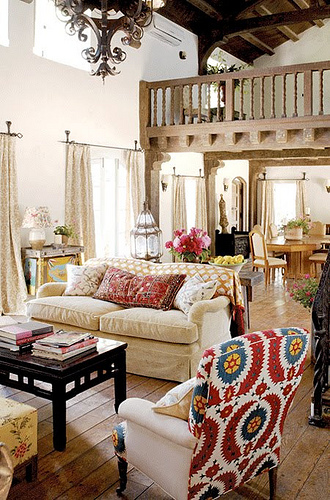
This bedroom features a similar combination with its Chinese bench, suzani as bedcover and another Moroccan lantern. A surefire formula!

Next in the series will feature styling accessories and collections! Send me photos if you have some you’d like to share!

About these ads

Read Full Post »

What if your style is prevailing modern, but while you lived in Japan (or China or Indonesia or India or Europe or anywhere else) you managed to acquire an antique cabinet or tansu or table that you are not sure fits into your spare aesthetic? One strategy that tends to be successful in contemporary interiors is to treat the item as an objet d’arte – to set it off on its own punctuated by only a few accessories and gallery style white walls. A small bit of punchy bright color will also lighten the mood, or as in the case of the antique Chinese wedding cabinet below, quite a bit of color. Also note the single graphic note struck by the antique Japanese spinning wheel placed on top.

In this stunning room a pair of Chinese lacquered chests crowned by a collection of bird cages functions in a similar fashion. The purple on the chair and the green on the trunk coffee table provide color in the otherwise neutral space. I love how the height of the birdcage topped cabinets lines up with the graphic dark window mullions.

In a glamorous Manhattan loft Chinese pieces mix with modern icons like the Barcelona couch by Mies van der Rohe. A similar lacquered cabinet to the ones in the photo above is topped with a single decorative object, while a red lacquer bench provides a note of color. Walls of mirror further reflect the light and seem to double the size of the space, making it seem as if there is a pair of cabinets in this photo too.

This home in the Pacific Northwest is punctuated by not one but two pawlonia wood and iron strap tansu and a wild chartreuse sofa. I love the open plan space but I am not as hot on the sofa. An exciting detail in this photo is the Japanese silkworm tray basket hung on the wall above the larger tansu. A favorite item of mine for decorating, I have never seen one used in an interior photographed for any magazine or other interior design press.

Low slung modern beds are a perfect match for sword tansu in bedrooms, here anchoring a gallery wall…

…and here at the foot of the bed.

Is this your style? If not, coming soon - Sayonara Series…Antique Furniture in Warm Modern Spaces.

For many more photos of tansu in modern and traditional interiors, check out my previous posts Where Do You Tansu? and Where Do You Tansu? Part II.

Image credits: 1 & 4. Metropolitan Home April 2009, photo credit: Erik Johnson, 2. credit unknown, via American Gypsy Living, 3. Elle Decor September 2005, photo credit: William Waldron, 5. Elle Decor March 2012, photo credit: William Waldron, 6. Metropolitan Home April 2009, photo credit: John Ellis

Read Full Post »

This time of year, like always, is bittersweet. It is sayonara season in Tokyo as the school year comes to a close and people get ready to leave, some just for the summer but others forever. Jobs get reassigned back in the US or other home countries, or sometimes there are new assignments, new adventures in store for folks. I have had a flurry of new clients recently who want help sorting out what else they should rush to purchase and pack into their containers and more importantly, how to deploy it all when they get home. Many have entire households of furniture back in the States in a totally different style while others have filled their homes here with tons of Japanese and Chinese pieces that need some space inserted between them to feel fresh. I wonder if the word fusion is too trite to use these days – it is actually quite apropos – and honestly what this blog is so often about, but there is truly a need to fuse their items together to make a cohesive decorative whole.

As a result I am launching a new regular sayonara series, not meant to be comprehensive, but instead to a focus on an idea, a decorative item or answer a question from a reader specifically about integrating their old life into their new one. Since I attended a sayonara party last night – a “college graduation” party – that required me to dress as I did in college, which for me was an Indian print skirt (who else remembers Putumayo?) and Birkenstocks (which I have had to borrow as I forced my self to graduate from them years ago), I decided to focus on the mix of Chinese and Japanese antiques with Indian block prints and other South East Asian textiles to lighten them up. It doesn’t hurt that I have some of this mix going on in my TV room project at the beach house too.

This Chinese cabinet in an older version of Windsor Smith‘s bedroom is just the kind of piece that people living in Asia have purchased. Functional in any room, I love it in the bedroom where all the soft furnishings and fabrics can lighten its dark heaviness. The ruffled bed valence and mix of Indian block print textiles – in indigo no less – link through their shared exoticism to form a pleasing contrast. Vintage luggage junkie me loves the travel reference too that all the Louis Vuitton makes piled on top of the armoire. The graphic modern rug, which looks to be Madeline Weinrib, keeps the space grounded but is much fresher than a Persian.

Here’s the mix again in bedroom designed by Amelia T. Handegan for her South Carolina bungalow. The Chinese table (doesn’t everyone here have one?) and mirror play off the soft paisley of the bedding. The graphic black and white striped rug keeps the space modern and casual. Actually, Handegan’s entire cottage is an exercise in just the kind of mixing I adore and well worth scrolling through on the great new Architectural Digest website. She even repurposes an old Chinese table as a bathroom vanity.

For me personally, I have just scooped up a nice sized remnant of Michael Smith’s Devonshire for Jasper fabric, thinking the tiny print and deeply stained background will make nice pillows to add to the textile mix in the back TV room.

So send me your conundrums – include photos is if you can – and let’s start a conversation about how to integrate our wonderful finds into our larger decorative life. Cheers!


Read Full Post »

So let’s head back on over to the back TV room at the beach house. I’ve talked recently about the light fixtures, the ceiling fan and the curtains, but one of the most pressing problems involves the main purpose of the room – watching television. Right now our TV has been sitting on our wicker porch table (which I would like back) as a stop-gap as we decided whether to hang it on the wall or figure out something to put it on. Since the room is tiny, hanging it seemed to make the most sense but I just couldn’t reconcile it with the style or the room, nor did it solve the problem of what to do with all the components (cable box, DVD player, etc). Over and over again I kept coming back to this photo of Abby Rizor‘s house in Florida. Placing the television on a slim etagere style bookshelf allows it to be unobtrusive while offering tremendous styling and display opportunities. That single high shelf doesn’t hurt either.

I began to think about the idea of open shelves – wooden – with some kind of metal frame, giving the unit a casual but slightly industrial feel and to look for inspiration photos with that aesthetic.

These are in a kitchen, but if you think about the microwave as if it was the TV, the idea holds.

One Kings Lane had this vintage bookcase a while back, (perhaps in March?) as part of a Tastemaker Tag Sale from Knight Moves (I think) and I bookmarked it both mentally and physically.

It got me remembering a great post from Michele over at My Notting Hill. She bought an inexpensive Sonoma Bookcase from Ballard Designs on sale…

…and styled it brilliantly.

That promptly sent me over to the website to look at their product photos and measurements. The upper shelves are a shallow 12 inches and the lower ones 16, which is about 4 inches narrower than what the TV had been resting on, freeing up space in the room. It also looked like the TV would fit perfectly, actually even tightly, both vertically and horizontally, which I thought would be more attractive…

…than this one, sent in by a customer, with a TV, but a slightly too small TV. So I waited for a sale offer too – it was $499 list but why not spend 25% less? – and then I pulled the plug and ordered it.

Now don’t hold your breath! Here’s the horrible crooked photo my handyman just sent me. But close your eyes and imagine the shelves all styled with books and tchotkes and baskets holding the ugly stuff. Imagine all the cords gathered and tied and hidden. And realize the paint color looks sickly green and awful here but it isn’t.

That makes two pieces from Ballard. Imagine that!

Related Posts:
Found! Kilim Footstools in Tokyo and Decisions on the TV Room
Sweating the Details…A Round-Up of Brass Library Wall Sconces
Just in Time…Last Piece of Cream Hibiscus Branch From Aleta
Beach Baskets…PaperGlueBamboo Sale and an Idea for the Ceiling Fan

Image credits: 1. House Beautiful, photo credit: Thibault Jeanson, 2. Ginger Barber via Cote de Texas, 3. Elle Decor September 2010, photo credit: Roger Davies, 4. via One Kings Lane, 5-6. via My Notting Hill, 7-8. via Ballard Designs, 9.

Read Full Post »

Was it this room in the October 2010 issue of Lonny that started it?

Or this one in the November 2010 issue of Elle Decor?

Either way, I don’t know the answer, but it is no longer just my own selective perception. I figure everyone must be tired of ikat and suzani throw pillows, as every time I turn around (or actually, click on a link) I come across indigo pillows, new and vintage, shibori or tie dyed, sashiko stitched, wax-resist dyed, printed and other techniques, all reminiscent of or actually made from Japanese textiles. Not a new topic for me at all, but I do think they have gone from being a rarely seen item to being prevalent and readily available. So if you are not here in Japan where you can stop by a shrine sale and pick up Japanese textiles to sew into pillows, or if you like your pillows ready-made, here’s a look at what’s out there.

There are certain places you’d expect to find them of course…John Robshaw for instance (his room is the top one above).  The website has tie dyed pillows for sale which I won’t call shibori as I believe they are made in India, not Japan.

Jayson Home & Garden still stocks the Zoe tie dyed pillow in the second photo, but unfortunately they are out of the blue and only have it in sage and plum. Don’t despair as Roni over at The Loaded Trunk has a nice selection of hand tied indigo pillows as well as a full assortment of Moroccan, Kuba cloth, Hmong, Afghan, Mexican, Indian – you name it – pillows from around the world.

Here’s a close up of the big 24 inch pillow on the floor in the photo above. It would make a good substitute for the ones in the Elle Decor photo.

Anupama also has a wide range of global pillows, including this typical shibori circles pillow…

…and this more unusual beehive shibori pattern.

Big shibori furoshiki (wrapping cloths) make great floor pillows as shown here by these from Ouno Design. I recently sourced a great furoshiki that designer and friend Maja Smith is making into one for her Lake Tahoe home. Looking forward to photos of that!

One Kings Lane has had some very authentic looking pillows from a shop called Viridian made from vintage tsutsugaki (literally, tube drawing) textiles, a paste resist method of decoration…

…as well as others made using the katazome (stencil paste resist) method from Erin Taylor of Botanik.

There are also some boro (tattered rags) styles too.

Even mainstream retailers are getting into the game. While Anthropologie is no longer stocking the Japanese inspired bedding and pillows they had last year, Serena and Lily, normally so preppy and demure, has been stepping up their game with an online bazaar filled with vintage accessories as well as their line of linens and furniture. They have also caught a bit of that boro fever…

…and have some new Japanese inspired textiles.

Even Ralph Lauren isn’t being left out with his Indigo Modern Stripe Collection, a dip dyed pillow and sheeting set.

Related Posts:
Tie Dye Heaven…Painterly Effects from Monique Lhuillier and Eskayel
A Little Shibori Feeling From Eskayel and Anthropologie
Selective Perception…Maekake at the Heiwajima Antiques Fair and Kawagoe Shrine Sale

Read Full Post »

Do you like your karakusa hot?

Or cool blue and white?

Your darumas bright?

Or modeled by the chef dressed in white?

Artist Lisa George of PaperGlueBamboo is having a sale this week of her new Spring 2012 line. For an extensive post about her modern take on the ancient craft of ikkanbari, take a look at Artist Spotlight…Lisa George and the Modern Art of Ikkanbari at PaperGlueBamboo. Her Tsukiji market shopping baskets would be great for toting stuff to the beach or having a summer picnic. Drop me a note at jacquelinewein[at]yahoo.com if you are interested in an invitation.

All this talk of baskets and ikkanbari has caused me to have an epiphany about a possible solution to the ceiling fan light at the beach house that I mentioned just the other day. Ceiling fans can be a necessary eyesore and I had been scouting ideas on improving them, finding posts over at Young House Love and Thrifty Decor Chick where they added a lampshade to give a fan light more style.

Those photos clicked in my memory with this photo from Kawagoe shrine sale last year in which a dealer had hung a basket upside down for eye level display. Even at the time it reminded me of a lampshade, but I didn’t put it all together.

Here’s another similar Japanese open-work basket, narrower and deeper than the one above, shown upside down to mimic a lampshade. It might just make a perfect lampshade for the ceiling fan, adding a bit of softening to the bright light and accessorizing the room. The basket has a great beachy feel too!

And if the open-work of the basket doesn’t camouflage the light bulbs well enough, we could always wrap it with a bit of washi paper ikkanbari style like this one…

George, are you listening?

Related Posts:
Artist Spotlight…Lisa George and the Modern Art of Ikkanbari at PaperGlueBamboo
Sweating the Details…A Round-Up of Brass Library Wall Sconces

Image credits: 1-4. Lisa George, 5. via Young House Love, 6-7. me, 8. via Lamps Plus

Read Full Post »

As always, I know my expectations of what I can accomplish at the beach house in just 8 weeks has to be tempered by reality. Posting about the brass wall sconces yesterday got me thinking that maybe a reasonable goal should just be to finish the TV room/back bedroom from soup-to-nuts and accept that everything else will only make as much progress as luck will allow me. So I pulled out my to-do list and started to work through it, which means you’re sure to be seeing posts on that space over the next weeks. Luckily, this decision sent me over to Aleta’s website as I have been planning on using one of her Brigitte Singh fabrics for the curtains with a vintage sudare bamboo blind, as mentioned in a previous post.

I had been choosing between Cream Hibiscus Flower Buta…

…and Cream Hibiscus Branch…

…but I had been lollygagging on the whole decision for a while.

While I had originally been leaning towards the Flower Buta, this autumn I came across this photo of Jennifer Aniston and Justin Theroux’s new bedroom in the Hollywood Hills which features the Hibiscus Flower Buta on the curtains. It looks lovely, but I decided it also looks too regimented and stripey when the curtains are open. Therefore I decided to choose the Hibiscus Flower Branch, at least in my own mind, and promptly did nothing about it.

Now the danger with artisanal hand printed fabrics like this is that they can run out easily and are not always reprinted. You’ll remember I used the work “luckily” at the top of the post – and luckily it was that I checked over the website as there was only one final piece of the Branch fabric left and it is not being reprinted! Phew, just enough for my curtain.

Related Posts:
Sweating the Details…A Round-Up of Brass Library Wall Sconces
On the Blind’s Side…Sudare and Curtains
Found! Kilim Footstools in Tokyo and Decisions on the TV Room

Image credits: 1 & 2. via Aleta, 3. via Huff Post

Read Full Post »

Goodbye ephemera and katagami lady…

Goodbye military paraphenalia guy…

Goodbye excellent porcelain dealers…

Goodbye senbei canister guy (although I don’t have your photo I know I will still see you at Kawagoe)…

Today was a gorgeous Mother’s Day, but unfortunately the closing day of an historic shrine sale at Nogi Shrine. It had dwindled to no more than about 8 antique dealers, but excellent dealers they were. My very first shrine sale experience was there and my first post ever featured it too. It was the place the Lalique lamp was bought out from under me when I turned my head. It was so close by and easy to pop into and always yielded some good treasure – I don’t think I ever left empty handed.

Word is afoot of a new sale starting up soon and close by. I’ll keep you all informed when I have fully scouted the details. Until then have a moment of silence with me at the passing of this institution.

Related Posts:
Nogizaka…A Good Place to Start
The End of an Era…Togo Shrine Sale Ends

Read Full Post »

The small details can really make or break a space, which is why it is so easy to get caught up in them. From the very beginning of our renovation of the back TV room/guest bedroom at the beach house I have been planning on putting in a pair of aged brass sconces on either side of these antique butterfly prints over the daybed. Of course I don’t have a great photo of the space for you, but here is a close-up of the very unfinished space…

…and here is a long view shot taken right after the door to the room was put in. One of my goals is to get rid of the overhead light on the ceiling fan, and two sconces would certainly help with that. Since there is no room for any kind of end table either, they would also work for reading and as night table lamps.

A swing arm or moveable style makes the most sense to serve such a multi-functional space and I have long been in love with the Sandy Chapman designed Boston functional library wall light from Circa Lighting, whether it be the single arm version…

…or the double arm version. The beautiful patina of the brass and the details of the hardware are just beautiful. The question between them has always been whether the 2 arm version is simply too large for the small space or perhaps it is just that oversized kind of piece that helps to make a small room look larger.

While I have been tracking dual arm sconces for more than a decade – like this pair in an old version of Nanette Brown’s summer house from a 2000 House Beautiful

…the entire design world has gone nuts for them more recently, perhaps stemming from this much blogged about photo from Domino magazine. This photo gives a good sense of how big the dual arm version is, but also how dramatic it can be in a small room.

Everywhere I look, I come across dual arm sconces, from this Celerie Kemble designed bedroom…

…to Candia Fisher‘s gorgeous living room…

…to above kitchen windows, often in long rows.

The Boston style is not the only choice. Circa Lighting also makes this similar Anette library lamp

…and the Graves Pivoting Sconce, which has lovely hardware but not the brass shade.

Rejuvenation makes a version called The Reed. But none of them compare to Circa’s Boston version for me.

For all that I love that Boston version, what I really wish I could have is the real thing – a one-of-a-kind vintage sconce, like these 1930s brass boat lamps selling for $1200 and $1800 on 1st dibs

…or these 1940s brass sconces from a recent One Kings Lane sale, priced at $1299. But with prices like that, it is not going to happen unless my fantasy of stumbling across a pair at a shrine sale comes true (and stranger things have happened!).

My other worry is that they have now become ubiquitous and too trendy. Don’t you just hate when things you love move too far into the mainstream? So I have been contemplating some other options.

Another favorite lighting company of mine is Holtkotter. The quality of their fixtures which have halogens on amazing rolling dimmers is unsurpassed. I already have a pair of standing desk lamps from them, my first anniversary present bought many years ago (for those in the know, they are the lamps that were backordered, causing my husband to have to write that very first poem instead of present). I have always liked these swing arm sconces from them, with their exaggerated retro shape, but hadn’t considered them until stumbling across a post by Camille over at The Vintique Object.

She bought a pair at a thrift shop in California for $4. Shall we say that again? Four dollars! And as she doesn’t seem to be using them, I have been trying to trade her any Japanese antique of her choice for them, but she hasn’t yet made up her mind.

They are also available new over at the Holtkotter site, as is this sconce, a wall version of the desk lamps I just mentioned. Sweet practical husband votes for this one because it also up-lights as well as down-lights which would help in the quest to get rid of the ceiling fan light, but in this case we are going to ignore him, because we (the global we) care more about form than function at this moment.

There is also a cheapie version in black on sale for $59 over at PB Kids. Just mentioning it!

As the Holtkotter sconce continued to feel too mod and not antique-y enough for the beach house, I kept my eyes open. And then the other day I was reading some blogs new to me, including Bryn Alexander‘s and I saw these brass sconces she had used in her bedroom.

They are from the Robert Abbey and combine the qualities of the Circa Lighting Boston functional library light with the Holtkotter swing arm sconce. The shape is reminiscent of the Holtkotter light, but more fully formed and the brass has the aged feel of the Circa lamp as does the hefty detailed hardware.

So what do you all think? Which would you choose? And would you change you mind in the 11th hour, or go with your long-term vision?

And in case you think I am over thinking it all, I am not the only one agonizing over these decisions – take a look over at Pure Style Home and The Lettered Cottage for more.

Related Posts:
Found! Kilim Footstools in Tokyo and Decisions on the TV Room


Read Full Post »

Ranma, the pierced or open-work transom panels found in almost all traditional dwellings are a staple of classical Japanese architecture. Placed above shoji or fusuma sliding doors and used to allow light and air to move between rooms when the doors were closed, they also became a place for designers to exercise their decorative imagination.

Like the sake jugs of my last post, Japanese ranma can be found with a bit of searching at most shrine sales here in Japan. In general there are two types, pictorial and geometric, as shown below. The pictorial ranma can be highly carved and detailed, and sometimes even lacquered or gilded. The geometric ranma are comprised of oft repeated Japanese motifs or employ balanced openwork compositions.

Pictorial ranma are almost always oriented horizontally, which would follow naturally based on their form.

The level of open-work in any design varies with the function of the panel – some are almost completely open, while others, like the one below, have very little piercing.

Published examples of ranma screens used in interior design are slim, although I did find this interior featuring a ranma in an overlayed circle pattern called shippou-tsunagi (seven treasures pattern). On the other hand, there are many similar items such as Chinese fretwork and Indonesian transoms out there, which I am going to use to illustrate my post as they perform the same decorate function. And as always I wonder why Japanese antiques continue to be under used by designers, while doing my darndest to remedy that.

One of the most obvious placements for a long horizontally oriented ranma (besides actually building it into construction as an actual transom) is over a bed or even turned into a headboard. Designer Jonathan Pierce has hung what looks to be a Chinese screen over the bed in this apartment…

…and a pair of Asian panels here. He also has a show Interiors, Inc. on HGTV that I am curious to watch this summer. Has anyone out there seen it?

Vincente Wolf is a master at weaving in global wooden screens, such as these Indonesian transoms hung above the fireplace. Note the Chinese fretwork screen just off to the left of the fireplace as well.

Here’s the same room from another angle – you can see the Chinese fretwork screen better here.

Long ranma panels with non-directional designs can easily be hinged together to make standing screens too.

Another great idea courtesy of Mr. Wolf is backing a screen with a mirrored panel, adding a whole new element to the composition and helping to brighten a darker space.

This ornate and gilded ranma in a similarly colored space has quite a similar effect. (And be sure to note the pillow on the chair, won in my ZAK + FOX giveaway!)

Panels can also be propped instead of hung, such as in this Rosemary Beach home by Tracery Interiors.

Their firm also seems to love using open-work panels as both their portfolio and referential company name and logo would imply. Note the small green transom in this project – Indonesian again I believe – in the corner beside the fireplace.

And I am not sure what kind of panel is featured here, but I had to include it if for no other reason than the amazing glass bottle display!

Michael Smith has propped and old wooden panel – this one looks Indian to my eye – along with some other mounted objects on this Malibu home’s mantle.

Ranma in the bathroom? Why not? I love the use of these fretwork panels in this cool and spare Manhattan bathroom…

…and I also love the way these Chinese fretwork pieces cozy up this warm London bathroom.

And let’s not leave out the kitchen – shown here with a stack of small Chinese fretwork doors on the wall.

Related Posts:
Divide and Conquer…Thomas Hamel, Jalis and Shoji Screens

Image credits: 1. Japan Style by Geeta Mehta and Kimie Tada, photo credit: Noboru Murata, 2-4 & 10. me, 5. D Home March/April 2007, photo credit: Danny Piassick, via My Notting Hill, 6-7 & 18. Pierce & Co., 8. House Beautiful May 2010, photo credit: Eric Piasecki, 9 & 11. via Vincente Wolf Blog, 12. via A. Ridge, 13-15. Tracery Interiors, 16. Elle Decor October 2009, photo credit: Henry Bourne, 17.Elle Decor November 2009, photo credit: Pieter Estersohn, 18. World of Interiors July 2010, photo credit: Bob Smith.

Read Full Post »

Older Posts »

Follow

Get every new post delivered to your Inbox.

Join 424 other followers

%d bloggers like this: