Feeds:
Posts
Comments

Archive for November, 2011

Dear Mr. Yamamura’s suitcase (because that is the name painted on the leather case and somehow, I am sure you belonged to a man), I was lucky enough to stumble across you at the shrine sale the other day, picking you up because you are a beautifully preserved example of early 20th century luggage, but if you could talk, oh, the stories you could probably tell! I bought you for decorating purposes, but in the days you have been in my home, I have become obsessed with trying to research your path across Manchuria and the Tientsin Concession in hopes of dating you more specifically and understanding what might have brought you there. If my Japanese was better, maybe I could even have figured out who you belonged to – a 1920s salary man named Yamamura for one of the big zaibatsu (business conglomerates)? A government official with a mission of imperialist goals?

Did you watch as Japan seized control of Manchuria (the large northeastern corner of present day China) from Russia between 1904 – 1905, taking control of the Russian built railroads and creating the South Manchurian Railway, which established its headquarters in Dairen? Or was that before your time? I think it may have been.

Five Yamato Hotels were also owned and operated by the railway between 1910-1940, serving stops along the line. The Yamato Hotel in Dairen was a showstopper in the grand European style, both on the outside and the inside…

…but you seemed to have stayed in the Dairen Mansyu Hotel, making it seem like perhaps your owner was not such a big wig. I have not been able to find any additional information on that hotel, so it is a dead-end, at least for now.
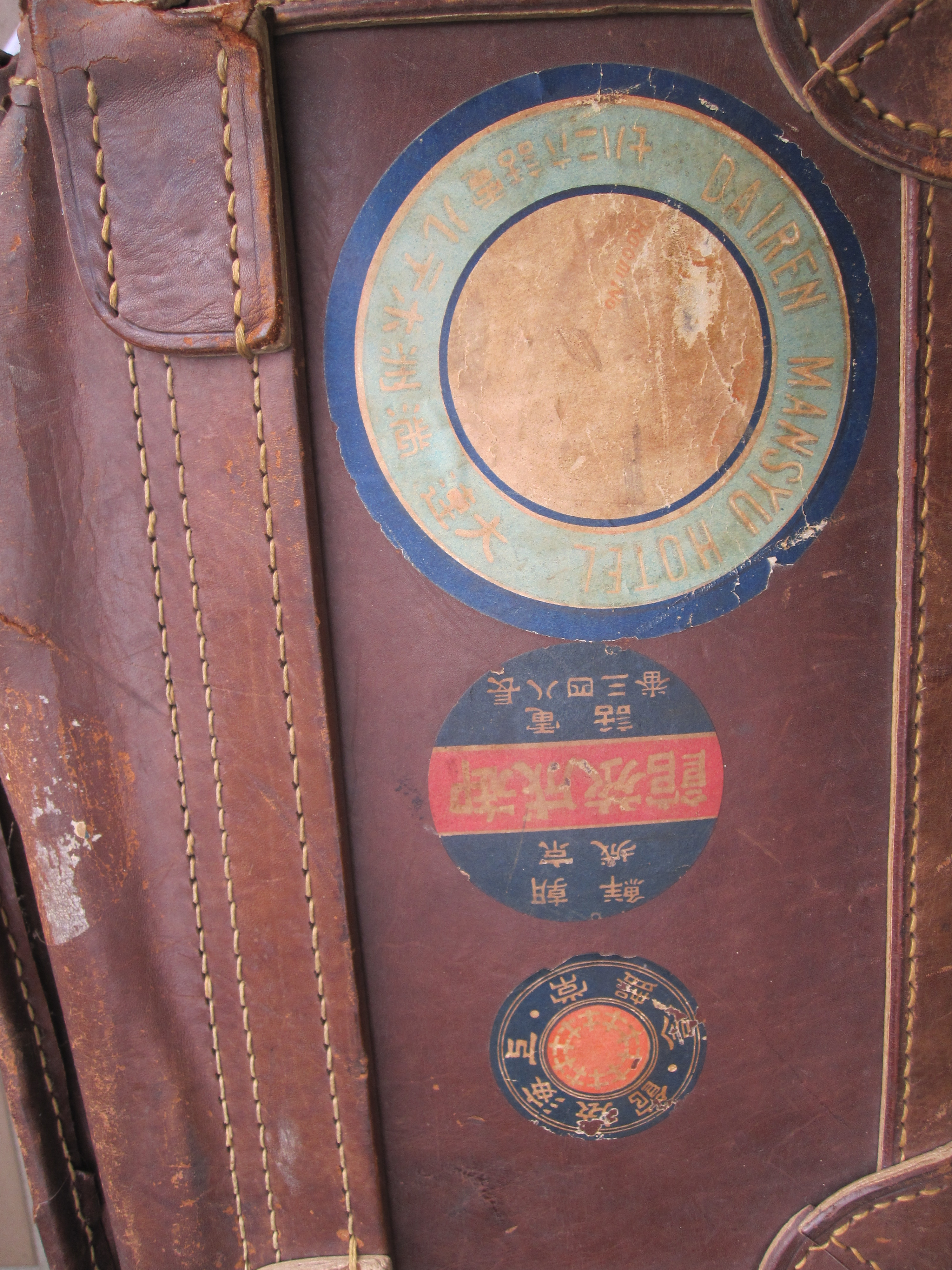
You definitely spent significant time in Manchuria, as the hotel labels on your suitcase continue to reveal. But was that time during Japan’s years of influence, or after their full of seizure of control in 1931?.  The Anto Hotel (red oval sticker below) is located just past the railroad station in Antung, and it would certainly seem to imply that you were there in the 1930s, as the Antung Province was first created in 1934 as an administrative region of the now Japanese controlled Manchuria, newly called the Empire of Manchukuo.

If you look closely at this 1930s postcard, you can see your hotel in the far distance from the station. I wonder, did your room have a good view?

You probably arrived via the station above, on the Mukden to Antung Railway, the main mode of transport, if not the only one, through southern Manchuria at this time. Perhaps you even worked for the railway, as over 35,000 Japanese did by 1910.

I would guess that you travelled through Mukden as well and that the Shenyo Hotel in “Mubuden” (the first hotel sticker on that photo above) was simply a bad English spelling of Mukden.

But things with you get tricky from the largest label found on your lovely lid. The Yamato Hotel chain doesn’t seem to show any properties in the Tientsin Concession, an extremely unusual city as it was an open trading port in the late 19th and early 20th centuries. Like Shanghai, it existed as its own sort of miniature world, with eight foreign concessions in the district, including that of France, Great Britain, Japan, Russia, Italy, Germany, Austria-Hungary and Belgium. Eric Liddel, the missionary runner (remember him from Chariots of Fire?) was born there and I believe President Herbert Hoover lived there in his earlier life.

The international concessions looked nothing like China and a lot like Europe. The Japanese concession certainly looked as Western as the others…

Tientsin had an extremely famous and fancy hotel, the Astor House…

…with quite its own luggage label.

But there is no mention of any Yamato Hotel there whatsoever. My theory is that after the Japanese seizure of Tientsin in 1938, while they respected foreign concessions for the most part until 1941, perhaps they occupied the properties in their enemy’s territories and changed a few hotel names?  So my final guess is that you travelled in the late 1930s, just before the war. I am hoping to do more research, but maybe I’ll get lucky and a reader will have some extra insight and/or better language abilities.

So for those of you who have been wading through all this history and had enough, on to the juicy decorating ideas on how to use Yamamura-san’s suitcase. Perhaps Joanna Madden’s stack is a bit excessive, but she does have a special way of arranging large multiples!

I am desperately wishing to visit Chicago to see an extremely dear friend, but also to finally get over to Jayson Home & Garden.

We all know I am a sucker for anything that looks like this – One of those amazing photos you only find in Skona Hem - and I love the pair of cases stacked underneath.

A small stack of vintage luggage makes a lovely and unusual night table. Stores quite a bit of junk too!

In a too “leggy” room, there is nothing like  a stack of old leather suitcases, serving as a side table.

And one last photo from one of the old magazine spreads that changed my life (can a magazine spread change your life?), Carolina Bunce’s Hudson River valley house, which did just that. One of these days I’ll feature the whole piece from 1993 and show how she has more recently re-deployed her amazing American antiques in an unlikely setting out in California, having already featured a few of her rooms here.

The shame of my situation is that the flea market dealer had a second smaller suitcase, with a broken handle, so I didn’t buy it. In retrospect, it was easily repairable, but more than that, I wonder what clues it might have held about Mr. Yamamura…

Image credits: 1, 5-6 & 9. me, 2. via eBay seller yangshulin1971, 3-4, 10-12. via AN AMERICAN IN CHINA: 1936-39 A Memoir, 7. via flickr photostream of Kernbeisser, 8. eBay seller yuhong1962, 13. via Country Living February 2011, photo credit: Lucas Allen, 14. via Lonny magazine June/July  2010, 15. via Skona Hem, 16 & 17. so sorry, missing credit as I picked these up on Pinterest somwhere
About these ads

Read Full Post »

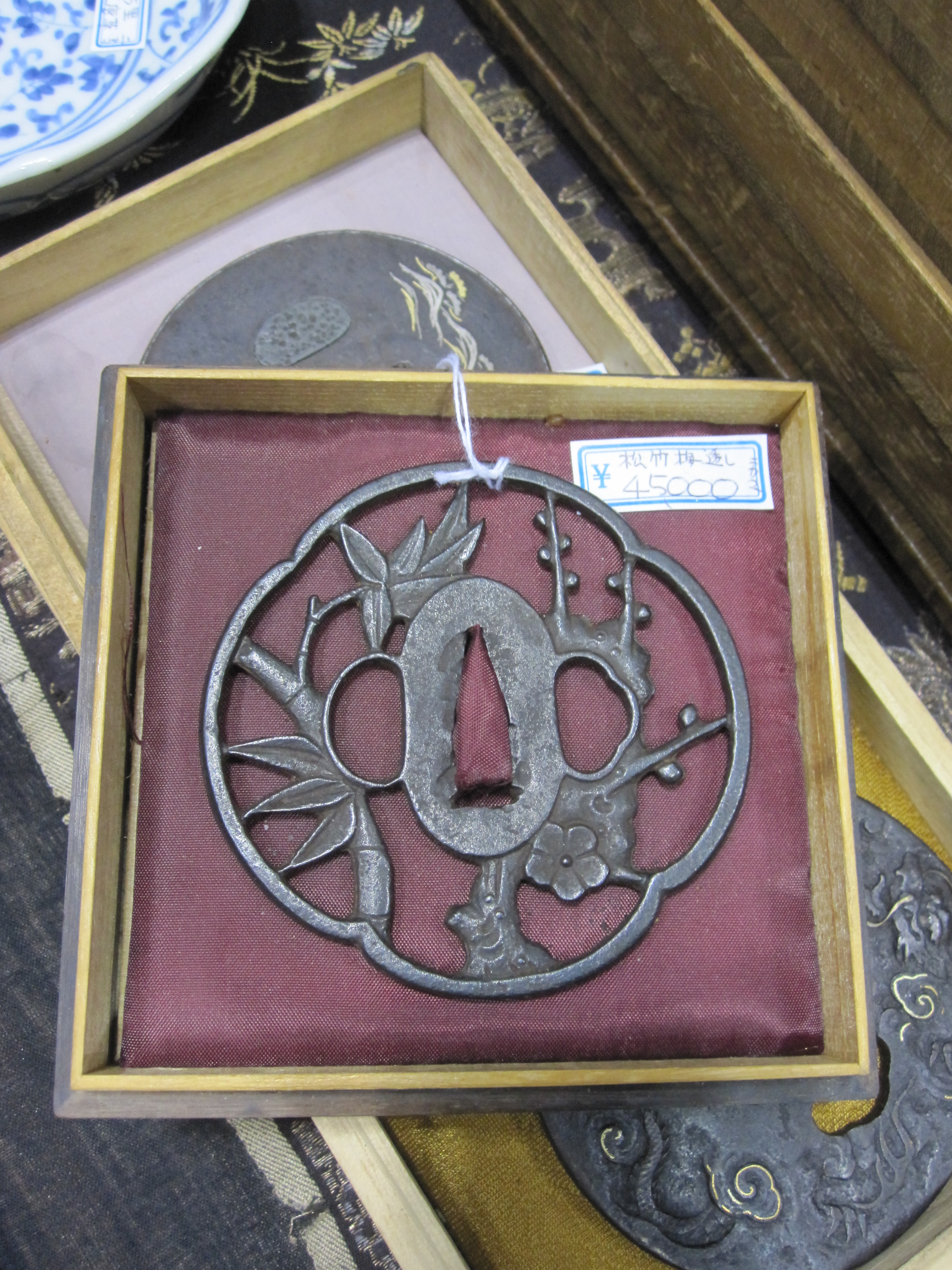
Found at almost any antique show and many shrine sales, Tsuba, the ornate metal sword hand guards, a key component of any good samurai’s sword uniform, are one of those things that befuddle me a bit. While I adore Japanese metal work and its incredible influence on my original specialty, 19th century American silver, I seem to lack enough testosterone to find the tsuba themselves fascinating. And buyer beware, they (along with inro and netsuke) are one of the few areas of Japanese antiques in which fakes, or recent copies abound. Real ones should be crazy expensive, as in 5 digit yen at least, so if you find one at a flea market for the equivalent of $50, most likely it is too good to be true. And like obidome, which I adore, they are beautiful, no doubt, but what are you actually going to do with them?

Enter November’s House Beautiful and an ingenious design by Josie Natori – this Tsuba inspired napkin holder – gorgeous holding paper napkins on a drinks bar, or even for an outside party, so that they won’t blow away.

A perfect house or holiday gift, no?

Read Full Post »

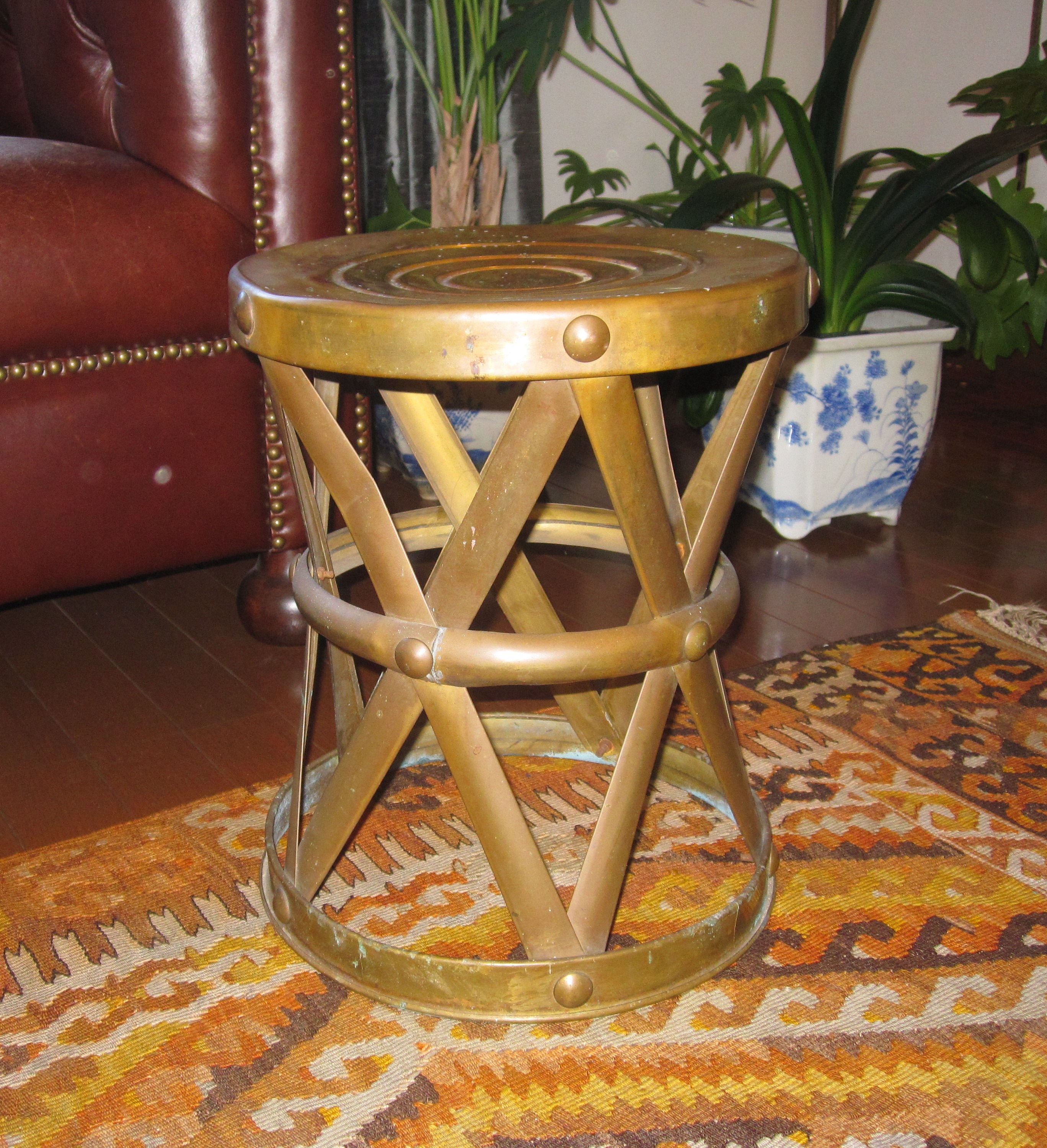
While we are chatting about my recent brass finds, let’s look back at another cute vintage brass item sourced from a Tokyo area shrine sale. Remember this guy found here last spring?

Well, he is now cleaned up a bit and safely ensconced here in my living room, having become an extremely useful addition to our household, a perfect spot to rest a book or cup of tea and serving as extra seating in a party pinch.

This is a slightly different style of “Identify This” post as I am honestly the one looking for help figuring out the origins of this small brass stool or table. I had not seen one before mine, but this summer at Calypso Home in NYC they had a larger and brand new side table sized one in the shop. No one there had any insight into the history of its style.

I have only ever seen one featured in a home design spread.

(Addendum: On a funny note, it was only after I received the Katie Ridder book I wrote about in my last post that I realized I had just shown another photo featuring not one, but two of these stools in one of her interiors! There is a shiny brass one adjacent to each the chairs in the photo.)

So without much to go on, I dived in to my usual research sources…Currently, there are a few available on 1stdibs right now, including this one from Belvair

and this pair from lawson-fenning. Both are simply identified as 1960s vintage brass drum stools or tables and are priced at $325-365 each.

Adam Bram Straus just had one for sale in his Tastemaker Tag Sale on OKL too. It and the one directly above on the left look the most like mine, although mine is in better condition than either of them and none have the repeated concentric circles on the seat/tabletop.

Less expensive new ones, which honestly have inferiors lines, seem readily available, like this one from Cyan Design for $247.

They even come in other finishes, such as aged bronze or this fancy polished nickel from Arteriors, the most expensive of the bunch at $458 for the small size and over $1000 for the side table size.

But I haven’t been able to find any additional information, or even proof that these are 1960s designs. One source suggested they are Italian, another art deco, but I don’t see any evidence of either, other than the usual problem in which someone wrote it on the internet once, so now everyone quotes it like it is true. For my eye, they have a real campaign furniture look, but as they don’t actually fold up or disassemble easily, that is not it either.

So I open it to you my readers – any theories or clues on origin, time period or even additional photos of these in use? I’d love any ideas, speculative or fact-based….And most of all, I wonder how it ended up in Japan?

Read Full Post »

OK, so maybe that title is a little extreme, but I am so excited by my recent find and actually, I think she would be too! For those of you not familiar with her name, Katie Ridder is one of my favorite designers working today, with a most accomplished and interesting approach to interiors, a refined and coordinated eclecticism. Recently, all the cool girl bloggers like Courtney, Jennifer & Ally got advance review copies of Ridder’s brand new book Rooms, which I am dying for, of course. (Are my sour grapes showing?) Unfortunately, I haven’t managed to get my hands on a copy yet (heavy holiday hint here).

Katie loves color and has a particular penchant for my favorite – lavender. In addition to the iconic book cover image with its amazing Kiki Smith etching, you can find the hue sprinkled liberally throughout her designs…

…and gently too.

She is also quite skilled at mixing it with blue and white porcelain, another favorite trick of mine.

She is a big fan of Muriel Brandolini prints, and also has her own line of charming patterns, including Peony…

…and the Japanese inspired Wave.

For me, Katie’s first great lavender room is from the days before digital images (1993!), but I am lucky enough to have saved it in my tear sheets, although it took me a good half day to find it. Featuring a lavender Asian toile from Manuel Canovas called Mandarin and quite a bit of whimsical ingenuity (love that valence) mixed with modern details, the small showhouse guest room, completed on a tight budget, was a clear stylistic precursor of what was to come. She worked with her husband, architect Peter Pennoyer, and I believe it was meant to invoke the Brighton Pavilion. Sorry the scan just can’t do the colors justice!

(Quick Addendum: I found a close-up of the toile in an old House & Garden tear sheet on Chinoiserie toiles. When I was writing this post originally, I couldn’t find a sample anywhere.)

More recently, to counter the vibrantly colored, robust and complex public living spaces she designs, Katie most often creates cool and tranquil sleeping areas. I come back to this simple guest room all the time, drawn in by the crisp hotel-like linens, Murano glass lamps and the mid-century Japanese brass globe lantern which, for me, is the key element that makes the space.

And so on to my find…Last weekend, I stumbled across not one, but two similar lanterns, in absolutely perfect condition. They also have a scrolling karakusa (arabesque vine) pattern, but no large flowers like Katie’s. And this photo, taken on the spot, somehow makes them look small, which they are not. No current plans for them, but I grabbed them as soon as I saw them and took them home! So let me gloat a little, and hope that the book finds its way to me this holiday season…

Image credits: 1-2, 6-7, 10-11. via Katie Ridder, 3-4 Elle Decor March 2008, photo credit: William Waldron, 5 & 13. Elle Decor March 2006, photo credit: Pieter Estersohn, 8. Elle Decor June 2009, photo credit: William Waldron, 9. Country Living November 2010, photo credit: Lucas Allen, 12. House Beautiful March 1993, photo credit: Antoine Bootz, 14. me. <a href=”http://www.bloglovin.com/blog/3209837/tokyo-jinja?claim=bhbgv3skc8m”>Follow my blog with Bloglovin</a>

Read Full Post »

While Dalia was off visiting the Mashiko Pottery Festival last week and checking on post-earthquake progress there, I was busy visiting Kimiake and Shin-ichi Higuchi, two of the world’s foremost Pâte de Verre glass artists up at their newly rebuilt studio at the northern end of Nikko National Park. As you might recall from a previous post, much of the Higuchis’ studio and about 40% of their artwork had been destroyed in the Great East Japan Earthquake. The weekend of November 5-6 was their joyous open house – a celebration of their rebuilding and faith in going forward – and we were lucky enough to be invited. Ironically, they had set up their entire exhibit by Thursday afternoon the 3rd, only for there to be a fairly strong quake that evening, which many of my local readers will remember. For safety, they took everything back down and only put it in place just before the weekend open house.

Simple linked buildings flooded with light house their bedroom, living quarters and studio, all surrounding their gorgeous garden which is the main source of inspiration for their work as well as much of their actual food. Upon arrival we were greeted by giant cabbage leaves spread about the grass. They were so life-like, we weren’t sure if they were glass or not!

Everything in the studio was back to being ship-shape and orderly. The rows and bins of glass powders and frits were a modern installation all their own. In the spirit of recycling, all the broken glass works are being ground down and re-used.

We got to see their process from sketch…

…to detail demonstration…

…to finished installation.

Their renderings of the everyday vegetables and flowers around them are so life-like as to almost be surreal. The asparagus looked so delicious that I was ready to pick it up and eat it.

The bearded irises were amazing.

Color and detail, here on a cyclamen panel…

…and here on a trumpet vine.

The little boxes and vessels made me swoon – I wanted this little sakura box…

…or the wisteria.

Some boxes had secret surprises inside.

Can you see the snail and the water droplet on the hydrangea leaf?

I don’t often include pictures of my kids on the blog, but here she provides a sense of scale. Keep in mind she just turned 8. Largest glass cabbage known to man – perhaps the original was the largest ever grown too.

Speaking of the girls, the younger ones had a ball catching praying mantids in the garden. They strongly suggested that Shin-ichi remake his praying mantis sculpture which had been broken in the earthquake.

And the pièce de résistance, which I cannot resist showing is this…

…their bathroom counter, covered in glass roses, and even including clear glass water drops and a few small insects.

Warm thanks to the Higuchis for hosting us and to Debra for introducing us!!

The previous week, Keiko Iishi, a former assistant to the Higuchis during a Corning Museum of Glass education program and a glass blowing artist in her own right, held a charming solo exhibit in a small Ginza gallery. She had been so disheartened by the loss of family and friends in the earthquake and subsequent tsunami that she had planned to cancel this long-awaited show. With strong encouragement from her supporters, she decided to go forward and it was a treat of color and pattern.

Having just made butterbeer with my elder daughter and her friends, the piece in the center rear, entitled “Honeydukes,” caught my eye. Keiko, a huge Harry Potter fan, said I was one of the only ones to get the reference.

Congratulations to Keiko on a very successful exhibition!

The net result of viewing all this modern glass art? I think we might need to sign up for classes at Hot Sand on the Asbury Park boardwalk this summer.

Read Full Post »

For my first ever guest post, Dalia Gold reports on a shopping excursion to the famous Japanese pottery town of Mashiko. The destruction of the kilns after the Great East Japan Earthquake was featured earlier on the blog here and updates on the situation here

The forecast called for and delivered clear, sunny skies for my first trip to the legendary Mashiko pottery festival. I’d been waiting almost a year for the day to arrive, having heard stories about rows upon rows of pottery stands.

Originating in 1966, the fair is now held twice a year – in the fall and spring – and draws approximately 150,000 people and 400,000 people, respectively. Last spring, the Great East Earthquake destroyed the ancient kilns used for generations to bake the clay works. Donations and support came from around the world to help rebuild the kilns and November 4, 2011 marked the second pottery fair after the devastation. More than 500 artisans displayed their work, including many from Mashiko and areas beyond, as well.

Much more information about the history of Mashiko pottery can be found at: www.mta.mashiko.tochigi.jp

I expected to be overwhelmed and had brought a small, wheelie suitcase, as I’d been advised, to store my purchases as I strolled. I had no particular agenda nor strategy for the expedition. I only knew that I didn’t want to leave thinking, “Why didn’t I buy that when I had the chance?”

The vendors at the beginning of the fair had mostly functional, primitive pieces. I bought these small bowls, finished in Nuka White (rice husk ash) glaze and paired them with these funky, unfinished green chargers.

As I moved deeper into the stalls, I found myself drawn to pieces featuring spouts, irregular shapes and almost anything white.

I think these oval pieces may be intended for ikebana, but I bought one to use as an everyday fruit plate.


Loved the simplicity of, and so purchased, both of these, which look great with the fruit bowl.

Though I didn’t buy one, I love the utilitarian grater featured in these spouted works.

As with so many things I’ve seen in Japan, the elegant simplicity of some displays rivaled the artistry of some of the goods being sold.

Other collections for sale besides pottery included glass, incense and shoes.

Given the huge piles of rubble within, I think these warehouses may be the sites of some of the kilns which were destroyed, although they had certainly been cleaned up from last spring,

After exhausting myself among the stalls, I finally arrived at the main street, where many finer pieces of art were for sale. The glaze on this vase looks as if there are layers of mosaic tiles beneath the smooth surface. The photo doesn’t do justice to the gorgeous tones of blue, grey and green held within.

My wheelie bag was full, and I had a couple of shopping bags draped over my arms as I returned to the parking lot before heading home. I’d been true to aim – not to leave any beloveds behind – and yet, I already knew I would need to return next year.

Read Full Post »

“This is an interior that’s modern and old-fashioned at the same time, and in all the right ways.”

Sometimes I really wish I could still get my hands on a paper copy of the Sunday New York Times. The ritual of holding it, reading it on paper – the fun sections on Saturday with the early edition and more serious sections on Sunday itself. You’d think I’d be over it after 7 years, but sometimes I still crave it desperately. Now there is also that great new Off Duty Saturday section of The Wall Street Journal, something I have never experienced outside of the internet. I know the paper form of journalism is turning into a thing of the past, but call me a luddite if you will, I still love it.

This past weekend was the Design & Living special Style Magazine and it featured the amazing Stockholm apartment of illustrator and artist Mats Gustafson (whose dreamy portfolio is well worth exploring) that I must share. While sunny and warm outside, it’s been a few grey weeks here at Tokyo Jinja, with my post on Megan Morton’s Australian home and my own purchase from the Bunny William’s shops Belgium tag sale on OKL. Add to those this apartment, filled with shades of grey and that wonderful Scandinavian light. You can’t miss the giant Noguchi lamp in this outstanding living room, so it even has a Japanese edge. And do I spy more taxidermy in the window? Just a swan instead of a peacock…goes with the color scheme.

The masses of organic pottery on the mantle remind me that I must get up a post following up on the pottery artists at Mashiko and my visit to Kimiake and Shin-ichi Higuchi‘s rebuilt glass studio.

The illustrator drawer cabinets in the studio could almost be tansu, don’t you think?

Aaaah, this kitchen! New, old, natural wood – what’s not to love…except maybe that stuffed crow? Perhaps people outside of Japan don’t have that same horror/fear/disgust that we do about those black birds!

And for my other glass junkies, look at these formal vases in the window, understated, and not competing with the view.

Check out the whole issue as there are many more articles of interest! And if you click on “View Print Magazine” it is almost as good as holding it in your hands…

Image credits: opening quote and all images from Design & Living 2011 New York Times, photo credit: Magnus Marding, styling credit: Jacob Hertzell.

Read Full Post »

Blame it on my friend Angela, whose beautifully styled bookshelves and glass floats were much admired. While she is newly back in Belgium after a few years in Tokyo and missing it, I am feeling the decorating pull of Europe every time I see a photo of her gorgeous home there. She has been mixing in her Japanese treasures with Belgian antique finds and modern pieces – you’ll be seeing more of her house in the upcoming post on tansu at home.

Blame it on Joan at for the love of a house, whose pitch perfect home takes my breath away every time she reveals a new room to her readers – we are all waiting for the barn room now! She actually got to have birthday lunch with legendary decorator Bunny Williams and her equally famous antique dealing husband John Rosselli at their beautiful house in Connecticut last year.

Joan’s kitchen…

…and Bunny’s bedroom.

Blame it on a bit of insomnia that put me in front of my computer at exactly one minute past midnight, giving me a chance to get in on the opening of the One Kings Lane shops Belgium with Bunny Williams sale. For those of you not familiar with this website, affectionately known as OKL, in addition to ongoing discount sales of home and design products, they also hold limited timeframe “Tastemaker Tag Sales” filled with the treasures and (sometimes) junk of designers and antique dealers. I had been scoping this particular sale for the painted furniture piece featured in the ads.

My long term readers know I have been searching for close to two years for a piece that could serve as a kitchen island and another as a sideboard in the dining room at our beach house in New Jersey. If you want to catch up on that story, click here, herehere and here. This one looked like it might be perfect. It had all the practical requirements – two roomy shelves for baskets and attractive storage/display and two small drawers – as well as a soft grey painted finish and those great barley twist legs. The dimensions were just right in that it was actually quite tall, as in tall enough to be an island, while small enough to fit in my tiny kitchen. I had room to add a white marble top for practicality and have it hang over a few inches, enough to tuck in two stools. And if for any reason it didn’t work in the kitchen, it would also serve wonderfully for the sideboard in the dining room.

Blame it on general OKL madness, a disease that seems to be affecting many people. As each Tag Sale opens, things pop into carts and sell out immediately, creating a sense of panic. I had yet to ever successfully purchase anything on one of these sales, as the hard-core stalkers always got to the good stuff first. So somehow I actually got this piece in my cart, held it for the 10 minutes they allow for you to make up your mind, and then lost it to another’s cart. By then I had finally checked in with my mom who actually liked it (shocking!) and a few friends in other time zones (couldn’t wake any Tokyo peeps at that hour) and they all agreed I should buy it. A number of bloggers have been poking a bit of good fun at OKL madness, but I think this piece, while expensive, was actually a reasonable price for what it is. Once I got it back into my cart, I wasn’t letting it go. My kitchen was assembling itself before my eyes (close yours and imagine it)…dark wood floors, pale grey island with white marble slab top, some simple glass front cabinets, farm sink, and stainless steel stove to toughen the sweetness a bit. I want so badly to post an inspiration photo right here, but that is perpetually the problem, as there is none out there that is exactly right…

(IMAGINE PHOTO HERE)

Blame it on the beer. After numerous frantic texts, sweet husband finally called in from one of those classic Tokyo “business meetings” which are a euphemism for drinking at a Roppongi bar. Of course he said “get it” without seeing it – beer makes everyone easy!

While this sale is finished, there is still a bit of time to check out the huge Chessy Rayner estate sale running on OKL right now. Another grand doyenne of the decorating scene, you might remember how inspired I was by her beach house here. Luckily enough, OKL has a photo of it that I had not seen before.

As for my new piece, I could not be more excited, even with all the “blame” I am spreading around. Just think, from now on, I can tell everyone that Bunny Williams bought me my kitchen island on one of her forays to Belgium. Love the sound of that!

Image credits: 1, 5-7. via One Kings Lane, 2. Angela Ridge, 3-4. via Joan from for the love of a house

Read Full Post »

One of the things that routinely grabs my attention at all the shrine sales around Tokyo are the boxes and piles of old photos and personal memorabilia lying around as if they were junk. I find it heartbreaking that these precious memories are out on the pavement for sale and often have the desire to buy them up, if for no other reason than to keep them safe for the spirits of those pictured. But I don’t have room to store them, nor much use for them either, so I rarely succumb. Most of the photos date to the 1920s and 30s and show a Japan long forgotten – a Japan in transition – a Japan before the war. The best ones make me wonder at the stories behind them. Was this a mother and son posing for shichi-go-san, the 7-5-3 year old traditional ceremony held for luck in November for children of that age?

Friends in town from Vienna this week took their seven-year old daughters to the shrine as this ritual is still practised. I love this Instagram photo of them in that there is a quality about it that approximates the photos of old.

What about this family? Mom and dad in traditional dress, the boys in military type school uniforms and perhaps an older daughter proudly holding her diploma. Girls in Japan still wear uniforms that look exactly like that one.

One of my favorites is this group, clearly on a pleasure outing. Dated 1926, it reminds me strongly of my very first post I ever wrote for this blog…

…featuring collectible matchbook covers from the same era.

And here we have a group of young soldiers posing in front of that unavoidable icon Mt. Fuji itself. I love the sakura (cherry) blossom photo corners and the contrast of their prettiness with the less savory side of military build-up.

This one is the biggest hoot I have come across so far – naked in the onsen (hot bath). Not much has changed since then…I have a similar photo of women friends and our kids in the onsen, but I’d be murdered if I posted it here (and possibly reported for lewd content)!

I think my fascination with these photos comes from my teenage years and my favorite ever Masterpiece Theater production — the 1980 dramatization of Nevil Shute‘s A Town Like Alice. Based on actual events, the book is wonderful, but the miniseries is one of those rare adaptations that surpasses the novel. Starring Helen Morse as a lovely and very “un-Hollywood” Jean Paget and a cheeky young Bryan Brown as Joe Harman, it tells the story of a young British woman trapped in Malaya by the Japanese invasion at the start of WWII. While the men are sent to prisoner of war camps, there is nowhere for the women to go, so they are marched around the country from commander to commander as no one wants to deal with them. Each week it ended on such a cliffhanger that my mother and I could barely wait until the following Sunday. I think it is a must see for anyone living in Asia or anyone who has watched Out of Africa more than once! The only problem is that I don’t believe it has been issued on DVD. I have the VHS if anyone wants to borrow it.

In the opening scenes of the series, the camera pans around Jean’s bedsit in postwar England – a 1948 London Olympics poster clues you into the date – and lingers for a moment on a black and white photo of a Japanese woman and three small children in a frame. The connection to the photo is completely unclear until much later in the story, but the relationship it involves is one of the backbones of the tale. I won’t tell you anymore as I don’t want to spoil it for you, but I think of that moment in the series every time I pick up an old black and white photo at a shrine sale.

So over the years I have smiled and laughed over these photos I find, but I have not brought any of them home with me. But this past weekend, two photos from a page in an album jumped out at me and I couldn’t leave them behind.

It was the beach scene that caught my eye; the adorable little boy with the parasol and perhaps older sisters looking on fondly. I had never come across any photos at the beach before. I think I’ll frame them together and take them with me to Ocean Grove to sit on my bookcase, just like Jean Paget.

Read Full Post »

I’ll be updating the Shrine Sale tab on the blog, but I wanted to catch all my readers and let them know that the Oedo Antique Market held on the grounds of the International Forum will be on hiatus due to renovations through February of 2012. The first market next year is expected to be held on Sunday, March 4, 2012. I’ll keep you up to date on the situation as it unfolds.

Other news includes the annual sale at Kanarusha, a fantastic Japanese antique store out near The American School in Japan. More information can be found here, in a previous post, and here, on their website. If you liked my last post on tansu, now might be the time to get one!

Read Full Post »

Follow

Get every new post delivered to your Inbox.

Join 423 other followers

%d bloggers like this: