Feeds:
Posts
Comments

Archive for October, 2011

In the Entryway?
Perfect for hats and scarves, keys and keeping other clutter out of view, this iron strap isho dansu is mixed with other Asian antiques and objects in this elegant entry by Vincente Wolf.

Even shoes or rainboots can fit if the tansu is big enough. Love the similarity between the spare Shaker-like English rush-seat chairs and the simple mizuya tansu.

In the Living Room?
The gilded doors and elaborately grained wood on this early 20th century tansu dresses up a corner of Chris Barrett’s tiny home.

In the Dining Room?
Designer and blogger Lauren Liess uses the bottom half of a tansu as a sideboard in her dining room. The big sliding doors and deep cabinet make storage easy.

In the Kitchen?
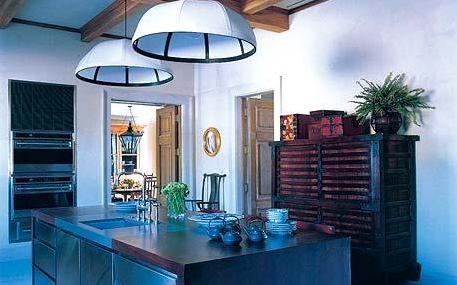
I know I’ve shown this Michael Smith photo before, but I love it so much I’ll show it again. He is a master at using Japanese antique furniture in his designs. For more great examples from him click here.
In the Family Room?
This example is a bit of a cheat as it actually a Korean bandaji (blanket chest), a family heirloom of Ally’s of From the Right Bank.

In the Bedroom?
A big tansu, perfect for clothes, blankets and pillows in the Chelsea bedroom of Ray Booth and John Shea…

or a small one on raised metal legs, making a perfect nightstand in this gorgeous Madeline Stuart designed bedroom.

Smaller chigai dana with their open staggered shelves, often laquered and decorative, are incredibly versatile too. Besides the most famous one residing in the White House, you can find them tucked in numerous interesting spaces. Check out the one in the left corner of this Markham Roberts designed living room…

…and another hidden in the left corner of Celerie Kemble‘s bedroom.

I’ve had a few questions lately from readers on how to blend Japanese antique furniture into Western interiors, so this post proves my adage that a tansu can work in almost any design style, whether modern, traditional or eclectic. Perpetually underused in the design world, tansu are great for storage and display as well as gorgeous in their own right.

So friends and readers, where do you tansu? I’d love to do a follow-up post showing photos of tansu in your rooms! Get out your cameras, do a little styling if you want and send me photos of tansu in your homes!

Related Posts:
What’s Cooking? Tansu in the Kitchen
Sourcing Antiques for Michael Smith Interiors
A Masterful Modern Mixmaster…John F. Saladino
An Artistic Reflection…The 1860 Japanese Envoy to America and Yokohama-e

Image credits: 1. Metropolitan Home November/December 1995, photo credit: Simon Watson, 2. credit unknown, perhaps Kelly Hoppen, 3. House Beautiful July/August 2011, photo credit: Victoria Pearson, 4. via Pure Style Home, 5. via Chinoiserie Chic, 6. via From the Right Bank, 7. Elle Decor September 2007, photo credit: Eric Piasecki, 8. Elle Decor January 2007, photo credit: unknown, 9. House Beautiful May 2011, photo credit: Thomas Loof, 10. Lonny October/November 2010, photo credit: Patrick Cline

About these ads

Read Full Post »

Maybe it is the change in weather, or perhaps I am missing my beach cottage, or most likely worrying that I have not made any new progress on it and it is already October, but these photos of stylist Megan Morton‘s home in Australia from The Design Files have left me utterly drooling.

No matter how many times I see a Saarinen tulip table with bentwood chairs, I never tire of the combo. And I love that slipcovered corner chair!

The room is so quintessentially Aussie to me – the combination of sunny open space, found objects and modern upholstered furniture.

I would kill for this console at my beach house – perfect for under the stairs. And her display is so natural and organic.

Ah, the lockers….

One of my summer regrets is not buying a set of giant keys up in the Red Bank antique stores. This photo is really rubbing it in.

Is that a tiny Boston fern I spy in the all white bathroom, tiled in penny rounds and subway tiles?

The house is on the market and the industrial lockers are staying, so if you are looking for a place in Sydney, I say go for it. Oops, it has sold already, so you’ll just have to enjoy the photos…More of them found at The Design Files.

And for good measure, I am adding this photo from Riviera Interiors spotted over at Delight by Design

Note the marble-topped rusty cast iron table in the back corner. Still dreaming of one of those too…

Read Full Post »

After my butterfly finds post last week, I have had a little voice in my head whispering to me over that small detail about the stuffed peacock in the Celerie Kemble designed apartment in the newest Lonny magazine. I had mentioned that taxidermy peacocks have been all the rage for some time now, but as trends go, they don’t do it for me quite the way butterflies do. Here’s the aforementioned bird in the dining room.

But why did it all feel so familiar? The article mentioned that Kemble had designed this space previously as a model apartment for the building’s developer, but that wasn’t it. I knew Kemble herself had a peacock on the wall in her living room, but it was definitely a different one.

She can’t be credited with starting the trend - for instance, here is Anna Sui’s NYC apartment resplendent with pattern and peacock from an autumn 2009 Elle Decor issue…

…and prior to that I can recall the one in Jeffrey Bilhuber‘s gorgeous place, featured in the New York Social Diary.

The recent September Elle Decor featured the San Francisco home of Alexis and Trevor Traina with their peacock filled dining room, which I was also decorated some time ago and shown earlier elsewhere. But I am getting off tangent and I don’t really mean to be writing a post about the trend of dead birds in decorating! If I was really planning on doing that, I’d need to get all historical on you…

Then it finally hit me! Kemble’s dining room, which I had featured in a previous post, was basically the same room. Maybe her clients live in the same building in a similarly laid out apartment?  After all, it is a big new building. And Kemble’s dining room had quite unusual display items too – a pair of samurai warrior armor. Do you remember these?

At the time of that post, I asked what you thought of the armor. So I guess today’s question is which do you prefer? Stuffed birds or stuffed suits?

And while we are talking about peacocks anyway, I simply cannot avoid getting all historical on you. I have to put in a pitch for the most extraordinary peacock related place in the world – James McNeill Whistler’s Peacock Room – the showpiece of the Freer Gallery in Washington D.C. Recently restored to its original splendor…

…the curators have taken yet a further step by temporarily taking down the blue and white style porcelain that Frederick R. Leyland originally displayed in there and installing Charles Lang Freer’s (who later purchased the room and brought it to America) original collection of ancient Asian ceramics. In effect, the room has been rewound to 1908. Furthermore, on the third Thursday of each month, the shutters on the windows will be opened, allowing visitors to view the room in natural light. This is truly a special opportunity and not to be missed! The full history and further information can be found here and here.

Courtney mentioned it this summer and a few friends from the D.C. area wrote to me about it as well. I plan on making a pilgrimage (and when talking about the Peacock Room, that is the correct word) there this summer with the girls. Anyone want to join me?

Related Posts:
Thumbs Up or Down? Samurai Armor in the Home
Artist Spotlight…A Final Dose of Japonisme for the New Year
Artist Spotlight…Whistler, Hiroshige and the Best Coffee table Book of All Time

Photo credits: 1. Lonny September/October 2011, photo credit: Patrick Cline, 2 & 6. Lonny October/November 2010, photo credit: Patrick Cline, 3. Elle Decor September 2009, photo credit: Eric Bowman, 4. New York Social Diary July 13, 2007, photo credit: Jeffrey Hirsch, 5. Elle Decor September 2011, photo credit: Simon Upton, 7-8. Freer/Sackler website

Read Full Post »

So once again it is that time of year. Starting on Friday, October 14th and running through the weekend, the College Women’s Association of Japan‘s annual exhibition and sale of modern Japanese hanga is on at the Tokyo American Club. Admission is free and open to everyone and the prints themselves are as varied and well-priced as they always are. Whether you go every year or this is your first time, I recommend that you do not miss this show. It is a chance to view and purchase top quality original art, whether you are looking for a souvenir of time in Japan, are a serious art collector or are simply tired of looking at your bare white walls. I am going to highlight a few pieces from the show in this post, but if you are not familiar with the history of Japanese printmaking I recommend that you read my Hanga 101 primer first.

The cover print shown above, Evening Snow on Mt. Hira, is by master printmaker KUROSAKI Akira (it is a standard device to put the last name first in capital letters), whose print last year was also on my top list and sold out completely. Kurosaki is working on a series called “Eight Views of Omi,” a title reference to the early ukiyo-e series by Ando Hiroshige. I continue to think they are his best prints in years and that by looking backwards, he is actually moving forwards.

Another artist moving forward by looking backward is URATANI Hiroto with his (Face I <Hill Form>). After years of similar looking prints – colored and lined rolling fields – his entry this year builds on those hill forms by creating a face from them while also speaking to earlier 20th century printmakers and even, to my mind, Modigliani.

I am never normally an animal print lover, but the charm and fun of IMAI Yosuke’s Braid has really caught my attention this year. I know you dog aficionados are going to like this one.


And KIM Sohee must have the funniest sense of humor of any of the artists in the show. Her inaugural entry last year made the catalog cover and left everyone smiling. This year’s print is hysterical and inventive again.

For sheer prettiness, I think there is a tie between MATSUSHIMA Junko’s Spring Scent No. 3 and…

…OKAWA Miyuki’s A Life, and A Life over Lives.

Nostalgic Japan prints, while lovely, don’t always push the artistic envelope. This year, NORIKANE Hiroto’s Big Roof-2 (Autumn) is so visually arresting in the way the roof dominates the space that I have to change that opinion.

Traditional CWAJ Print Show rules require submitted prints to be from the current year or one prior. New changes in these rules have allowed invited artists (as opposed to those prints selected by jury) to submit older work. For example, in this NAKAYAMA Tadashi Wind/Girl from 1956, the youthful exuberance not only of the subject, but also of the artist, shines through.

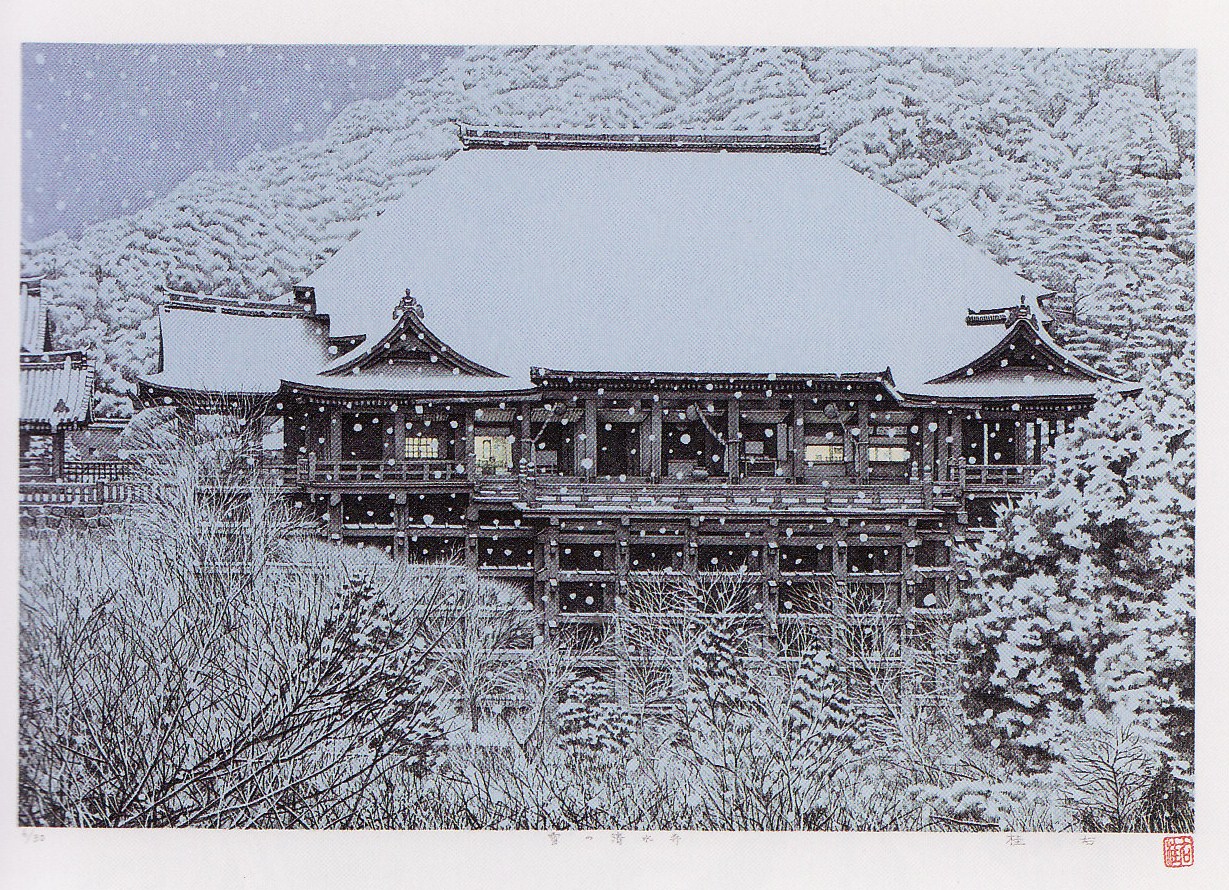
The guaranteed sell out? YAMAMOTO Keisuke’s Kiyomizu Temple covered with snow. If possible, it may even be more beautiful that last year’s print, as well as smaller, with a dusky blue of twilight. Supposably, you cannot see the temple from this angle, so he is working entirely from his memory, not a photo. Make sure to enlarge this one by clicking it. Even the poor quality of the scan cannot hide the incredible quality and detail of his lithography technique.

The winner of best title goes to ZHUANG Man for her Outside Is All Buzzing of Cicadas, as I find the roar of late summer cicadas in Japan to be a romantic sign of our return after the summer, but I have also always admired her moody detailed mezzotints. I believe she was a dentist before she became an artist, so fine detail work comes easily to her. Part of what made me notice her print so strongly this year is that is sits on the page of the catalog right next to…

…my absolute favorite print in the show – YOSHIHARA Eri’s Mark Rothko’s chair. I have had a passion for Rothko’s work since college and am currently having a bit of a Thonet chair obsession. But even if you don’t, it is just such a witty print and the scan doesn’t do it justice. This is Yoshihara’s first year in the show and it reminds me that new artists are what interest me most and leads me to my next topic…

…the Young Printmaker Award. Once again, I must offer up a caveat as I co-chaired this committee with the lovely Akiko Tatsuke, but I am so excited by our winning artist and our returning artist.

HIROSE Risa, with her stunning collage of finely detailed wood engravings supplemented by rose petal ink, was the recipient of this year’s award. The photo of Document-A Taste of Impressions in the catalog is about the size of a postage stamp, and cannot do the 97 x 67cm print justice, even if enlarged here. In addition to her winning print, we have two smaller works for sale including this one shown below, The Time Before Morning is Over (which could also be in contention for best title). To really get a sense of her work and technique, please see Artist Spotlight…Rise Hirose’s Ephemeral Beauties.

Our returning YPA winner from 3 years ago is ISHIZAKI Miku who also has three extraordinary works in the show, printed on her signature handmade washi paper. They are gorgeously textural and warm.

Don’t miss the Associate Show in the downstairs Fred Harris Gallery either, an incredble retrospective of work by HAGIWARA Hideo, spanning some 50 years and including amazing prints from his Mt. Fuji series.

The CWAJ Print Show opens at 11am on Friday, October 14th until 8pm that evening. I’ll be there from opening until about 3pm working as a docent. I’m available to answer questions and give tours. The show continues 11am-6pm on Saturday and again from 11am-5pm on Sunday. There are so many more prints I could mention here, but unfortunately not room for them all. Catalogs are available for sale at the show if you would like to have a record of all the prints.

Interested in working on the Print Show? Join CWAJ and get started.  Volunteers are needed for returning day in November and that will give you a chance to actually touch and see the work close up.

Image Credits: All images from the 56th CWAJ Print Show catalogue.

Related Posts:
Hanga 101…A Quick Primer on Japanese Prints
Artist Spotlight…55th CWAJ Print Show
Artist Spotlight…Rise Hirose’s Ephemeral Beauties

Read Full Post »

Just been perusing the Jayson Home Fall Flea Market full of to-die-for antiques and other items, when I spied this late 19th century marble-topped cast iron table from France…

Close-up

…And this Belgian one with a salvaged oak top.

Close-up

Now I have talked a lot about the perfect kitchen island for my tiny Victorian beach cottage here. And just a few weeks ago I waxed endlessly about my long-term dream island from Peri Wolfman’s house here. And we all know that whatever I choose will be antique, but all of a sudden, the particular charm of a cast iron table base has really caught my attention. It wasn’t just these offerings at Jayson Home either. I saw one, brought all the way from France, at the Oedo market that day out shopping with Peri. I loved it – it was sold of course – and I wasn’t dragging it back to the US anyway (imagine the carbon footprint on transport from France to Japan to the USA). But I think the idea has been germinating in the back of my mind for a while.

The more I think about it I realize the idea is not a new one for me. I looked at a similar one this summer in Asbury Park at the great cast iron and garden furniture store.

It had a great rusty patina (I can hear some of you chuckling at that idea) but I also might have considered painting it. It was actually too small and once again sold to boot, but I liked the idea then. It was also missing its marble top.

Side view

So I went off to check that magic market of all things – eBay – and came up with a few gorgeous, but wildly expensive options (the items at Jayson have pretty hefty price tags too), including this 1920s French marble-topped butchers table with bull head details.

Amazing, but too large and at over $8000, definitely not the answer. But liking this idea…What say you all???

Image credits: 1-4. Jayson Home, 5-9. me, 10-11. via sillyrabbits95428q90

Related Posts:
Ingenious Repurposing…Unusual Kitchen Islands and Printers Drawers
What’s Cooking? Peri Wolfman’s Kitchens Through the Years and That Marble-Topped Bakers Table

Read Full Post »

Following up on the idea of “finding” from my last post, I want to show my most recent purchase – a true unexpected find! I have long had a butterfly fetish and have been stomping my feet in frustration the last few years at their trendiness. I think I may have even complained about it in earlier posts and I am sure long time collectors of silhouettes and intaglios feel the same way I do right now. I won’t recreate the wheel by showing the plethora of interiors featuring butterfly art as there are already tons of posts out there.

I will, however, mention the more recent trend of some wonderful butterfly installations, different from the more typical 19th century prints or taxidermy mounted ones we usually see. The first to catch my eye was Myra Hoeffer’s all white California house, with its stream of butterflies mounted high on the wall as if they had come to roost there.

The butterflies are by artist Paul Villinski, made from recycled beer cans no less, who currently has an amazing looking installation at the Morgan Lehman Gallery in NYC. His work is utterly thrilling so if you have a moment, I would recommend paging through his website.

You might also remember the black butterflies on Serena’s wall in the TV series Gossip Girl. Those were his too…

And then there was that gorgeous butterfly box in the Celerie Kemble designed apartment in the newest Lonny. Obviously this room was irresistible to me as it is lavender, but I thought it was the perfect combination of pretty and functional too. And by the way, there is also a stuffed peacock in that apartment, talking about another trendy item right now, but one that definitely holds less interest for me…

What does any of this have to do with my newest finds? Not much really, other than the butterflies. This past weekend I had the opportunity to purchase two early Chizuko Yoshida butterfly prints from the 1970s. Yoshida is from one of the most distinguished families of Japanese woodblock print artists, and I had long admired her work. About five years ago, the CWAJ Print Show had a retrospective exhibition for its 50th anniversary that included one of her pieces, which had actually been the cover print of the show catalog in 1976. (Lower left corner of the catalog page below). I loved it, but unfortunately it was not for sale. With the 56th annual show coming up next week (watch for an upcoming post), I have had Japanese prints on my mind.

So imagine my surprise at stumbling across 2 of her seminal butterfly prints, one from 1977 and the other from 1978, already framed by the best gallery in town some 35 years ago. Perhaps they were her print show entries for the next two consecutive years after her cover print? I don’t know and have not had time to research it yet because I am too excited to wait to share them with you. Sorry in advance for the lousy photos, but the glare on the glass made it impossible to get a good shot, at least not without special equipment and more fussing on my part.

Here are some close-ups with detail, but I will have to show them on the wall in a later post. Click the image for a large view.

Definitely a little magic in the air…

Image credits: House Beautiful April 2011, photo credit: Francesco Lagnese, 2-3 via Paul Villinksi, 4. Lonny September/October 2011, photo credit: Patrick Cline, 5. 50th CWAJ Print Show Catalogue, page 152, 6-9. me.

Related Posts
Artist Spotlight…55th CWAJ Print Show
Junking in Singapore…Arab Street and the Dinky Di Store
Butterflies in Japan and New York…Sori Yanagi’s 1954 Classic Plywood Stool at MOMA

Read Full Post »

Making sense of the misty ideas floating around my head can be hard, so I will do my best to make this post intelligible.  So much of what this blog is about and what I truly love is the hunt, the surprise, the excitement of a found object, a piece of art, or a moment or item of beauty in a place least expected. Along those lines it is no surprise that my family, led by my girls, but with the mantle well taken up by me, has become addicted to geocaching. If you haven’t heard of it, geocaching is an outdoor hobby in which the participants use a Global Positioning System receiver and other navigational techniques to hide and seek containers, called “geocaches” or “caches”, anywhere in the world (thanks Wikipedia). When you find a cache, you leave a tiny gift inside and choose one to take that has been left there previously. Sometimes there is even a special trackable item with a mission such as “travel around the globe” and the job of the finder is to move that item onwards in its journey. For the kids, the math, geography and the actual search are challenging and fun, but for me it is truly that eureka(!) moment that makes it so irresistible. The whole idea of it is like a net that binds a mass of strangers together, almost a form of performance art. We had just started in New Jersey this summer, but now have been working our way through our neighborhood here in Tokyo as well as further afield. I feel like I need to add it as a tip to my post on antiquing with kids – or actually just as plain old parenting advice. Add a geocache site to your day and it will keep any child happy doing even boring errands.

We are making sure to addict our friends too as there is no fun in going it alone. Recently, one of those friends whom we introduced to geocaching and who also happens to be from Corning, NY, glass capital of the world, introduced a glass artist to me - Josh Simpson - who makes tiny miniature worlds and then leaves them places for people to stumble upon, whether it be in a few weeks or hundreds of years. Josh writes, “In 1976 I discovered several handmade marbles outside my kitchen door. Probably left there by children a generation before, they were still just as bright and colorful as they were on the summer afternoon they were lost.” His fascination with them led him to begin his Infinity Project, making and hiding tiny glass worlds and then, through the help of a few thousand volunteers, hiding them all over the world. “I hope future archaeologists will be confused about the meaning and purpose of the little spheres, wondering what they are and how they got there.”

Simpson’s website is full of photos of these amazing worlds, some tiny and some very large. My kids think they are amazing and love to study them and make comparisons with our own planet. My littlest one even kind of believes there are tiny little people in them and asks if it is possible that we are really in a glass sculpture and don’t know it. Simpson says, ”the cores of Planets are full of bubbles, threads, and kaleidoscopic patterns evoking unseen landscapes and underwater worlds. I know I’ve succeeded when you feel like you have to look closer at one of my little worlds and then lose yourself in its textures and color.”

One of my favorite photos from his site shows the glass canes that must get embedded in the globes (forgive me if I am completely wrong about that technique). I find them very mysterious….What do you see when you look at them? (I see coral reefs).

Hunting for glass balls is something we are already very familiar with as we are also perpetually on the lookout for old Japanese glass fishing floats. My elder daughter has taken to this one in particular, learning the marks and history and begging to drive nine hours north to the tip of Japan for our vacation in order to look for them on the beaches there. Last weekend, we went out searching with friends as part of a jaunt along the nearby coast, only to discover a few beloved ”lucky” floats that no fishermen were willing to part with. Nonetheless, just finding things has a magic of its own.

Exploring by flashlight was quite exciting.

Our actual haul to date has been pretty good – this isn’t even all we have found. Like any enthusiasts, glass float collectors talk lovingly about bubbles, swirls and spindles. Rare marks and shapes are all the more collectible. Give her a minute and my daughter will be happy to talk your ear off.

Another friend turned me on the annual “Finders Keepers” event in Lincoln City, Oregon, in which local artists hand blow and hide roughly 2000 floats along the beach every winter for people to discover. It has become a huge tourist attraction that pulls folks in and gets them to tour the art galleries as well as hunt on the beach. Again, like Simpson’s tiny glass worlds, this is art that allows the viewer to participate in such that they become part of it.

Late this summer there was also a special glass drop in which 200 small antique Japanese glass floats were planted along the Lincoln City beaches. Won’t mention that to my daughter…

But perhaps the most unusual found items of late are these extraordinary and minutely detailed paper sculptures being anonymously left at numerous Scottish libraries. Each one is absolutely amazing in both its construction and wittiness, but it is a complete mystery as to who has been making them. I cannot resist showing them all, in the order they have been found, but for more information on the story and wonderful close-ups see Txikito Planet.

The tag on the first one left at the Scottish Poetry Library in March read:
It started with your name @byleaveswelive and became a tree.…
… We know that a library is so much more than a building full of books… a book is so much more than pages full of words.…
This is for you in support of libraries, books, words, ideas….. a gesture (poetic maybe?)

Next up was this gramophone over a coffin deposited at the National Library of Scotland:
For @natlibscot – A gift in support of libraries, books, words, ideas….. (& against their exit)

The third was found at the Filmhouse theater:
For @filmhouse – A gift in support of libraries, books, words, ideas….. and all things *magic*

I thought the one left at the Scottish Storytelling Centre was my favorite. The tag reads:
For @scotstorycenter – A gift in support of libraries, books, works, ideas….. Once upon a time there was a book and in the book was a nest and in the nest was an egg and in the egg was a dragon and in the dragon was a story…..

But in sentiment it may have been replaced by this one appearing at the Edinburgh International Book Festival which reads “Nothing beats a nice cup of tea (or coffee) and a really good BOOK, except maybe a cake as well“. The attached tag:
To @edbookfest ‘A gift’ This is for you in support of libraries, books, words, ideas…… & festivals xx

This one also appeared at the festival with the following tag:
To @edincityoflit ‘A gift’ LOST (albeit in a good book) This is for you in support of libraries, books, words, ideas…. “No infant has the power of deciding….. by what circumstances (they) shall be surrounded.. Robert Owen

The final one I have seen appeared at the Central Lending Library at the end of August.
For Central Library ‘A Gift’ @Edinburgh_CC This is for you in support of libraries, books, words, ideas…. LIBRARIES ARE EXPANSIVE. Note the letter change in the last word.

In late September the mystery was solved, with the Edinburgh News taking a poll as to whether or not to reveal the artist’s name. As far as I know, it is still not public knowledge. I think it is more fun to keep the mystery alive!

As for us, my girls are hoping to convince Josh Simpson that we should be the next participants in his Infinity Project. They want to hide one of his tiny worlds in a geocache and give it an assignment in the hopes that fellow geocachers will carry it from place to place, creating a traveling art exhibition of one.

Image credits: 1. G. Fukuda via Instagram, 2. Hector Rodriguez via Josh Simpson, 3-4. Josh Simpson, 5-7 & 9. me, 8. via oregon.com, 10-16. chrisdonia via Txikito Planet

Read Full Post »

Follow

Get every new post delivered to your Inbox.

Join 405 other followers

%d bloggers like this: