Feeds:
Posts
Comments

Archive for April, 2011

Thursday was the 28th of the month which means that it is time for the Kawagoe shrine sale. We have had a lot of rainy 28ths lately, so it was lovely to wake to a warm sunshiny day.  I went with every intention of not buying anything (ha!), which of course proved to be an impossible task. The market felt a bit quieter than usual, but there were plenty of Tokyo folks there.

The theme of the day was clearly baskets…

I was dying for these amazing huge winnower baskets, imaging them hung on a wall in the den of a country house. I know I’ve seen a recent photo of a similar basket display, but can’t remember where. When I do, I’ll add it in here.

Addendum: I didn’t find the photo I was thinking of, but I did find this one with a symmetrical display of Vietnamese fishing hats…

and this one from The Bootstrap Project (more on that in a later post) of handmade Zambian baskets displayed asymetrically.

These baskets would be perfect in a bathroom with one closed holding extra toilet paper and the other open with extra towels.

I didn’t buy any baskets, having just found this one last week. It is just perfect for holding magazines.

But there were some things I couldn’t resist…

I have a weakness for Japanese bellflowers, so this katagami stencil came home with me.

A couple of Tokyo friends got lucky and bought big Japanese fishing floats from this dealer. I got a bunch of small rolling pin or roller floats, all slightly different in shape and size, but roughly around five inches long. I figure I can’t get my big floats back to the US anytime soon, but a handful of these in a basket in the bathroom might do!

Speaking of the bathroom, I thought this kashigata looked like a sand dollar and a starfish and would be perfect to display alongside the bowls of the real things collected by the girls.

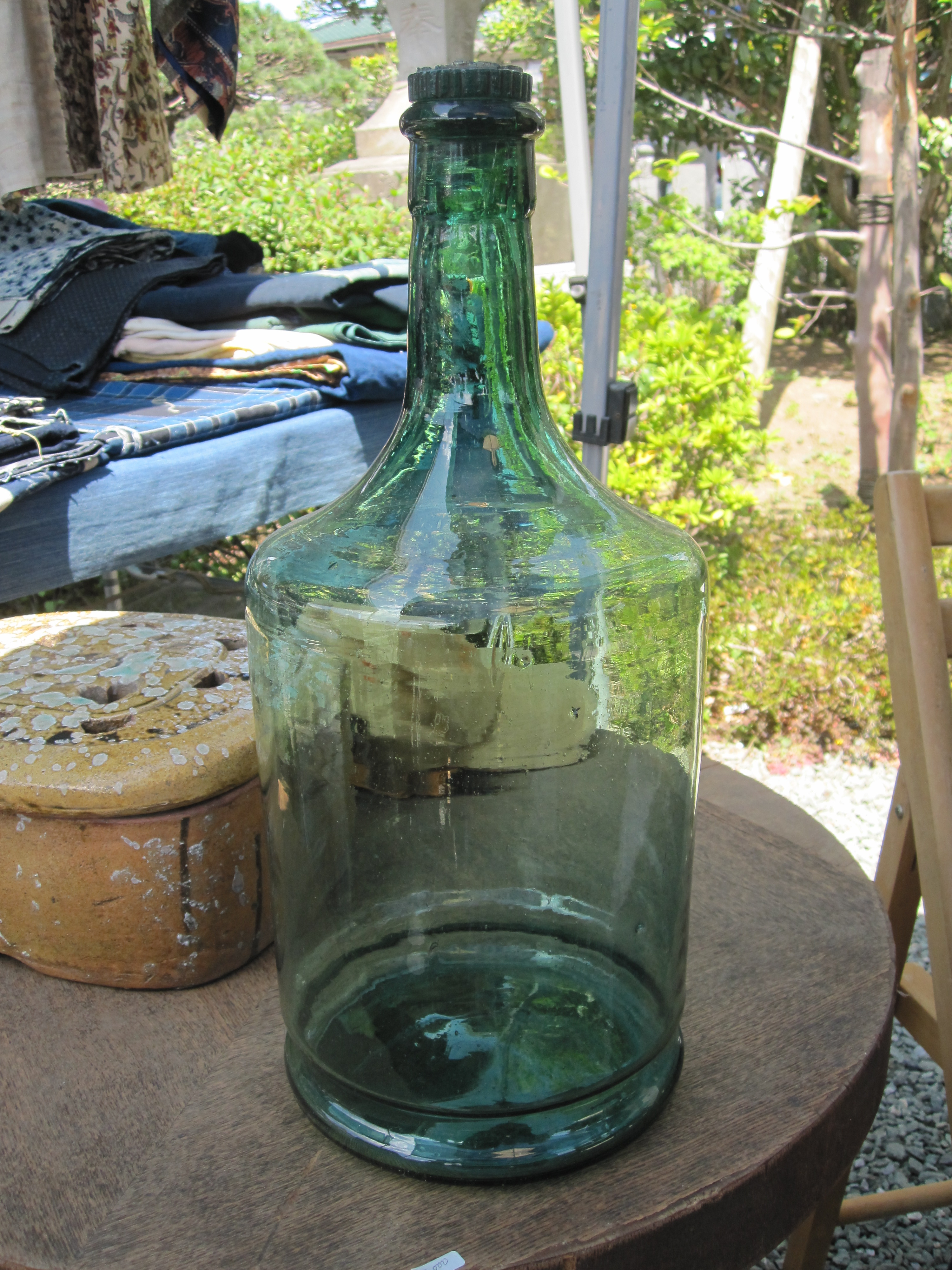
Gorgeous shape and color, but it was the glass screw top that sold me!
Is it a stool or a table? Either! This was my favorite find of the day.

Remember this post from a couple of days ago? Patina over perfection…antiques with flaws can be very affordable. I didn’t need this big Seto pot, but it was a lovely one, fishbowl style with a finished and glazed interior. At first glance a 30,000yen (about $300) piece…

…at second glance, this repair brought the price down to 10% of that.  For 3000yen ($30) it came home with me.

Friends scored big time too. The sake jug on the left came home with M, as her birthday present. I was so happy to find it after another friend got the one on the right last October.

M got this amazing roof tile cap from Nagano too.

And these 3 smaller inban hibachi (transfer printed charcoal brazier), probably from tobacco sets.

Another friend bought these gorgeous late-Edo period covered bowls. I want to research the unusual painted pattern as I know I have seen it in a museum collection somewhere.  Just so modern!

We finished with our usual post-antiquing repast. Indian food! Their keema curry is super-delish!

About these ads

Read Full Post »

So what do you do with a really worn carpet? Yesterday’s post left me wanting to say more about my love of faded and threadbare carpets and ways to use them. One of the best is to pull them into bathrooms and kitchens  – a little color and texture to liven up the space, soften it up, or just plain old add some pizzaz.  The truth is that most have withstood years of use and possibly neglect.  A little water won’t hurt them and frankly, it doesn’t matter anyway.

I’ll start with one of my favorites. Domino billed this bathroom as “English bohemian” and I wish my master bath could look like this.  I love the pale painted armoire and the faded but still dark Persian. I believe it is a Lavar Kerman.

Carolina Bunce creates a soothing and elegant master bath in her California home.

Betsy Burnham uses a small red Chinese stool to pick up on the red color notes in the rug in this otherwise very neutral bathroom.

Antique rugs even look good over traditional bathroom tiles, as seen in the two views of this Los Angeles bathroom.

The rug and the chair add a bit of color to pop the bathroom. This one looks to be a Khotan.

Philip Gorrivan lays one over dark wooden floorboards in a powder room…

…while Sandra Lucas adds some warmth to a rustic Texas bathroom.

Kristen Buckingham uses another style of Khotan rug, a bold pictorial one with a real Chinese feel as a contrast in the most elegant of bathrooms.

Another view of the same room. Amazing how different it looks in this lighting.

Chinese and Tibetan rugs make some of the best bathmats as they have simple geometric forms, come in small sizes and can be quite plush. Mary Watkins Wood creates a beautiful tableau here.

They even work well in contemporary bathrooms. Here the rug is the only bit of color in this smooth monochrome bath by Tom Scheerer.

Flatweaves are a bit harder to use in a bath, but Penny Morrison layers a Bessarabian kilim over what looks to be another carpet. This bathroom has all the charm of an English drawing room – just change the tub out for a sofa.

Mona Hajj uses a geometric kilim for contrast in the most elegant of bathrooms.

Even vintage American hooked rugs get in on the action making a nice casual country-style alternative.

A recent issue of one of the new online shelter magazines High Gloss featured not one but two charming kitchens with great rugs, so clearly this is a trend in the making. In the first, Tia Zoldan uses an unusal pink and purple rug and a glossy dark grey door to highlight her simple kitchen. She has a great quote in the article, “I love using antique rugs in the kitchen, it just makes any kitchen look lived in.” I am in complete agreement.

Elsewhere in the same issue, Jaime Meares uses an antique rug in warm colors to set off the cool stainless steel in her kitchen.

Worn Persians are just the thing to soften a white country kitchen. Joan at for the love of a house bought hers for $5 over twenty years ago. Her house renovation in New Hampshire is just beautiful! If you have a moment, stop by her blog and take a look.

A kitchen with a similar feel from Mark Maresca.

A really worn rug and a great collection of yelloware in Carolina Bunce’s California kitchen.  I can remember her Hudson Valley house from the early 1990s like it was yesterday. It was one of those spaces that just stayed with you. Funny to see so many of the things from that house redeployed in such a different way.

The rug in this kitchen by Peter Dunham is the perfect bridge to tie in the red chairs.

Mona Hajj uses a very neutral and geometric rug in this clean-cut kitchen.

So keep your eyes open. I have picked up small vintage Tibetans in the backstreets of Beijing as well as antique Persians in New Jersey and Florida antique centers for a song. I love giving them a new lease on life.

Image credits: 1. Domino June-July 2007, 2 & 19. Martha Stewart Living September 2004, 3. Burnham Design, 4-5 Country Home September 2005, photo credit: Eric Exene, 6. Philip Gorrivan Design, 7. Traditional Home December 2010, photo credit: Werner Straube, 8-9. Kristen Buckingham Interior Design, 10. House Beautiful May 2010, photo credit: Thomas Loof, 11. Tom Scheerer, 12. Penny Morrison, 13 & 21. Mona Hajj Interiors, 14. credit unknown, 15-16. High Gloss February-March 2011, photo credit: Grey Crawford (15) and Dustin Peck (16), 17. via for the love of a house, 18. Southern Accents, photo credit: William Waldron, 20. House Beautiful November 2010, photo credit: Victoria Pearson,

Read Full Post »

Before the earthquake, I’d been having a great email chat with a reader who collects inban (Japanese transferware), in particular, the chipped, unwanted bargain pieces. She uses them to store her jewelry and other small items, spread across her dresser. This being Japan, she lives in tight quarters, so if something gets knocked off and broken, she doesn’t mind much. I loved the idea of her collection, beloved but a bit broken. Afterwards, I checked with her and none had been destroyed.

At the end of February as well, I found this great Meiji period square platter at the market. It is beautiful, painted in a really rich cobalt with iris and butterfly, but it had a few small firing flaws.

Firing flaws can be caused by many things. Sometimes a piece going into the kiln would touch another item, or a bubble might pop, or some ash would get into the glaze. The detail below shows the flaws up close and they have gotten dirty over time. They will probably wash out, but I don’t really care.

For some, unblemished perfection is the standard but for me, without patina there is no soul, no depth, to an item. I want to see the echoes of wear, of use, of small damages even – perfection is for museum pieces. Most likely as well, perfection is unaffordable. Antiques with flaws make the unaffordable, attainable. And if you had all the money in the world, when would a piece be good enough? The example rare enough? The provenance historic enough? How would you choose what to buy if you did not need that magic intersection of cost and condition?

One of the places this is seen most clearly is in the world of Oriental carpets. My weakness is for worn, almost threadbare rugs. Perhaps it is a kind of sour grapes, as room size antique Persians in great condition tend to start in the serious five figures. By I love the softness of the faded colors and the indescribable quality called patina.

Take Khotan rugs, for example. Often referred to as East Turkestan or Samarkand rugs, they were woven in what is now the eastern-most province of China, long the central crossing of the Silk Road. They are a conglomerate of cultures and history –  part Chinese, part Arabic, part Indian, with a European reference. One of the most common, and my favorite, East Turkestan motifs is that of the pomegranate-tree or pomegranate-vase, usually woven in the towns of Kashgar or Yarkand. Surrounded by a series of borders with fretwork, trefoil and cloud patterns, a series of stylized pomegranates grow from a small pot in symmetrical patterns. Most East Turkestan carpets are long and thin, about double length to width, and very large ones (over 12 feet long) are rare and hard to come by. Almost all are old, having been woven no later than about 1940, and most often earlier, and the dyes tend to fade and soften with time.

For a little fun comparison I have assembled a smattering of similarly sized pomegranate East Turkestan examples that fall all along the price and condition spectrum.

“For the uninitiated, Doris Leslie Blau is to rugs what Harry Winston is to jewels—the best,” says designer Carey Maloney in the blog Rural Intelligence. I had to use the quote, as there is no better way to say it.  But like Harry Winston, the best is expensive. Doris Leslie Blau has numerous examples like this one, all in the $20-25,000 range.


Not long ago, designer Wendy Haworth featured one in her One Kings Lane sale, half price at around $5000.

Examples can be found on eBay in the $1000-2000 range, although condition can be quite hard to judge. It’s a question of just how threadbare is it?

My pomegranate rug has definite wear to the pile and a few repairs, but the colors are mellow and smooth. I bought it at Chine Gallery on Hollywood Road in Hong Kong eons ago. I was sad to see they didn’t have any on my recent visit.

Although I did see this large and unusual colored one down the street for sale at Chu’s Fine Arts & Tibetan Antiques.

Rose Anne de Pampelonne used a pomegranate East Turkestan carpet in her living room, a room that like the rug, is a mixture of European and  Asian design.  More photos of her home can be found here at Elle Decor.

My love of aged rugs is not limited to those from the Samarkand region. I am equal opportunity with Persians, kilims and the like.  Designers Roberto Peregalli and Laura Santori Rimini are masters at creating the old world look and faded antique carpets are one of the key components. This room is a perfect blend of Turkish overlay onto its very Englishness, if you know what I mean…

Newer to the game of old world elegance are Olya Thompson and Nathalie Farman-Farma with their new fabric line Tissus Tartares. The two women met and bonded over a love of romantic Russian style, the European Russia of Tolstoy and the Czars, ”the rich and sophisticated interplay between East and West as it is found in Russian, Persian and Central Asian designs”.

Featured in Vogue at the beginning of 2010, Thompson’s Brooklyn brownstone captivated me. This February, Farman-Farma’s London home was featured in The World of Interiors and The Wall Street Journal ran an article about their textile line later in the month. While their fabrics are a standout in their interiors, it is the mix with the carpets and the accessories that make the rooms.

The sofa in the photo above and below is covered in their “Ikat” fabric.

Pillows in both homes made from other fabrics in the line including “Jar Ptitsa” and “Eté Muscovite”.

Farman-Farma’s London home features chairs reminiscent of those in Muriel Brandolini’s interiors, a boteh motif (paisley) covered rug and the prettiest sheer curtains.

I believe the lampshade in the corner sports their “Fleur de steppes”. 

The daybed under the window wears “Lemontov”.

The guest room is covered with “Casse-noisette”.

When I first moved to Japan almost seven years ago, I couldn’t help but continue my incessant browsing of the Brooklyn real estate market as if it was important not to lose sight of it. As time went on, I became content with the idea of Japan as my home.  One of the unfortunate results of the earthquake is that I have resumed the habit, almost like a nervous tic. Well, lo and behold, Olya Thompson’s Brooklyn Heights townhouse is for sale, first for $5.395 million, but now it has come down to $4.95 million. I wonder if she will throw in the furniture and rugs for that price? It is fun to compare the realtor’s photos with those from the magazines, as they show the utilitarian spaces like the hallways and kitchen. Click here to see the listing.

And speaking of natural disasters, it is always hopeful to read about those who have recovered and rebuilt. Karina Gentinetta and her husband have recreated their New Orleans home from the ground up to look as if it was never damaged. Recovered items that most would have considered destroyed, such as a silver tray, now boast what she calls their “Katrina Patina”. Most impressively, her old world glamour has been achieved on the tightest of budgets. More photos of her lovely home and the great story here.

Gentinetta’s rug is so worn and threadbare, it is actually torn straight up the middle…

Next Day Addendum: Just for counterpoint, I can’t help adding this amazing room by Tom Stringer, featuring the most unusually colored East Turkestan pomegranate-vase rug in a very modern interior. One of the charms of Khotans is that they really can swing either way. Gorgeous!

(N.B. Most of this post was written months ago and then never got published. While some of it is older news, I can’t bear to scrap it as it is all topics that are dear to my heart.)

Image credits: 1. L. Twaronite, 2-3, 7-8. me, 4. Doris Leslie Blau, 5. One Kings Lane, 6. eBay, 9. Elle Decor April 2008, photo credit: Roger Davies, 10. Elle Decor April 2008, photo credit: Roger Davies, 11. Vogue January 2010, 12, 14-15. The Wall Street Journal February 25, 2011, photo credit: Paul Costello, 13, 17, 19, 21. Tissus Tartares, 16, 18, 20. The World of Interiors February 2011, 21. The New York Times April 6, 2011, photo credit: Sara Essex.

Read Full Post »

Los Angelinos, take note. Peter Dunham’s Hollywood at Home, his one stop shop for some of the hottest hand-printed textile lines around (Carolina Irving, Lisa Fine, John Robshaw, Martyn Lawrence-Bullard and his own), custom furniture and vintage finds has opened a second branch, also on La Cienega Boulevard.

Of even bigger news in my book, Hollywood at Home will be carrying Rodman Primack’s new line of Japanese inspired fabrics, hand-printed on Belgian linen, simply called R.P. Miller. Since childhood, Primack has been influenced by his grandparents extensive collection of Japanese art and antiques gathered on their travels. Based on 18th and 19th century ukiyo-e (woodblock prints), his new textiles are modern interpretations of traditional patterns.  ”In the fabrics various themes and details have been abstracted to create something new that is meant to evoke, not literally replicate.” I am still waiting on some live samples, but the showroom did send me some close-up photos.

You can see the four main patterns in the indigo blue colorway stacked up here. The one I find particularly interesting is the second one down, hard to see in just this small bit. It is an expanded and simplified rendering of the angled and foreshortened perspective seen in the depiction of wooden fences, bridges and walkways in woodblock prints and folding screens (byobu).

Here you can see it much better on the sofa in this photo from the showroom via Stylebeat. A pattern like this works best for a large-scale project with a horizontal view like this.

Here ia a 17th century masterpiece by Ogata Korin in the collection of the Metropolitan Museum that has just the kind of bridge and perspective I was referring to.

And again, in a woodblock print by Kitao Shigemasa, you can even see the grain of the wood on the floorboards. For more on Japanese perspective and its influence on Western art, see here and here (and make sure to compare this print to Whistler’s Caprice in Purple and Gold shown there).

It would have been a perfect lead-in for the next fabric if the motif on the doorway in the print above had been asanoha (hemp) instead of sayagata (key fret), as the classic hemp pattern is the boldest of the graphic prints in the line. It comes in numerous colors including the red, grey, green and indigo shown here. The truth is, the hemp motif needs its own post one of these days!

The sweetest pattern is this petals in the river motif, shown in red below and blue up at the top.

I was trying to find a yukata (cotton kimono) photo in my files with a similar pattern, as I know I have seen them, but the best I could come up with was this grass pattern.  But it could easily be part of his collection, don’t you think?  You can see why I am always wishing the fabrics of traditional Japanese dress were upholstery weight!


There is also a cute pattern of tiny stars and perhaps some others, I am not sure. More when I get my samples!

Image Credits: 1, 5-6. courtesy of Hollywood at Home, 2. via Stylebeat, 3. via The Metropolitan Museum of Art, 4. via The Library of Congress, 7. me.

Read Full Post »

“In Mashiko, nearly all the Nobori kilns fell down, and Mashiko’s firing is
about to go out. We, potters, cannot help being shocked because the kiln is the soul of us.
We cannot turn off this fire in “Mashiko, the Sacred Place of Mingei”,
“Mashiko, Town of Handcraft”, which Shoji Hamada established. We must keep
the smoke coming out of chimneys in Mashiko.”
Ken Matsuzaki

Around the world, Mashiko is almost a synonym for Mingei, the “art of the people” or “folk craft” movement started in the 1920′s in Japan by Sōetsu Yanagi, Shoji Hamada and Kanjiro Kawai. It was the potter Hamada who centralized Mashiko as the place for the production of these “functionally beautiful” pots, bowls and cups. The earthquake on March 11, 2011 has devastated the town, the kilns and the museums. Artist Ken Matsuzaki quickly sent out an appeal for help, worked with the Mayor of the town and NPO’s to establish the Mashiko Pottery Fund. In the USA, tax-deductible donations to the Mashiko Pottery Fund are made via Mudflat Studio, as they are serving as the fiscal sponsor. Long ties also bind the Leach Pottery in Cornwall to Mashiko as it was founded in 1920 by Bernard Leach and Shoji Hamada, and as a result, they were also early to launch a Mashiko Earthquake Appeal.

Locally, Gallery St. Ives in Setagaya is holding a Mashiko Earthquake Appeal exhibit from today, Saturday, April 16th until Sunday, May 8th in support of their own Mashiko relief fund. The Gallery is open 11-6, from Wednesday through Sunday.  The five person exhibit includes work by artists Ken Matsuzaki,

Ken Matsuzaki via Pucker Gallery

Tomoo Hamada,

Tomoo Hamada via Pucker Gallery

Euan Craig,

Euan Craig via Oakwood Ceramics

Minoru Suzuki

Minori Suzuki via Rakuten

and Yuchiko Baba.

Yuchiko Baba via Selfridge Ceramic Art

Since the earthquake I have been following Euan Craig’s emotionally riveting account of his family’s life changes on his blog Euan The Potter. He writes, “Houses can be repaired or rebuilt, kilns too. Pottery can be replaced, remade. Stuff doesn’t really matter. We’ll manage somehow. My family, my loved ones, are safe and sound. They sleep in the next room as I write this to you. I thank God. We are the lucky ones, and my heart and prayers go out to those who are not.” I am hoping to meet him as he, Ken Matsuzaki and Minori Suzuki will be at the exhibition on Sunday the 17th.

On the internet, the handmade community has geared up as Etsy potters have set up mudteam4mashiko and participating artists are donating 100% of the proceeds from their sales to the Leach Pottery fund. Additional potters are donating proceeds to the Red Cross and other relief agencies. Other non-pottery artists are also collecting funds from sales for earthquake relief charities. Searches such as “”earthquake relief” on Etsy yield over 3000 handmade items for sale. One of my favorites for sale is this Namaste bowl by an artist named Antonia. It has one of my favorite yoga sayings, ”The divine in me bows to the divine in you,” which is the literal translation of namaste and a sign of deep respect. It is exactly how I am feeling about the Japanese people right now. Their courage and patience in this last month have been so truly extraordinary that it defies my ability to write about it.

I urge everyone to donate a little (or a lot!), whether you donate directly to the many funds set up or do it while shopping!

Read Full Post »

In response to my Junking in Singapore post, a Tokyo reader emailed me this photo of her kilim footstool, bought at Persian Abrisham, in nearby Higashi Azabu. I stopped in to check it out and they had quite a few. While this is great news to Tokyoites, it doesn’t help me get a few back to America!

They had square…

…round…

…and extra covers.

As previously mentioned, I had been planning to buy the ubiquitous Moroccan poufs, sold and seen everywhere, like these in Candace Bushnell’s apartment, for the TV room/guest room in our beach house in New Jersey. The room gets piled with kids so we need extra seating, but it needs to be lightweight and moveable when the room becomes a bedroom. They seem like a sensible and stylish solution.

The kilim footstools push the TV room in a more sophisticated “library” style of decorating and I am still not 100% sure that is the way I mean to go. Originally, the room was used as a laundry room, a real waste of space in a house as small as mine where one of the main goals is to sleep as many people as possible, particularly as the room is decently sized. It was painted a bright yellow with a childish border around the top. Here is a taste of the ugly…

We cleared it out right away, but there wasn’t any time to consider how I wanted it to look. The key piece of furniture is from my parents, an amazing bamboo daybed with the old-fashioned 33 inch wide mattress, instead of the modern 39 inch, a more graceful and space-saving choice, to use as the couch and to sleep guests.  It really is a shame they don’t make that size any more. It has a simple creamy matelesse coverlet, basically Benjamin Moore’s Linen White, so I had the painter just go ahead and paint the room that color. Now, I am not normally a Linen White kinda girl, preferring instead pure cool whites to the yellowy beige of Linen White. But in such a cramped space, I do like how the daybed basically disappears into the wall. And all the accessories at my fingertips seem to work with it. My best friend bought me the amazing John Robshaw bolster pillow in the photo below, which started to clinch the deal. I pulled out my framed butterfly book-plates, planned for curtains in a Brigitte Singh block print (shown to the left) and headed down a path that would look great with either footstools or poufs.

As usual, the best way to get ideas across is to use photos of existing rooms. This cozy niche by Stephen Miller Siegel has the look that my room is starting to have. Muted colors, Indian prints, almost a masculine style.

The cane daybed piled with pillows in this living room by Chris Barrett has that same feel. I wish there was a way to rotate the photo and look at the sofa head on.

But there is another version of this room floating around my head. one with a soft white feel, with throw pillows in cool brights. The perfect example is Alayne Patrick’s apartment – she even has a dhurrie, albeit pink and white instead of blue, and some colorful poufs.

This is an outdoor version of the daybed, but has a similar feel.

Sometimes I think I want it even purer than that – all lacy and white. Theoretically hard to keep clean, but bleach does wonders. I have loved this photo for years.

Again, lacy whiteness, in this case set off by all the green. I could paint the walls or wallpaper them to make the space cozy which is sometimes the best strategy in a small room.

I’d really love opinions. Poufs or kilim footstools? Or something else entirely? And what about color schemes? The summer is fast upon me and I need something to distract me anyway right now – there were quite a few big aftershocks today. So what would you do?

Image credits: 1. L. Twaronite, 2-4, 6-8. me, 5. Elle Decor September 2005 photo credit: William Waldron, 9. Elle Decor, date and photo credit unknown, 10. House Beautiful January 2009 photo credit: Victoria Pearson, 11. Domino May 2007, photo credit: Melanie Acevedo, 12. House Beautiful June 2006, photo credit: Ray Kachatorian, 13. credit unknown, probably House & Garden or Architectural Digest, 14. credit unknown, probably House & Garden.

Read Full Post »

The sakura (cherry blossoms) are super late this year. Usually they are past their prime by now, but I would say today or tomorrow they will be reaching their peak. It feels as if they have waited – waited for people here in Japan to be ready to move forward and try to celebrate spring. There is definitely a sense that the wild o-hanami (blossom viewing) parties that usually happen will be out-of-place this year, but I think it is important to look for hope and renewal and nothing better represents that then the masses of blooms seen throughout the nation.

In honor of the season, I thought a would do a round-up of the prettiest pale pink bedrooms. I have to admit a weakness for the combination of the color with rich woods and lacy white fabrics. The pink itself needs to be soft and subtle, without any brightness or it will look like a child’s room covered in candy or bubble gum. The best pale pink paints have lots of grey pigment in them, like those from Farrow & Ball or a bit of a coral undertone to take away the sweetness.

The mosquito netting on the bed, the simple pom-pom trimmed curtains and the antique rugs combined with the fine Louis VXI furniture make Mihri Fenwick’s unpretentious bedroom in southwestern France one of my favorites.

Beverly Field has artfully added blue and white, in the form a dhurrie rug, porcelain lamp and pillow shams to her painted sleigh bed in her delightful pink bedroom.

On one side of the same room stands this amazing scrubbed pine Dutch chest which looks lovely against the pale pink of the wall. I love the formal shape made from such an informal material.

This room isn’t technically a bedroom, but it does have a day bed in it! And here you can see how lovely the pink looks with the dark Empire and Gothic Revival mahogany furniture.

Pink, as we all know, is the navy blue of India. This English country house makes great use of Indian printed textiles in collaboration with lacy white linens.

This bedroom uses exotic fabrics too, but has more of an old world faded glamour. Note the Empire dresser here as once again pink is a perfect foil for mahogany.

Sometimes, the prettiest pink bedrooms need little more than white to set them off, like these two by Philip Gorrivan and Sally Steponkus.

I love Haskell Harris’s bedroom because she has taken fairly ordinary furniture and accessories and grouped them in such as way as to make them all feel special. The pink is the unexpected backdrop that pulls it all together.

On the other side of her room the tall chest seems like a piece of furniture she inherited from her grandmother. While the big trend these days is to paint everything, I love the old fashionedness of the brown wood.

The inimitable Rita Konig seems to change her bedroom constantly, but she always finds the perfect feel for less than perfect spaces. Take a look at what a difficult space this was before she wallpapered it here. For other versions of her bedrooms (not pink) in different apartments, click here and here.

The aforementioned Rita Konig also wrote about what may be my favorite pale pink room ever, the bedroom of Marella Agnelli, in The Wall Street Journal. It has such perfect balance and I could stare at this room forever.

Instead, I am headed out to join my girlfriends at an evening o-hanami party in the park. There is nothing better than the real thing!

Related Post: Ume Blooming…Maybe Pantone Should Have Called Their Color of the Year Plum Blossom?

Image credits: 1. David Hicks tablescape via The Peak of Chic, 2. House Beautiful September 1996, photo credit: Elizabeth Zeschin, 2-3. House Beautiful April 1995, photo credit: Fran Brennan, 4. House Beautiful January 1994, photo credit: Lizzie Himmel, 5. House Beautiful September 1993, photo credit: Michael Dunne, 6. Elle Decor November 2009, photo credit: Miguel Flores-Vianna, 7. Philip Gorrivan, 8. Sally Steponkus, can’t remember where I got this from, 9 & 10. Southern Living, April 2009, photo credit: Charles Walton IV, 11. Domino Magazine, photo credit: unknown, 12. The Wall Street Journal, photo credit: Eric Bowman. 13. Carolyn Koshnick Photography

Read Full Post »

It was the best of times, during the worst of times…


When you live your life as an expatriate, friends become like family. You join them for holidays like Thanksgiving and they get to know your children well. In emergencies, they take care of you, just the way family would. We have a lot of people to thank for the last few weeks and I am enjoying searching out some thank you presents.

The friend who kept us in Singapore already has a pair of beautiful katagami, the Japanese stencils used in printing designs on fabric, usually for kimono. Hers are an unusal long narrow pair, used to make obi, but more commonly seen are smaller stencils, like the ones framed in the Eric Cohler designed bedroom above or those in the Steven Gambrel designed dining room below.

Gambrel is a master at using tightly hung textile arts in his interiors and he is one of the only published designers out there who does it often.

You can see it over and over again in his portfolio.

These look to be actual textile fragments.

Katagami are not the only fabric “printing aids” found among Japanese antiques. Obi zuan, the hand-painted patterns used in obi making can also be found at antique stores and shrine sales.  I even saw a number of them framed at the Altfield Gallery in Hong Kong. Honestly, I still cannot get over how many Japanese antiques there were for sale in Hong Kong!

On Saturday I ran down to the Azabu Juban patio market, knowing there is a dealer who usually has a nice selection of katagami. He did not disappoint – actually all the dealers were there and it was business as usual. In the wake of the disaster, it is not just aid that people need, it is for their livelihoods to continue. In that spirit, shopping seems to be one of the more valuable things I can do.

Picking out the stencils was not hard. There were two bingata style katagami, used to make traditional Okinawan cloth that I thought my friend would really like. The bingata stencils tend to be curvy and pictorial, with plants and animals depicted, unlike some of the more geometric katagami. They weren’t too big, so they wouldn’t take a lot of wall space commitment either. Key to highlighting the detail is to use a white or light-colored liner.

One common way to frame them is to cover the dark border entirely or partially with the mat.

Another way to frame them is to allow the dark border of the stencil to function as a mat in lieu of one. Here, Maja Smith of Alegria Design uses an unexpected modern lucite box frame and no matting to highlight her katagami.  

In the end, I chose a framing style similar to the first image in the post – with a mat, but allowing the dark border to show as an inner frame. I’ll post the final product when it comes back from the framer.

Unfortunately, I cannot blog about the other thank you gifts I am out shopping for as I know those friends are regular readers.  They will just have to wait and be surprised…

Image credits: 1. House Beautiful October 2008, photo credit: Julian Wass, 2. House Beautiful April 2011, photo credit: Simon Watson, 3-5. Steven Gambrel, 6-10. me.

Read Full Post »


Throughout the time I have been away from Japan, I have been thinking a lot about my friends in Ocean Grove whose house burned on the same day as the earthquake hit here. In a town famous for the most ornate Victorians, with gull-wing roofs or turrets, their house, built in 1923, is a simple four-square Victorian with an arts and crafts style front porch, a pair of bay windows and a dormered attic floor. Like its owners, it is a warm and unpretentious house, always filled to the brim with guests, whether sitting on the porch or cramming around the dining room table. My friends have jumped quickly into the rebuilding process, starting to meet with architects, and I am sure they are not planning to build some kind of fancy faux Victorian, but instead an improved version of what they already had. As they start to plan the exterior, I thought it would be fun to help them along in envisioning what the inside might look like. To do so, I am going to be leaning on certain designers heavily, such as Tom Scheerer and Markham Roberts, whose wonderful relaxed beach and vacation houses fit the bill.

The colors of the interiors before revolved around a palette of blue, white and naturals like tan and brown - the colors of the beach, clouds and sky. I can’t see changing that as it fit the house and locale perfectly.  Starting at the arrival point, I am hoping for a similar front porch, with a beadboard ceiling and comfy chairs for happy hour, just as was there before.

One “flaw” of the previous house was the lack of an entryway as the front door opened directly into the living room. Perhaps the new design might make room for one, with space to hang hats and drop beach bags.

The living room had whitewashed paneled walls and I could see using beadboard or horizontal shipboard in rooms throughout the house. Most of the photos following have some, whether on the walls or ceiling. I also love the idea of some grasscloth to add texture. The original living room had a simple painted brick fireplace, a feature I would love to see kept. My friends also like having carpet in the living room, not as usual in a beach house, but actually practical and easy to keep clean.  A patterned one like this one would hide dirt and stains.

Sisal or seagrass would be a reasonable alternative to carpeting too.

Add comfortable upholstered furniture in straight forward shapes and simple bamboo blinds and plain or checked curtains at the windows.

A games table might be a nice feature to sneak in – great for extra diners too! And it is so easy to pick up inexpensive Victorian furniture with great lines along the Jersey shore.

The original dining room was my favorite room in the house with built-in china cabinets with glass doors, the backs of which were painted blue to highlight the contents. Simple Windsor style chairs circled an oval table.  This dining room with its Victorian chairs, white cabinet and painted table is quite similar.

Another view of the same dining room shows a simple Aesthetic Movement settee upholstered in a modern fabric.

Bentwood chairs could be another charming choice and a formica table is always practical, inexpensive and can be custom sized to fit any space.  But the key to this Tom Scheerer room is the scenic wallpaper, made from blowing up vintage images.

He does it again here, with a Nantucket feel and simple Windsor style chairs. My friends have a great Ocean Grove vintage postcard collection – I’d love to make a wallpaper out of one of the cards and use it in the dining room like Tom Scheerer does.

Kitchens are the budget busters of these kinds of projects. I am thinking straightforward white cabinets as it is easy to change the look down the road and a compact cooking area because we all do so much barbecuing.

I love the idea of color on the floor – here the wood is painted blue.

Perhaps the most practical solution in terms of care and cost would be a blue linoleum, much like the one used here. Black and white linoleum squares would be another classic choice.

I’m not sure there would be room for an eat-in table in the kitchen, but a built-in booth like this one…

…or this one, could be great.

One great feature of the old house was a small sun porch off the back. I’d love to see them keep a small space like this.  With so many guests, more bedrooms and more small spaces to get away to are always at a premium.

Bathrooms are super easy! Go with all white fittings and fixtures as they are clean, easy to care for, and always look fresh. Either beadboard with a bit of a country feel…

…or more 1920s. I am sure we could find some old photos like these at Shore Antique Center!

Perk up simple white hexagon tiles and a pedestal sink with broad painted stripes. Easy and inexpensive!

The master bedroom should be relaxed and comfortable, a haven of peace to escape from busy days and the demands of many guests. Beautiful fabrics on an upholstered bed set the mood here…

…and here…

…and here.

Vintage iron beds are also easy to find and have the right period feel. They are great for kids rooms as they are sturdy and easy to make. Love the little painted table here…

…and the painted chair here.

Attic bedrooms tucked under the eaves don’t even need much furniture, just a comfortable bed, some nice linens and a bit of color.

I’ll be curious to see if my vision in any way matches theirs…

Image credits: 1. via K. Woodruff, 2. design by Myra Hoefer in House Beautiful January 2009, 3, 5, 10, 11, 15 and 17. design by Tom Scheerer in House Beautiful August 2008 and April 2011, 4,8,9,16,21 and 23. design by Markham Roberts in House Beautiful August 2006 and October 2008, 6. design by Ashley Whittaker in House Beautiful February 2008, 7. design by Marshall Watson in House Beautiful September 2008, 12. designer unknown in Cottage Homes, 13, 18, 25 and 26. design by Gil Schafer in House Beautiful August 2007, 14 and 19. design by Alex Bates in Country Living June 2010, 20 and 27. design by Leslie Klotz in House Beautiful July 2008, 22. design by Tom Stringer in House Beautiful February 2008, 24. credit unknown.

Read Full Post »

Follow

Get every new post delivered to your Inbox.

Join 424 other followers

%d bloggers like this: