Feeds:
Posts
Comments

Archive for February, 2011

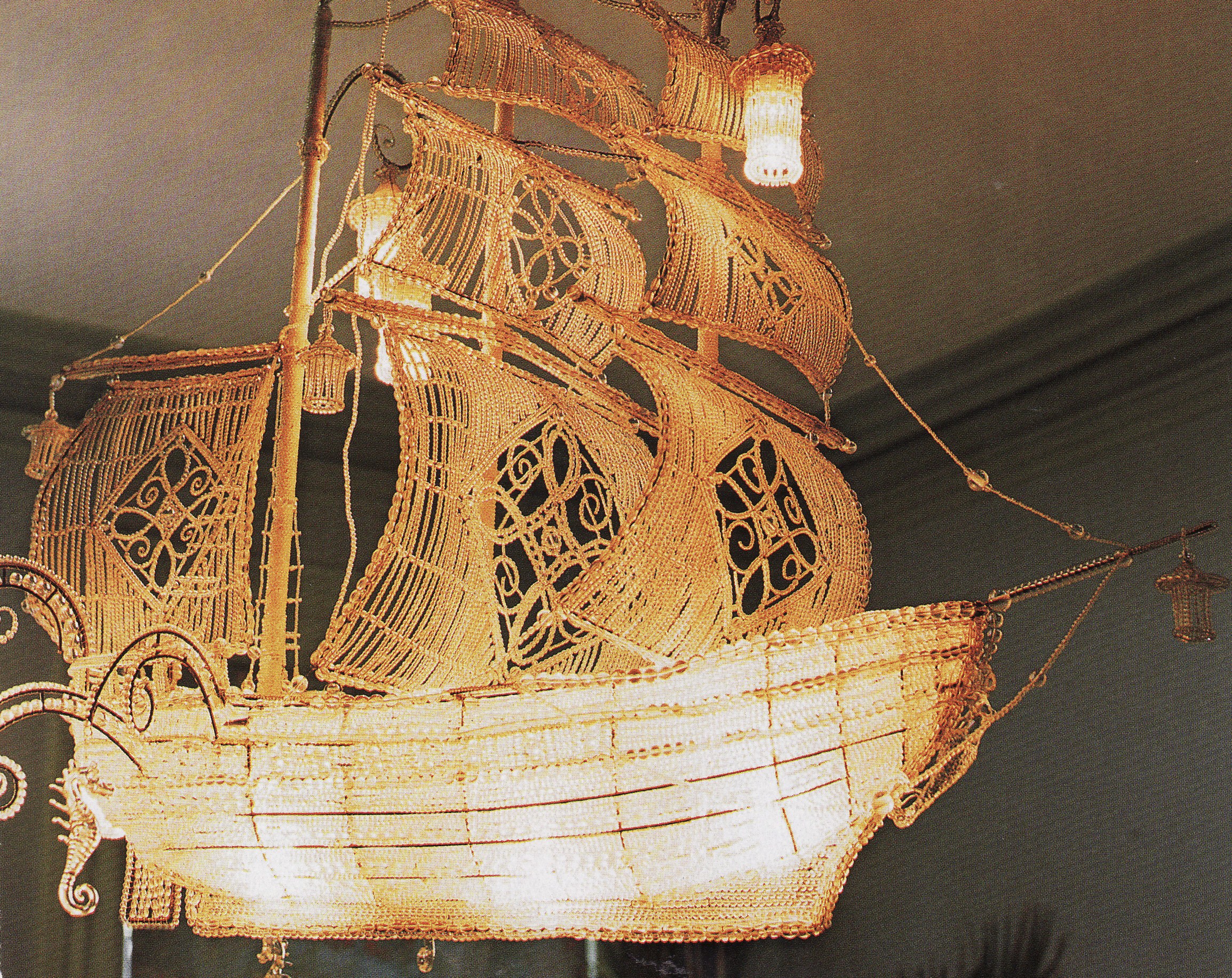
I love that feeling of a ship being blown by the wind. The chandelier wouldn’t be nearly as pretty if the sails were flat.
Muriel Brandolini

While Muriel Brandolini has not actually been missing, I feel like we haven’t seen many of her projects in the recent design press. Luckily, the freshly renovated Architectural Digest has a great spread on her most recent redecoration of her own townhouse. The half Vietnamese and half French/Venezuelan interior designer is one of my favorites for her riotous use of color and ethnic objects and textiles from around the world.  Her deft mix of the unexpected means that her designs are always thought-provoking and never boring, even when they go too far or don’t work for me. Branded the queen of “eclectic” style (just go to any of the on-line magazine sites and click that category), she was one of the first to combine such a broad variety this way. Over the years she has used a number of “trademark” pieces in most of her designs, but at the same time she has a signature by having no set signature.  She has said, “If I had to describe my style I would have to stop working. I always like to surprise myself and my clients, to evolve with the flow of life.”

Brandolini’s kaboom moment for me and many others was the amazing set of double height patchwork curtains showcased in the January 1998 Vogue. Her command of color and textile was evident at this early date, although many of her trademark pieces are not yet evident.

The next space of hers to really catch my eye was the Manhattan townhouse apartment she designed for Molly and Hugh Burns. In their space we start to see many of the early and ongoing signature Brandolini touches such as fabric covered walls in bold ethnic prints, interesting flat-woven rugs (this one by Allegra Hicks), and stylized tufted seating in the round. Brandolini has a gorgeous line of textiles, rich with color and pattern, one of which was used to cover the walls.

The central living room boasts a turquoise portière (door curtain) and a pair of her trademark slipper chairs, upholstered in 18th century Japanese ikat, French tapestry and silk.  I don’t think there is a Brandolini interior without one of these chairs! And the Madeleine Castaing cocktail table is another piece found often in her early rooms – “You either like it or you don’t. I love it, ” Brandolini has said. I agree!

One of the best features in the bedroom started out as a mistake.  Rather than try to make the tiny cramped space seem bigger, she cozied it up with grasscloth on the walls and ceiling.  Unfortunately, the seams didn’t lay flat, so she added strips of embroidered ribbon to cover them, creating a grid. The bright silk pillows and suzani pick up the colors in the detail of the ribbons, making this room feel like a tiny jewel box.

Over time, Brandolini has pared down her color palette without losing any of her whimsical juxtapostioning. This New York apartment featured in the April 2001 edition of House & Garden has that toned down color scheme. The furnishings continue to include other Brandolini signatures, including her rolled arm sofa and the tufted center seat. She also begins using Japanese bamboo blinds called sudare, which become another of her trademarks, found in almost all her decorating projects.  Again we see an interesting hand embroidered flatweave on the floor (this one by Frederica Tondato of Fedora Design)…

…and the patchwork slipper chair covered in antique textiles.

One corner of the living room features a 19th century Japanese low table with floor cushions.

The library has a unique wall treatment – cut velvet upholstery panels  – which read like fretwork doors. A 19th century Chinese daybed piled with cushions made of global antique textiles provides a comfy spot to curl up.

In contrast, a modern turquoise desk and orange upholstered flea market chairs anchor the other corner. This entire room is full of unusual choices.

For an Upper East Side apartment, Brandolini combined graceful sudare blinds with a modern adaptation of a Japanese screen. Another trademark, pierced fretwork tables, are seen here too, along with a flatweave rug and interesting throw pillows. An earlier version of this room had lucite coffee tables and different throw pillows. Which do you prefer?

And in this amazing Chelsea dining room, designed for Ava and Henry Pincus, a modern mural painted on stylized sliding doors (fusuma) gives the room a real Japanese vibe. I find this room eminently functional but oh so charming.

Brandolini can also handle very contemporary spaces, as in the media room designed for Sean and Leslie Goodrich which showcases modern artwork (including a piece by Jenny Holzer), that perforated table and throw pillows made of Japanese fabric.

But it is in Brandolini’s own townhouse which she redesigns on a regular basis that I think we see her real genius at work.  By changing paint colors and furniture placement, adding and subtracting, but fundamentally re-using so many of her things, she transforms the space completely each time she redecorates. My kids have long loved the “Where’s Waldo” books, perfect for entertainment on plane flights or train rides. If you have never seen one, a character in a striped red and white shirt is hidden among hundreds of other small people and the goal is to spot him on each page. As you look through Brandolini’s incarnations of her home, play it with yourself.  Pick an object and see where you find it next.

I have ordered the photos by room, having a version from 1997, again in 2006 and finally the newest version just published in the March 2011 issue of Architectural Digest. In some cases the perspectives line up perfectly, but in others they don’t, so it may take some imagination to sort it out.

Living Room
In the earliest version I have, Brandolini’s living room is painted blue with green trim and she uses a similar Allegra Hicks rug and Madeleine Castaing table as in the Burns apartment and the slipper chairs covered in antique fabric. She has not yet discovered sudare and has soft Roman blinds at the windows.  A huge painting by George Condor hangs over the sofa. The show-stopper of the room is the extraordinary crystal and jade galleon ship chandelier made by Claire Cromier Fauvel. She also loves to use Venetian half shades on her lamps. Brownstone rooms can be very narrow, so they are a great space-saving device, as well as a design statement.

By 2006, Brandolini had completely changed the color scheme in her living room as well as tweaked the layout. She still had a large size painting on the left wall, but a different one by Ross Bleckner. The rug is changed, she has added a Mattia Bonetti designed Smarties cocktail table and sudare at the windows. The two slipper chairs are still there but re-positioned and two 19th century armchairs have been added along side a new red sofa. The ship continues to sail on…

In the most recent incarnation of the room (2011), the palette has been toned down, the original Condo painting returned to its position, yet a different sofa moved under it, and the armchairs activated into the seating plan. The sudare and Smarties table remain. She has changed the rug to yet another design by Tondato. Imagine my despair at seeing the crystal ship chandelier gone (replaced by a Dutch modernist fixture by Gerrit Rietveld) but do not panic yet.

Dining Room
Brandolini’s dining rooms have undergone some of the most dramatic transformations.  One of her unique choice is to place a daybed in the dining room for reclining after eating. This photo shows Brandolini in her circa 1997 dining room on a red lacquer Chinese daybed, with walls covered in a fuchsia Indian block-print of her design. Maybe we should be playing ”Where’s Nuno” with the 1956 portrait of her husband Nuno hanging behind her (hint- we have just seen it relocated to the 2011 living room).

By 2006 the dining room was completely changed. There was still a daybed to recline on, but this one is 19th century French. Vintage fabrics from Turkey, Japan and China have been made into pillows and hand-embroidered Vietnamese silk lines the walls. The Fortuny sconces are still there though.

I didn’t show a photo of the Louis XV inspired antique chairs in the earlier version of the dining room, but I believe she was using them then, and continues to do so.

While the 2011 version is paler in color, it is no less exuberant. Again Brandolini uses fabric on the walls, this time a white corduroy, beaded in Vietnam with her favorite Ernest Hemingway quote. I wonder if she still has a daybed in the dining room?

Study
Like some of her earlier work shown above, the 1997 study has portières, these made of a Chinese silk. The room is painted the opposite colors of the living room, green walls with blue trim and I feel fairly sure that the window does not yet have her trademark sudare blinds.

Her 2006 study was wildly popular in the blogosphere. The richly saturated color and the neoclassical banquettes covered in a mix of Japanese, French and Indian textiles were actively admired. The Chinese rug has been traded for another one of Tondato’s designs, sudare added and the chandelier changed as well. In fact, I think I remember this chandelier from an earlier version of her bedroom, pictured in the ’98 Vogue.

Thar she blows! This is where I breathed a deep sigh of relief. I knew Brandolini could not have gotten rid of the Fauvel ship chandelier. Instead she moved it from the living room into the study. On the other hand, this 2011 version of the study just cannot live up to the last one. I loved the blue and I am sad to see the Neoclassic banquettes are gone (but I have spotted them here in her beach house in the Hamptons, along with numerous other recycled items here and here. See how many you can find!)

Kitchen
I don’t have a view of her kitchen earlier than 2006. Here the 1940′s Jean Dunand marble table is the showpiece along with the Ingo Maurer designed light fixture.

In the 2011 kitchen, not that much has changed. The 1940s marble table hasn’t moved – I figure it is too heavy! The bentwood chairs have been traded out, as has the light fixture and new cabinets commissioned from furniture maker Jonah Zuckerman.

Master Bedroom
Unfortunately, I don’t have earlier views of the bedrooms either. In 2006, Brandolini’s master bedroom has another rug designed by Fedora designs and a bed upholstered in 18th century French brocade.

The wall covering remains the same in 2011 but she has added an ornate Portuguese bed and changed much of the artwork.

Guest Room/Media Room
The guest room doesn’t change that much either.  The patchwork grasscloth on the walls, the vintage silk saris lining the ceiling and Donald Baechler print are found in both. This 2006 version has a wrought iron bed. Another view of this room, including a very familiar chair can be seen here.

Her guest room in 2011. The wrought iron bed is gone but do you remember where you last saw this lamp?

I’d love to hear your comments on which version you like best, as well as the items you spot moved around. And I can’t possibly show as many photos as I would like so I really recommend taking a look at her portfolio on her website, as there are projects there I have not shown. More photos of the 2006 version of her apartment and the Goodrich apartment can be found at Elle Decor.

And how is the newly revamped Architectural Digest with former Elle Decor Editor-In-Chief Margaret Russell at the helm you may ask? This first issue is looking good, frankly, looking a lot like Elle Decor…More on that changeover can be found in a recent article in The New York Times.

For more background on sudare, see On the Blind’s Side…Sudare and Curtains.

Image credits: Patchwork curtain photo from Vogue January 1998, image credit: Eric Bowman, Burns apartment from Elle Decor February 2001, photo credit: Fernando Bengoechea, Upper East Side apartment and Pincus Chelsea dining room from Muriel Brandolini’s website, Goodrich media room from Elle Decor January October 2009, 1997 Muriel Bandolini townhouse photos from House & Garden October 1997, image credit: François Halard, 2006 townhouse photos from Elle Decor January 2006, photo credit: Pieter Estersohn, 2011 townhouse photos from Architectural Digest March 2011, photo credit:  Pieter Estersohn.

About these ads

Read Full Post »

Let’s say you have been bitten by the antiquing bug, but the rest of your family is unsure about your hobby. Here is some advice about turning that time into a shared family activity. While the photos and some of the items are geared towards shrine sales here in Japan, the tips would hold true for antique shopping anywhere else in the world as well. Realistically, flea markets and large group shops filled with mid-low level antiques are the right places for kids, not pricey provenanced antique stores. But hey, everyone has to start somewhere!

Here is my basic advice on antiquing with kids. Please feel free to send me comments and ideas that work for you!

1. Give each child a small but reasonable sum of money to spend, whether it be their allowance or money specifically for that day.  Set guidelines (no candy, for instance) or have them create a shopping list in advance (small animals to add to their doll house scene, for instance). Then try to let go of controlling their purchases.  The key here is that they need to be truly interested and feel like they are in charge of what they buy.

2. Like adults, kids are interested in what they know. Over time, help each child to start a collection and help them to become educated about what they like. Get reference materials at their reading level or go to museum exhibits when possible.

3. Use imagination to speculate about what and how things were used in the past, their meanings, their histories and discover new uses for them. Talk about an item’s cultural significance.

4. Have kids shop for gifts. If you love to hunt for antiques and collectibles, then they can always look for gifts for you.  Gifts for friends are always fun, especially mementos of time abroad for those of us who are expats. A unique and authentic sayonara (good-bye) present for a friend who is moving is a perfect thing to find at a shrine sale.

5. Add in the life and math lessons. Make kids inquire about prices, test their courage by bargaining and calculate change.

6. Manners, manners, manners.  While the requisite bow in addition to the thank you is for those in Japan only, completing a transaction with grace and gratitude is important anywhere. And being respectful of breakables – ask before touching – is crucial.

Now I know there are those of you out there who are reading this saying “You went antiquing with GIRLS – that is easy”. To pre-empt those comments, I decided to test drive a shrine sale with two boys, aged 9 and 11, the sons of my college roommate who is visiting this week. We traveled to Takahata Fudo, a big Buddhist temple in the western suburbs of Tokyo. In addition to the shrine sale held on the 3rd Sunday of the month, Takahata Fudo boasts a 5 story pagoda, an excellent yakisoba (fried noodles) seller and an active schedule of events.

The boys were lukewarm but willing as we set out. My girls dove in, knowing what to expect, while the boys cased the scene slowly. A sure-fire hit? There are always dealers selling war mementos or weapons or tools of some sort, sure to engage any boy’s interest. Machete anyone?

Everyone was interested in vintage coins. Collecting stamps and coins feels like it has gone out of style, so I think that means it is ready for a come-back. There is no “funner” way to learn about geography!

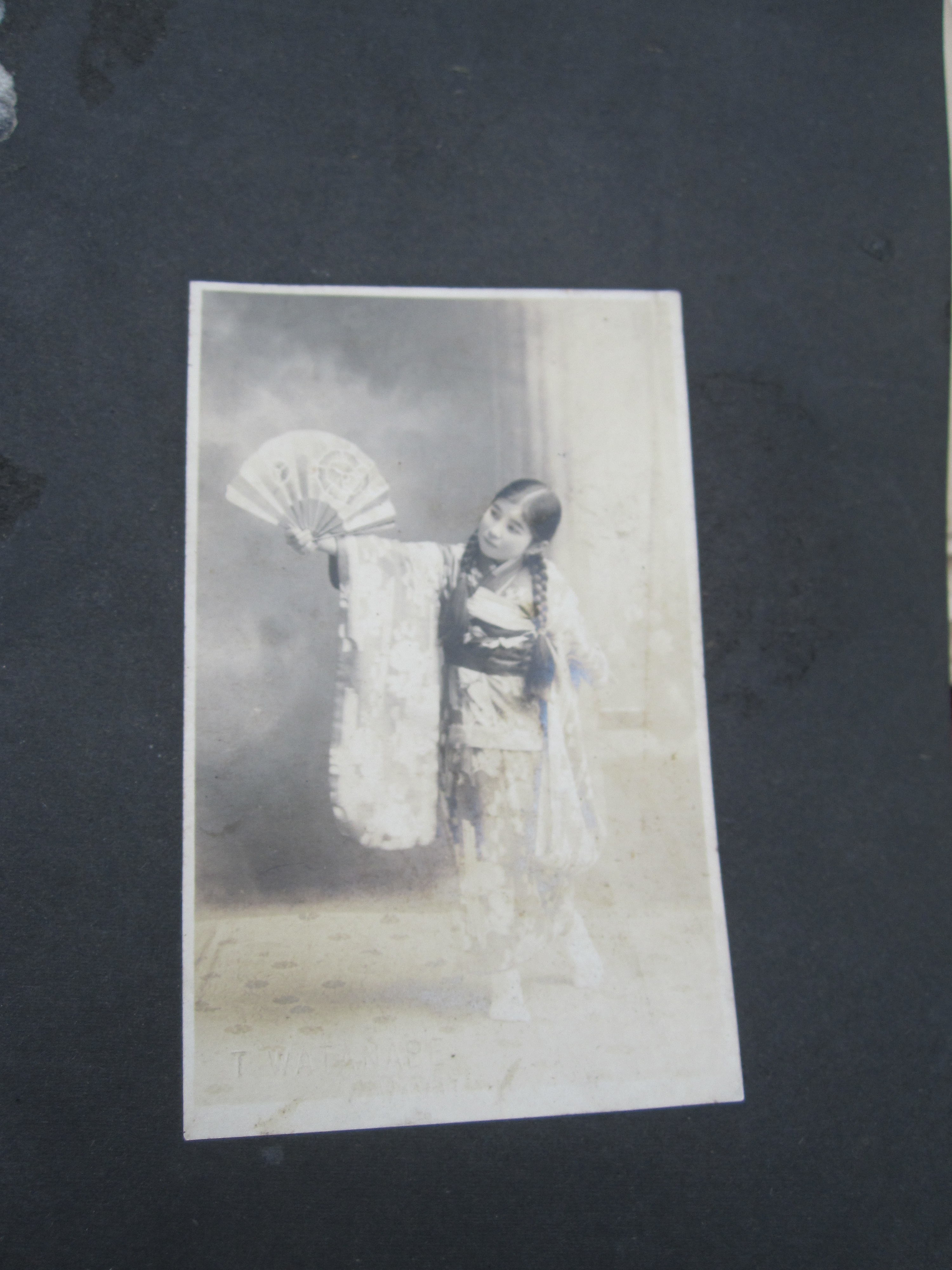
Postcards, old photos and other ephemera are one of the cheapest and most varied of all collectibles.

We made up stories about these folks…Note the connection with the girl doing nihon buyo (Japanese traditional dance) in the black and white photo here, and the purchase of a fan up above.

The first vintage thing I ever collected were these alphabet “language of flowers” postcards from the turn of the century. I still love them and they hang in my daughter’s room now. Ask my elder daughter what gift she’d love to find for me most and she’ll tell you “a letter my mom doesn’t have”. I often find her procrastinating on her homework, trolling eBay for them. Nothing makes me prouder!

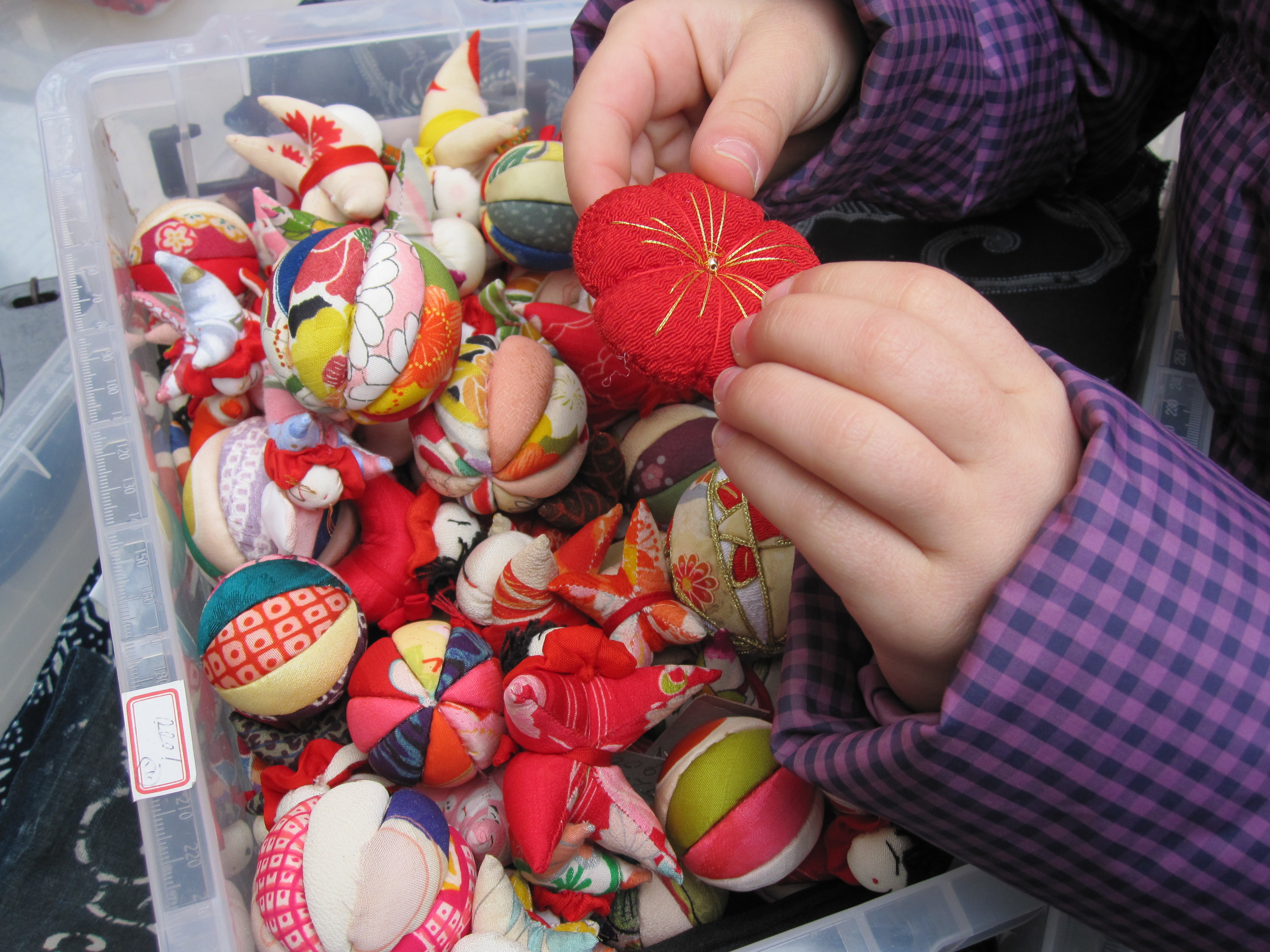
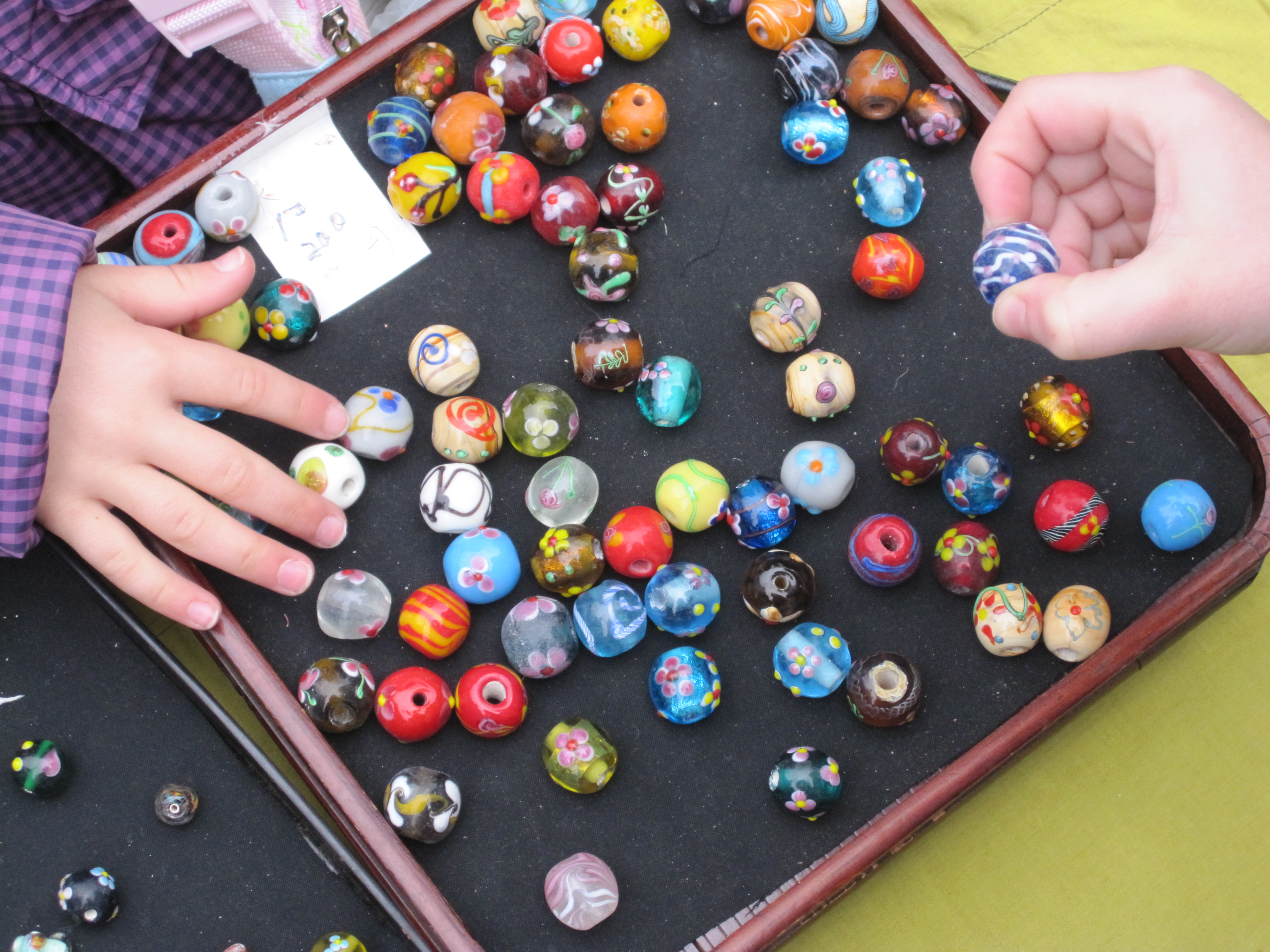
Old toys, geodes and rocks, marbles, buttons, the list of what interests a child is endless and the most fascinating tend to be tiny and cheap, perfect for their budget and your decorating scheme. Remember, a little bit of tat is always a good thing!

Just be sure to avoid the life-sized Godzilla at all costs. Perhaps a size rule is in order before heading out! (I was avoiding it so much that I forgot to take a photo!)

How do I know I triumphed? Nobody was anxious to leave, everyone spent their money with great joy, and the younger boy asked if “this fair was on all week,” hoping to return. And the moms got some goodies too!

While tips on shopping for antiques with kids was easy, shopping for antiques with husbands will have to be a later post…

Read Full Post »

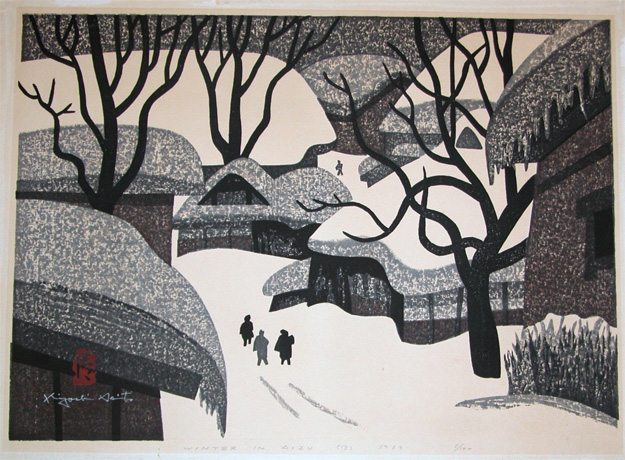
I am off to ski for a holiday weekend here, in the best powder anyone can remember for a long, long time. So, in honor of the wonderful snow here this year and the crazy snowy winter in the US, I will leave you with a series of Japanese woodblock images of snow falling. Viewed in chronological order, they give such a clear narrative of the development of the medium, changing artistic styles, and advances in print making technology. All have a marvelously realistic but magical quality to their depiction of the snowfall.

Hokusai, Fuji in Deep Snow, from 100 Views of Fuji, c. 1834

Hiroshige, Gion Shrine in Snow, from Famous Places in Kyoto, c. 1834

Hiroshige, Atagoshita and Yabu Lane from 100 Views of Edo, 1857

Kawase Hasui, Spring Snow at Kiyomizu Temple in Kyoto, 1932

Kiyoshi Saito, Winter in Aizu, 1969

Tomikichiro Tokuriki, Snow Over Kiyomizu Temple, 1983

Masao Ido, Nanzenji in Snow, 2003

Seiji Sano, Snow Falling Softly, 2004

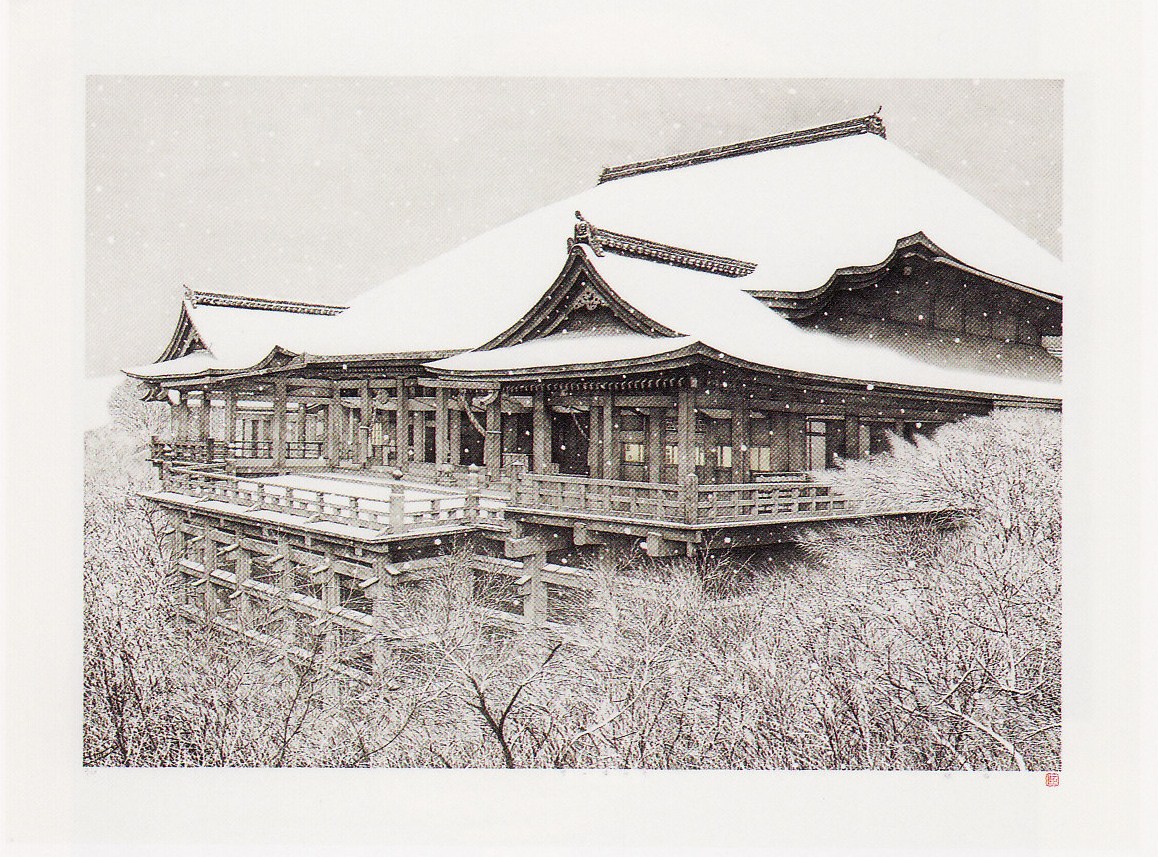
Keisuke Yamamoto, Kiyomizu Temple Covered with Snow, 2010

And one more I can’t help but share, even though it is not a print at all, but a photograph from a series by Yuji Obata. It took Obata five years to figure out how to photograph the snowflakes directly as they fell from the sky. For more images and information see James Danzinger’s blog, The Year In Pictures.

Yuji Obata, Homage to Wilson A. Bentley #10, 2005 - 2006

Enjoy! I hope you all get some time on the slopes this year…

For more on Japanese prints see Hanga 101…a Quick Primer on Japanese Prints.

Image credits: 1, 3-6. via Ronin Gallery, 2. via Hiroshige.org.uk, 7 & 8. 50th CWAJ Print Show Catalogue, 9 55th CWAJ Print Show Catalogue, 10.via The Year In Pictures

Read Full Post »

Move over Tom Scheerer and Steven Gambrel, Tokyo Jinja readers are collecting glass floats and displaying them in their homes. I’ve given up on getting mine back to the US right now so I have combined it with my ever-growing collection of Japanese glass bottles.

One Tokyo reader got lucky at the Oedo Antique Market just a week or so ago. She scored a medium size float with its original net and a handful of small ones. I just love the way she displays them on the shelves, with her books organized by color – it makes for such a soothing composition.

The husband of a reader in Singapore knew how obsessed his wife was with floats that for Christmas he bought her a group from a dealer in Alaska. Simultaneously, a friend gave her a bowl from Core Bamboo. She’s combined the two and displays them on a woven Laotian textile in her living room.

Blue & White’s Amy Katoh displays her floats in a senbei (rice cracker) canister on her window overlooking the Sumida River.

And for the most unusual placement, this float joins sea glass on the bathroom wall at Amy’s Tokiwa house.

Elsewhere in the internet, Brooke Giannetti of Velvet & Linen has just posted photos of the Gilt Home Showhouse room she and her husband designed in support of the Demi and Ashton Kutcher Foundation, which raises money to combat human trafficking. Using paintings by her husband Steve and items from her shop Giannetti Home, they created an artist’s studio.

She used a grouping of floats in a covered glass apothecary-style jar, as one of the main decorative items on the coffee table.

Along with the paintings, they really make the blue and aqua tones in the room sing!

For my earlier posts on glass fishing floats please take a look at:

Photo credits: 1. me, 2. A. Ridge, 3. A. Wilhoit, 4 & 5. Amy Katoh, 6 & 7. Brooke Giannetti

Read Full Post »

Perhaps I am a little late to the party as many bloggers have commented on Pantone‘s choice of a bright pink called “Honeysuckle” for Color of the Year already, but nonetheless, I cannot resist commenting. I don’t really see honeysuckle in the vibrant pink – usually I associate it with yellow or golden orange. Instead, I am thinking of the mid-winter ume (plum blossom) opening now against the cold, the first sign of winter’s turn towards spring. That is the bright pink they are talking about!

I think this kind of plum blossom pink looks best with the colors it appears with in nature – the blue and white of the sky and the dark brown of the branches. Decorating with pink has to be handled carefully. Pink unmoored, or paired only with white can look little girlish or nursery-like. But handled correctly, it can be sophisticated and warm. In this post I think I’ll start out as saturated as it gets and slowly take it down….

Mary McDonald is a master of intense color and in this bright pink hallway she pulls out all the stops with walls and upholstery covered in matching shades. The key to making all that pink work? The contrast of the gleaming mahogany, the zebra rug and all the blue and white porcelain. The golden chinoiserie mirror doesn’t hurt either. This is an entry that lets you know you’ve arrived!

Jonathan Berger uses Benjamin Moore’s “Razzle Dazzle” in this Brooklyn entryway. It’s a bold move that not all could live with, but it certainly jazzes up this small space. Note the blue and white porcelain (again) and the brown needlepoint upholstered chair, white paneling and dark stair risers, all of which help to balance the brightness of the shade.

This Windsor Smith living room, featured in the September 2009 issue of House Beautiful is one of my absolute favorite rooms, both in terms of the colors and the furniture. I have been tracking that scroll arm sofa and painted Indian coffee table through many variations in her homes and designs…Click here to see an earlier incarnation.

In the course of writing this post over the last weeks, I heard through the grapevine that the March 2011 issue of House Beautiful was going to feature pink. Guess how surprised I was to see this same living room as the cover feature! Am I wrong in thinking it is fairly unheard of for a major publication to feature the same space twice, without any major design changes??? Of course the issue has been on the newsstands for days now in the US, but I have yet to see it. This post may need a follow-up once I do! [Quick addendum: I got my hands on a copy and it featured "Ten Rooms They Couldn't Forget", so it was the exact same room from the original photo shoot. I guess they wanted to do a "pink issue" but it must be difficult to rustle up many new projects with pink in them. It actually made the magazine feel more like a blog post...kinda like this!]

Too much pink for you? Moving the pink off of the walls and onto the major upholstery and fabrics might be the way to go. Here, in another interior designed by Mary McDonald, pink fabrics play off the soft blue walls, and lots of wood furniture softens the design. Gotta love those bamboo armchairs, and, once again, the blue and white porcelain. [In reality, this room is red, and only looks pink in the photo. But lets all pretend anyway, since I think it is softer and prettier in pink!]

This Schuyler Samperton designed project has heavy wood beams that balance the vivid pink fabrics…or perhaps it is the other way round and the vivid pinks brighten and lighten up a heavy beamed space. Here turquoise has been used as the major accent color, along with woven rugs from Texas as a throw and upholstery, giving the room an updated ranch feel, slightly Southwestern. See Style Court for more photos of this room.

Another home that has influenced me and scores of others is Alayne Patrick’s Brooklyn home. Using amazing textiles and colors from India, she has put together a pink and white dhurrie, dark tropical feeling blinds and a cane daybed piled with pillows. I’d love my TV room/guest room at the beach to have this kind of feel.

Patrick’s Brooklyn shop Layla has the same vibe as her home. I spent quite a bit of time there over the holidays searching for the perfect throw pillow. They reopen today after renovation and I really recommend a visit!

Sometimes a little goes a long way, as in actress Rashida Jones’ Manhattan studio, cleverly made over by Domino. The antique Persian helped set the palette with magenta and blue accents. White paint ties otherwise disparate furniture together and the wood edge of the sofa and touches of black ground the color scheme. Pale blue walls give the tiny space an expansive sky-like feel.

Would Rita Konig’s chair and her entire apartment actually, be the same without that shot of magenta? Again, a pale grey blue wall, soft as a cloud white window treatment and bits of dark wood in the frames.

And finally, for those too afraid of a real pink commitment, I give you Deborah Needleman’s bedroom…All the components are there, it just takes that pink scarf to pull it together.

This can also be done with flowers, particularly a big bunch of pink peonies or some beautiful branches of plum blossom. I am cheating here, as these are actually redbuds, but you can get the idea…

The only downside to picking a “Color of the Year”? Calling anything “in” always implies that there is an “out” coming…

Image credits: 1. Pantone, 2. me, 3. Mary McDonald, 4. House Beautiful July 2009, photo credit: Francesco Lagnese, 5. House Beautiful September 2009, photo credit: Victoria Pearson, 6. House Beautiful March 2011, 7. Mary McDonald via mydeco, photo credit: Miguel Flores-Vianna, 8. Schuyler Samperton via style court, photo credit: Lisa Romerein 9 & 12. Domino May 2007, photo credit: Melanie Acevedo, 10. The New York Times, 11. Lonny Magazine October/November 2009,  photo credit, Patrick Cline, 13. Domino March 2006, photo credit: Mikkel Vang.

Read Full Post »

Back in December I stopped by the Nogi Jinja sale and got “accidentally” pulled in by some 19th century Japanese botanical prints. They called my name (hollered actually) even though I was not out shopping for prints or anything particular at all. Much like ukiyo-e, they were mass printed on paper and probably bound in some sort of book or pamphlet originally. These are entitled “One Hundred Views of Flowers”, a typical naming device, and I am sure there were actually a hundred at some point. While the flowers depicted are all commonly grown in the West and easily recognizable, their presentation within the boundaries of the images is very Eastern and I loved that. Foolishly, I bought three. Foolish because I bought them? No, foolish because I only bought three. Upon further reflection at home I realized of course, I needed four, two to hang on each side of the window.  The difficulty was that there would not be a January sale held at Nogi shrine and I did not know where else to look for that particular dealer. I had never seen these prints elsewhere either.

What charmed me about them was that they felt like a cross between traditional botanical prints which I find more formal…

…and the framed herbiers (pressed flower and plant pictures) we have been seeing a lot of in recent years, such as in this Ginger Barber designed Texas guesthouse.

Or these, in Jeffrey Bilhuber’s Nantucket Cottage.

So imagine my surprise when I came across them early on as I browsed the huge Antique Jamboree out at Tokyo Big Sight in early January. Unfortunately, I had forgotten to get cash before going and was hoarding the little I had. I also could not quite remember exactly which three I had bought – which flowers and how they were arranged. It seemed important to have two consistent pairs, with the colors and orientations picked carefully. After a chat with the dealer about when and where I could find her in the coming month, I walked away to scope out the other 499 dealers. (Cue the dramatic tension inducing music)

Wait (even the most inexperienced among my readers) you cry out! Could I possibly be breaking the golden rule of antiquing, NEVER WAIT? As all antiques are unique you roll the dice walking away from anything you might want, even for a short time.  And this is Japan, which while officially in recession for the last 20 years or so, is the land of  “sold out”.  There is no inventory or stock of anything and hesitating before purchasing is sure to bring disappointment. Nonetheless, I was cocky and confident and walked on.

Two hours later, after a long a fruitless afternoon of over-priced and relatively uninteresting items, I was walking out to leave when I spied a Japanese couple looking at MY prints (note the capitals). I sauntered over, sure they would not be buying.  Not wanting to be rude, I held back and waited, only to slowly come to the realization that they were buying and perhaps buying deeply! I knew I would never find this set of prints again. All of a sudden the New Yorker in me stepped up to the plate – I was going to get my print no matter what. We began a dance as they realized I was interested – they were not giving an inch - no gaijin (foreigner) free pass. When they put one down, I picked it up. We both started scrambling. I could see they had the one I wanted in their hands as I realized I held one they desired. I tried to get the dealer to intervene, after all, she knew I had others and needed one more, but she was not going to help as they were buying many. I took a chance and set one down, the husband followed suit. Quickly I picked that one up as the wife seemed annoyed that he had relinquished it. He said something to her that calmed her and they settled and paid up, the dealer giving them a discount for a bulk purchase. As I went to pay, I realized I had been trumped. My print was torn and that was why they left it. Frustratingly, the dealer did not want to give me any discount, neither on the strength of my prior purchase nor the damage of the current one. Shoganai (nothing can be done), is never my favorite term, but in this case, it was true.  The matting would just have to cover the tear.

Luckily, the print I had managed to purchase worked perfectly with the others I had already bought. I called the framer, as key to bringing out the beauty in these would rest on their presentation.  Normally, I am not a colored mat kind of girl, but between everyone else’s obsession with colored mats these days and the fact that they looked blah with just a beigy tea-stained one, I decided to give color a try.

And what a color it is! Inky dark blue-green, with a very thin aged gilded frame. The key to the whole thing was having the inside edge of the mat darkened. I really love how these came out!

While this story has a happy ending, it might not have. Take it from me and remember, if you love something antique or vintage and the price is right, don’t wait, just BUY IT!

Antique Jamboree

Read Full Post »

Since today is both Chinese New Year and Japanese Setsubun (Bean-Throwing Festival), I feel like a dose of red is in order. Coupled with requests for more Asian inspired kitchens, I have two sleek modern kitchens to show – both hinging on the color red – and both quite different from the rustic mizuya tansu (kitchen chests) I have shown in the past.

Designed by the architect Winthrop Faulkner for playwright Barbara McConagha, this first kitchen has many literal Japanese references and details. Inspired by Japanese jewelry cases, the red cabinets were custom-built and lacquered and traditional pull handles, like those found on tansu chests, were ordered from Japan. Upper storage is hidden behind shoji screens which can be lit from behind. Maple cabinetry and small shadow boxes are highlighted by painting their interiors black and filling them with ceramics. A witty touch is the classic farmhouse table – in this case painted black and sealed to look like lacquer.

Storage for extra books was squeezed in below the ceiling and a library ladder, designed to taper like a pair of chopsticks, was built for access.

This second kitchen in a historic 1915 Chicago building was renovated  by architect Lawrence Booth. It’s keystone is the bright red Aga stove, set for cooking worship in its own altar-like niche. The shiny finish looks almost like lacquer and its stalwart British shape could almost be a tansu base.

Again we see the contrast between the light maple cabinetry and the dark black honed granite with touches of stainless steel. There are also great details, like the flip down drawers hiding all the electrical outlets and disposal switches and the pot filling faucet at the stove.

The adjacent sitting area has cabinetry filled with Asian display items, including Chinese and Burmese lacquer pieces and a kimono box, an unusual glossy red ceramic garden stool and a richly colored Persian rug. And speaking of molded plywood the other day, how great is that Frank Gehry Ribbon chair? The contrast of textures, finishes and periods makes this space sing.

Definitely two kitchens that would keep any evil spirits at bay…

Image credits: 1 & 2. House & Garden, February 1998, 3-6. House & Garden, date unknown.

Read Full Post »

Opening tomorrow at the Museum of Modern Art in New York City,  the exhibition Plywood: Material, Process, Form showcases “modern designs that take advantage of the formal and aesthetic possibilities offered by plywood, from around 1930 through the 1950s.” Long queued up in my files, this gives me the perfect excuse to showcase one of my favorite design items of the 1950s, Sori Yanagi’s brilliant Butterfly Stool. A piece coveted by collectors and displayed world-wide in museums, I have always had a soft spot for this modern Japanese classic.

A masterpiece of curved plywood wings, almost in flight, made by steaming and pressing layers of wood into a mold, the stool is an accent piece that works in almost any design or interior. We see ceramic garden stools constantly, in every issue of every magazine these days. The butterfly stool serves all the same functions and I am all for some more butterflies.

It is perfect as a seat or a place for a stack of books in modern rustic bedroom.

Kids can’t reach the milk? Want a stylish boost?

To those of you in Japan, doesn’t this feel familiar?

For many years, the stool, made by a Japanese manufacturer called Tendo, was only available in Japan and it is currently available in their on-line shop. But since the 1990s, Vitra, a Swiss company already making many Charles & Ray Eames and George Nelson pieces, has had a license to produce them as well. Currently available from Hive, Design Within Reach, and other retailers around the world, the stool continues to be offered in pressed maple or rosewood.

If you are loving the molded plywood vibe, check out Lonny Magazine’s Trend Alert! Cool, but none of these do it for me like the butterfly…

Image credits: 1. MOMA, 2 & 4. via designroof, 3. House & Garden, date unknown, 5. Lonny Magazine blog

Read Full Post »

Follow

Get every new post delivered to your Inbox.

Join 405 other followers

%d bloggers like this: