Feeds:
Posts
Comments

Archive for January, 2011

Interior View, Royal Pavillion by John Nash

While imported goods from the China Seas trade had influenced furniture design in Europe throughout the 18th century, from Thomas Chippendale to the chinoiserie of Louis XIV at Versailles, the popularity of Asian inspired furniture and design reached a peak with the John Nash designed Royal Pavilion at Brighton, completed by the Prince Regent between 1817 and 1822. Furniture designed to resemble bamboo had appeared about 1750 in England and it was used extensively throughout the Pavillion. But by the 1840s, Brighton  – both the place and its related design – was out of style.

Fast forward a few decades to the London International Exhibition in 1862, the Exposition Universelle of 1867 in Paris and the 1876 Centennial Exposition in Philadelphia, all of which created a craze once again for all things exotic and of Asia, particularly Japan, as it had just been opened to the West in 1854. Bamboo furniture had a quirky lightness that was a real counterpoint to the heavy Rococo Revival styles of the early Victorian era. An industry making “faux bamboo” furniture sprang up, as real bamboo was only suitable for very lightweight pieces. Golden stained birds-eye maple and pine were shaped to resemble bamboo stalks as the decorative detail on more substantive pieces. Large suites of furniture, particularly for bedrooms, including beds, armoires, wash stands, night tables, chairs, etc., were manufactured in great numbers in England, France and America. According to a 19th century decorating magazine, their characteristics made them perfect for furnishing “morning rooms, bed chambers, summer houses, and cottages.” R.J. Horner of New York City produced some of the finest examples made in America.

Antique faux bamboo continues to be extremely desirable in the furnishing of vacation homes today. This Southampton bedroom, designed by the late Jed Johnson for Maureen and Marshall Cogan, has long been a talisman room for me. It has one of the most beautiful groupings of faux bamboo, including a number of R.J. Horner pieces, such as the dressing table and chairs. For all the elaborate detail on the furniture, the simplicity, calmness and lightness of the room makes it look like floating on a cloud. The owners wanted their country house to feel “nondecorated” – to be soft and cozy, informal, with nothing off-limits to grandchildren, in the true spirit of a Hamptons great house.

This is the other side of the room. In order to keep all the detail, I did not join the photos. Note the simple pale upholstery and the cheval mirror, which is a particularly fine and rare piece.

Here’s a compressed view of the whole room. The bed is what I call the “English” shape – with rectangular detail along the headboard. I cannot decide if the bed is a reproduction as it looks to be king size, but it is so finely made that I can’t be sure.

Unfortunately Jed Johnson died in the prime of his life and career on TWA Flight 800 to Paris in 1996. Architectural Digest has a poignant memorial to him written by Paul Goldberger, in which he writes, “Johnson seemed always to be able to hear the objects that he loved speak.” I just love that idea!

I always find this Upstate New York home and bedroom a bit unexpected as it belongs to avant-garde American poet John Ashbery. Why a modern poet shouldn’t live in a William Morris papered 1894 Victorian I can’t really say. But the pairing of contemporaries – the arts and crafts wallpaper with the faux bamboo bedroom set – is a perfect combination and a cheery mix of rugs and objects adds to the appeal.

Rosanne Wasserman has written a great personal account of John Ashbery’s home on Rain Taxi, which has many additional, less styled photos of the house and as shown below, the guest bedroom. Wasserman writes, “I found John’s house a perfect antidote for what I like least about museums: that they are not lived-in spaces. John’s house, filled with objets d’art and arranged into subtle, funny, and magnificent scenarios, is also always a place where people live and visit, sleep and dine, watch TV, wash up dishes, sit in chairs. Long may they do so.” No way to say it better than that.

For a house that falls stylistically somewhere between the two above, I turn to Joan Davidson’s Hudson River manse Midwood, featured in Martha Stewart Living. Here, a pair of faux-bamboo twin beds that were found at the Armenia Church Auction are part of a set of 8 pieces.  They were also made in 1888, the same year the house was built. This set is ebonized and it makes a strong counterpoint to the richly colored paisley in the bedding and rug. Warm white beadboard walls complement.

The dressing table has a lovely form.


Kevin Sharkey (a powerhouse behind the whole Martha Stewart brand) writes in his Home Tour column about the house, ”I believe that a truly beautiful room is one that hasn’t been decorated at all, but rather considered…There are no absolutes. You just have to be inspired, passionate and informed. Then you take it and make it your own. That’s really where beauty comes from.” Many other photos of this beautiful property can be found there.

Besides sets of antique faux bamboo furniture, these homes have something innate in common. Whether created by designer or homeowner they are all somewhat undecorated and fluid. Wasserman writes about her view of the Ashbery home as “only one stage in the evolution of his house, some rooms of which have, since then, been further embellished, or reimagined, or pulled apart and are still being put together.”  Cogan says about her Southampton home, “These are living places, and they need fussing with.” I don’t have the entire article on the Davidson house, but I am somehow sure she’d say something similar. I find it slightly ironic that such spaces have ”matched” bedroom sets, as little else in these houses is “matchy.” In general, matched furniture sets are not a look that I like, nor the current mood in decorating. But somehow, groupings of faux bamboo just work.

As you might expect, Martha Stewart Living has featured bamboo and faux bamboo many other times as well. This charming green room was an in-house style feature, not a real residence, but I love some of the details, like the curtain valances, sheers and bamboo matchstick blinds. It feels exactly like a summer-house should. This headboard has the “French” shape with two crossed bamboo poles in an inverted V and small newel posts at either end and a straight footboard. It is very common to see French armoires with the same shape too.

This side view shows the raised bamboo decoration found on the side rails.

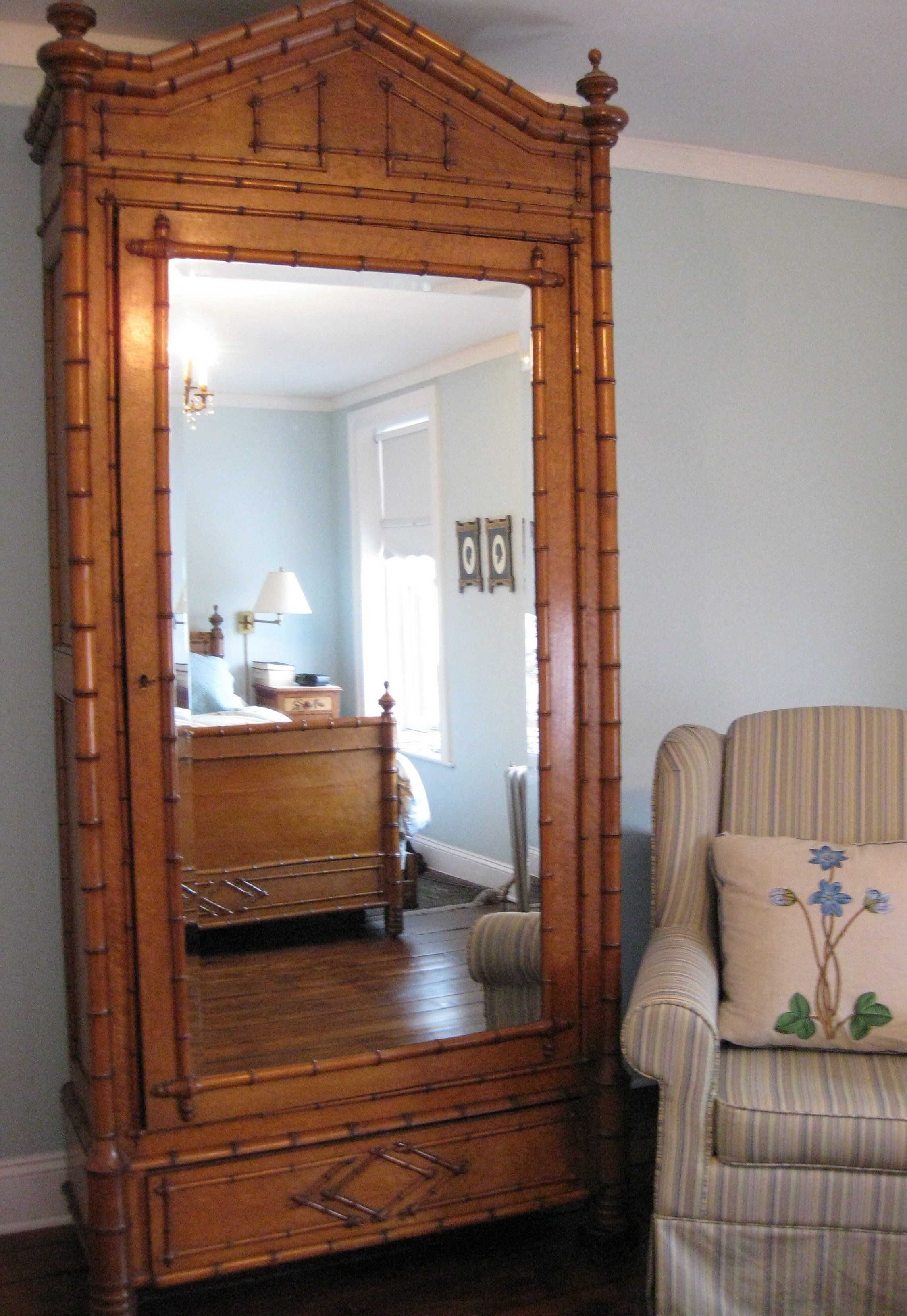
Here is a view of an antique French armoire in a Brooklyn bedroom of my design. While the bed can be partially seen reflected in the mirror, the inverted V of the headboard is cut off. You can really see the beauty of the birds-eye maple on this armoire. John Robshaw hand painted pillow on the chair.
In this bedroom by Peter Dunham, featuring his hemp and cotton fabric “Jaipur” on the walls, curtains and bed coverings, we can see a very similar French maple bed, only larger, perhaps a double. There is a dresser and a mirror too, although they do not look antique.

.

He shows an additional view on his website, with the bed against a different wall. Faux Bamboo pieces also look wonderful with Indian block prints and crisp white linens – they play off the “British Colonial” feel.

Here is a similar bed in a room designed by Martyn Lawrence-Bullard for Nick Steyne. This bed and nightstand are not antique – they are his design. Again, there are Indian block prints and white linens.

But this pine bed in another room by Martyn Lawrence-Bullard does look to be antique. Here the bed and room are dressed very differently, with a formal french toile, ticking stripe and paisley coverlet. Perhaps little too formal to live with all the time, but I would love to sleep there for a few nights, imagining I was in France.

While I love the antique beds, sizing can be an issue. Twins tend to be somewhat standard, but most of the larger size beds are US double size at best. They can be converted to queen or another option is to use only the headboard and not the side rails and footboard, both of which I have done.  For those who don’t relish all the hassle or cannot live without their king size bed, there are many reproductions on the market, such as the one in the first Martyn Lawrence-Bullard photo and those following.

Starting at the top end of the market, here Suzanne Kasler uses a Michael Smith bed from his line with Jasper Furniture in a bedroom she designed in Atlanta. I don’t know the list price on this, but I imagine it to be hefty.
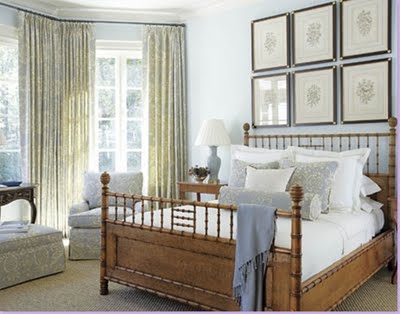
Leonards offers this meticulous copy of a 19th century English bed resized for the modern home. A king retails for $8300 and there is a matching marble top stand.

The Williams Sonoma Hampstead bed retails for $3550 for a king size. There is a matching nightstand and two different dressers and it also comes lacquered in white.

And of course Martha made one in her furniture line for Bernhardt called “Bali Coast,” which listed for around $1500, but unfortunately seems to be out of production. Craig’s List anyone?

.

But before rushing out to buy a new set, I heartily recommend searching out the antique pieces. While dealers in the Hamptons keep a steady supply around, they often come with big price tags. On the other hand, there are quite a few dealers who import large containers from France, filled with reasonably priced beds, armoires and night stands. Or you can always use it as an excuse to visit les puces….

Image credits: 1. artrepublic.com, 2-4. Architectural Digest, November 1990, photo credit: Scott Frances, 5. Architectural Digest, June 1994, 6. Rain Taxi, photo credit: Ahndraya Parlato, 7-8. Martha Stewart Living, September 2001, 9-10. Martha Stewart Living, date unknown, photo credit: Simon Watson, 11. R. Michaelson, 12. House Beautiful, November 2010, photo credit: Victoria Pearson, 13. Peter Dunham, 14. Elle Decor, December 2005, photo credit: Tim Street-Porter, thanks to So Haute, 15. Martyn Lawrence-Bullard, 16. House Beautiful, April 2008, photo credit: Frances Janisch, 17. Leonards, 18. Williams Sonoma Home, 19. Bernhardt

About these ads

Read Full Post »

As a follow-up to yesterday’s post on antiquing in Nishi-Ogikubo, I wanted to devote a little more airtime to a wonderful shop, selling mainly porcelain, called Les Yeux Noirs. Owner Haruko Hasegawa has assembled one of the prettiest and most cohesive collections of antique Japanese porcelain that I have seen. She seems to buy and stock nothing ordinary – everything felt special and unusual, whether it was the motif, the shape or the pattern.

One of the things I really liked about the shop was the diversity of styles and periods and therefore prices.  While she had her very valuable Edo period karakusa (Chinese winding grass or arabesque) pattern pieces locked in a cabinet, she also had the largest most diverse collection of inban (transfer printed porcelain) I have come across. As mentioned earlier, mass-produced transfer printing did not become popular in Japan until the Meiji period, even though it had been produced extensively in the West for more than 100 years prior. In transfer printing, a pre-made image is inked with dye and then pressed against a blank surface. The dye is “transferred” (thus the name) and the item is then fired in the kiln. There is none of the hand-painting that you find on all the other types of antique porcelain. But the transfer prints have their own distinct charm and a following. At shrine sales you can often see piles of these small round plates, in a few basic patterns. Hasegawa-san had an extraordinary display with great depth and variety. They are great fun to collect – often being more affordable that other porcelain – and wonderful to mix and match.

Take a close look at this scenic, almost map-like plate and the charming momiji (maple leaf) patterned covered bowls. Both are fairly rare shapes for transfer printed pieces.

We had great fun arranging pieces into groups, perhaps for wall display. Looking closely you’ll see everything from wisteria to peach to our good friends sho-chiku-bai (pine, bamboo, plum). Quite a few of these patterns were new to me.

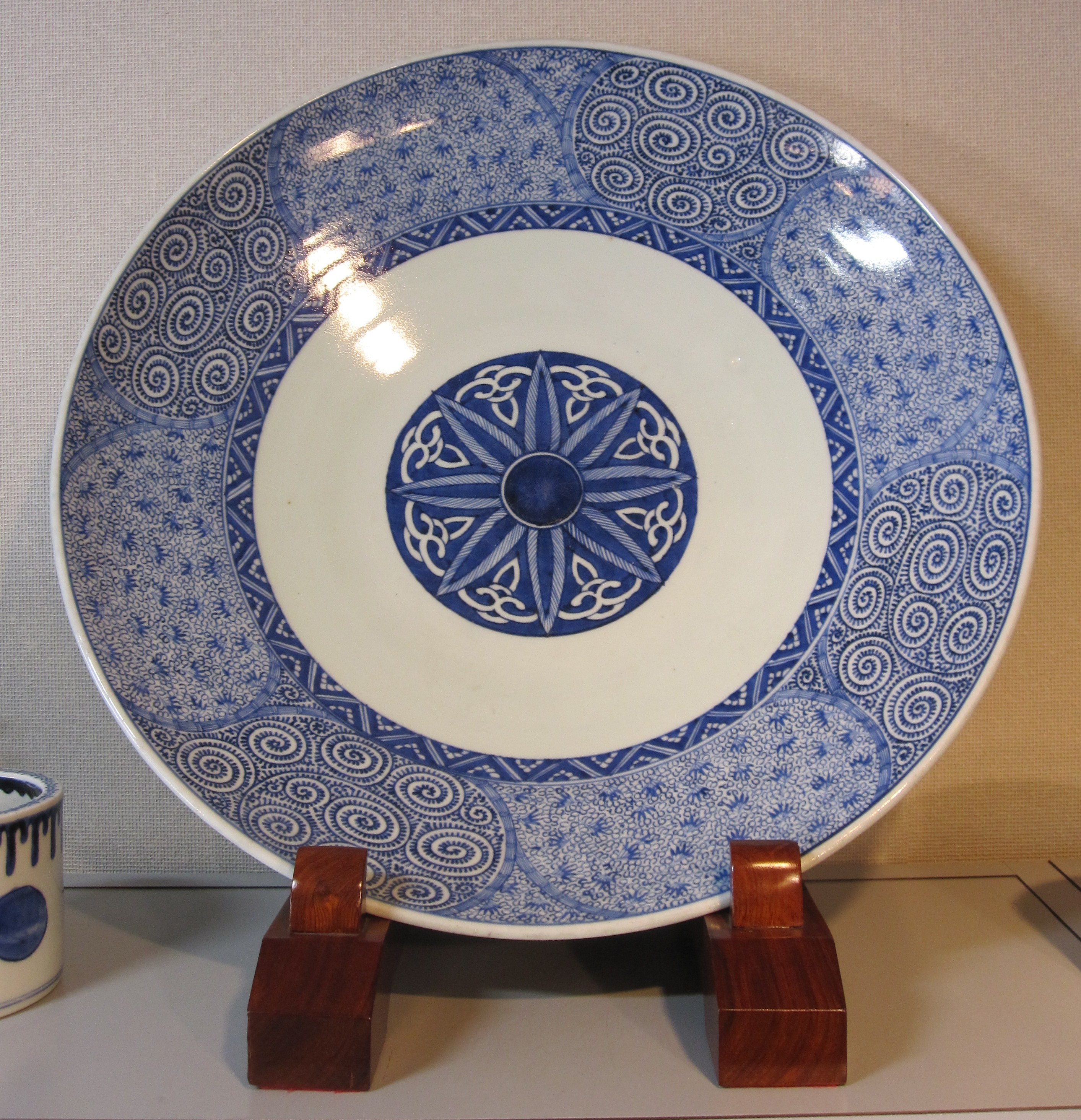
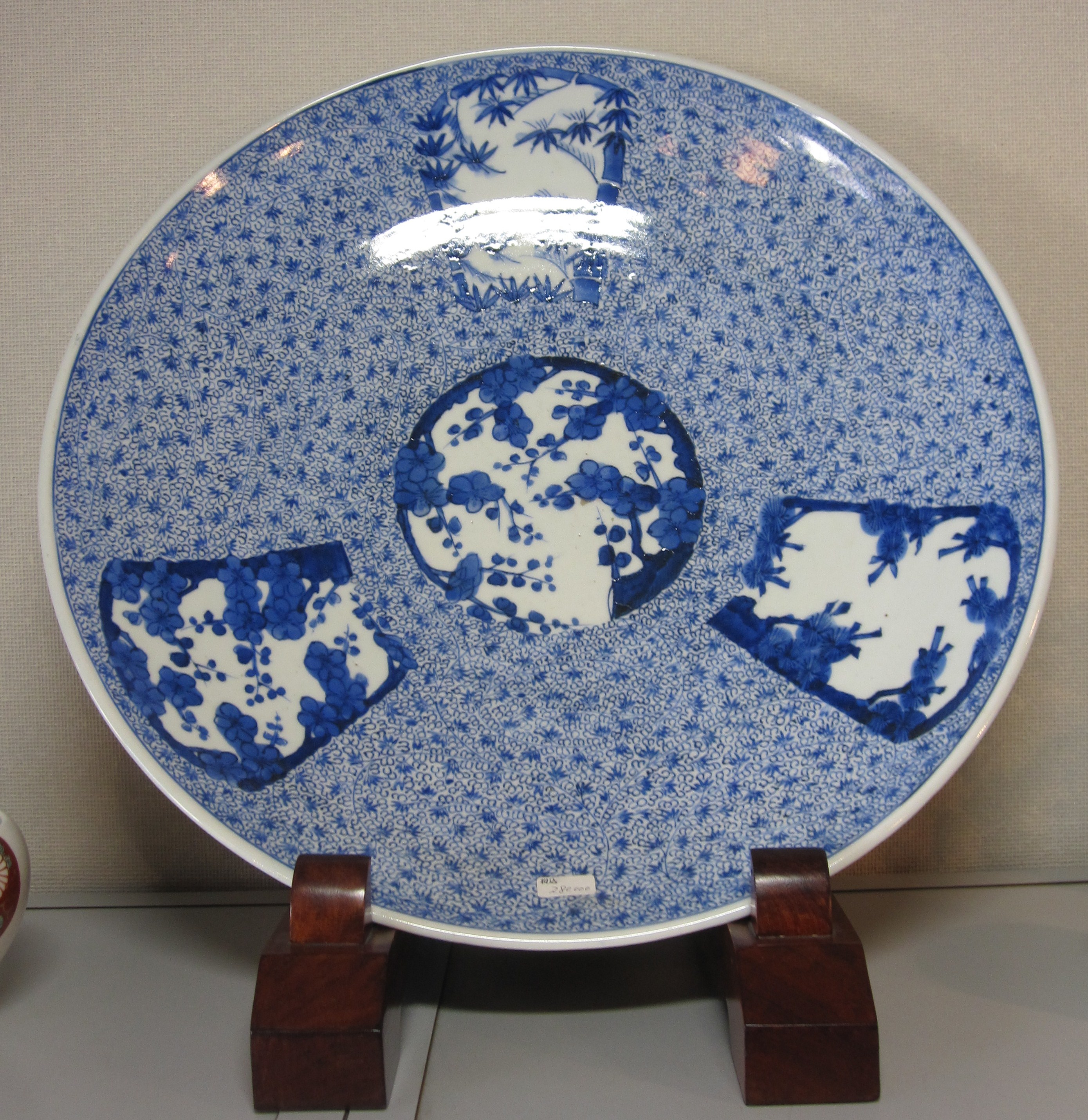
On the opposite side of the shop prices went up, with gorgeous pieces of Imari, like these giant display plates. Don’t let the small photos fool you – they are enormous - and would be a real focus in any room. There were also lots of  hard to find small hibachi – great for little planters.

There is also a branch of Les Yeux Noirs in the lovely mountain town of Karuizawa.  That shop is open from April 20 – May 25 and again from July 20 – November 25.  What is currently unclear to me is whether or not that means the Nishi-Ogikubo shop is closed during that period. I’ll update that here as soon as I have an answer.

The most difficult part about traveling to Les Yeux Noirs is that they are open tokidoki (sometimes) from roughly 12 p.m. until 6:30 p.m. It might be best to call ahead.  But well worth the effort!

  • Les Yeux Noirs, 4-1-22 Nishi Ogikubo: telephone 03-3395-5509
  • Les Yeux Noirs, Karuizawa: telephone 0267-42-1534

For more on antiques in Nishi-Ogikubo see Shop Talk…Discovering Antique Treasures in Nishi-Ogikubo.

Read Full Post »

While not quite on par with Dixie Highway, relaxed Nishi-Ogikubo in Tokyo’s western suburbs has a grouping of 60+ antique and vintage shops gathered near the train station. Situated along the Chuo line, Nishi-Ogikubo (nicknamed Nishiogi) was a counterculture hotbed in the 1960s, then receded from notice, only to become popular in recent years as the “slow life” movement has gained steam in Japan. It seems like just the kind of place one would find a collection of quirky and individualistic antique shops.

Conveniently, a free map of the stores is available right in front of the koban (police box) on the left side of the station right outside the North Exit. The map seems fairly current but things can change overnight, so think of it only as a basic guide. Most stores do not open before 12p.m., they all seem to have variable hit-or-miss opening days, and there is not much spoken English to be had, but it is a lovely way to while away an afternoon. Hopefully this post will help steer you in the direction of the best shops!

Organized into four zones, NE, NW, SE and SW on the map, I’ll say right off the bat that the South side of the station has much less to offer than the North side, and can be skipped entirely when pressed for time. The NW zone is by far the best for traditional antiques, so I will start the tour headed in that direction, counter-clockwise around the rough rectangle the walking tour makes.  The shops are numbered numerically on the listing pages, but do not always appear in numeric order on the map.

Actually the first few shops don’t even seem to be listed on the map. After peeking in grape, a small but charming vintage kimono shop with two other locations in the area, our first stop is not Japanese at all. Filled to the brim with lanterns, poufs, silvered mirrors and embroidered slippers, Morocco Marché is one-stop shopping for adding a bit of middle-eastern flair to your decor.

Weaving up and down the small side streets along the main road, we pass a few small shops, including Baby Doll (#60), which is not open, but full of antique and vintage toys and dolls. Moving back towards the main road we come to Les Yeux Noirs (#42), the unquestionable star of the tour, deserving its own individual post (coming tomorrow). Owner Haruko Hasegawa has one of the best eyes I have seen for choosing unusual and rare pieces of porcelain. We were very excited and spent a long time (and quite a bit of money) in her shop. If you are interested in porcelain, this is one of the main attractions and it is well worth the train ride for this store alone.

As we continue along the main road we pass mood (#45), full of groovy 60′s looking used goods. We try to stop into Quilt & Old Textiles (#44) way hidden in a back lane, but they are closed – perhaps to go to the Tokyo International Great Quilt Festival. At the turn in the main road, we come to Kido Airku (#59), a great mixed shop full of smaller tansu, porcelain, textiles and odd and ends. Unusual things there include vintage spool threads, great for using as plant stands or display props. A collection of old iron tea kettles looks great on these.

Some modern shibori dyed textiles.

One of the most interesting finds for me personally were wood blocks, used to print patterns on textiles. I have been scouring eBay for Indian wood blocks for a DIY project I am planning this summer, but hadn’t considered using Japanese ones.  Frankly, I hadn’t realized that in addition to all the stencils, tie-dying and resist techniques used here, that wood blocks are too.  Definitely something to look into more.

Numbers 48,49 and 54 were all the same named shop, Antiques Jikoh, with mainly used modern furniture. The branch at the #49 location was full of heavy oak Victorian and Arts & Crafts era furniture.

My friend H spotted a gorgeous blue and white porcelain “umbrella stand” that she loved there. I was so sorry to have to let her know it was actually a late 19th century urinal. Needless to say, she could not look past its original use.

The next two shops were eureka! moments for me. I have been searching for the perfect vintage milk glass ceiling fixture for the bathroom in the beach house, passing up many individual pieces at shrine sales. Imagine my delight at stumbling across the Teardrop Club (#53). I’ll be dragging my patient husband back there soon. If you too are interested, please note they are open 12-6 and not on Wednesday. More photos here and here.

Rakuda (#51) which means camel, also had numerous vintage light fixtures in addition to ranma (transom) panels, old doors, stained glass and cut glass…

Turning the corner right after Rakuda completes the NW zone. The tour continues east, crossing a small river. Other than the charming Le Midi (#37) full of imports from the South of France, not much else was open. Any visit to Nishi-Ogikubo comes with that risk.

Continuing to the next major intersection the tour turns right to head south back to the station. Most of the shops along this NE section seem to specialize in vintage clothing and used goods. Perhaps because we were getting hungry, they didn’t hold our attention. In the grand tradition of antiquing outside of Tokyo, we ate Indian food for lunch at Ganesha Ghar, right near #31 and the bridge over the river on the map. As would be expected, it was packed! And following shortly thereafter was Amy’s Bakeshop, which billed itself as “NY Style Sweets & Things”. Of course we had to stop!

If you arrive hungry, it might be easiest to head the opposite direction (clockwise from the station) and eat first as shops don’t open until lunch time or afterwards.

We skimmed the shops listed on the map on the South side, but many were closed, perhaps permanently. None stood out this visit but perhaps they merit a second chance.

Nishi-Ogikubo is very easy to get to and quite close to central Tokyo. It is only 16 minutes from Shinjuku and 18 minutes from Yoyogi on the Sobu Chuo line. Taking the Toei Oedo line from Azabu Juban and changing at Yoyogi took a total of 32 minutes. I’d love to hear from anyone who goes, especially if you discover a gem I haven’t mentioned. Happy hunting!

Read Full Post »

I am dreaming of swaying poles and rustling leaves and the deep but soft grey green of a bamboo forest. I have dug deep into the inspiration files as this is not an everyday kind of color, but when it works, it is spectacular!

It is no accident that many of the following images are from British magazines or are attempting to create an English feel as this seems like such a quintessentially Anglo color.  Suzanne Slesin’s library/dining room may be in New York City, but the light fixture, chairs and glass doors give the room an “English library atmosphere”. Combining the dining room, which tends to get little use, with a library is such a typical NYC trick, but one that would be useful anywhere. Books are always the best decoration!

This library, painted Farrow & Ball’s ‘Sutcliffe Green’ is in England, on the Norfolk/Suffolk border to be exact. Called Blo’ Norton Hall, it is the home of Charles and Rachel Morris. The cozy room occasionally serves as the dining room too. I love the white slips on the chairs and the thick white molding with the rich green paint.

Yet another library, this one by Martyn Lawrence-Bullard, is a favorite of mine.  Too many black and white photos hung together can be stark, but these are set off so perfectly by the green wall and the unusual green Persian carpet. The warm golden-hued Biedermeier desk and chairs provide just the right contrast.

It’s hard for a room to go bad with a wall of french doors and transoms, and this eclectic beauty doesn’t disappoint. I imagine it to be as pleasant to sit here in the summer as it is cozy in the winter, with the great mix of textures and textiles. Unfortunately I have no idea who designed this room – please let me know if you do!

This is an image I have been holding on to for years and it continues to inspire me.  Calling the look “Swamp Palazzo,” interior designer Rosemary James has packed her tiny New Orleans house with amazing French furniture. The dining room is painted a shade she calls “Empire Green.” I love the simplicity of the bare plank floors and the perfect lines of the furniture paired with the opulence of the silver and mirrored cabinetry. The rest of the house is equally charming, including the pale lilac bedroom which will have to wait for a future post.

This dining room by Gregga Jordan Smieszny is renovated in a “twenties rendition of Adam style.” Beautifully proportioned but a little formal for my taste, I couldn’t help but include it as it has bamboo wallpaper, Asian porcelain and those yummy velvet chairs.

There are few people more elegant than Carolina Herrera and her interiors are a reflection of her persona as she designs them herself. The painted Italian chairs make me swoon and the whole room feels like an extension of the garden.

Green kitchens are unusual, although there have been some very bright, very contemporary ones featured lately (Miles Redd anyone?). This English country kitchen in Brynderw Manor has such a casually assembled feel, with mismatched cabinets and chairs, blue and white transferware and those fabulous Majolica dishes on the table.

Compared with the manor house above, this kitchen, with its rustic beams and cheery toile curtains, feels like a country cottage. Again, I wish I had more information and details on location and designer.

This Hamptons (as in Long Island, not England) bedroom looks like it might be right upstairs from that kitchen! Designed by Fox-Nahem, it has just the right ingredients for a summer house - spool bed, striped linens, and airy voile curtains.

One of my bedroom fantasies is a tented room. This Paris apartment has trompe-l’oeil wallpaper to replace a real tent (which gathered too much dust). With the craze for all things Indian and Moroccan unabated, expect to see more of these!

This pretty, pretty bedroom was designed by Renzo Mongiardino for Contessa Christiana Brandolini (a sister of the late industrialist Gianni Agnelli). Somehow I am crazy for any decor that has anything to do with the Agnellis, and I think it is his doing! Click here to read more on this legendary designer.

Is it cheating to add garden rooms to a post on the color green? I don’t think I care. The Paris garden of Pierre Bergé is simply divine…

…as is the conservatory dining room of Robert Kime. I want to have a party under that Venetian chandelier and all those paper lanterns.

For more green (of a very different shade), check out Habitually Chic’s post Green is Good. And thanks to her for the Carolina Herrera photo as I couldn’t get mine to scan properly!

Image credits are sketchy on this post as many of the photos were torn from old magazines with no further information recorded.  Please let me know if you have any dates/names, etc. 1. House & Garden, December 1996, British House & Garden, June 2009, 3. Martyn Lawrence-Bullard, 4. unknown, probably House & Garden, 5. The New York Times Magazine, March 17, 1996, photo credit: Antoine Bootz, 6. Architectural Digest, date unknown, 7. House & Garden, November 1999, 8. unknown, probably British House & Garden, 9. Elle Decor, date unknown, 10. designed by Fox-Nahem, publication unknown, 11. Domino, February 2008, photo credit: Miguel Flores-Vianna, 12. unknown, probably House & Garden, 13. House & Garden, date unknown, 14. Architectural Digest, January 1995, photo credit: Derry Moore.

Read Full Post »

Sho-Chiku-Bai. If that name doesn’t sound Japanese to you, then you have a good ear, as it is actually the Chinese reading of the Kanji characters 松竹梅. In Japanese, they are read matsu (pine), take (bamboo) and ume (plum) and they form a threesome as one of the most popular decorative motifs the “Three Friends of Winter,” representing promise and good fortune. Together, they stand for the scholarly ideals of pure spirit (plum), longevity (pine) and flexibility (bamboo).

One of the most common places to find them is on Japanese porcelain, often in a very stylized form, so that you might not even notice they are there. This old Imari pattern is extremely common and at first glance there is no real sign of any botanical motifs.

When you look closely at the design in the round, the two trunks of the pine and the plum and the bamboo pole become visible. This central motif has been repeated on versions of this pattern for centuries and continues to be very collectible.

I’d say about a third of the traditional polychrome Imari patterns with a central roundel have our three friends in the center. Close-ups of the photos highlight the details and the difference between the blue underglaze and the enamel and gold overglaze.

So similar to the one above, yet oh so different!

Notice the different manner of painting the pine on this dish – the spiky needle style instead of the puffy bush style.

The Three Friends of Winter are also a common motif on Japanese transfer printed blue and white porcelain. Transfer printing was invented in England in 1756 and is commonly associated with the Staffordshire potteries and the classic “Blue Willow” pattern. This process was developed as an inexpensive way to recreate the characteristics of the hand painted underglaze blue ceramics of China and Japan. Ironically, transfer printing does not become popular in Japan until the late 19th century, but modern-day markets abound with transfer printed pieces that show it eventually did. Often very inexpensive, they are a great purchase as they have more character than modern blue and white. Patterns are often standardized (like this stylized Sho-Chiku-Bai dish) so collecting a particular one is easy – or they are fun to mix and match.

This small covered dish is also transfer printed, with the plum and bamboo encased in fans (a common design device) and the pine in snow, represented by the ruffled circle surrounding it.

This small dish has a naturalistic rendering.

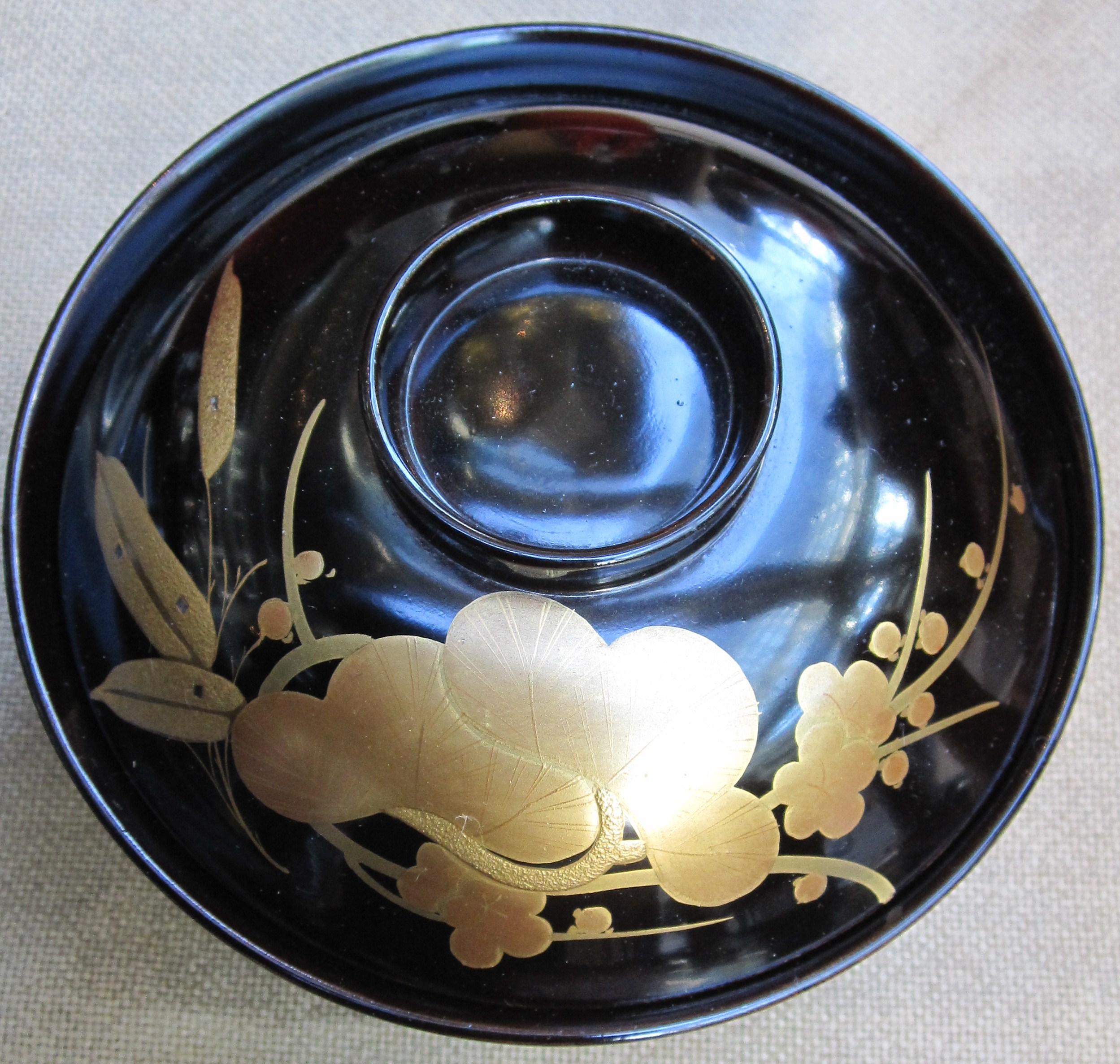
The Three Friend of Winter are not limited to porcelain. They can be found on lacquer…

…and here is a set of three kashigata (sweets molds) in the motif.

This paste-resist dyed indigo cloth takes a different approach, blending the naturalistic pine and plum with the stylized kamon for bamboo. The process is called tsutsugaki (literally, tube drawing) as rice paste is squeezed from a tube to draw the design, much like a giant crayon. The cloth is subsequently dyed and then the rice paste is washed off. This antique futon cover dates to the late 19th century.

Same for this one.

A more formal version can be found on this brocade fukusa. Popularized in the Edo period, a fukusa was used to “wrap” a formal or important gift by being draped over the box or tray on which it was presented. The Three Friends are a very common motif on fukusa as they represent such good wishes to the recipient as well as the New Year.

Speaking of important gifts, how about this set of watches from Vacheron Constantin? They have paired up with Zohiko, a 300+ year old lacquer maker in Kyoto to create these limited edition maki-e (literally, sprinkled picture) timepieces, embellished with Sho-Chiku-Bai. I am not sure what you do with three and at $335,000 for the set, I don’t think I’ll be getting them anytime soon. But interesting, desu ne (isn’t it)?

All of these example came from the Antique Jamboree held at Tokyo Big Sight the weekend of January 8-9th. And for more on the symbolism of these three friends, see Kadomatsu…A Traditional Welcome for the New Year.

Image credits: All images by Jacqueline Wein except Blue Willow platter: marks4antiques.com, and Vacheron Constantin watches: via House of Pens

Read Full Post »

Ikkanbari (literally, idly pasting) is the ancient Japanese art of recycling worn out baskets by wrapping them in washi (handmade paper), coating them in nori (rice glue) and sealing them with kakishibu (persimmon juice) for a waterproof finish. Original old baskets are hard to come by, as they were not preserved as precious art objects, but here is an antique example from Sri Gallery.

Artist Lisa George of PaperGlueBamboo (known permanently to all as George as the result of years of British boarding school)  has created a modern version of this venerable craft for the past 10 years. Using new bamboo baskets, hand-made unryushi (mulberry paper) and mingeishi (sugar paper) along with non-toxic glue and a low VOC varnish, she is custom making beautiful ikkanbari for modern interiors. Each season she creates a number of limited edition designs, hand tearing paper in shapes and motifs to decorate her pieces. Her inspiration is taken from Japanese textiles and items which she combines with a Western color palette. She is also inspired by the joy of the changing seasons, which is such an integral part of the Japanese outlook on life.

Items include kitchenwares such as bowls and platters, desk sets with trays, pencil holders and wastebins, small boxes and traditional shape baskets to hold everything from extra change on the nightable to rolled wash cloths in the bathroom. Items are finished in a clear varnish, giving them a durable finish. They may be cleaned with a hot damp cloth and then be left to air dry.

The photo gallery below has a wide range of designs from past seasons. The pictures don’t begin to show the handmade tactile quality of the pieces.

George is most famous for her shopping baskets, which take traditional Tsukiji fish market handled bamboo baskets and turn them into the chicest handbag, picnic basket, diaper bag, carry-on (they fit in the overhead compartment) or magazine rack around. After wrapping the exterior in traditional tenugui (cotton fabric), she hand paints a design on the outside.  Interiors are lined in paper, much like the ikkanbari pieces and decorated with hand-torn motifs and then sealed.

Unlike the brightly colored, more abstract patterns above, these shoppers have distinctly Japanese motifs and themes. Some are new designs this season.

In addition, George creates large-scale paper “paintings” on boards and canvas called chigiri-e.  Like ikkanbari, chigiri-e is an ancient Japanese art with the word chigiru meaning “tear” and e meaning “picture”. Traditional chigiri-e tends to be landscapes or still lifes, but George’s style is more whimsical and abstract. Technically, it is closer to collage or decoupage using hand colored papers that she has carefully torn into images and designs. She is always happy to discuss commissions.

So, the scoop on how to get some PaperGlueBamboo into your home?  George is currently living in Carmel, California, so US orders are easy. You can contact her via the PaperGlueBamboo Facebook page and you can find more information on her technique and materials as well as additional photos. She will also be posting the new Spring line there shortly. George will be back in Japan for a big show and sale in April and is currently taking pre-orders for delivery then. If you want to be on the invitation list for the sale (and have never received an invitation before) just drop me a note. Her Etsy shop is empty right now, but should be up and running soon (if we all keep poking her about it).

My new lilac ume (plum blossom) shopper (and a Christmas gift, I must disclose) is sitting under a table in New Jersey at the beach, just waiting to be filled with magazines…

All photos courtesy of Lisa George, except image 1 from Sri Gallery and the final image from me.

Read Full Post »

1878 Gorham Advertisement in the Jeweler's Circle of "Decorated Spoonware" in the Japanese Style

Tiffany has emerged triumphant as the most important American silver company today, but in the late 19th century they held equal court with other silversmiths such as Gorham, Whiting, and Wendt. By the late 1860s, all were creating numerous silver patterns and holloware pieces to follow the changing fads in American decorative arts — what is amazing is how quickly they adapted to each and every new trend. One of the most influential to sweep the nation was Japanese style and the silver makers were quick to follow.

I recently had the pleasure of re-examining a collection of John Wendt’s 1872 ”Bird” pattern that I worked to assemble a number of years ago. This Japonesque pattern has a bamboo stem running up a simply shaped handle, with a swooping or plunging bird amidst assorted flora. If you look at the handles in the photos below, you can see that the bird varies from piece to piece.  This was a very popular device in the Victorian era, called a “multi-motif” pattern. All teaspoons would be the same, but they would differ from the forks, from the knives, from the serving pieces, etc.

Ah, those serving pieces! The Victorians were not content with the “Five Piece Hostess Set” that comes with modern silverware. They had servers and individual place pieces for every food imaginable! There were three sizes of soup spoons – bouillon, cream and gumbo. Oyster forks, asparagus tongs, nut picks, cheese scoops, macaroni servers and Saratoga chip servers were all required. New technology in food storage and preparation made exotic foods available to the wealthy and having the right silver to serve it with demonstrated status to guests. Ice cream, which requires cold storage, was a newly available luxury and had its own special forks and spoons and elaborate servers, like this ice cream slice below.

In addition to the pattern on the handle, fancy servers would often have details etched or engraved on the blade. It is well worth clicking the photo above, and the pie server below, to see the wonderful Japoneseque engraving.

Sometimes, customers made bad choices as they could customize their purchases. The berry spoon below ia a bit of a hodge-podge as it was ordered with an Egyptian revival shaped bowl (the Victorians were not just influenced by Japanese design, they were interested in anywhere exotic and new to them) but with traditional rococo engraving.  Definitely not as seamlessly beautiful as the two pieces above.

One charming aspect of collecting antique silver is the monograms and commemorations engraved in spaces on either the front or back, depending on the style of the pattern.  Wendt’s “Bird” has space on the back, as this youth knife monogrammed “Frank” shows.

This large ladle was a silver anniversary present, engraved with the date February 2, 1853-1878.

Most likely “Bird” was not designed by John Wendt, as he sold his share of the company to his partner Bernard Beiderhase by 1871. But looking at Tiffany’s “Japanese” pattern sugar sifter below, do you think Mr. Beiderhase was creative in his design? Tiffany did not, and sued for design patent infringement.

To add to the confusion, Whiting entered the fray with their 1874 “Japanese” pattern.

All three patterns were multi-motif and all had realistically depicted birds, flowers and grasses. Tiffany’s pattern had reeds or grasses growing up the handle, as opposed to bamboo. And what about Gorham, you may ask? They too had a multi-motif pattern called “Japanese”, but took a very different design approach, although the birds and bamboo are still there on some of the pieces.

Seeing these extremely similar patterns together gives a real sense of how popular the Japanese aesthetic was. But like all trends, it fell out of favor and went relatively unnoticed for decades. Prices on today’s antique silver market once again show how highly Japonesque design is valued.

If you are interested in silver I highly recommend Charles Venable’s absolutely gorgeous book Silver in America: 1840-1940 A Century of Splendor. There is a fantastic “Bird” macaroni server on page 138. And for more on these patterns, see D. Albert Soeffing’s “The Battle of the Bird: An Investigation of the Bird /Japanese Patterns of the 1870s” in Silver Magazine Nov/Dec 1995.

Interested in the Japanese influence on Western decorative arts? See an earlier post Japan-a-mania…Cracked Ice and Crazy Quilts. The knife handle on Wendt “Bird” has a cracked ice pattern at the juncture point which can be seen on both the youth knife and the ice cream slice.

Many thanks to the silver collector who allowed me to photograph the collection.

Image credits: 1. reproduced in Silver Magazine May/June 1990, 2-8. me, 9-12 Romance With Silver, all items currently available for sale,

Read Full Post »

After a friendly complaint about the paltry kadomatsu (literally, gate pine) on yesterdays’ post, I took my camera with me today. Pairs of kadomatsu, flanking the entrance to homes or businesses, have been ensuring a fresh start to the New Year with their auspicious symbolism for over 400 years. Matsu (pine) is the most important component, signifying longevity as the pine tree is long-lived. Take (bamboo) represents strength and prosperity, as it grows straight and strong. Ume (plum blossom) is sometimes added, symbolizing endurance, hope and constancy, as it is the first flower to bloom after winter. Chrysanthemum (signifying perfection, wealth and truth) and other flowers are sometimes added too. The arrangement is bound in rice straw and sometimes zig-zag heisoku (Shinto sacred papers) are tied on too. Officially, there should be 3 pieces of bamboo, cut on an angle to allow the spirits to enter, and all facing different directions to ward off evil spirits, but as you can see, florists take quite a bit of artistic license. I am not sure what the oranges signify (perhaps a sweet year?), but please let me know if you do.


And the pièce de résistance

Read Full Post »

A dear friend who knows my taste so well gave me a housewarming present – a bamboo bowl and servers in a delicious shade of deep eggplant – from Core Bamboo. I just love them! The folks at Core Bamboo seem to be able to turn out an adorable and functional line of bamboo kitchenwares, while remaining committed to a completely organic and green product.

Their success is based on the uniqueness of their raw material. To quote from their website: “Bamboo is one of the most remarkable resources on Earth. As a member of the grass family, not a tree, it grows at a much quicker rate than any other wood. From start to harvest (60-70 feet tall) it can take just four years. Bamboo is naturally anti-microbial, therefore stopping bacteria from growing. It is also one of the strongest yet lightest materials around. Bamboo is 16% stronger than Maple and is 33% lighter in weight than Oak.  What is probably most remarkable is its unique extensive root system. When bamboo is harvested its natural root system spreads and automatically regenerates itself.”

 
What I particularly love about the line are the bright mix and match colors, and the lightweight strength. 

The trays come circular and rectangular. I am going to get a big one for my mother-in-law as her drinks tray was on its last legs this Christmas.

They also do a line of classic natural colors, particularly the gorgeous cutting boards.

Gilt Groupe has lots of great items from Core Bamboo in their current sale, at about 50% off and more. It only runs for a few more days, so take a look here

Image credits: 1-4. Core Bamboo, 5. Gilt Groupe

Read Full Post »

I know it is the thing to do at this time of year, but I am not really one for making public New Years’ resolutions. What I do know for sure is that I have loved blogging and plan on continuing full force. I have relished the writing and the learning of new things. I have enjoyed making new friends and reconnecting with old ones. Every comment and email has made me feel part of a greater whole. Revisiting ideas and items that I haven’t thought about in years has been rejuvenating.

January 2011 will be bamboo month here at Tokyo Jinja, both in topic and spirit. Traditional Japanese still place pairs of kadomatsu made of bamboo and pine in front of their house during New Years for luck and good fortune.

Kadomatsu on my neighbor's gate out my front window

Bamboo symbolizes strength, endurance and resilience as it bends readily but doesn’t break easily. It is also one of the fastest growing plants in the world making it an environmentally sustainable and attractive building material. Bamboo, along with pine and plum blossom, represents one of the “Three Friends of Winter” as a design motif on everything from textiles to gardens. So watch for posts on these subjects as well as 19th century faux bamboo furniture, Aesthetic Movement silver patterns, contemporary bamboo art from Japanese masters, green room inspiration, ikkanbari from artist Lisa George of Paper Glue Bamboo and more.

My Own Starter Buddha

New Year’s at The New York Times brought a great essay on the back page of the magazine entitled ”Starter Buddha,’” adapted from Susan Conley’s new memoir “The Foremost Good Fortune,” which is being published next month. The essay is a pitch perfect piece on buying a “fake” buddha in a big Beijing flea market. The book also looks like a must read, especially for those of us living the expat life in Asia as it tells the tale of their family’s move from Maine to China in 2008 and her subsequent battle with cancer. On the eve of a new year, it is always good to be reminded of and thankful for the gift of good health. I’ll also be headed to Hong Kong this winter, so I’ll finally be answering some of your questions on how to know if something is “real” or “fake” as I tackle the Chinese antique stores and markets.

I want to recommend an outing to the Setagaya Boro-ichi (rag fair) on January 15th and 16th. Held in one form or another for over 400 years and now every December and January on those dates, it is a great traditional market experience.  For more details and information, take a look at this article in The Japan Times. I will also be updating the “Shrine Sale” tag at the top of the blog to have current information for winter and spring events, and introducing some new sales and antique shows.

I have heard from a lot of you that you like some of the more personal posts and updates on our renovation and decoration. In that spirit, I want to share an exciting idea for the entrance area to the beach house. Under the window, in this empty space, we knew we wanted a bench of some sort to sit and put on shoes as well as to pull up to the dining table when we have many guests (my table has 12 leaves and can open to almost the full length of the dining room/living room). In the summer the front door on the left of the photo is always open, so we don’t think much about this space, but this winter, with the door closed, it really functioned as part of the living room.

As I was flying back to Tokyo on Monday, I picked up the February issue of House Beautiful with this charming bench by Alexandra Angle on the front cover. A bench like this is the perfect solution. We are now so Japanese that we never (and will never again) wear shoes in the house.  The design of this bench, with the bar on the bottom, gives us a place to tuck shoes in, keeping them less visible and neat. The other great take-way from the photo is the loose pillows that make it a comfortable place to sit, as if it was a small settee, without having a permanent back. So it can function as a bench, as a couch, and I could even see the girls stretching out here to read.

I have five yards of this adorable Cowtan & Tout Kemerton Check (another great eBay find) that is perfect to upholster it in.

And I could use my last piece of my beloved Bennison Faded Floral that I have been saving for a pillow.

So my dear readers, thank you for your support and encouragement. I would love to hear what you would like to see me write about this year, whether it be questions you want answered or features you’d like to see more of. And please keep those comments and emails coming!

Image credits: 1. A.N. Hudson, 2-4, 6. me, 5. House Beautiful February 2011 photo credit: Victoria Pearson, 7. Bennison

Read Full Post »

Follow

Get every new post delivered to your Inbox.

Join 406 other followers

%d bloggers like this: