Feeds:
Posts
Comments

Archive for October, 2010

There is nothing like the indecision of a rainy shrine sale day. Will the vendors be there? Is it worth going? This past Thursday was no exception. The eagerly awaited Kawagoe market falls on the 28th of each month and I skipped it last month as it was pouring out (and later heard that no one was there). We had planned to go this month, no matter what.  But as we readied ourselves to leave, it began to rain. Nonetheless, after stalling over yummy breakfast, we set out on the 1 hour drive.

Well, they say “good things come in small packages”.  I wish there was a similar adage for “great bargains come from rainy day shrine sales”. There were only about 20% of the vendors present, everything was covered in plastic tarps with only a few brave customers wandering around - mostly foreigners (the only ones foolish enough to be there). We jumped in and had the best day! Let me show you what I found…

First, this huge turquoise bottle originally used to hold alcohol of some kind. The dealer offered me his “rainy day special price” and I couldn’t resist.

I have long adored the interiors designed by Tom Scheerer, the king of the giant glass bottle. If you page through his portfolio or back issues of shelter magazines, there is not a single project that doesn’t include a gorgeous glass bottle in some way.

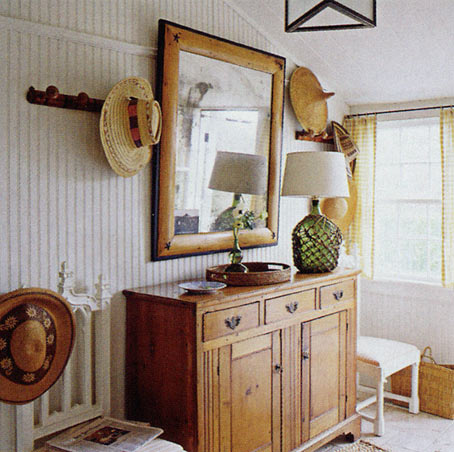
Often, the bottles have been converted into lamps.

I was so excited about my bottle, that I was unprepared for what I found next.  I had long admired these Japanese fishing floats in magazines, but never seen one for sale in Japan. I got the large aquamarine one to go with my giant bottle. It has its original net and is in great condition. I had thought they were asking a bit too much for it, but luckily the dealer who sold me the giant bottle came over and got involved.  He convinced them to give me a rainy day special price too!

Japanese glass fishing floats have been used by fishermen here for most of the last century. Floats continue to be in use today, but many have broken off from their nets and surf the Pacific Ocean, sometimes for decades. The floats follow the ocean currents and tend to wash up on shore in Alaska, the Pacific Northwest and islands throughout the region, especially after storms. There are devoted beachcombers who go out and hunt for these treasures, sometimes even flying to a remote area. Take a look at Glass Float Junkie’s blog for more history, information and great photos.

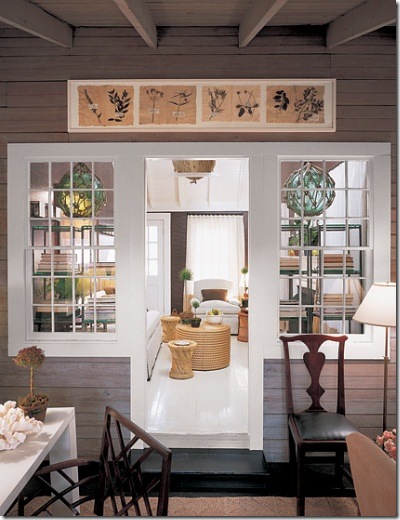
Modern day collectors love them for their decorative possibilities. Thom Filicia hangs three as an accent in a lake house.

Jeffrey Bilhuber has used two as pendants in his adorable Rose Cottage on Nantucket Island. They are like jewelry in the room!
Tom Scheerer has even managed to inspire one into a lamp.
The popular market place has picked up on the trend as well. Pottery Barn had a Japanese float lamp, which is no longer available, but can be found on eBay…

and currently has the giant bottles.

Japanese glass floats have inspired artists as well. Dale Chihuly, the world-renowned glass artist has a series called Niijima Floats.  Around 1990 he visited a glass school on the island and it reminded him of “the Japanese fishing floats, which [he] used to collect on the beach when [he] was a kid in Washington State on the Pacific Ocean.”  Chihuly’s floats can be giant – up to 40 inches in diameter – and brightly colored, but I found these sheer blue ones particularly beautiful.


I haven’t had a chance yet to clean mine up and look for markings. More details to follow, including where I plan on using my finds, but as many of you know, I am renovating a bathroom at my NJ beach house (hint, hint). Other bloggers have written about these floats and I recommend posts at Completely Coastal and Things that Inspire.

I am going to leave you with this most beautiful image. Maybelline Te of Frou La La took this photo of the loggia at a friend’s house in the Philippines just resplendent with hanging floats.

Wow!

Image credits: 1 & 4. me, 2, 3 & 7. Tom Scheerer, 2. photo credit: Pieter Estersohn, 3 & 7. photo credit: Simon Upton, 5. Thom Filicia,  6. Jeffrey Bihuber in Architectural Digest, September 2003, photo credit: Peter Vanderwarker, 8 & 9. Pottery Barn, 10. Dale Chihuly, 11. Maybelline Te

About these ads

Read Full Post »

I like living with my stuff. I feel safe when it’s around.
Judyth van Amringe

Some expats come abroad with nothing but a few suitcases and rent furniture for their apartments or buy everything new again. But we brought everything we owned, lock, stock and barrel, because I am in complete agreement with Judyth van Amringe. I like living with my stuff. And living in Tokyo with my things – gathered slowly and carefully over time –  makes me feel connected to the very fabric of my life when I am so far from home.

Fabric, it seems, is something I cannot resist. Once again, at the shrine sale this weekend, I bought another vintage kimono. I tell myself I don’t need another but their colors, their patterns and the feel of the fabric call out to me. It’s easy to give in as they are relatively inexpensive, costing all of 500-1000 yen ($5-$10). I imagine the projects, the throw pillows, and the dress-up possibilities, both for the imaginary play of my children and for myself. This weekend my friend C actually found a fabulous black lace happi coat (short kimono) at the market and she plans to wear it over a camisole and skinny jeans for a night out.

I really believe there is such a thing as a “magpie gene” and that the desire to collect is inborn in some of us. My younger daughter, who is all of 6 years old, has it for sure. She has dug up a collection of porcelain and pottery fragments from the dirt of all the parks around us in Tokyo and keeps boxes and boxes of them for some future use (Why the fragments are there is another question entirely).  Her eye is good enough that when she finds a piece of the Seto region porcelain I collect, she can pick it out to give to me to add to my collection.  This giant fragment took her a number of tries over a few days to dig up and we are thinking of using it as a doorstop.

Collecting, assembling and re-purposing are inherent to the magpie mentality. Reading Dominique Browning‘s blog Slow Love Life last night I stumbled across scarves made of vintage kimono by artist Judyth van Amringe. Van Amringe seems to be the master magpie - an artist working in many different mediums, switching gears throughout her life. And Dominique Browning herself (formerly editor-in-chief of the now defunct House & Garden) is re-purposing as she explores life in the slow lane. I am looking forward to reading her book Slow Love: How I Lost My Job, Put On My Pajamas & Found Happiness. The title alone is irresistible.

In making the scarves, Judyth combines different fabrics and colors and they are reversible. Sometimes she adds details like beads or embroidery. They sound as interesting as they look in the photos, but I do wish I could see the combination of fabrics more clearly.  This silk ikat positively glows – I’d love to know what she adds to it.

This one has embellishments, with a narrow obi jime (silk cord overbelt) and beads. It may even be a purse as she makes them too.

To my thinking, Judyth van Amringe’s apartment may very well be her “master work”, an accumulated montage of a life’s belongings distilled into a small space. The expression used to describe her place by The New York Times is “artfully crammed” and it is a good one.  Van Amringe brings nothing new in without knowing where it is going and how it will relate to everything already there. Her space feels serene, even though it is jam-packed with objects, most of which she has changed or improved in some way. 

To compensate for a standard boring bathroom in her rental, she layered a huge bookshelf, a hand carved coat stand, an upholstered slipper chair and real rugs. Oh, how I love real rugs in a bathroom, but that will have to wait for a future post.

It looks like a perfect spot for a little birdie to rest…

Photo credits: 1 & 2. me, 3 & 4. from Slow Love Life, 5 & 6. The New York Times, Photo: David Allee

Read Full Post »

Today I went to Tomioka Hachimangu shrine sale for the very first time.  Established in 1627, the shrine has burned and been rebuilt repeatedly over the centuries and is particularly famous for its connection with sumo wrestling. Held on all Sundays of the month except the 3rd Sunday, the market was outstanding today (the 4th Sunday) with well over 80 dealers. Repeat visits will confirm which days are best, as I recognized many dealers who go elsewhere on other weekends.  My guess is that the 4th Sunday may be the best one as there are few other nearby options. I did also meet a number of dealers unique to this market as well.

But today, even amidst all the wonderful Japanese antiques, what caught my eye over and over again were the vintage glass senbei (rice cracker) canisters. Occasionally you see one or two, but today they were everywhere in splendid and unusual variety. These were not the only ones I saw, but I tried to keep the photos to the best ones.

I had never seen a double stacked one before…What efficient use of counter space!

This shape was very rare, being squared off in the back to sit against the wall. The price reflected its scarcity!

Charming art deco styling on this one.

By far the best was this long narrow one. The metal cover is hinged for easy opening and it says “Cake Vessel” on the front. It would be perfect to hold spaghetti or bread sticks.

Modest upon first sight and taste, senbei are an integral part of Japanese food culture. On one hand, they are a basic snack kids love, while on the other hand, they can be sent as elegant gifts and souvenirs. They can be salty when dipped in soy sauce or speckled with nori (seaweed) or sweet when dipped in sugar or honey. There are still many traditional senbei shops scattered around in the nooks and crannies of Japan.  Some have modernized, but others, like Tamaiya in Shimokitazawa, still keep the crackers in glass canisters.

My favorite senbei is from Tanuki Senbei in Azabu Juban. A tanuki translates best as “badger” or “racoon” in English,  but is actually a mythical creature. A giant tanuki stands guard over the entranceway and their delicious crackers are baked in the shape of the animal. Supposedly, the Emperor orders his senbei from them!

Today’s market trip proves what I have been suspecting for a while. There is no doubt or surprise about it, I have country kitchens on my mind…Beadboard, weathered cabinets and butcher’s block, with rows of vintage canisters filled with staples lining the shelves.

A perfectly collated pantry…

Cuteness in a jar!

Tomioka Hachimangu is a few blocks from the Monzen Nakacho stop on the Toei Oedo line and the Tozai line. More details about the shrine sale can be found on the “Shrine Sale” tab at the top of the blog.

Image credits: 1-5. me, 6. via Tokyobling, 7. via Rekishi no Tabi, 8-10. all Country Living Magazine, 8. photo credit: Michael Luppino, 9. photo credit: Steve Gross & Sue Daley, 10. photo credit not listed.

Read Full Post »

I am often asked for suggestions on buying antiques in Tokyo, so this is the first in a series called “Shop Talk”. One of my favorite antique shops, Kanarusha in Fuchu (near the American School) is the perfect mix of a beautifully arranged store with a dusty but treasure filled backroom and attic, providing the best of both worlds.  There are items for the immediate gratification folks to take home on the spot and lots to dig through for those who love to make their own discoveries. To clear up a bit of confusion on the name, Akariya is the name of the parent company and also of their high-end shop in the Yoyogi area, while this store is actually called Kanarusha. Rarely do I stop by the more polished shop in Yoyogi, preferring instead the more casual warehouse-style store. Drop in and let Ohashi-san and his staff help you chose just the right piece for your home.

Inside is a treasure trove of objects…

Tansu of every style and region…

An unusual golden mizuya (kitchen) tansu…

In the back rooms, there are shelves filled with everything imaginable, including these ikebana (flower arranging) baskets…

These shelves have iron lanterns, inlaid hibachi (small charcoal heaters) and vintage milk glass fixtures…

Speaking of hibachi, they have this gorgeous imperial lacquer one…

They also have a number of beautiful byobu (screens) including this unusual two-panel made of fabric using a wax resist dye technique and adorned with embroidered details. I think William Morris would have loved this piece.

Here’s a close-up of the detail on the spider web and thistles…

Cranes are lucky and represent long life in Japanese art. This 1930s copper vase inlaid with silver cranes is signed by the artist.  Frankly, Art Deco pieces can be rarer than 19th century ones.

Ohashi-san’s pick? This extraordinary choba tansu (merchants chest) from Yonazawa Prefecture made of solid keyaki wood.  The gorgeous burl wood has its original finish in dreamy condition. Inside is a shelf and small compartments.

My pick? It has to go to this amazing Meiji period mizuya tansu from the Biwa Lake region near Kyoto.  It is super long – a full 105 inches – and the staff have only ever seen one other like it in 30 years of antique dealing.  I can just imagine it lining a long wall of a kitchen instead of cabinets. Talk about a room-making piece of furniture.

In addition to the items mentioned above, Akariya specializes in antique doors and ranma transom panels, which can be customzied and used in new construction (building a house anyone?)

A few more great things about Kanarusha…They have their own workshop for repairs and customizations and their restoration is always sympathetic and natural.  They are also happy to work with international customers over email with photos and they will ship around the world.

The big news is that Kanarusha is having its big annual Autumn Sale next weekend from Saturday, October 30 – Wednesday, November 3. Everything is 20-35% off the already reasonable prices.  The shop is open 10a.m. – 7p.m. (an hour later than usual).

The really big news is that Tokyo Jinja readers can start shopping at sale prices now!! Just stop in between now and Wednesday, October 27 (Kanarusha is closed for set up on Thursday and Friday) and mention the blog and you can have first pick before the big sale starts. You may have to wade through as things are not fully set up for the sale, but isn’t that the best kind of antique shopping anyway?

Interested in tansu? You might want to read my post from last month “What’s Cooking? Tansu in the Kitchen”.

Driving directions from Tokyo: Take Shuto #4 (Chuo Expressway) to the Chofu exit and head towards Fuchu after the toll as if going to ASIJ. Pass the turn at Ajinimoto Stadium and keep going straight on Route 20 for 2 km. There will be a rise in the road (bridge over the train tracks) and at the next light called Shiraitodai Police Box intersection (Family Mart is on the right hand corner) take a right. Kanarusha is immediately on your left. Parking is available.

Image credits: All courtesy of Kanarusha and taken either by me or Ohashi-san.

Akariya Kanarusha

Read Full Post »

As a quick follow-up to my Hanga 101 post, the Legion of Honor Museum in San Francisco is holding an exhibition of Japanese prints from 1700-1900 and their influence on the Impressionists.  The exhibition runs from October 16, 2010 – January 9, 2011 and looks to be extraordinary, with over 250 prints.

Examples include Hiroshige’s Gion Shrine in the Snow from the series Famous Places in Kyoto ca. 1833–1834 compared to Henri Riviere’s La Tour en construction, vue de Trocadero, from the book Les Trente-Six Vues de la Tour Eiffel, 1902.  Riviere’s calling the book “Thirty Six Views of the Eiffel Tower” is a direct nod to Hokusai’s classic ukiyo-e series, Thirty Six Views of Mt. Fuji.

Running concurrently is another exhibition entitled “Aspects of Mount Fuji in Japanese Illustrated Books” which includes illustrations from Hokusai’s series One Hundred Views of Mount Fuji.

Oh, how I wish I could go! (Robin, George and Betty, I expect a full report! ) And Lonny readers get 20% off if they use coupon code JLONNY. 

I’ll have to settle for the exhibition book

Image credits: 1. via October-November 2010 Lonny Magazine, 2. via Legion of Honor Museum website

Read Full Post »

Sudare are bamboo blinds used to screen out the sun and stay cool during the hot summer months in Japan. The blinds keep out the sun’s rays, while letting the breeze blow through.  They also offer a modicum of privacy when doors and windows are thrown open (in a hopeful attempt to catch the aforementioned breeze). Traditionally hand-crafted, the art of making sudare has been lost to inexpensive imports from China, although craftsmen do still exist (particularly in Kyoto) and antique and vintage examples can be found at shrine sales and antique shops. Fancy sudare have decorative brocade trim around the edges, elaborate cording with tassels and engraved metal hooks to hold the blinds rolled open.

A typical view of a house in high sun in Kyoto, with sudare hanging over the veranda and front windows. 

The decorative arts offer proof of the use of sudare through the ages. One of the first images that springs to mind is this amazing 17th century byobu (Japanese screen) depicting “The Tale of Genji” in the collection of the Isabella Stewart Gardner Museum in Boston. If you click on it to enlarge, you can see sudare hanging in the doorways and windows.

More recent Edo and Meiji period byobu create a direct window view using a trompe l’oeil sudare. This charming screen was for sale at the Heiwajima Antiques Fair.

A second one, styled in an apartment filled with Japanese objects – split tansu, map of old Tokyo, and shoji lanterns.

Built in 1878, the Fujiya Hotel was the first hotel in Japan that catered to Western tourists.  It is an absolute fantasy of a building – all Victorianism and Japonism scrambled together and should not be missed by anyone interested in either. The grand dining room, built in 1930, has amazing botanical frescoes on the ceilings, carved ranma (transom) panels, and the loveliest decorative sudare I have ever seen. They are hard to see in the photo below, but I couldn’t resist the view of the building and the autumn foliage out the window.

The detail is a little easier to see in this photo.

So how to use my sudare in a modern interior? I have always loved the look of matchstick blinds hung behind curtains and if you open any decorating magazine today, it seems as if everyone else does too. Joni at Cote de Texas has an amazing post about curtains, both with and without blinds, and great suggestions on hanging curtains in all kinds of situations.  To hang the blind correctly, you mount it on the outside of the window, filling the space between the window frame and the curtain rod, which has been hung as close to the ceiling as possible to maximize the illusion of height.

So, the plan is to take this window in the den/extra bedroom of the beach house (sorry for the poor photo – room under renovation)…

and add this lovely Indian block print fabric (Cream Hibiscus Flower Buta) from Aleta Fabrics

or possibly this one (Aleta’s Cream Hibiscus Flower Branch), as floor length curtains hung from a slim aged brass curtain rod from Gracious Home (more on my love of aged unprotected brass another time)…

using the sudare from the top of the post as the blind.

Aleta’s fabrics were featured in the to-die-for apartment of Nancy Tilghman, designed by Daniel Sachs, in the October 2010 issue of House Beautiful, including the Cream Hibiscus Branch fabric which was used on a chair in the bedroom.  The bedroom has just the feel of what I want the den/extra bedroom to look like, although taking the children into consideration, perhaps a little darker color scheme.

Image credits: 1,4,6,7,9 &12. me, 2. from il-ne-kore, 3. Property of Isabella Stewart Gardner Museum, photo via The Curated Object, 5. Okura Oriental Art, 8. via Cote de Texas, 10 & 11. from Aleta Online, 13. October 2010 House Beautiful, photographed by Ngoc Minh Ngo


Read Full Post »

Here is a speedy abridged version of the history of Japanese prints, mostly via images and touching on the big name players.

Ukiyo-e

Ukiyo-e, traditional Japanese prints, have existed since before the 17th century but truly flowered during the Edo period (1603-1868).  They were mass-produced and created for mass-consumption by the common man.  A four-part team of artist, carver, printer and publisher worked together to produce these images of “the floating world” – impermanent places of pleasure. Geisha and courtesans, kabuki actors and sumo wrestlers, were all common subjects, such as in Utamaro‘s “Beauty in Front of Mirror”. (At that period, the nape of the neck was considered one of the most erotic places on a woman’s body)

Landscapes also were popular and large series, such as Hokusai‘s “Thirty-six Views of Mt. Fuji” were common. This first image from the series has become one of the most iconic Japanese images ever.

During the Meiji Restoration, everyone (including artists) was so busy trying to modernize, and ukiyo-e fell out of favor.  Artists wanted to study oil painting, often traveling to Europe to do it, only to discover that Monet had a houseful of Japanese prints. His dining room at Giverny had over 50 prints alone and his collection included “The Great Wave off Kanagawa” shown above, as well as over 200 others.

Monet was not the only artist influenced by Japanese prints. Van Gogh made his own version of Hiroshige‘s “Sudden Shower at Atake”. Many other 19th century artists also reflected Japanese sensibilities and themes in their work.


Just as the West was influenced by Japanese art, Western art had a huge influence on Japanese print makers. So, as the century turned, two new movements in Japanese print making were born.

Shin Hanga

Using new ideas about light, shadow and perspective learned from the Impressionists, the shin hanga (new prints) movement revitalized the traditional 4 tiered ukiyo-e structure. Like ukiyo-e, shin hanga prints could be produced in very large numbers, with some popular images running into the thousands. It is estimated that Hiroshi Yoshida’s “Avenue of Cherry Trees” has been printed over 3000 times.


The prints were not overly popular at home, but instead designed to appeal to a Western customer, with their romantic and nostalgic views of Japan.

Don’t you think Kawase Hasui’s “Fisherman at Sunset” could almost be mistaken for a Van Gogh?

Sosaku Hanga

Simultaneously, the sosaku hanga (creative prints) movement began around 1910 and gathered steam during the pre-war years, reaching success after World War II.  Artists of the sosaku hanga movement believed that they needed to carry out each step – design, carving and printing – for the work to be classified as art and not a commercial product. This definition feels correct to the modern reader, although in truth, many of the great European painters throughout the centuries had studios with students and helpers working on their paintings. But the creative prints movement scorned the “copies” made by the shin hanga artists.

Some of the early print artists actually had bad and/or primitive technique as they were often self-taught. Yet the prints have a sense of sincerity and naivety. Kanae Yamamoto, the “father” of the movement, created simple wood engravings that still feel fresh today, as seen in his 1912 “On the Deck”.

As Yamamoto turned his attention to his other idealistic ventures, Koshiro Onchi took up the mantle of the sosaku hanga movement and continued at its core and key mentor through the war years.  This period also signals the start of true modernism in Japanese art, as the creative prints movement turned away from representational art and explored abstraction. I love the title of the Onchi print below: “Allegory: Columbus’s Egg”.

Like shin hanga prints, Westerners were the main purchasers of art by the sosaku hanga group, particularly after WWII as they were aesthetically tuned toward modern art and abstraction. This was spurred on by the publication of Modern Japanese Prints: An Art Reborn by Oliver Statler, who became an influential collector, critic and spokesperson for Japanese printmakers. I recommend that anyone interested in modern art procure a copy.

Contemporary prints (such as those in the CWAJ Print Show) are the heirs of the sosaku hanga movement. Advances in technology have allowed artists to add techniques to their repertory, but the artist is still the creator at every step in the process .

Image credits: 1.Utamaro Kitagawa, “Beauty in Front of Mirror” via  kimonovintage.blogspot.com, 2. Hokusai Katsushika, “The Great Wave at Kanagawa” and 3. Monet’s dining room at Giverny via intermonet.com, 4. Utagawa Hiroshige “Sudden Shower at Atake” and Vincent Van Gogh “The Bridge in the Rain” via wikipedia.com, 5. Hiroshi Yoshida ”Avenue of Cherry Trees” and 6. Kawase Hasui “Fisherman at Sunset” via hanga.com, 7. Kanae Yamamoto “On the Deck” via Nihon no Hanga 8. Koshiro Onchi “Allegory: Columbus’s Egg”

Read Full Post »

Stumbled across this photo of Gloria Vanderbilt at Habitually Chic from The World of Gloria Vanderbilt by Wendy Goodman. It turns out that Gloria went through a “quilt phase” and that the bedroom I posted last week is hers!

Read Full Post »

For the past 6 years I have had the honor of working with the College Women’s Association of Japan on their annual exhibition of hanga – Japanese contemporary prints. This year is no exception. Featuring 195 prints by 181 artists, including the foremost printmakers in the field as well as 32 debut artists,  the show gives viewers a real taste of the breadth of work being made. The prints span the full range of different printmaking techniques, from traditional woodblock to intaglio to silkscreen, as well as variety of subject matter.

Since the inception of the Print Show in 1956, CWAJ has worked tirelessly to produce one of the most prestigious hanga shows, using the proceeds to fund their respected scholarship program. What I find even more extraordinary than the artwork itself is the strength of the commitment that has kept an exhibition of this size and stature running by an entirely volunteer organization for 55 years.

In discussing the prints below, I have left family names in all capital letters (a CWAJ convention to avoid name confusion) and titles in parenthesis are English translations.

While some artists are more local names, many are well-known abroad including Yuji HIRATSUKA. His print TRADERS is my favorite one of his since Rock Around the Clock from Print Show 2006. What really stands out is the layered texture and color detail of his intaglio/chine collé technique – her skirt just makes me want to get up and dance!

The perennially popular  Daniel Kelly returns to koi fish in his offering WHATS UP for this year’s show. I love the perspective and the narrow elongated form of his piece. Not all makers of hanga are Japanese – Daniel Kelly is an American artist who has been living and working in Kyoto for years.

For those wanting traditional woodblock prints with the old sōsaku hanga feel, look no further than two of the best (and more expensive) prints in the show. Akira KUROSAKI’s  Eight Views of Omi “Descending Geese at Katata” makes me feel as if it could be 1920 filtered through a modern-day lens and I think it his best print in years.  Isamu MORISHIMA’s The moon at Musashi Plain has a similar feel.


In contrast, a new gritty, almost photographic direction is taken by Kin-ichi MAKI in Which way to go 1 and Tadanori YOKOO (Soul and Body Intersected)


Looking to buy a print that is good for the environment? In addition to being beautiful, Atsuhiko MUSASHI’s BLIND FLOWERS 10-FEB is a green print. His technique, polymer intaglio, is non-toxic and does not require acid to etch the image, instead using a photosensitive polymer plate.

Highlighted in the 2007 Show, Keisuke YAMAMOTO’s dramatic monochrome prints, like Staircase D at left, sold out. This year he has submitted two prints on a completely different theme – almost romantic views of Kiyomizu Temple in Kyoto – one in snow and the other in spring. While his topic has changed, his painterly command of the lithographic process has not. That is why they are “almost romantic”, as the preciseness of his technique keeps them from being at all saccharine.


If you are looking for a nostalgic print, Takeyoshi NAKAYAMA’s (Night before Gion Festival[Sugimoto Residence] ) is one of his most charming in years.  The soft rose tones of the lantern make it a perfect piece for a daughter going away to college or setting up her first apartment.

Another good “old Japan” choice is Noboru YAMATAKA’s traditional woodcut (Kabukiza Theater) as they will soon be knocking the theater down. Kill two birds with one stone and own both a piece of art and a piece of history.


My favorite newcomers include Mio OHMORI (Flower in water-Standing) as I am a sucker for its watery lavender thistles or the abstract expressionism of Eiji OBA’s (Blue and Black-101).


Another print close to my heart is Nature story-(heaven) by the Young Printmaker Award winner Kyung Sun KIM as I was the co-chair of the YPA committee this year. Evaluating student artwork and their grant proposals is a joy, as the level of the work has been so high. The scanned photo below doesn’t begin to do justice to the color and detail in this woodcut, nor does it suggest how large it is (100cm x 150cm). It is a very small edition of 3, so I imagine it will be gone by the end of the Donor and Artist Reception Thursday night.

My guess on what will sell out? The catalog cover print, Onbu by Sohee KIM, and not simply because it is the cover print and only an edition of 15.  For Kim, the image represents “the burden she [the figure] is feeling from the overwhelming affection and expectations of her family and friends.” Affection and expectations? Well she might see it that way, but every woman I know has had an absolutely visceral response to what they see as an amazingly huge (but beautiful) pile of laundry.

I could write about every print in the show, but neither space nor time allow.  The 55th CWAJ Print Show opens to the public in Tokyo on Friday, October 15 (10a.m.-8p.m.), Saturday, October 16 (11a.m.-6p.m.) and Sunday, October (11a.m. –5p.m.) at the Tokyo American Club. Free admission. Membership is not required for attendance. I’ll be working as a docent on Friday morning until 1:30 and Sunday until 2p.m. Please stop by – this is a don’t miss event!! The following weekend it travels to the Kobe Club, so if you live in the Kansai region you can catch it there.

Interested in working on the Print Show? Join CWAJ and get started.  Volunteers are needed for returning day in November and that will give you a chance to actually touch and see the work close up.

Image Credits: All images except #9 from the 55th CWAJ Print Show catalogue. Image #9 form the 52nd CWAJ Print Show catalogue.

Read Full Post »

What do Victorian crazy quilts sewn in America and antique Japanese porcelain have in common? Well, like the face that launched 1000 ships, Japanese art and wares displayed in the 1876 Centennial Exposition in Philadelphia launched an almost instantaneous and frenzied fad among American quilters.

While trading with the East had gone on for centuries, most of that trade centered on China.  Only the Dutch and the Portuguese had access to Japan and even that was quite limited to a small port at Nagasaki. In 1854, that all changed with the arrival of Commodore Perry and the opening of Japan to the West.  While this event radically transformed every aspect of Japanese society, the result in the US was a jumpstart to the American imagination. The effect was truly profound and hard to imagine for us here in 2010 as we are bombarded with new ideas instantly and constantly. The Japanese aesthetic, with its hand work, asymmetry and natural motifs had simply never been seen before by the average person. The quality of the Japanese items at the Centennial also contrasted so strongly with the new shoddy industrial made products of the US and other Western countries.

The fascination with these exotic new ideas translated into the decorative arts almost overnight and there is no better example than the craze over crazy quilts. It is believed that the term “crazy” quilt comes from the “crazing” of the porcelain glaze. The word “crazy” at that time would have also meant broken and irregular. The pattern design comes from a well-known Japanese pattern called “cracked ice”. Quilting designs had always been based on uniform and regularly shaped pieces of fabric, sewn into repeating patterns and then quilted in a uniform pattern as well. For the first time asymmetric and irregular patches of fabric were being cut and sewn and decorated along their seams.

Examples of cracked ice patterns abound in Japanese porcelain.  Sometimes the pattern stands on its own, as in the covered bowl above, with shadings of color and decorative patterns highlighting each block. Make sure to take note of the little pattern painted inside the rim of the lid and compare it to the feather stitch used extensively on the quilt below.

This plate is even simpler, with just the lines of the cracking ice painted in.

Often it is overlayed with ume (plum blossom) or even sakura (cherry blossom) to symbolize the coming of spring and the breaking of the ice.

This 1880s crazy quilt from New York State is a near perfect example of the American craft. Made of 20 square blocks, with a sawtooth border, it has all the typical aspects one would expect to find.

Unlike earlier (and later) quilts, crazy quilts were not made with a sense of thrift or recycling, even though it may seem so as they utilize bits and pieces of valuable fabrics such as silks and velvets.   Nor were they made for warmth as they do not typically have a batting layer in between the top and the back. Crazy quilts were originally made by well-to-do women in the middle and upper classes to demonstrate their needlework skills and show that they had the leisure time to make completely ornamental pieces.  The use of the word quilt is a misnomer -  crazy quilts were not used as quilts at all – nobody slept with them. They were made to be displayed.

While irregularly shaped patches of silk, velvet, brocade, satin – anything ornamental or textured – were cut to make the quilt, it was usually too difficult to make the entire quilt completely “crazy” and the pieces were organized into square blocks, a necessary compromise.

The fabric was pieced together and decorated along the seams with embroidery stitches of all kinds, including feather stitch, chain stitch, lazy daisy, herringbone, chevron, blanket stitch and others.  Detailed pictures and scenes, monograms and messages were added too.

In addition, there was a fascination with Japanese motifs. In crazy quilting this was particularly noticeable with fans and many quilts have fans in all four corners, like this one.

Unfortunately, manufacturers of the day rinsed the fabrics in metals to make them heavier and this has caused them to deteriorate extensively. In the fan below, the peach silk has rotted away, leaving only the cotton backing and the embroidery.

Crazy quilting mania trickled down the social ladder as womens’ magazines of the day ran articles and how-tos. Fancy scraps were recycled, but as the craze progressed, it was possible to buy kits with a variety of fabrics – some of which were even embroidered in advance. Cigarettes and other products were sold with bits of leftover silk as a perk of purchase. Ornamental trims like lace and beads were added. Below, you can see a Masonic Lodge ribbon from 1871 that was saved and used and if you scroll back to the full-sized photo you can see a political ribbon for Vice President used in the second block on the top.

While the 1870s and 1880s were the heyday of American fascination with the exotic, the craze for crazy quilts died down by 1910.  By then, cracked ice patterns and many other Japanese motifs had fueled the Aesthetic Movement and helped to launch Art Nouveau and later Modernism.

Out of prevailing fashion, crazy quilts were usually folded up and put away, only to reappear 100 years later. The success of the 1971 Whitney Museum of American Art exhibit,  Abstract Design in American Quilts, elevated quilts to the status of “real art” and launched a wave of quilt mania that built up until the 1976 Bicentennial.  Since then, quilts have been collected, displayed and valued, and occasionally, as seen below, used in iteresting ways.  For a modern take on an old art form, designer Steven Gambrel used pieces of a 19th century crazy quilt to upholster a chair.

A Few Hours Later…

Rather than pack for camping, I was procrastinating and reading a few blogs. One of the things I need to do is make a list of blog resources — there are some great sites about Japanese textiles/art/history etc. out there. But my favorite blogs are the decorating and design ones – they have so much eye candy for a magazine starved person like myself.  This photo from Abbey Goes Design Scouting cracked me up and I had to post it. She calls it an “unapologetic interior”! Talk about crazy quilt-a-mania…


Image Credits: 1. Philly History Blog, 2-13. me, 14. House and Garden, April 2002 15. Vogue Guide to Patchwork and Quilting Vintage

Read Full Post »

Older Posts »

Follow

Get every new post delivered to your Inbox.

Join 405 other followers

%d bloggers like this: